


There are moments in politics when the official explanation matters less than the timing.
The Justice Department says it is suing Minnesota because Minnesota’s climate deception case against ExxonMobil, Koch Industries, Flint Hills Resources, and the American Petroleum Institute is really climate regulation in disguise. That’s the polished version; the one wearing a suit and carrying a folder labeled federal authority.
Minnesota, according to DOJ, isn’t merely enforcing its own consumer protection laws. It is trying to regulate greenhouse gas emissions through the back door. Federal power must be defended, state overreach must be stopped, and the constitutional furniture must be arranged just so. Okay, that’s the argument; but look at when it arrived.
Minnesota filed this case in 2020, six years ago. The state alleged that some of the most powerful fossil fuel interests in the country misled the public about climate change. Not that they sold oil, or personally invented global warming in a basement laboratory under Houston. The allegation is narrower, and therefore more dangerous. Minnesota alleges these companies knew things they didn’t say, said things they knew were misleading, and spent years helping shape public understanding in ways that protected their profits.
That isn’t “just” a climate allegation, that’s a paper-trail allegation; and paper trails have a way of changing the room. Which is why discovery is important here. Discovery is the part of litigation where the slogans stop and the documents begin. It is where emails, memos, internal research, public relations plans, trade group communications, strategy decks, warnings, doubts, and inconvenient little sentences written before anyone remembered to be careful can become evidence.
Essentially, it’s where the public story gets set next to the private record, and that is the comparison powerful industries spend fortunes trying to avoid. For years, Minnesota’s case has been trapped in the procedural machinery. The defendants tried to move it, shrink it, delay it, and stop it, using all the usual choreography. Then, this spring, the Minnesota Supreme Court declined to intervene, clearing the way for the case to move toward discovery. Then suddenly, here comes the United States Department of Justice, at the precise moment Minnesota may finally be able to ask Big Oil for the receipts.
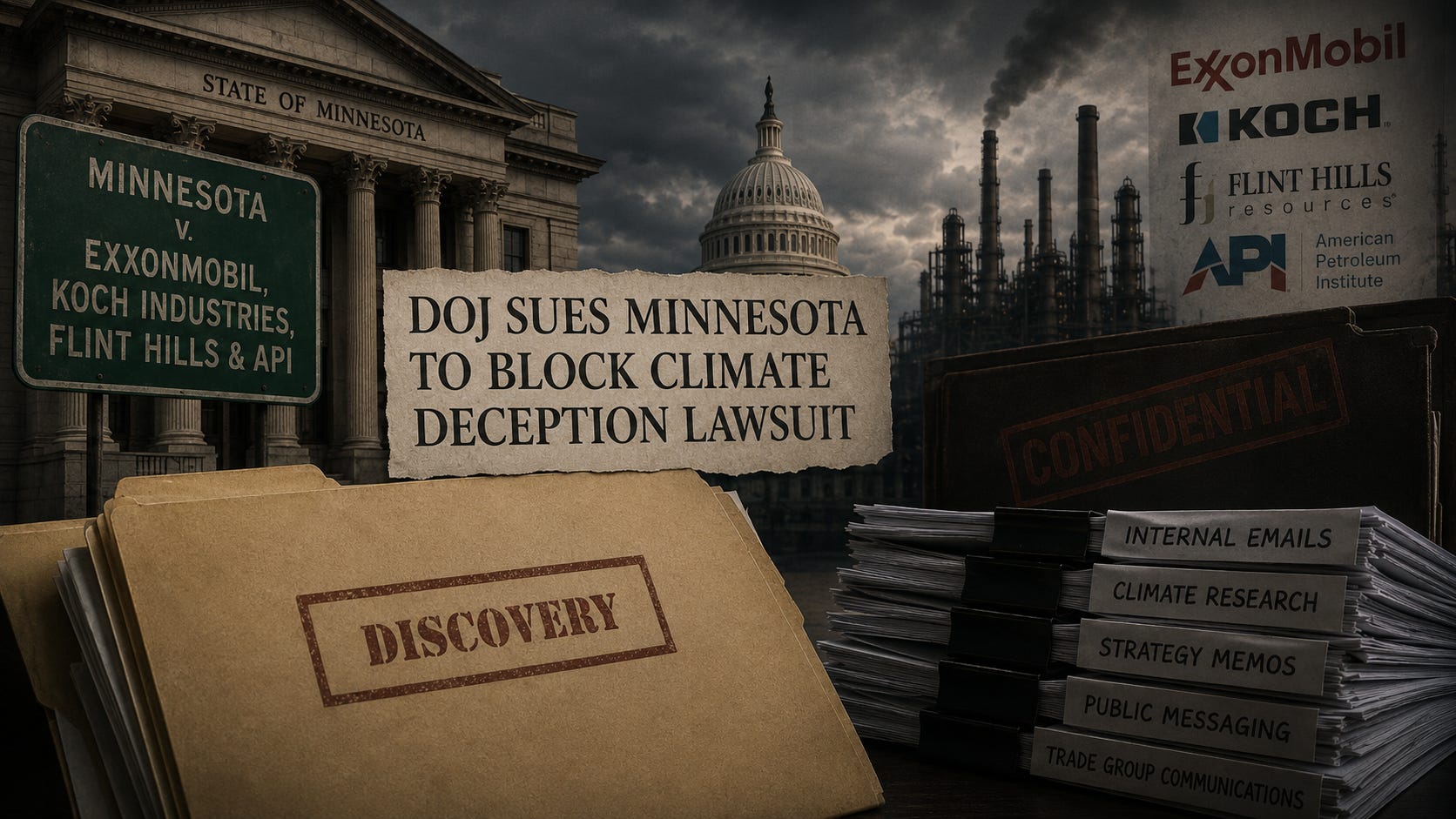
The DOJ would like the public to understand this as a sober dispute over state overreach. A phrase that’s doing a lot of work. It turns a consumer fraud case into a constitutional weather system; by moving the conversation up to an altitude where ordinary people are gently escorted out and replaced by words like preemption, federalism, foreign affairs, interstate commerce, and national energy policy. Up there, everything gets foggy. Down here on Earth, however, the question is easier.
Did these companies tell the truth?
Did they know more than they admitted?
Did they fund, shape, or amplify public messages that confused people about climate change while their own internal understanding told a different story?
And should Minnesota be allowed to find out?
That last question is the one DOJ’s intervention puts front and center. Because if the federal government can shut down a state deception case before discovery, then the fossil fuel defendants may avoid something even more useful than liability, exposure.
The lawsuit is dressed as a defense of federal power, but its practical effect is much more convenient. It could keep the filing cabinets closed. We’ve seen this movie before. Tobacco, opioids, asbestos; the story always changes when the internal documents surface. The documents matter because they show the gap between what the industry told the public and what the industry told itself. That gap is where accountability lives, it’s also where panic lives. Big Oil’s problem is not that Minnesota is trying to regulate emissions through the back door. Big Oil’s problem is that Minnesota is trying to open a drawer.
That’s why this case deserves more attention than the usual legal back-and-forth. It’s not only a climate story; it’s a power story, a story about whether an industry can hide behind process until the clock runs out, and a story about whether the federal government exists to protect the public interest or to provide emergency shelter for companies with inconvenient archives.
Of course, the DOJ will say climate policy belongs to the federal government. That will sound reasonable to some people, especially anyone who hears the word “climate” and immediately pictures emissions caps, fuel standards, international agreements, and national energy policy. But Minnesota’s case is not framed as a demand that Exxon stop selling gasoline tomorrow. It’s framed as a deception case.
A company can sell a legal product and still lie about what it knows, it can participate in a national market and still be accountable under state law for misleading consumers, and it can be central to the economy and still have to answer questions under oath. Unless, of course, the federal government manages to stop those questions from being asked.
That is the uncomfortable part. The Justice Department is presenting itself as the guardian of national energy policy, but its lawsuit could function as something much more familiar: a shield against discovery. Whether or not that is the legal intent, it is certainly the practical effect.
And practical effects count. Because if Minnesota reaches discovery, this case may become much more than one state’s lawsuit against a handful of fossil fuel defendants. It may become another chapter in the long American tradition of discovering that corporations knew more, earlier, and with greater clarity than they ever admitted in public.
So state control of education, abortion rights, even gerrymandering is okay, but issues about the environment are strictly federal? Yeh. Got it.
The oil barons have a lot more power and broad political support than tobacco execs or the Sacklers did. This'll be a dark and dirty fight.
Deception is rampant, but here (oil) the lie is more effective and the danger more inclusive. With smoking, it was still a personal choice. You could easily determine it was hazardous and not. With oil, there is no easy option out. Maybe convert to Amish.