

Donald Trump has reviewed the Republican Party’s midterm losses and identified the problem: Americans have been allowed to think about their own problems for entirely too long.
Fortunately though, he has located some people walking through Mexico.
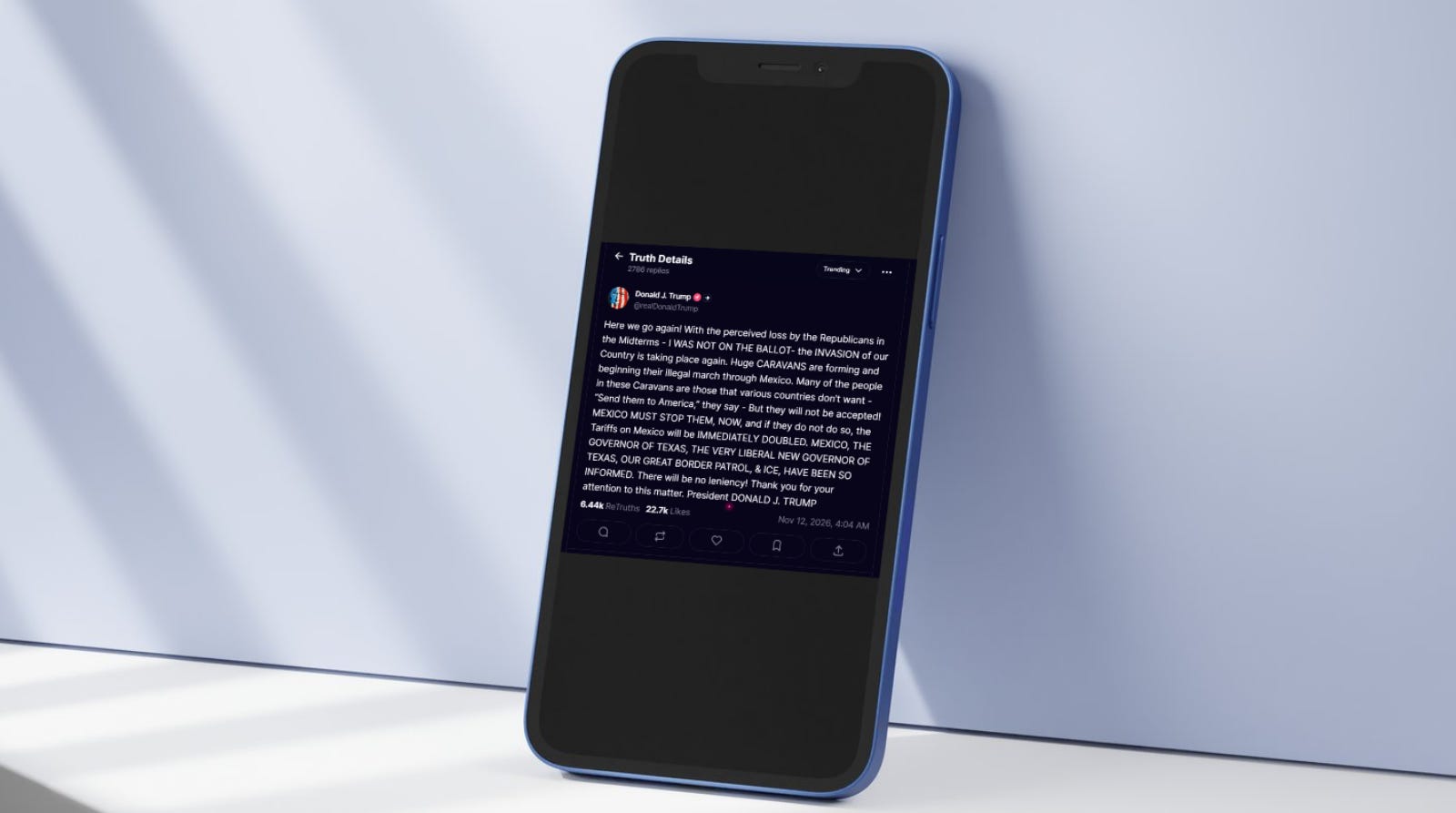
On Thursday, Trump threatened to double tariffs on Mexico unless it stopped migrant caravans, announcing that an “INVASION” was underway after what he called the Republicans’ “perceived loss” in the midterms. He also inserted “I WAS NOT ON THE BALLOT,” because even during a national emergency, the president must take a moment to establish that he was in the bathroom when the restaurant failed its health inspection.
“Perceived loss” is a lovely phrase. Very gentle. The political equivalent of standing beside your overturned vehicle and explaining that some observers have developed concerns about its orientation.
There are real migrant groups traveling through Mexico. Reuters reported an estimated 1,500 people leaving Tapachula, some hoping Democratic victories might eventually improve their chances of entering the United States. Mexican President Claudia Sheinbaum said no caravan had reached the U.S. border since January 2025 and described one recent group as largely dispersed.
Hoping a policy might change, however, is several constitutional steps away from a policy changing. The incoming congressional terms begin January 3. The new majority hasn’t taken office. Donald Trump remains president.
I realize that last part is upsetting, but it is particularly relevant to Donald Trump’s complaint about who’s running the country. He’s speaking as though Democrats have already taken over border enforcement while he’s been reduced to a concerned neighborhood resident posting footage from his Ring camera.
Sir. You are inside the White House. The calls are coming from your administration.
The White House nevertheless published a release tying the caravans to Democratic promises, assembling migrants’ hopes and politicians’ statements into a warning about what the election had unleashed.
An impressive turnaround. The incoming majority hasn’t found its offices yet, and it has already been assigned responsibility for an international emergency.
This is the arrangement Trump appears to prefer: he retains the power, somebody else acquires the blame, and the rest of us are instructed to be frightened enough to stop asking questions.
Unfortunately, voters have questions. Questions involving prices. AP’s reporting identified rising costs as a major force behind the Democratic victories. Trump’s response to those concerns includes threatening higher tariffs.
Which means we’ve reached the portion of the customer complaint process where the manager comes out, blames a pedestrian, and raises the bill.
Tariffs are paid by importers bringing goods into the United States. Businesses can absorb some costs, negotiate with suppliers, or pass costs along; Federal Reserve research has documented higher consumer prices resulting from the tariffs. Doubling a tariff would not double the price of everything, and Trump’s latest threat is still a threat. But carrying it out could add costs for American businesses and households.
Somehow, the punishment for people walking through Mexico may arrive at an American checkout counter. That should require a much more detailed explanation than capital letters. Imagine telling your mechanic the repair is too expensive and having him respond that a man three counties away is approaching on foot, so your transmission now costs extra.
You would leave. You would also warn people about that mechanic. But this is the president’s proposed answer to an electoral rebuke: revive the threat, blame the opposition, and reach for a policy that could make the bills worse.
The people walking north have their own reasons, fears, families, and decisions to make. Their existence doesn’t establish that Democrats have opened a border they don’t control. Their hopes aren’t legislation. And they shouldn’t have to serve as the emergency understudies in Donald Trump’s production of Nothing Is Ever My Fault.
Americans deserve a government capable of hearing “we can’t afford this” without responding “have you considered being afraid of someone poorer?”
He can call the election result a perceived loss. He can announce an invasion before the incoming majority takes office. He can threaten Mexico at whatever volume the keyboard will accommodate. But if his answer makes life more expensive, Americans will encounter that answer in actual dollars. And the cashier will not accept a perceived payment.