


TrumpRx.gov wants you to feel like a historic event is happening to your browser. The homepage announces, with the confidence of a man selling a car that “just needs a little work,” that “the days of Big Pharma price-gouging are over.” It also declares this is “the most impactful prescription price reset in the history of our country,” which is an absolutely magnificent sentence to print on a website that mostly functions as a polite traffic cop.
The White House framed the rollout the same way. One official write-up called TrumpRx “a transformative new government platform” giving “direct access to dramatically lower prices.” The fact sheet promised HISTORIC LAUNCH energy, and described a “world-class experience” for “deep discounts” on “40 of the most popular and expensive branded medicines.” President Trump, at the launch event, told the crowd: “Starting tonight, dozens of the most commonly used prescription drugs will be available at dramatic discounts.”
So yes, the marketing is set to Apollo 11. The problem is that, one month later, the measurable reality is set to Excel, but the file is missing half the tabs. STAT did the most subversive thing a reporter can do in modern America, which is count. A month in, TrumpRx went from 43 drugs to 44 drugs, which is an improvement in the way that adding one crouton improves a salad. The White House is still promising more meds “on a rolling basis,” and the TrumpRx site itself says “We’re just getting started.” Sure, but you can say “we’re just getting started” about anything, including a house fire.
Here is the most honest description of TrumpRx I have seen, and it comes not from a rival politician but from the corporate plumbing. In GoodRx’s own press release, the company explains: “TrumpRx does not sell or dispense drugs.” It is “a website that lists discounted cash prices,” and then “the underlying partner platform executes the pricing.”
That is the whole concept in one sentence: it is a government-branded directory, plus a referral system, plus coupons, plus a majestic golden eagle graphic, plus the spiritual assurance that something big is being done.
This is not inherently evil. It could genuinely help some people who pay cash, especially in categories like fertility meds where out-of-pocket spending is common and where, as the White House keeps emphasizing, people can be stuck paying everything themselves. It could also help a person who is uninsured and desperate, which is not a niche scenario but a daily American genre.
But it is not the revolution implied by its own language, and it is definitely not a substitute for a functioning insurance design, a sane formulary system, or a country that treats access to medicine as a normal civic expectation rather than a scavenger hunt with a checkout screen.
ABC News reported the TrumpRx site’s FAQ says: “TrumpRx discounted pricing is only available for cash-paying patients.” CBS reported the same line, and added the obvious consequence, which is that using TrumpRx will not count toward your insurance deductible. KFF’s analysis makes the point even more bluntly: the discounts “are only available to those purchasing medications without using insurance,” and that is not how most Americans buy most of their drugs.
This is the part where TrumpRx becomes accidentally poetic, because it captures the special American flavor of “saving money” while still losing the war. You can get a cheaper cash price today and still fail to make progress toward the deductible that determines whether the rest of your year is survivable, which is like getting a deal on a parachute that does not count as a parachute for purposes of the law of gravity.
If TrumpRx were actually doing what the branding implies, the administration would be giddy to publish the basics: how many people used it, how many prescriptions were filled, how many dollars were saved, how many repeat purchases happened, and which drugs were responsible for most of the impact. Instead, STAT reports that “Administration officials have yet to release data” on use “despite promises to do so.” That leaves us with the public proxies that journalists grab when the official scoreboard is locked in the trunk, namely traffic estimates and search interest.
STAT cites Similarweb estimating about 439,000 monthly visitors, Semrush estimating 178,000, and Glimpse reporting 1.3 million Google searches in the last 30 days, with a peak right after launch and then a decline to about 11,000 searches a day in recent weeks. Those tools disagree on levels, but the trendline is the point: the thing arrived like a spectacle and then settled into the quieter life of a website that exists.
And again, web traffic is not prescriptions. Clicks do not equal insulin, and interest does not equal access. All of this is the statistical equivalent of trying to measure hunger by counting how many people looked at a menu. Which is why the refusal to publish actual utilization numbers is so revealing, because it forces the public to judge a health policy initiative using the same tools we use to judge a new sneaker drop.
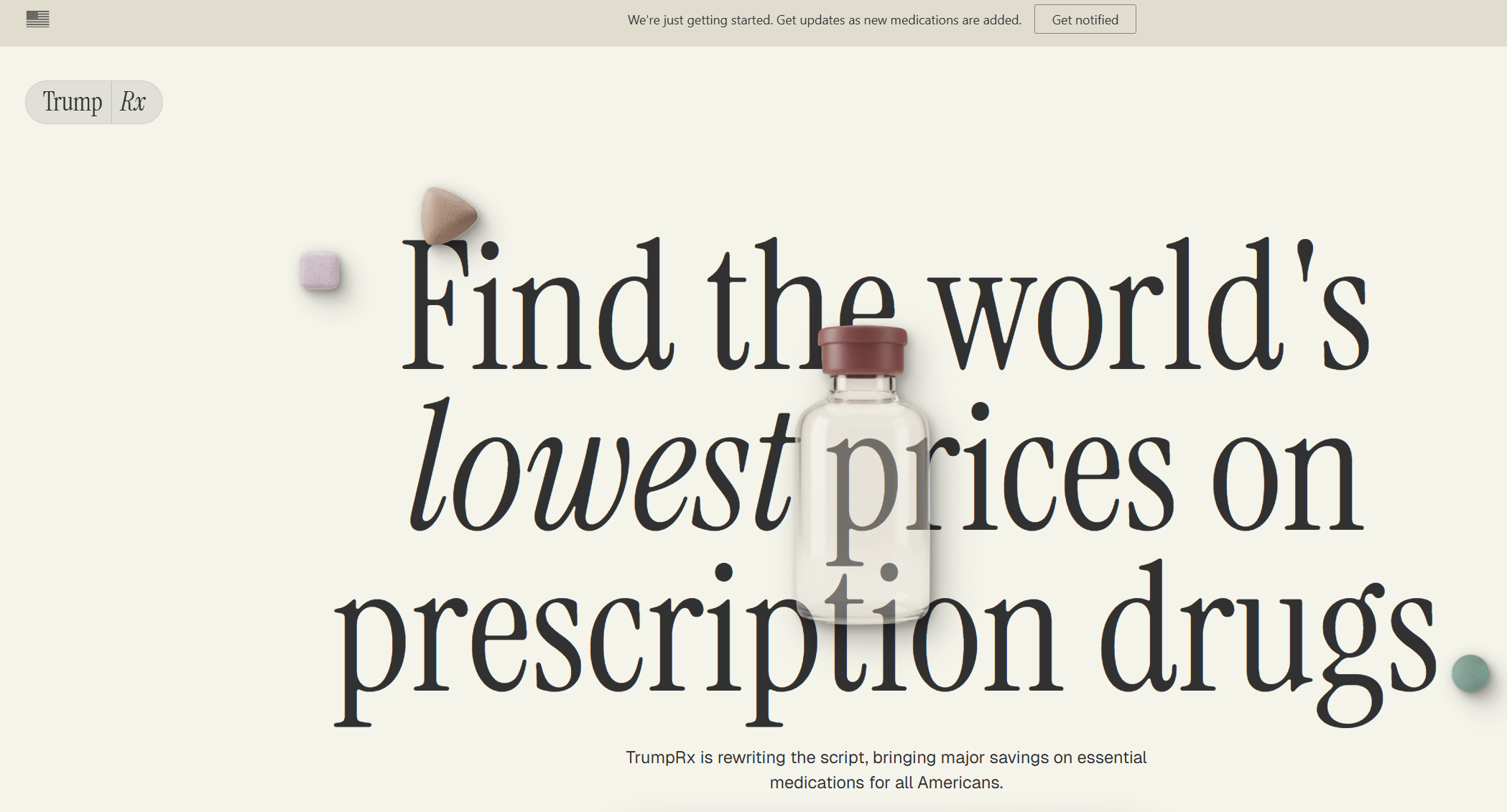
TrumpRx’s homepage invites you to “Find the world’s lowest prices on prescription drugs.” House Energy and Commerce Democrats, in a staff report, responded by basically saying: absolutely not. The report argues that for nearly half of the drugs listed, the lowest prices claim is “misleading or completely false,” because prices are unchanged from preexisting discounts or cheaper generics exist and are not disclosed.
That report also reminds us of the original hype cycle, quoting Trump’s September claim of “mathematically impossible price reductions,” including “14-, 15-, 1,600 percent.”
STAT’s reporting lands in a similar place, using a less partisan tone but a similar set of observations. The early days show “few drugs” and “uneven savings,” and patient advocates said that in some cases TrumpRx prices are “the same or even higher” than what patients pay with insurance.
Even the Democratic staff report provides an unintentionally perfect illustration of why this model is so slippery. It notes AstraZeneca announced a $35 cap for parts of its respiratory portfolio in 2024, but TrumpRx lists a cash price of $201 for Airsupra and $51 for Bevespi, which the report calls “the highest possible out-of-pocket option” if you are shopping only through TrumpRx. If your “discount portal” can, in some situations, steer people toward paying more than they otherwise would, then the portal is not a reform, it is a map with sponsored pins.
Meanwhile, the corporate partners are doing what corporate partners do, which is describing cash discounts off list prices as heroism. Pfizer’s CEO said Americans have “shouldered a disproportionate share” of innovation costs, and framed its participation as “ensuring affordability for American patients.” GoodRx’s CEO declared: “Together, we’re turning the promise of prescription drug affordability into a reality.”
All of which may be sincerely meant, and may even be partially true for some patients, but it is still operating inside the same structural trick: list prices remain the theatrical set, and cash discounts become the plot.
If TrumpRx were a clean, durable policy accomplishment, the deals behind it would be public, or at least the core terms would be, because public policy is supposed to be legible to the public. Instead, Public Citizen says it filed a FOIA lawsuit after HHS and Commerce “failed to produce” the records of the agreements it requested. Fierce Pharma quotes Public Citizen’s Peter Maybarduk saying: “We are suing the Trump administration to learn exactly what it has negotiated with Big Pharma.” In the same piece, he adds that the “secrecy makes it impossible” to evaluate effectiveness, which is a polite way of saying: you cannot prove a miracle if you will not show the lab results.
The program also has a regulatory shadow that the branding never mentions, because possible fraud and abuse under the Federal anti-kickback statute is not as fun as a countdown clock. In a January 29 letter, Senators Durbin, Warren, and Welch warned of possible conflicts of interest and legitimate concerns about inappropriate prescribing, conflicts of interest, and inadequate care. They also note that congressional oversight requests about the program’s scope, structure, and legal authority have “gone unanswered.”
If your health policy initiative is both a marketing launch and a legal gray zone, you do not get to act offended when people ask for documentation.
We know the administration is selling TrumpRx as a “transformative” affordability breakthrough with “massive” savings. We know the site promises “the world’s lowest prices,” while multiple analyses, including STAT and the Democratic staff report, argue the savings are uneven and sometimes undercut by existing options. We know it is cash-pay only, and that matters enormously for anyone who has ever lived inside a deductible. We know the administration will not release the clean metrics that would let the public evaluate impact, leaving journalists to infer momentum from web traffic.
And we know the site itself, like an eager intern, keeps repeating: “We’re just getting started.” Fine, then start with the basics. Publish the utilization data. Publish the deal terms. Publish the methodology for “Most-Favored-Nation” comparisons. If this is truly the “most impactful prescription price reset,” it should be able to survive contact with the numbers.
Until then, TrumpRx is what America keeps mistaking for reform: a high-gloss interface that routes you elsewhere, a discount framed as deliverance, and a government asking you to clap for a mystery box, because the one thing we still cannot afford in American health care is proof.
This is a useful analysis of yet another Trumpian smoke-and-mirrors initiative.
You call it a 'government-branded' site ... but it is more precisesly a Trump-branded site. Is there ANY precedent for a site on the .gov domain being named for a sitting politician? Obamacare of course was never officially called that.
It's similar to hanging huge pictures of Trump on government buildings, most recently (that I have read of) on the Department of Justice, probably the least appropriate one to have his ugly face on. Is there ANY precedent for a sitting president to deck government buildings with his picture (or name, for that matter)?
Why does this cult of personality not bother some of the MAGA crowd? Cults of personality are not normally associated with effective government.
Thank you. This is off topic, but can I still send one month trial gifts to friends?