


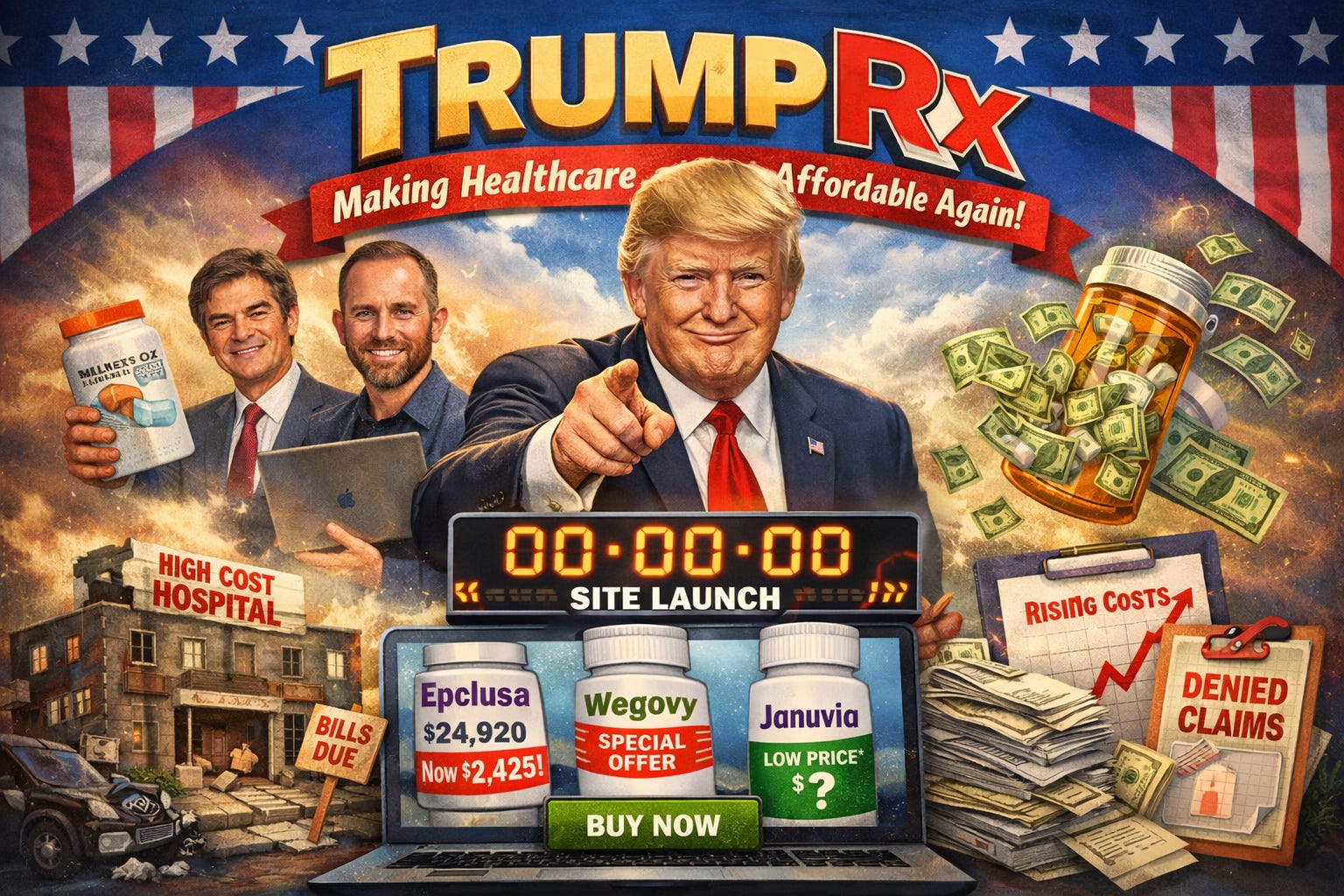
TrumpRx is the kind of name you give a product when you’re more interested in the label than the medicine. A prescription-drug “discount” website, launching with a countdown clock like a sneaker drop, is a perfect artifact of our era: politics as merch, governance as a landing page, public policy as a link-in-bio. It’s a website that doesn’t actually sell you anything, it just points you somewhere else to buy the thing. Which is, if you think about it, an almost religiously accurate metaphor for how we do American health care: everyone routing you, nobody responsible, and the “savings” living in the fine print.
To be fair: yes. A tool that makes certain drugs cheaper for people paying cash could help some people. That’s not nothing. Anyone who has ever stood at a pharmacy counter while the register spits out an amount that looks like a mortgage payment knows that “not nothing” is sometimes the difference between medication and denial. But TrumpRx is not a system fix; it’s a coupon aesthetic. It’s the political equivalent of discovering a leaky roof and proudly unveiling an umbrella.
The White House’s pitch is straightforward: TrumpRx will let Americans buy some prescription drugs at discounted cash prices by sending them to manufacturers’ own direct-to-consumer sites. Sixteen drugmakers have “negotiated agreements.” A handful of drugs are named, Januvia, Repatha, Wegovy, Zepbound, while the full list remains conveniently unreleased. We’re told the discounts are part of a “most favored nation” push, a phrase that sounds like a trade treaty and plays like a campaign slogan: the U.S. will pay no more than the lowest price charged in other wealthy countries.
All of this arrives with the scent of competence theater: an announcement flanked by Dr. Mehmet Oz, the government’s favorite daytime-TV placeholder, and Joe Gebbia of Airbnb, which is a neat pairing if you enjoy your health policy served with a side of vibes and a brief tutorial on “disruption.”
There’s something almost charming about it, in the way a child’s lemonade stand is charming. “Look! A website! A countdown! A promise!” It’s adorable until you remember the lemonade is made from the same economy that charges $2,000 for an ER visit and calls it “consumer-driven.”
Because here is the problem TrumpRx doesn’t solve, and barely acknowledges: most Americans are not walking around without coverage. Most Americans are, in fact, covered, and still getting hosed. An NBC article mentions that roughly 84% of Americans have prescription drug coverage. That’s the part the TrumpRx pitch slides past like a magician palming a coin. If the majority of people already have insurance and they’re still anxious about drug costs, then the question isn’t “how do we route cash-pay customers to manufacturer sites.” The question is: why does “having insurance” in America so often mean “still fearing the bill.”
TrumpRx lives in the narrow slice of the market where you are either uninsured, underinsured, or choosing to pay out of pocket because the insurance version of reality is somehow worse. It is not built to confront the bigger beast: the total cost of care, the premium spiral, the deductible arms race, the absurdity of paying every month for coverage that becomes useful only after you’ve paid thousands more.
The administration seems to know this, at least we hope. Experts warn that the biggest savings will be limited to people who are uninsured or paying entirely out of pocket. For people with private insurance or Medicare, the deals don’t necessarily change what they pay. For people with Medicaid, copays are already minimal. In other words, TrumpRx is most relevant to the people the system is already failing hardest, and even then, we don’t know how long the discounts last, what the final agreements say, or what the full medication list will be. It is a rescue ladder lowered into a river while the bridge upstream continues to collapse.
And the funniest part, funny in the way a hospital bill is funny, is that the site’s model can actively punish the insured. The NBC article notes that what you spend through TrumpRx might not count toward your deductible or out-of-pocket maximum. Translation: you can “save” money now and still get clobbered later, because you didn’t pay your tribute into the correct bureaucratic volcano. You can’t make this stuff up, America is the only country that has invented a form of shopping where the best deal is sometimes the one that costs more, because at least it’s accredited by your insurer.
The whole thing is structured as if the central crisis is that Americans lack enough “options,” as though the missing ingredient in health care is one more website with a heroic font and a nationalistic domain name. We already have options, we have options the way we have streaming services: dozens of interfaces, different pricing tiers, bundling schemes, surprise fees, and cancellations that require a blood oath. TrumpRx joins the chorus as a government-endorsed aggregator of manufacturer discounts, an official nod to the idea that the best we can do is help people hunt for bargains in a market designed to be confusing.
And if you squint, you can see the deeper ideology: nothing must ever be allowed to look like a universal public guarantee. It must be a deal, it must be negotiated, it must be optional, must be personalized, must be available as an app, but it must never be a right.
The administration’s favorite talking point is “most favored nation” pricing, which is conceptually appealing in the way “no more bad things” is conceptually appealing. Who wouldn’t want Americans to pay what other wealthy countries pay? But their own vagueness becomes a clue: it doesn’t explain how “lowest price” is calculated, what counts as a comparable price, or whether this is net pricing after rebates (the real game) or list pricing (the fake scoreboard). It simply says discounts are “part of” a broader MFN effort. That phrase “part of” does a lot of work, it’s the political equivalent of saying your new multivitamin is “part of” a fitness plan.
Then there’s the tariff angle: the administration says it negotiated price cuts in exchange for tariff relief. This is a classic Trump move: treat complex policy like a trade negotiation conducted via swagger, then present the result as a masterstroke. But again, the NBC article hints at the fog: Public Citizen filed a FOIA lawsuit because documents related to the deals haven’t been provided. So we’re in the position Americans know well, being asked to cheer for a big win without seeing the contract. We’re supposed to trust the dealmaking genius while the paperwork is allegedly stuck in the basement.
Even the marquee “steep discount” example, Epclusa dropping from about $24,920 to $2,425 is both impressive and revealing. Impressive because, yes, that is a huge difference. Revealing because it underscores what we all suspect: the sticker price was never the real price. If a drug can suddenly cost a tenth of its listed amount, it means the listed amount is a kind of fantasy number that exists to be negotiated down in back rooms, used as leverage, and then cited in press releases to make discounts look miraculous. TrumpRx isn’t undoing that system; it’s leveraging it for a headline.
Meanwhile, the national crisis keeps humming, premiums rise, deductibles climb, and employer coverage gets skinnier. The “insured” increasingly function like temporarily solvent cash-pay customers with a membership card. We have the world’s most expensive health system and a political culture that treats real reform like a forbidden spell. So instead we get gestures: a portal, a promise, a brand.
This is the part where Trump’s style becomes the point. TrumpRx is exactly what you’d expect from a political figure who understands the nation as an audience and policy as stagecraft. It’s not that the idea is purely useless; it’s that the scale of the solution is comically mismatched to the scale of the problem, and the mismatch is presented as a triumph. It’s as if someone tried to solve climate change by handing out paper straws and then demanded a parade.
And because it’s Trump, the whole thing is wrapped in the confidence of a man who mistakes naming something for fixing it. His approach to governance has always been: slap your name on it, declare victory, and let everyone else figure out what it actually does. TrumpRx is a monument to that impulse. It’s a website dressed up as a national strategy, and it’s launching with a countdown clock, because of course it is. You don’t fix America’s health-care costs without at least a little event production.
The tragedy is that the hunger for any relief is so real that a partial measure can feel like salvation. People are desperate, they want a lever that moves something. They want an explanation for why their insurance premium rises even when they don’t get sick. They want to know why a drug that costs $10 in one country costs $1,000 in another, and why that gap is treated like a natural phenomenon instead of a political choice.
If TrumpRx helps an uninsured person afford a medication, that’s good. If it makes it easier to access a legitimate manufacturer discount that already existed, great. But as a “broader push,” it’s a distraction with a domain name. It doesn’t confront the consolidated power of insurers, hospital systems, PBMs, and pharmaceutical pricing tactics that inflate costs throughout the system. It doesn’t address the premium and deductible escalation that makes coverage feel like a scam. It doesn’t reduce the administrative labyrinth that devours money like a second mouth.
What it does do is offer a familiar comfort: the feeling of action without the burden of transformation. It’s a workaround, not a cure. It’s a new path through the maze, not a plan to stop building mazes. America doesn’t need more websites that point to other websites. America needs fewer middlemen, fewer secrecy-driven pricing games, and a health-care financing model that doesn’t treat getting sick like a personal failure of budgeting. It needs policies that are boring, structural, and effective, which is why, in our current political economy, it will probably get another countdown clock instead.
TrumpRx will launch, people will click, some will save money, others will discover it doesn’t help them, and the larger story will remain the same: the country will continue paying luxury prices for basic security, while leaders perform discount-page heroics and call it a revolution. If nothing else, TrumpRx is honest in one way: it admits, without meaning to, that in America, the most realistic health-care reform is a link.
Is there any precedent for an official government website, in the .gov universe, being named for a sitting US politician?
Trump sells fantasies, it’s what he does. His target market: people who believe anything he says. His view of these people: they’ll adore him even if he shoots and kills innocent pedestrians on 5th Avenue. His words, not hyperbole. That’s not high praise, but it is how malignant sociopaths calculate their prey.