


Good morning! Welcome to the abbreviated grandma-duty edition of the roundup, because democracy may be wheezing into a paper bag, but snacks must still be distributed and small humans remain very committed to asking where their shoes are.
Today’s story is really one giant foreign-policy casserole: Trump went to China looking for a win, because his Iran war has metastasized into an energy crisis, Republicans are starting to sweat the midterms, Congress is still refusing to reclaim its war powers, and Xi Jinping appears to understand leverage in a way that Trump mostly understands chandeliers.
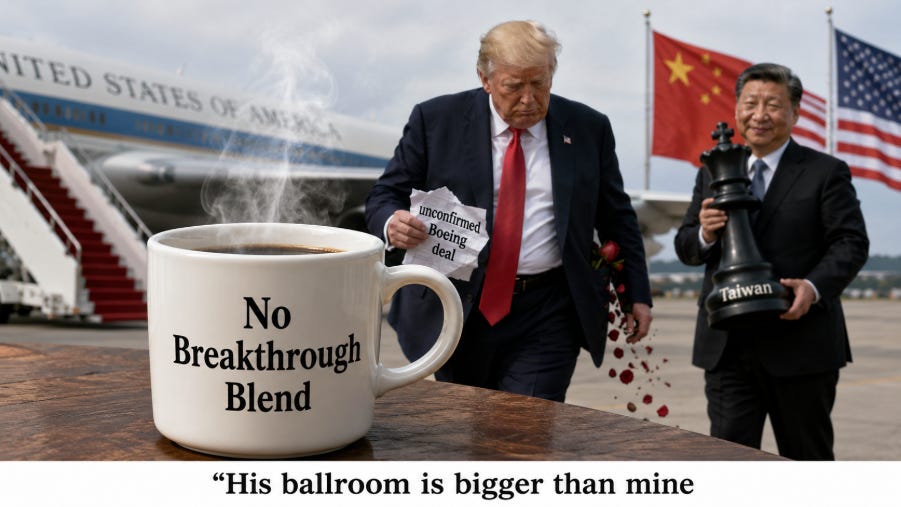
The official White House version of Trump’s Beijing summit is that everything was historic, fantastic, beautiful, amazing, and probably available soon in commemorative gold-plated ballroom form. Trump emerged from two days with Xi Jinping declaring that China would buy 200 Boeing planes, maybe 750 if Boeing behaves itself, plus billions in soybeans, plus unspecified “fantastic trade deals,” plus some vague sense that Xi had become “really a friend.” As always, the deals were huge, the details were tiny, and the confirmation from the other side was largely missing in action. Neither Boeing nor Chinese officials confirmed the big plane order, and China’s public statements were notably more restrained than Trump’s traveling sales pitch from 30,000 feet.
The Guardian put it plainly: Trump left China without breakthroughs on Iran, Taiwan, or AI. The summit was heavy on pageantry and promises of stability, but light on tangible progress. There were state dinners, garden tours, ancient trees, rose seeds, business executives, Elon Musk, Tim Cook, Trump’s son Eric, and all the ceremonial trappings of a superpower summit. What there was not, apparently, was a clear resolution to the major crises Trump needed solved.
That is the real story. Trump did not go to Beijing from a position of strength. He went there weakened by the prolonged war in Iran, a war he keeps insisting is either won, paused, terminated, ongoing, legally irrelevant, or about to resume depending on which reporter has annoyed him most recently. The Strait of Hormuz remains at the center of the crisis. Oil supplies have been disrupted, global energy markets are tightening, and the economic blowback is becoming a serious political problem for Republicans heading into the midterms. The Financial Times reports that Trump’s allies are openly pinning hopes on Xi Jinping to help defuse the Hormuz crisis, because China is the world’s largest oil importer and has close ties to Tehran.
Pause here to appreciate the majesty of America First: Trump starts a war with Iran, oil prices spike, Republicans panic about voters blaming them for gas and diesel prices, and now the plan is apparently to ask the Chinese Communist Party to save the GOP’s midterm prospects.
FT reports that Republicans such as Steve Daines, Kevin Cramer, and Lindsey Graham are hoping Beijing will lean on Tehran because China depends on energy flowing through the Strait. The White House claimed Trump and Xi agreed that Hormuz should remain open and that Iran should not have a nuclear weapon. But China’s own readout was much thinner, saying only that the two sides exchanged views on the Middle East. That gap is not a detail. It is the Grand Canyon wearing a diplomatic nametag.
The Guardian added a quote that may deserve its own tiny brass plaque in the Museum of Consequences. Zhou Bo, a retired Chinese army colonel and senior fellow at Tsinghua University, described the Chinese attitude toward being asked to fix the Iran mess this way: “Why should I clean your shit?”
Elegant? No. Accurate? Tragically, yes.
Trump told reporters he and Xi felt “very similar” about Iran and that both wanted the strait open. But wanting something open and persuading Iran to open it are not the same thing, especially when China has its own interests, its own relationship with Tehran, and very little incentive to rescue Trump from a crisis that drains American power and credibility. FT reported that China has given no clear indication it will help the U.S. reopen the Strait, and analysts warned Beijing may only cooperate if it is “paid handsomely,” potentially with concessions elsewhere.
Which brings us to Taiwan, where the air gets very cold very fast. Xi made Taiwan a central issue at the summit. Chinese state media said he warned Trump that mishandling Taiwan could lead to conflict and an “extremely dangerous situation.” FT reports that Trump is now undecided on a $14 billion arms sale to Taiwan after the summit, even though the package had already been authorized by his own administration. Trump told reporters on Air Force One that he would “make a determination.” That is a phrase that sounds normal until you remember he is talking about a democratic partner facing pressure from Beijing, not choosing between ketchup brands.
Even more alarming, Trump admitted that he discussed Taiwan arms sales with Xi “in great detail.” That matters because directly consulting Beijing on U.S. weapons exports to Taiwan would break decades of precedent going back to Reagan-era assurances that the U.S. would not do exactly that. When a reporter pointed this out, Trump brushed it off by saying the 1980s were a long time ago. Strategic commitments expire like yogurt when they become inconvenient to the man who thinks history began the day he descended an escalator.
Then came the most dangerous little performance of the gaggle. Asked whether the United States would defend Taiwan from a Chinese invasion, Trump refused to say. “There’s only one person that knows that,” he said. “You know who it is? Me.” He also confirmed that Xi asked him directly whether he would defend Taiwan, and Trump told him he does not talk about those things.
Strategic ambiguity has long been part of U.S. policy toward Taiwan. But Trump’s version does not sound like disciplined ambiguity. It sounds like a man hiding the answer in his jacket pocket because he thinks foreign policy is more powerful when it comes with a cliffhanger.
The concern is not simply that Trump is weak. It is that he is transactional. He needs Xi’s help on Hormuz. Xi wants space on Taiwan. And suddenly Trump is undecided on a $14 billion arms package for Taipei. Far from any grand strategy, it is more like foreign policy as a pawn shop.
There was also the minor matter of Marco Rubio being sanctioned by China. Since 2020, Beijing has had Rubio on its sanctions list for his outspoken criticism of the Chinese Communist Party. The solution the two governments arrived at was simple, elegant, and deeply unserious: the sanctions applied to Senator Rubio, not Secretary of State Rubio. Same man, different hat. China’s foreign ministry confirmed the distinction with a straight face. Rubio, for his part, wandered around the Great Hall of the People marveling at the ceiling. Everyone proceeded as if this was normal.
Trump’s actual gaggle on Air Force One did not reassure anyone unless they were hoping the commander-in-chief would recreate international relations as a late-night infomercial hosted by a malfunctioning casino owner. He opened by praising Xi as “an incredible guy” and claiming they made great trade deals. Then he moved to Iran, where he said he had thrown away Tehran’s latest proposal because he did not like “the first sentence,” which he described with constitutional precision as “an unacceptable sentence.”
He went on at length about “nuclear dust,” a phrase he proudly claimed to have coined, and insisted that only the United States and maybe China had the equipment to remove it after what he called the “complete obliteration” caused by U.S. B-2 bombers. He said Iran had agreed to terms, then took them back, but would agree eventually. He sounds like a man trying to manifest compliance through repetition and aircraft trivia.
Challenged on whether the bombing campaign had produced political change in Iran, Trump erupted. He called the reporter fake, accused outlets like The New York Times and CNN of writing “sort of treasonous” coverage, and insisted the U.S. had achieved a “total military victory.” He claimed the U.S. had knocked out Iran’s navy, air force, anti-aircraft systems, radar, top leaders, second-tier leaders, third-tier leaders, and 85 percent of missile manufacturing. If there had been a fourth-tier assistant regional deputy missile-adjacent intern, Trump would have claimed we got him too.
He also threatened that the U.S. could knock out Iran’s bridges and electrical capacity within two days. So while his administration argues the war is somehow over enough to avoid congressional authorization, Trump is on Air Force One casually describing additional targets like he is browsing a demolition catalog.
That body we call Congress had another chance this week to act like the branch of government that actually has the constitutional power to authorize war. Naturally, it blinked.
The House narrowly blocked an effort to force Trump to seek congressional approval to continue the Iran conflict. The vote tied 212 to 212, which meant the measure failed. Nearly all Republicans opposed advancing it, and one Democrat, Jared Golden of Maine, joined them, casting the deciding vote while his colleagues chanted “one more” on the floor, which is either poignant or farcical depending on your remaining reserves of optimism. The 60-day War Powers deadline passed on May 1, but Trump has continued to insist that the conflict is either terminated or not subject to Congress at all, a legal theory best summarized as “because I said so and also please ignore the explosions.”
There were cracks, though. Republican Representatives Brian Fitzpatrick of Pennsylvania and Tom Barrett of Michigan, both in challenging re-election races, joined Thomas Massie and Democrats in supporting the effort. Barrett said plainly that Congress has the authority to authorize the use of force and that the 60-day point had already passed. Massie pointed to the economic pressure from the war, saying diesel is six dollars, gas is five, and people cannot afford fertilizer because of this conflict.
That is the kind of thing that tends to focus the mind. Constitutional principles are lovely, but nothing says “maybe we should revisit Article I” like a constituent screaming at you from a gas pump.
The administration’s legal argument is as convenient as it is absurd. Senior officials claim the War Powers Resolution is unconstitutional, and also that the ceasefire pauses the withdrawal clock. Legal scholars across the ideological spectrum reject that view. Also, bombing has continued, and Trump himself said the ceasefire was on “life support.” So the ceasefire is apparently alive enough to suspend the law, but dead enough to keep bombing. Congratulations to the administration on inventing Schrödinger’s War.
Republicans defending Trump argued that forcing a vote now would send the wrong message while Trump is supposedly negotiating. Representative Rick Crawford called the effort political gamesmanship while Trump and his administration were trying to bring Iran’s “tyrannical reign” to an end. Which is a very elegant way to say: please do not interrupt the president while he asks Xi Jinping to help clean up a war he says he already won.
Back in Beijing, the summit’s symbolism was unmistakable. Xi hosted Trump at Zhongnanhai, the secretive Communist Party leadership compound near Tiananmen Square. He gave Trump a garden tour, showed him ancient trees, talked about roses, and promised to send seeds for the White House rose garden. At the state banquet the night before, Elon Musk sat alone at a long table while a parade of executives rotated through the empty seat beside him for photos. When Lei Jun, the billionaire founder of Xiaomi, one of Tesla’s fastest-growing Chinese rivals, approached and gestured for a selfie, Musk grimaced, pulled a few faces, hammed it up for the camera, then turned ostentatiously back to his phone. The clip went viral within hours. By Friday afternoon the hashtag had 75 million views on Weibo. A Chinese influencer rendered his verdict: “No matter how high you climb, as soon as you look up, you see a butt.” The diplomacy was going great.
Trump was dazzled by all of it. He later posted that “China has a Ballroom, and so should the U.S.A.!” and called Xi one of the world’s great leaders. This may be the purest distillation of Trump’s foreign policy yet: Taiwan is under pressure, Iran is burning, Hormuz is unstable, rare earths remain unresolved, AI guardrails are vague, human rights are sidelined, and the President of the United States is thinking, “Nice ballroom.”
Human rights barely made it into the discussion. Trump said Xi was giving “serious consideration” to releasing jailed pastors, likely including Pastor Ezra Jin, but that Jimmy Lai’s case was “a tough one.” After Trump left, China’s foreign ministry described Lai as an “instigator” and reiterated that Hong Kong affairs are China’s internal matters. Translation: Trump got roses. Jimmy Lai got the boot heel with paperwork.
The AI portion was similarly thin. U.S. officials floated possible guardrails and protocols around powerful AI models, but there were few concrete details and no major breakthrough. Nvidia’s Jensen Huang was in the delegation, but export controls on high-end chips apparently were not a major topic, leaving Nvidia’s future in China unclear. Trump gave one of his classic answers on the subject: first suggesting the chips did not come up, then saying they did, then saying something could happen. No, yes, maybe, very strongly.
Rare earths also remained unresolved. Trump’s visit ended without visible progress on China’s restrictions on exports of critical rare earth metals, despite their importance to global supply chains. Beijing made the usual soothing noises about stability and security, but there was no sign of a major concession. Xi, in other words, kept the choke point and the garden path.
The whole summit appears to have been designed around “constructive strategic stability,” Xi’s preferred framework for keeping U.S.-China competition within limits while Beijing consolidates its own position. Analysts noted that Xi has been preparing for this moment for years: bringing an American president to Beijing as a peer, widely acknowledged as such around the world. One Chinese government adviser said the balance of power is shifting toward greater parity. That is the key. Xi did not need to humiliate Trump. He needed to host him, flatter him, press him on Taiwan, offer vague stability, and let Trump leave bragging about unconfirmed deals and ballroom architecture. It was pageantry as power politics.
Trump, bless his gold-plated little weather vane, seemed delighted. The president came home from Beijing with rose seeds, ballroom envy, and a foreign policy posture best described as: please clap, but in Mandarin.
Roses don't come true from seed. Each seed is individual. That's my big takeaway. President Xi effectively said, "Grow your own roses. They will be the children of mine, and will bloom eternally, as mine do, but they won't be mine, and mine will be senior." Now, isn't that a fine piece of diplomacy. Masterful.
Xi's comments about a declining superpower pretty much defined the visit. China is standing back and watching the crash out of Pax Americana while Trump pretends (maybe even believes?) that he was talking about Biden. Also, you note China has been preparing extensively for this meeting; do you think Trump did? Did State Dept China experts prepare in depth discussion papers to brief Trump what to expect and how to pressure Xi? Yes, that was a joke. No career professionals on the trip, no substantial gains for the US, rose seeds for the Epstein Memorial Patio, cleverly veiled insults for Trump, and we're back to Trump settling his lawsuit against his own administration for $1.7 billion from the taxpayers to distribute to whomever he wants (probably with a commission to himself).