

There is a strange problem with interviewing Donald Trump.
On one level, it can feel almost meaningless because Trump does not operate in the realm where interviews are supposed to live. An interview is supposed to clarify. It is supposed to produce information, expose contradictions, test claims, and give the public some reliable sense of what a president believes, knows, intends, and can defend.
That machinery breaks down almost immediately, when interviewing Trump.
Ask him about Iran, and you do not get a coherent account of negotiations, military objectives, legal authority, regional risk, or the cost of escalation. You get a fog machine with shoulder pads. Iran is desperate to make a deal, but also too proud to make a deal. Iran has been “virtually decapitated,” but somehow remains dangerous enough to blow up the world. Trump is close to an agreement, but if not, he will “blow the hell out of them,” which is apparently the diplomatic track with fewer hors d’oeuvres.
Ask him whether he broke his “no new wars” promise, and the answer is not so much an answer as a warranty dispute. No, he says, he did not break the promise. Then, when Kristen Welker reminds him that this was not some stray aside he muttered once into a shrimp fork at Mar-a-Lago, but a central part of his political brand going all the way back to 2015, he insists that he “didn’t guarantee no war.”
Ah. “No new wars” apparently came with terms and conditions. Please consult the fine print buried somewhere between the Trump University refund policy and the “Infrastructure Week” commemorative snow globe.
This is why Trump interviews often fail as fact-gathering exercises. You can press him on policy, and he will respond with grievance. You can ask for evidence, and he will answer with volume. You can point to a contradiction, and he will build a casino on top of it, declare bankruptcy, blame the press, and insist it was the most successful casino in human history.
That still does not mean the interviews are useless. In fact, the opposite may be true.
Useless as sources of factual data, but deeply useful as public stress tests. Put Trump under even modest pressure. Ask a follow-up question. Refuse to let the third lie erase the first one. Keep him in the chair long enough for the performance to outrun the script. What you learn may not be “the truth” about Iran, the economy, Jan. 6, or California elections. What you learn is something more basic and more dangerous: how he behaves when truth is required of him.
Trump’s Meet the Press interview with Kristen Welker was so revealing because he scattered claims like confetti fired from a leaf blower. The interview revealed, in real time, the operating system of a man unsuited to democratic power.
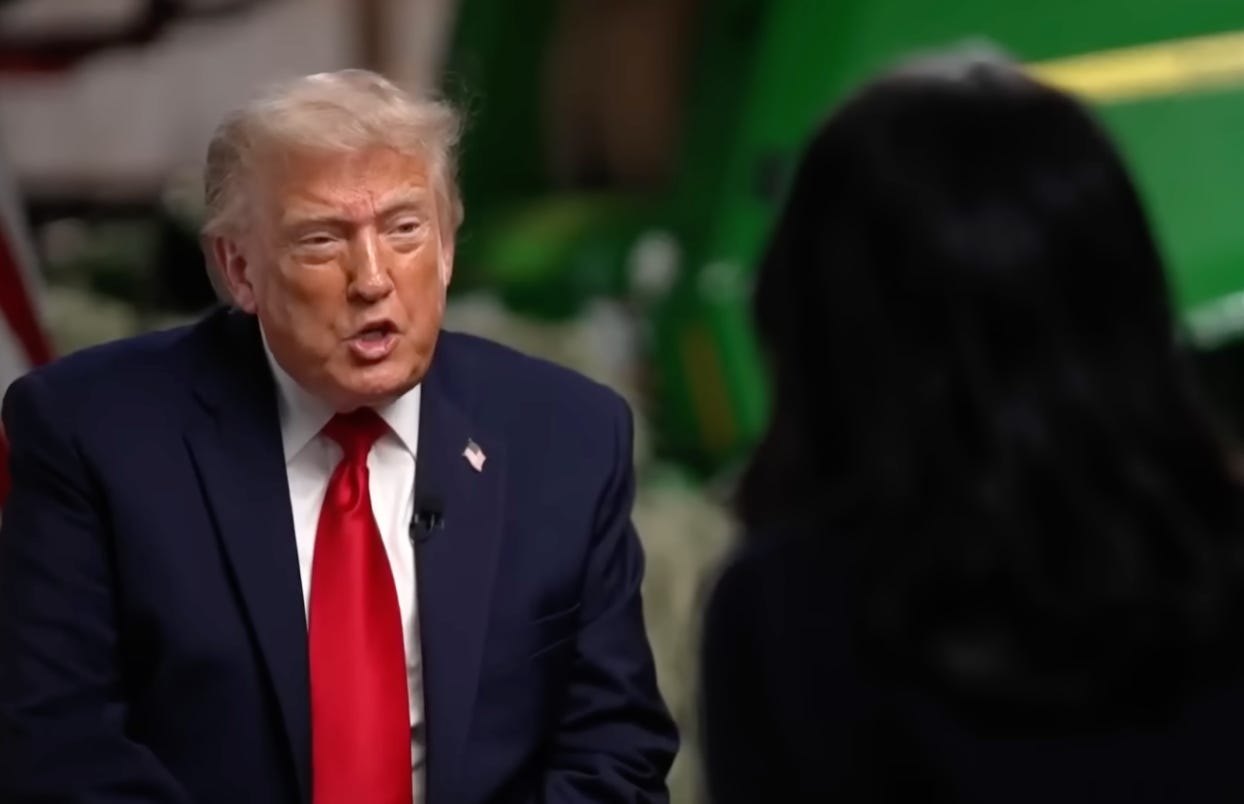
The setting alone bordered on parody. Trump sat for the interview in Wisconsin, inside a barn on a farm, at the request of the White House. The whole scene was meant to support his pitch to rural America: strength, prosperity, command, leadership, the return of the golden age, probably with a side of cheese curds and a decorative tractor. Instead, rain began hammering the metal roof, repeatedly interrupting the taping. The interview had to stop and restart as the storm passed overhead. If an anxious screenwriter had written it this way, a producer would have crossed it out for being too obvious.
There he was, in a barn, in farm country, trying to sell control while the weather itself kept heckling.
Welker began with Iran, and she did what interviewers should do: she followed the logic of Trump’s own claims. He has repeatedly said Iran is desperate to make a deal. So she asked the obvious question. If Iran is so desperate, why is there still no deal?
Trump’s answer was a tangle of domination theater. Iran, he said, is strong and proud. They have had independence. They have gotten away with things for 47 years. They cannot believe the situation they are in. They have “no choice.” They have been “virtually decapitated.” They are beaten, but not yet compliant. They are desperate, but not yet desperate enough. They are about to fold, unless they do not, in which case he will escalate.
Trump is narrating foreign policy as if it were a cage match and he had already cut the promo.
Welker pressed him on the promise that helped define his first run for office: no new wars. Trump’s answer was blunt denial followed by instant contradiction. No, he had not broken that promise, because he had to stop Iran from getting a nuclear weapon. He claimed they would “blow up the world,” “blow up the Middle East,” “blow up Israel,” and “come here and blow up the Earth.” He called them crazy people, then, in the next breath, said he gets along with them and likes them. We were one “many people are saying” away from a diplomatic fruit basket.
When Welker pushed again, Trump tried to reframe the entire premise. He did not guarantee no war, he said. Why would he have built the strongest military in the world if he did not intend to use it?
This is the kind of statement that should stop the conversation cold. Because the entire point of “peace through strength,” at least in the version sold to voters, is that military strength deters war. Trump’s version is more like buying an expensive blender and insisting the smoothie was inevitable. Why have all this beautiful military equipment if you are not going to fire it at somebody?
Trump insisted this would not become a quagmire. It was not a forever war. The United States had only been doing this for three months. Three months, in Trump’s telling, is apparently the historical boundary between “quick and easy” and “uh-oh, somebody call Ken Burns.” Vietnam, Iraq, Afghanistan, those were stupid wars run by stupid people. This one is different because Trump says it is nearly over. Just like everything Trump touches is always two weeks away from perfect resolution, whether it is health care, infrastructure, the Epstein files, Ukraine, or his latest plan to turn constitutional government into a loyalty rewards program with federal stationery.
Then came the economic contradiction, and this is where the Wisconsin setting mattered. Welker asked about gas, diesel, and fertilizer prices. Farmers are feeling the pressure. Trucking companies are feeling the pressure. Rural communities are feeling the pressure. The very people Trump came to flatter are paying the bill.
Trump, in his own way, acknowledged that the war was raising costs.
Gasoline and fertilizer prices would come down when the war ends, he claimed. He said they might not have peaked because “it depends where the war goes.” He told farmers, essentially, that they would understand the sacrifice. He had a choice to make. He could have kept things cheap, he said, but he had to remove the nuclear threat. Once that was done, gas prices would “drop like a rock.”
This is the Trump economic promise in miniature: everything bad is temporary, everything good is because of him, and the check is always in the mail. Prices are high because of the war, but the war is necessary. The war will end soon, unless it does not. Gas will fall, unless it rises first. Farmers are hurting, but they love him. They trust him. He gave them money once. China paid for it, which is not how tariffs work, but why let economics interrupt a perfectly good campaign anecdote?
This was supposed to be the “golden age” tour. Instead, Trump’s pitch to farm country boiled down to: absorb higher diesel and fertilizer costs, ignore the broken war promise, trust me to end the crisis I am escalating, and please clap in the general direction of the barn.
Then came the Federal Reserve, because no Trump interview is complete without him taking a moment to explain macroeconomics like a man trying to assemble a treadmill with instructions written in Sanskrit. He touted the jobs report, said the numbers had smashed expectations, and complained that when the country does well, the Fed wants to raise interest rates. In Trump’s view, success should be rewarded with lower rates. Growth, he said, does not cause inflation. Success can kill inflation. If inflation comes, you “stamp it out,” but also lower rates, grow faster, spend more on the military, and somehow build the greatest machine the world has ever seen.
Economic policy as a motivational poster. “Growth does not cause inflation” may sound reassuring, in the same way “gravity does not apply to me” sounds reassuring right before the coyote notices there is no cliff underneath him.
But the interview had not yet reached its most revealing phase.
The final collapse came when Welker turned to the proposed $1.8 billion so-called “anti-weaponization” fund. This was the plan to compensate people who claim they were targeted by the federal government, a taxpayer-backed grievance pool for Trump-world victims, allies, and potentially Jan. 6 defendants. Acting Attorney General Todd Blanche had said the Justice Department was backing away from it. Welker asked Trump whether he was also backing off the idea or looking for another way to revive it.
Trump said people had been hurt “so badly” by “radical left lunatics” in the Biden administration. He said lives had been destroyed. Families lost. Jobs lost. Marriages lost. Suicides. He included himself, naturally, because all roads in Trump’s mind lead back to Mar-a-Lago being searched pursuant to a lawful investigation into classified documents he was not supposed to have. The suffering of others may be useful, but the central wound is always his.
Welker then asked the question that matters: should anyone who attacked police officers on Jan. 6 receive taxpayer money?
Trump said he would not be inclined to say so, but he would “have to see it.”
There it is. The whole authoritarian loyalty economy in one little hesitation. He could have said no. He could have said, of course not, no one who assaulted police should receive a dime from taxpayers. He could have drawn a bright line between supposedly wronged citizens and people who joined a violent attack on the Capitol. But that would require moral clarity, and moral clarity is not one of the products available in the Trump store.
Instead, he pivoted to the mythology. Most of those people, he claimed, were ushered into the building. There were “dirty cops.” James Comey was a dirty cop. FBI agents told people to go in. Guilty pleas were coerced because defendants were afraid of long sentences. Welker kept reminding him that people pleaded guilty to assaulting police officers, that there is no evidence for his claims, and that many defendants were arrested for actions beyond merely walking around the Capitol.
Trump did what Trump does when confronted with evidence. First, he attacked the evidence, then attacked the person citing it.
Many of those people should be compensated. He said the fund would be handled case by case by “fair people” and “smart people.” In other words: do not worry, the loyalty payouts will be reviewed by the finest independent minds in the Ministry of Revenge.
Inevitably, the conversation moved from Jan. 6 to election lies. The stolen-election myth is the black hole at the center of Trumpism; every subject eventually gets pulled into it. Welker said there was no evidence for what he was claiming. Trump insisted there was “tremendous evidence,” “nothing but evidence,” and then declared that the election was dirty and that the same thing was happening “right now in California.”
California was still counting votes. Slowly, as California often does, especially with mail ballots. This is not a conspiracy. It is an election system processing ballots under state law. But Trump saw Democratic gains as proof of cheating because in Trump’s world, the only legitimate election is one he likes. If Republicans are ahead early and Democrats gain later, that is not vote counting. That is theft. If Democrats win, the election is rigged. If Trump loses, democracy malfunctioned. If Trump wins, the people have spoken with perfect clarity and possibly a choir of angels.
Welker asked him for evidence.
Trump replied, “All I have to do is look.”
That may be one of the most revealing lines of the entire interview. Evidence, in Trump’s mind, is not something gathered. It is something declared by his own perception. If he looks and dislikes what he sees, then fraud exists. Reality is whatever bruises his ego.
Welker did not let it go. She told him that was not evidence. He grew angrier. He called California officials crooked. He called Welker crooked. He called Meet the Press crooked. He called NBC, ABC, CBS, CNN, and the press crooked. When Welker calmly replied, “To be fair, I’m not crooked,” Trump told her she was either crooked or stupid. Presidential, if your model of the presidency is a malfunctioning comment section with nuclear codes.
Then he quit.
He said, “Let’s call it quits ’cause I’ve had enough.” He thanked her, called her “darling,” and walked away. Welker noted that she had traveled all the way to Wisconsin and sat with him through the rain. Trump said he had given her enough time and told her to straighten out her press. As he exited, he appeared to step on the microphone. It did not look deliberate. It did not need to. The symbolism handled itself.
The interview matters because Trump could not give the country a clear account of Iran policy, or offer a coherent plan for farmers hit by higher fuel and fertilizer costs. He would not or could not clarify the status of the weaponization fund. He rewrote the history of Jan. 6 and could not provide evidence for California election fraud. He offered his eyeballs and demanded everyone treat them like a subpoena.
Trump cannot be pinned down because he does not believe he should be pinned down. He does not treat questions as instruments of public accountability. He treats them as attacks. He does not experience evidence as a standard, but as an obstacle. He does not distinguish between governing and personal vindication. He does not see public money as belonging to the public so much as a potential instrument for rewarding allies and punishing enemies. Unless they validate him, he does not accept elections as legitimate democratic processes. And when a journalist asks the obvious follow-up, What is your evidence?, he does not answer, he escalates.
That is why interviewing Trump can be both factually barren and politically essential. You may not learn much reliable information from him. But you learn how he responds when reality refuses to flatter him. He wants all the authority of the presidency and none of the obligations that come with being answerable to the public.
The setting only made the metaphor louder. In a Wisconsin barn, rain hammering the roof, Trump came to sell strength and prosperity to farm country. Instead, he acknowledged that the war was raising costs, insisted “no new wars” did not mean no war, defended a possible taxpayer fund for his political allies, called elections crooked without evidence, attacked the journalist asking the question, and walked away. The interview produced almost no usable truth from Trump. It produced something else: a clear picture of a man who cannot be trusted with truth, pressure, or power.
This is a brilliant recap of what should have every American scared beyond belief. You made sense of the senseless. I'm still waiting for the GOP to declare the emperor has no clothes. A few are questioning the emperor's taste in clothing but no one will declare he's gone the full monty.
I rarely watch run as he makes me sick. I do read reports of what he says which as you point out Mary are useless and baseless. I did watch a snippet at the end of this interview and was totally appalled by his attitude and behavior. This is what we have for the President of the United States?? We should all be hanging our heads in shame that this is happening. The worst part is he’s not alone as the grotesquely stupid hogsbrest shows us all the time.