


Good morning! The United States government has been busy, if by “government” you mean one man with a Truth Social account, a compliant Justice Department, and a geographic ambition that appears to have no northern or southern limit. Let us review.
The Department of Justice indicted Raúl Castro on Wednesday, murder charges, four counts, stemming from Cuba’s 1996 shootdown of two civilian planes operated by Brothers to the Rescue, a Miami-based exile organization that searched the Florida Straits for Cuban rafters. Three Americans and one Cuban national died. Acting Attorney General Todd Blanche announced the charges at a ceremony at Miami’s Freedom Tower, Cuban exile central, on Cuba’s independence day, because subtlety is for administrations that are trying to hide something.
Castro is 94 years old and will not be boarding a flight to Miami. Everyone in that room knew this. The indictment is more a predicate than a legal instrument.
The Venezuela template is not a secret. Congresswoman Maria Elvira Salazar said the quiet part on camera the same morning, noting that the U.S. used a Maduro indictment as justification to invade Venezuela and forcibly extradite him, and that she expects Raúl, his son, and his grandson to “understand the signals being sent by the White House.” Blanche, asked whether Castro would appear in U.S. custody, said he expected it “by his own will or by another way,” and declined to elaborate. “Another way” is doing considerable heavy lifting in that sentence.
Then came the gaggle. Asked what comes next for Cuba, Trump said the CIA is there, Marco Rubio is there, someone was there “last week,” the place is “falling apart,” they have “no food, no electricity, no energy,” and, here is the headline, “we’re freeing up Cuba.” He added that an embargo announcement was coming “pretty soon” and that Cuba “is not going to be like the biggest thing we’ve ever done, but to a lot of people it’s going to be one of the most important.” The Cuban American community, he noted, supported him at a 94% level. They’ve been waiting 65 years. He hears them.
This is the Venezuela architecture, applied to a smaller, weaker, geographically more convenient target. Legal predicate. Intelligence presence confirmed by the president’s own mouth. Exile community activated. Economic framework (the embargo) being prepared for announcement. The difference between Cuba and Venezuela is that Cuba has no capacity to resist. There is no Bolivarian military, no regional patron, no counter-leverage. If the administration decides to move, the rudder comes off in 48 minutes and 13 seconds.
Cuba sits at the mouth of the Gulf of Mexico. Every ship moving between Gulf Coast ports and the Atlantic passes through the Florida Straits, ninety miles from Key West. It is the reason the United States has been obsessing over Cuba since before the Monroe Doctrine, the reason the Soviet Union spent $4 billion a year subsidizing an island of 11 million people during the Cold War, and the reason Trump’s interest in it fits a pattern that becomes visible only when you zoom out far enough.
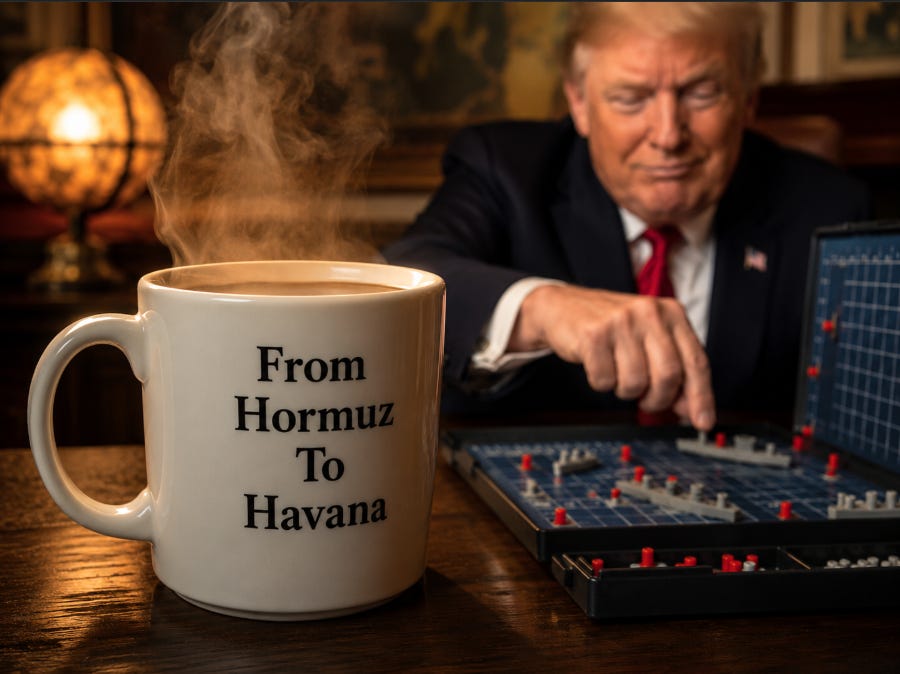
Iran controls the Strait of Hormuz, twenty percent of global oil transit. Cuba controls the Florida Straits. Trump has already made noise about the Panama Canal. He is ordering 55 icebreakers and has designs on Greenland and the Arctic shipping lanes. The thread connecting these is not ideology, or the exile community, and certainly not the indictment of a 94-year-old man who will die before any trial date. The thread is chokepoints. Whoever controls the passages controls the commerce controls the leverage. This administration has been pursuing that logic with more strategic coherence than its daily chaos suggests, and the Coast Guard commencement speech, delivered the same day as the Castro indictment, made it explicit.
“From the shores of Havana to the banks of the Panama Canal,” Trump told the graduating class at New London, “we will drive out the forces of lawlessness and crime and foreign encroachment.” That is a geographic operational mandate delivered to the branch of the military that patrols those exact waters. He also mentioned that Russia has 48 icebreakers and we have one, that he’s ordered 55, and that “maybe I’ll be here in 32 too,” said to people who cannot politically respond. He described shooting the rudder off an Iranian tanker as “a beautiful thing to see. It just fell in.” He ran through Venezuela, “48 minutes and 13 seconds,” and then immediately catalogued the economic dividend: Venezuelan oil pouring into Houston, Louisiana, Alaska. Here is what we did, he told the cadets. Here is what we got for it.
The problem with using the Venezuela template everywhere is that Venezuela worked because Venezuela had nothing to fight back with. Iran is a different lesson, and it is the lesson this administration appears determined not to learn.
The New York Times published a brutal timeline this week mapping Trump’s statements about the Iran war against what was actually happening at each moment. “Iran is totally defeated.” “VERY GOOD AND PRODUCTIVE CONVERSATIONS.” “They’ve made a proposal, and it’s a significant proposal.” “A whole civilization will die tonight.” Cease-fire announced. Strait remains closed. Cease-fire extended indefinitely. Cease-fire canceled. Talks resumed. Talks called off. The S&P 500 twitching like a patient responding to stimuli at each announcement, oil markets swinging ten percent on sentences that turned out to describe nothing real.
In a Senate hearing this week, Congressman Adam Smith did something increasingly rare in American political life: he separated the military scorecard from the strategic reality, and refused to let the former substitute for the latter.
Yes, Iran’s navy is degraded. Yes, launchers have been destroyed, missiles eliminated, air force capabilities reduced. The administration has been diligent about reading those numbers into the record, and the numbers are real. Smith’s point is that none of them answer the only question that matters: how does this end, and what does winning actually look like?
Iran’s nuclear program is no weaker today than when the war started. Not one gram of nuclear material has been destroyed. The centrifuges are where they were. The enriched stockpiles are where they were, and the only thing that changed on the nuclear question is that Iran, which was actively negotiating about its program before the war began, is now unwilling to negotiate about it at all. The administration went to war ostensibly to stop Iran from getting a nuclear weapon, and the direct result is that the one diplomatic path that might have constrained that program has been closed.
The Strait of Hormuz remains shut. Eighteen percent of global oil transit, paralyzed. Gas prices at a four-year high. 1,600 ships backed up. Iran’s current negotiating position, pay us to reopen it, is, as Smith noted with the particular dryness of a man watching a preventable disaster unfold in slow motion, “an incredibly weaker position for us.”
And then the sentence that should be quoted in every piece written about every subsequent Trump foreign policy move, including Cuba: “The credibility of our country, because sadly the credibility of our country hinges on the credibility of our president, is dead. Who’s going to believe anything we say?”
The metastatic damage, isn’t the ships, or even the gas prices. It isn’t even the nuclear program, grave as it is. It’s that every threat, every promise, every announced breakthrough now arrives pre-discounted by the documented record of a president who said Iran had completely capitulated on a Friday morning when Iran had done nothing of the kind. The market has priced it in. Allies have priced it in. Adversaries have certainly priced it in.
Into this environment, the administration is now telegraphing Cuba. A president whose threat credibility is functionally zero, whose word on diplomatic progress has been proven worthless by his own documented statements, whose military misadventure in the Middle East has produced chaos rather than resolution, is preparing a new move on a soft target in his own hemisphere. The soft target part is the point. Cuba is corrective. Cuba is the quick win that Iran hasn’t been, the place where “we totally won” actually writes itself because there is nothing to stop it being written.
Before boarding Air Force One Wednesday evening, Trump told reporters he would speak directly to Taiwan’s President Lai Ching-te, an act that would break with 47 years of diplomatic protocol established when Washington shifted recognition to Beijing in 1979. He called it “the Taiwan problem,” which is Beijing’s preferred phrasing. He has described future weapons sales to Taiwan as “a very good negotiating chip.” He just came from Beijing having announced almost nothing of substance and called the meeting “amazing.”
The Zelenskyy architecture is familiar by now. A smaller ally, a larger adversary, aid held as leverage, a phone call in which the President of the United States explains to a democratic leader that they don’t quite have the cards they think they do. Taiwan has considerably more economic weight, fourth-largest US trading partner, controls the semiconductors Trump spent a commencement speech bragging about recapturing, but economic weight has not historically protected smaller democracies from being used as chips in a negotiation they weren’t invited to.
The Strait of Hormuz is closed. Havana is being circled. The Taiwan Strait is next on the agenda. Trump is channel surfing with aircraft carriers. Somewhere in a Senate hearing room, Adam Smith is asking what the strategic plan actually is.
Nobody answered.
On a personal note, Marz and I are traveling to attend my uncle’s memorial. It is a solemn occasion, of course, but also one of those rare moments when the far-flung branches of the family tree bend back toward the same patch of ground. A muster of Geddrys is not something these parts see every day, and I expect there will be grief, stories, laughter in the wrong places, and the strange comfort of remembering someone together.
I’ll be posting as I’m able while we’re on the road. Be kind to each other, keep your eyes on the chokepoints, and hug your people while you can.
The Halls of Montezuma...
As Yogi Berra put it so well, this coming invasion of Cuba is: "Deja Vu all over again."
Why, when I see or hear the next thing that spews from Trump's mouth, do I feel as if I'm trapped in repeating loop of The Monroe Doctrine and 19th century and early 20th century American Colonialism.
The 1898 invasion of Cuba by the US was as much about sugar companies making virtual slaves out of Cubans so they could run their sugar plantations... Just like one of the main motives of the failed CIA invasion in 1961 was to take back the sugar plantations and make sure the Mafia could take back their hotels and casinos in Havana (see the Godfather, part 2 as a good rendering...) As Marine General Smedly Butler said, in 1935--when the USA was raping yet another Latin American country to make it safe for corporate profits-- "War is a Racket."
So now, the Don of the US crime family is going after Cuba again! Within a year of the US government taking over Cuba, the sugar plantations will be operating again--forget about unions--and some form of Trump-shaped gangster will re-build casinos and take over the hotels... Whatever the revolution was at the beginning, Cuba quickly became, and still is, a police dictatorship-- But WHY is Trump's government going to invade Cuba? To establish a democracy? To bring justice and freedom and equality to the Island? OR--to make it safe for gangsters, AKA corporations, to take it back to the good old days-- 1898 and 1958.
I am always amazed at your clear, excellent writing. Thank you for your research. It is hard for me to recognize the government of the country I was born and raised in. I had a 55year career as a public school teacher and was proud and happy to be an American. The same is not true in today's environment.