

If there was ever a moment when the walls of the Oval Office deserved hazard pay, it was this meeting: Donald Trump presiding over a lavish mutual-admiration society with Saudi Crown Prince Mohammed bin Salman, whom he repeatedly praised as a “great man,” “future king,” and “one of the most respected people in the world.” This was a literal public staging of the new geopolitical love story of 2025: Trump and MBS, together again, united in their commitment to making each other look enormous.
Trump opened the session with his signature flourish. America, he declared, is now “the hottest country in the world,” a line delivered with the self-assurance of a man convinced that GDP, the weather, and his personal mood are all the same metric. As proof, he unveiled a brand-new fantasy figure: “Twenty-one trillion dollars will be invested in the United States in one year.” He repeated it often, presumably hoping that if he said it with enough confidence, the number would stop sounding like something a caffeinated MBA student scribbled on a napkin.
As always, Biden was the foil, “the Biden lack of administration”, who allegedly attracted “less than one trillion over four years.” Trump, meanwhile, is sitting on $18 trillion in commitments after nine months, because of tariffs, magic, and possibly divine intervention. He promised $2 gasoline, factories sprouting across the land like patriotic mushrooms, and auto plants arriving from Canada, Mexico, Germany, and Japan as though they were immigrating to America to live their best life.
Then came the news he could barely contain: Saudi Arabia, he hummed lovingly, would be investing $600 billion into the United States. MBS, perhaps sensing that Trump’s mood improves when numbers inflate like parade balloons, casually upgraded the figure to “almost $1 trillion” in “real investment and real opportunity.” Trump practically levitated. “I appreciate that,” he beamed. “That’s great.”
And thus the tone was set: the U.S.-Saudi relationship has never been better, never been bolder, never been more committed to ensuring that every press photographer got plenty of shots of two men agreeing vigorously with one another.
MBS, for his part, spoke in the soft, deliberate cadence of someone fully aware that every syllable was being fed through the Trump Ego Converter™ to determine its caloric value. He praised Vision 2030, computing power, artificial intelligence, and, yes, magnets. And if you were wondering whether that was a metaphor, it wasn’t. The crown prince actually invoked magnets, as though the future of global supremacy depends on a shared U.S.–Saudi commitment to refrigerator science.
The irony, of course, is that Trump nodded along gravely, despite being the only world leader in modern history to warn the public, on camera, that pouring water on magnets destroys them. (For the record, magnets can survive a casual encounter with water far better than most of Trump’s business ventures.) Watching Trump solemnly entertain the idea of a magnet-based bilateral future is like watching a man nod respectfully through a physics lecture conducted entirely in hieroglyphics.
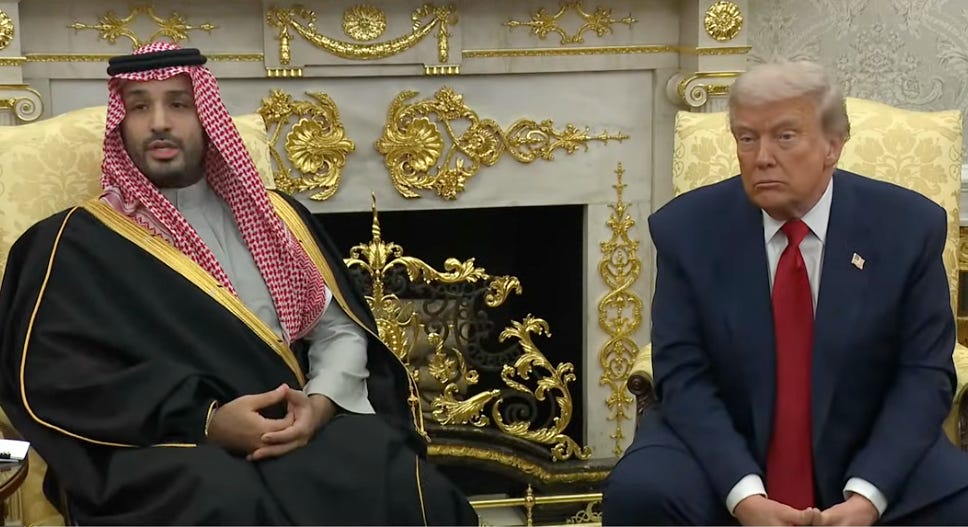
MBS declared that Saudi Arabia needs it all, AI, chips, magnets, every shiny object in the American industrial pantry, and that it will all come from the United States, which he glowingly described as “the most hottest country in the planet.” He unveiled figures with the gravitas of a man announcing a moon landing: $50 billion in short-term semiconductor consumption, “hundreds of billions” more over the long term. Beneath the flattery was the quiet part said at full volume: Saudi Arabia wants to anchor its entire emerging tech ecosystem to the United States, not China, because in Trump’s America, the Oval Office functions as a high-end showroom, one where geopolitical influence is best purchased through praise, promises, and, apparently, magnet talk.
GE’s David Romel was brought in like an impressed onlooker in a late-night infomercial, dutifully testifying to job creation in Greenville, SC. Trump interrupted only to remind everyone that he won that state by “record numbers.”
But the warm bathing in praise hit a snag when an ABC reporter asked the obvious questions: Isn’t it a conflict of interest for Trump’s family to do business in Saudi Arabia? And what about MBS’s involvement in the murder of a Washington Post journalist? The reaction was pure Trump theater. “Who are you with?” he demanded.
“ABC News,” the reporter replied.
“Fake news,” Trump snapped, before launching into a tirade that included calling the journalist “extremely controversial” and motioning to MBS, insisting “he knew nothing about it”, a line that would strain the patience of anyone with even a casual awareness of the CIA’s assessment.
MBS attempted to rescue the moment with his own version of damage control, explaining that bin Laden specifically chose Saudi hijackers on 9/11 to “destroy the American–Saudi relation,” and that criticizing the partnership is essentially helping al-Qaeda achieve its goals. It was a creative framing, if not precisely comforting.
The topic then turned to Syria, where Trump proudly announced he lifted sanctions at the request of MBS and Erdogan, praising Assad as a “strong guy” who is making “tremendous progress.” This was followed by a detour into why Trump refused to attend the G20 in South Africa (“their policies on the extermination of people are unacceptable”), which was apparently news to everyone including South Africa.
Asked whether selling F-35s to Saudi Arabia might undercut Israel’s legally guaranteed qualitative military edge, Trump responded with a kind of diplomatic shoulder-shrug, the verbal equivalent of tossing a grenade into a filing cabinet. “We’ll work it out,” he said, insisting that both Israel and Saudi Arabia deserve “top of the line” equipment, an answer that manages to satisfy no one and explain nothing, but does neatly preserve his personal policy of never committing to anything he might later need to deny.
MBS, sensing an opening, pivoted to the Abraham Accords with the finesse of a man who knows exactly which topics keep Trump in a state of blissful self-regard. Saudi Arabia, he said, “definitely” wants to join, but only with a “clear path to a two-state solution,” an actual diplomatic position buried inside a performance otherwise engineered to keep Trump smiling at himself on the inside.
And here’s the surreal part: Trump, a man who has never once supported a two-state solution, never endorsed it, never pursued it, and never allowed his administration to pretend otherwise, responded as though this were all completely fine, nodding along without acknowledging that he has spent years openly opposing the concept. He cheerfully announced that they had talked about “one state, two state,” as if he were listing ice cream flavors rather than the geopolitical outcome of a 75-year conflict.
MBS was making a real policy statement. Trump was making a noise. The two moments occupied the same room but not the same plane of reality.
Trump then recounted how he has “stopped eight wars,” which is impressive given the State Department, Pentagon, and basic timeline of reality belie that statement. He lamented that the Russia situation was taking “longer than I thought,” but assured the room that a solution is imminent.
The Fed got its moment too. Asked about the next Fed chair, Trump declared that Jerome Powell is “a fool” and “a stupid man,” adding that he’d fire him now but “people are holding me back.” He said he already knows his replacement, but “he won’t take the job,” because apparently the Treasury is more fun.
And then came the grenade: the Epstein files. The ABC reporter, now officially on Trump’s enemies list, asked why Trump doesn’t release them himself. Trump’s rage meter hit red. He called the Epstein files a “Democrat hoax,” declared he has “nothing to do with Epstein,” and rattled off the names of Democrats he claims Epstein funded, including Bill Clinton, Larry Summers, and Reid Hoffman, whom he labeled “a sleazebag.” ABC, he said, should have its license revoked because it is “97% negative to Trump,” an accusation that would sting if it wasn’t the result of his own behavior.
The meeting wound down with another long ode to the wonders of the Oval Office and its transformative power. Trump bragged that he is building a grand new White House ballroom (“all private money,” he promised repeatedly), partly because the East Room is too small to host all the people who apparently wanted to dine with MBS that evening. He suggested he would have asked the crown prince to chop a check on the spot if only foreign donations weren’t restricted. MBS nodded serenely, as though imagining himself underwriting the most garish ballroom in presidential history.
By the end, the message was clear: Trump considers the U.S.–Saudi relationship not just strong, but unbreakable; MBS considers Trump a vessel through which Saudi Arabia can secure its long-term tech ambitions; and the two men share a bond powered by flattery, mutually useful delusions, and trillion-dollar promises that may or may not survive contact with arithmetic.
As Trump concluded, “I don’t think our relationship could be better.”
After this performance of synchronized self-congratulation, it’s hard to disagree.
Excuse me while I wash off the stench.
With all that gassing and mutual fellatio, no wonder Trump never got around to complaining that Bin Salman wasn’t wearing a suit, the way he did with Zelenskyy.