


Valentine’s Day is a holiday designed to test your tolerance for narrative. Two people meet, sparks fly, obstacles emerge, and if the story is working, you are asked to believe that a handful of gestures can stand in for an entire relationship. American politics has become a similar genre, except instead of a bouquet and a reservation, we get a talking point and a microphone. And no one has played this better, longer, or with more devotion than Donald J. Trump, a man whose most stable long-term relationship is not with a policy platform or a party coalition or even a personal philosophy, it is with a lie.
Not a lie in the small, human sense. Not the “I’m five minutes away” lie, the “I read your email” lie, or the “this haircut was my idea” lie. Trump’s lies are built like commercial jingles. Short, sticky, and designed to be hummed. They show up in the same outfit. They do not ask questions. They do not grow. They do not evolve. They just return, again and again, like an ex who never learned to stop texting “u up?” at 2:13 a.m.
Valentine’s Day is perfect for this because it is a festival of public intimacy. People perform love outwardly, for an audience, with objects that say “look at us.” “Look how chosen I am, look how real this is.” Trump’s lies function the same way, they are not merely attempts to persuade, they are attempts to bond. They let his audience feel like insiders, like they are in on something other people refuse to admit. They are less arguments than relationship status updates. It’s complicated.
So, let’s make it official. Trump and Lies are together, they are posting, they are tagged. He is the kind of boyfriend who brings her up in every conversation, even when nobody asked. She is the kind of girlfriend who never has to change her look because nostalgia is her skincare routine. Call her Lady Lie.
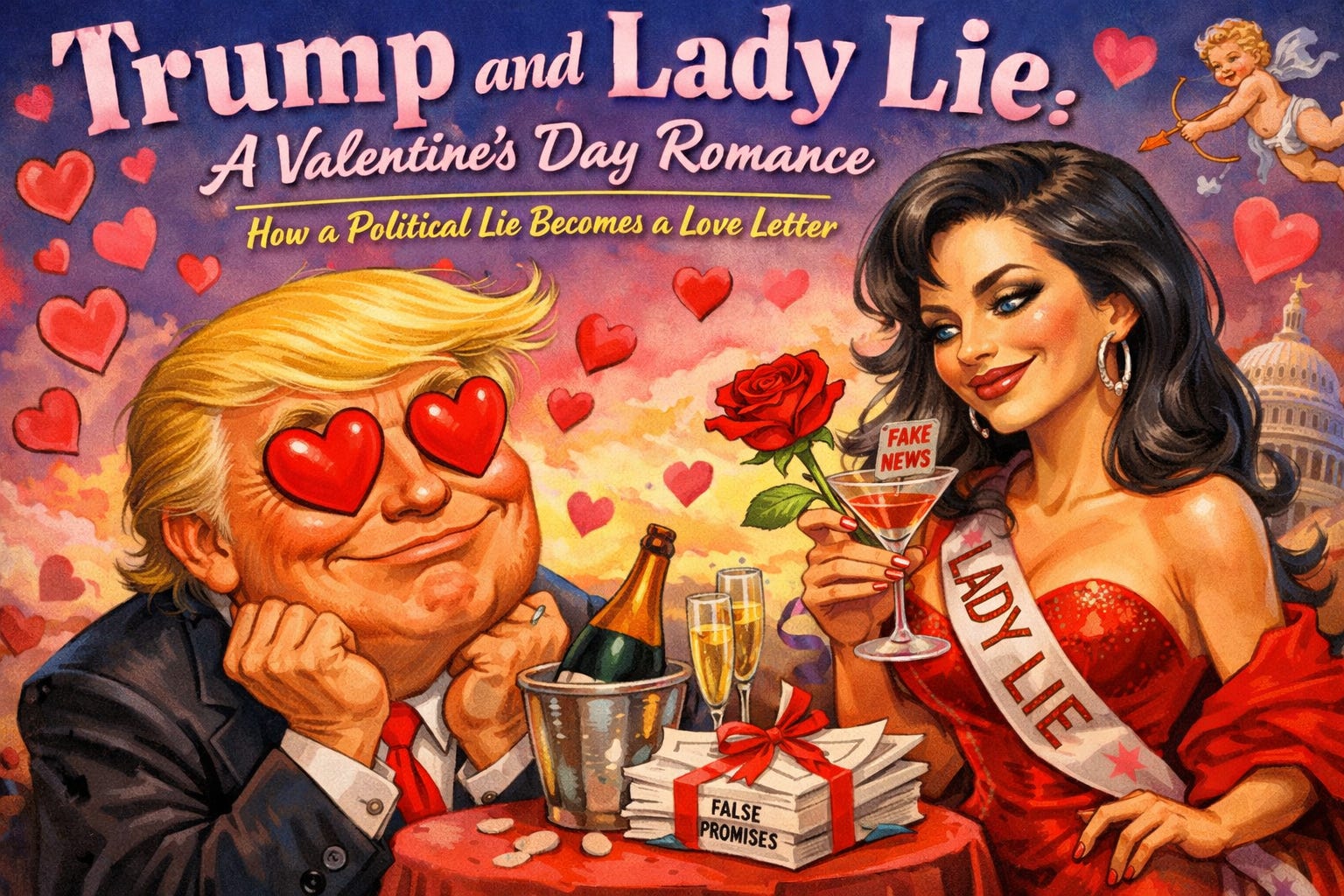
He adores her because she is easy to take out in public. She does not require a plan, she does not require a policy, she requires a line that fits on a sign, a hat, a chyron. She is always ready for a photo. She loves a crowd, she loves a “some people are saying,” and she loves a long, intense stare into the camera like it is the honeymoon suite.
The question is not whether the relationship is healthy, but rather what makes it last.
The seduction is not that the lie is sophisticated, it is that it is affectionate. A good political lie does two things at once, it flatters you and it gives you someone else to blame, and it tells you; you are right to feel how you feel, and that the reason you feel that way is that they did something to you. It is emotional outsourcing, you hand over your confusion, your anger, your sense that the world is tilted, and you get back a packaged explanation with a ribbon on it. The ribbon is the best part, the ribbon is the point.
Trump keeps closest the lies that travel well, the ones that can be repeated in any setting and survive any reality. They do not need facts, they need vibe. Lady Lie is low maintenance, she never asks him to define terms, she never asks him to slow down and be precise. She never sends the dreaded text, “Can you explain what you mean by that.”
This is why the economy is such a reliable first date. The economy already lives halfway in the nervous system. Your grocery bill is real, your rent is real, your paycheck is real. But the story you tell about those realities is elastic. It can be tightened or loosened depending on what you want to feel, and who you want to blame. Trump’s signature move is to collapse the complexity of a giant system into a single romantic line, “I can fix it.” Or, even better, “I already did.”
This is how you get claims like inflation being “stopped,” a statement that is easy to disprove because inflation is measured over time and does not simply stop like a microwave timer. Even when inflation cools, that does not mean prices reverse, it means they rise more slowly. Fact checkers have flagged the literal “inflation is stopped” style rhetoric as false, even in moments when inflation has eased. But the point is not precision, it’s reassurance. It is the political equivalent of someone saying “Babe, I’ve changed,” while still doing the same three things that made you cry last week.
Then there is the claim that energy costs are down, another line that sounds plausible because energy prices move, often dramatically, but becomes misleading when it is treated as a sweeping, stable condition. Some costs do not cooperate with the narrative, and the truth is not a single arrow. It is a mess of regional prices, timeframes, and tradeoffs. But Lady Lie likes her stories like she likes her Valentine chocolate boxes. Assorted, glossy, and labeled so you do not have to think too hard before you bite.
Trump’s economic storytelling also loves big number romance, the kind where you are told the relationship is serious because the gestures are huge. He reaches for figures so large they feel like a bouquet you cannot hold with two hands. The “$18 trillion in new investment” line is a good example, challenged by fact checking organizations that note the number does not match what official materials supported, and that much of what gets counted in these totals are announcements or aspirations rather than completed investments. This is engagement ring math, counting “we should totally get married someday” as “married.”
He also loves credit taking by collage. A factory opens, a company expands, or a town gets a ribbon cutting and suddenly Lady Lie is at the event in a heart shaped frame, insisting the whole thing happened because of her boyfriend’s aura. Fact checkers have flagged the mismatch as part of the pattern. The specific can be true while the sweeping conclusion remains misleading. It is the difference between a sweet text and a stable pattern. Not “did he do one nice thing,” but “is this what he does.”
The pattern is that Trump’s economic lies are designed to feel like certainty in a system that rarely offers it. They do not need to explain how inflation works or why prices behave the way they do, they just need to offer the emotional relief of a single sentence. And like the best bad relationships, the sentence keeps working because it contains a grain of truth. The economy has been weird, and people feel squeezed. Lady Lie simply takes that feeling and tells you exactly where to point it.
Then every romance needs a scandal, because this is America and we cannot have intimacy without a plot twist. Enter Epstein, which functions less like a policy argument and more like a fever dream the entire country keeps half remembering. Epstein misinformation thrives because the underlying story is already about power, sex, money, and the protected class. People come to it preloaded with justified anger and a desire for accountability. In that environment, the line between “unanswered questions” and “anything goes” gets thin, fast.
Trump’s move in this ecosystem is often to convert a complicated set of real documents, real crimes, and real failures into a political weapon, and then, when convenient, to set the whole thing on fire and say the ashes are a hoax. One especially stark example is the claim that the Epstein files were “made up” by political enemies, which PolitiFact treated as wildly false and baseless. This is the classic messy situationship tactic. If you heard something about me, it was planted. It is not an argument, it is a demand for loyalty. It is “do you believe me or your own eyes,” said softly, over dinner, while the check is already on the table.
The “client list” mythology is where Lady Lie really shines, because it is less a single claim than an entire universe of expectation. There is a pervasive belief that there must be a definitive list of powerful “clients,” a document that would provide the clean catharsis of a final reveal. But reporting has noted that law enforcement has disputed the existence of such a list as popularly imagined, and coverage has described official statements saying there is no “client list” to release. This is what conspiracy culture does, it turns absence into evidence, it turns disappointment into fuel. It is a perpetual motion machine that runs on the promise of one more drop, one more leak, one more unredacted page. The point is the feeling, we know something they do not want us to know.
Then comes the status part of the relationship, the part where the couple wants to look powerful in photos. “America is feared again.” Fear is not a statistic, it is a mood, so it is harder to fact check directly. But you can break the mood into the smaller repeated sub claims Trump uses as evidence, and NATO is one of his most durable props.
Trump frames NATO as a protection racket where the U.S. pays the bills and everyone else freeloads until he shows up and shakes them down. Fact checks have repeatedly explained that this mischaracterizes how NATO funding works, conflating NATO’s common budgets with member nations’ separate defense spending targets. The romance logic embedded in this lie is simple, “we were being laughed at, I threatened people, now they respect us.” It is a story of dominance as love, a story that equates fear with admiration and treats volatility as strength. It plays well in a culture where masculinity is often defined as being unbothered by consequences.
But what does “feared” mean in practice, often it means allies are uncertain. It means alliances become transactional; it means diplomacy becomes a hostage negotiation. It means everyone is smiling while quietly checking the exits. The funny, clinical truth is that if you have to announce that everyone respects you, you might be confusing respect with silence. Fear is not love, fear is compliance, fear is avoidance, fear is “sure, whatever you want,” said quickly.
Now you can see the design, like a Valentine’s Day gift bag stuffed with emotional necessities. The economy offers reassurance, Epstein offers heat, “Feared again” offers status. Together they cover the basics, safety, excitement, and prestige. The lies do not just persuade, they soothe, they validate, and they give your feelings a plot. That is also why fact checks matter but do not always land like you want them to. A fact check is a receipt, but a lie is a love letter, and love letters do not disappear because you show someone the credit card statement.
And this is where the lackeys matter, not because they are geniuses, but because they are amplifiers. They launder a claim into a meme, into a slogan, into “everybody knows.” Once a lie becomes shared language, it turns into a social object. It is not just a statement, it is a handshake, a way to signal membership. It is how you make a crowd feel like a couple.
There is a phrase people use about relationships. “When someone shows you who they are, believe them.” Trump has shown us who he is, over and over, in the claims he cannot quit. He returns to the same narratives because they do what he needs them to do. They cast him as the hero who fixes what others “destroyed.” They turn complexity into moral melodrama and convert public life into an intimate story where you and he are on one side and they are on the other.
Lies are the easiest way to produce intimacy at scale, they are shortcuts to belonging, how you make politics feel personal, and how you make the personal feel like politics. Which is why Valentine’s Day is not just a gimmick here, but a mirror. A holiday built on ritual and performance is the perfect time to talk about a political figure whose power rests on ritual and performance. Flowers are expensive, sure, but they are cheaper than accountability. A prix fixe menu is annoying, sure, but it is less annoying than living in a reality where “truth” is whatever your favorite man says it is.
So, this Valentine’s, maybe the real question is not whether Trump is lying. We know that the question is why the lie keeps getting our attention in the first place, and why so many people keep mistaking that attention for devotion. Because the scariest part of Trump’s love story with Lady Lie is not that he tells her he loves her. It is that for millions of Americans, the lies sometimes feel like somebody finally said “I love you” back.
Spectacular column!
As long as his lips are moving . . .