


At a Halloween party at Mar-a-Lago on Saturday, a reporter asked Donald Trump about the $50 million contract his former lawyer, Alina Habba Mildon, signed with the family of a Venezuelan billionaire who wanted a pardon. The billionaire, Julio Herrera Velutini, got one a few weeks after she started work. Trump called her deal “totally obnoxious and outrageous.”
It was the most revealing thing he said all night, though not for the reason he intended.
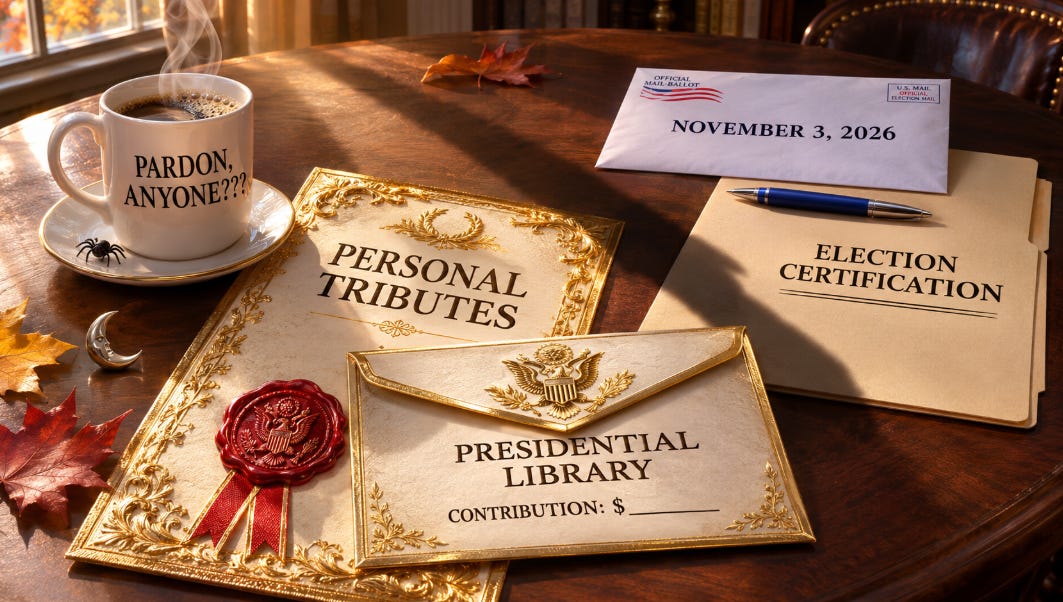
“I told her, and I said, ‘I don’t want her paid,’” Trump explained. Then he added that “we had somebody speak to the people that did it.” Asked whether Habba should make a donation to his presidential library, he said probably not her, but “maybe the people” might. The people, in this case, are the Herrera family.
The New York Times reported that when Trump first read about the contract, his reaction was that Habba should hand some of the money over to his future library or another Trump entity.
Presidents have every reason to object when someone profits from access to their pardon power. What they are not supposed to have is a personal claim on the proceeds. Trump spoke as though he had one. Trump had several. He had already instructed Habba on her private compensation. Someone acting for him had contacted the family of a man he pardoned. And he had even suggested a destination for some of the proceeds, an institution bearing his name.
Trump offered no explanation of why Herrera deserved his pardon. He had considerably more to say about who should receive the money.
The path to that pardon was not subtle. Herrera faced felony bribery charges, then struck an unusually lenient plea to a misdemeanor campaign finance violation. His daughter gave $3.5 million to a pro-Trump super PAC. Her company then hired Habba as general counsel at $10 million a year, while Habba was still a senior adviser at the Justice Department. Habba started on January 1. The full and unconditional pardon arrived weeks later.
Habba says she played no role in obtaining the pardon, and the pardon stands. Trump objected to the size of her fee and the relationship she used to secure it. But he also suggested that some of the money might find its way to his presidential library. In the peculiar economy of Trumptithe, the cardinal sin isn’t necessarily collecting the fee. Habba’s offense was pocketing the tithe.
A man who believes the proceeds of a pardon belong to him may believe the same about an election. Harvard’s Larry Tribe put it plainly to the Financial Times this week: for Trump, there are only elections he wins and elections that are stolen. Results, like pardon fees, are presumed to be his. When they go elsewhere, someone has taken something.
And the polls suggest that Tuesday could produce considerable disappointment. Trump’s approval is in the 30s. The Cook Political Report projects substantial Democratic gains in the House, with control of the Senate also in contention. Democrats lead the governor’s races in Wisconsin, Michigan, Arizona and Iowa. Trump is spending the final Sunday of the campaign in Iowa and Kansas, two states where Republicans are fighting unexpectedly competitive Senate races. Both appearances were canceled on Thursday, then hastily reinstated on Friday.
The voters haven’t finished speaking, but the Justice Department has already been busy. In the event Trump is unhappy with an unfavorable result, what has his government already set in motion to challenge one?
The Washington Post reported Saturday that the Justice Department has spent the campaign’s closing days filing lawsuits and opening investigations designed to keep disputes alive well past Election Day. The administration has repeatedly lost its attempts to intervene in the count. But losing in court doesn’t necessarily end an investigation, and litigation can continue long after voters have made their choices.
In California, the department sued to block the counting of ballots from 20,930 voters it says may be noncitizens, using a list that election officials warned was riddled with errors. An analysis by UCLA’s Voting Rights Project found that 8,880 names, 42 percent of the list, didn’t match anyone on the state’s current voter rolls. At least 22 were confirmed U.S. citizens. The Justice Department disputes the findings. It nevertheless warned county officials they could be charged with aiding and abetting illegal voting if they counted the disputed ballots. A federal grand jury has since subpoenaed Los Angeles County officials’ emails and texts about how they handled the department’s demands.
The department lost three times in one week. U.S. District Judge David O. Carter found the plan would likely violate the Voting Rights Act, the Civil Rights Act and the National Voter Registration Act, and told department lawyers that threats against election workers should cease immediately. The Ninth Circuit rejected the department’s emergency request, 2-1, finding it had failed to justify an intervention that risked disenfranchising eligible voters and disrupting the count. A judge in San Francisco then barred the department from threatening to prosecute election workers who simply do their jobs.
In Alaska, the approach is more inventive. The department has sued to stop the state from certifying the Senate result if Democrat Mary Peltola wins, arguing that voters may have been confused by the two Dan Sullivans on the ballot. On Friday it asked a judge to segregate some ballots. Its legal theory rests on a line from the introduction to the National Voter Registration Act, a law about registering voters, not certifying winners. Alaska’s lawyers called it a limitless grant of authority for federal interference. If a court accepts it in Alaska, it can be used anywhere.
On Thursday, the department sent letters to election administrators in all 50 states, signed by acting Deputy Attorney General Trent McCotter, reminding them of their existing legal obligation to preserve election records for 22 months. The letters also warned of criminal prosecution for failing to comply. The preservation requirement was nothing new. The nationwide warning, issued days before the election amid an expanding series of investigations and threats against election officials, was another matter.
The department’s record in court is dismal. It sued 30 states and Washington, D.C., for their voter rolls and has lost all 27 cases decided so far.
Sometimes, allegations are all that matters. On Saturday, Trump complained that his Justice Department had identified 20,000 potentially fraudulent votes in California, perhaps hundreds of thousands or even millions, only to have the courts rule against it. What the department had actually identified were suspected noncitizens, not proven fraudulent votes. And an independent analysis had already found serious problems with the list.
The distinction didn’t survive Trump’s telling.
The courts have refused to give his administration control over California’s ballot counting. Trump has already turned that refusal into another claim about election fraud.
Trump supplied the narration himself on Saturday. Asked about the second Dan Sullivan, a retired Petersburg teacher who won 2.5 percent of the primary vote, Trump called his candidacy “voter fraud at the highest level.” He said Sullivan “knows he’s guilty,” and that Chuck Schumer and Democratic election lawyer Marc Elias “should be held criminally responsible.”
There is a real controversy underneath this. Alaska’s election director found that Dan J. Sullivan had tried at one point to list his middle initial as “S,” the incumbent’s initial, and concluded that his candidacy was intended to confuse voters. The Times reported this week that operatives connected to Peltola’s campaign were involved in recruiting him, which Peltola denies. Alaska’s courts nonetheless ordered him onto the ballot, finding that the state had imposed a candidacy requirement unsupported by law. Nothing reported so far connects Schumer or Elias to the recruitment effort.
The sudden concern about political manipulation is worth examining against the larger campaign. At Trump’s urging, Texas Republicans redrew their congressional districts last year to create as many as five additional Republican-friendly seats. Republican-controlled legislatures in Florida, North Carolina and Tennessee followed with maps designed to improve their party’s prospects. Ohio adopted another Republican-favoring map. Democrats retaliated in California, where voters approved new districts intended to deliver as many as five additional Democratic seats. Across the country, politicians have been redrawing the electoral playing field in the middle of a decade, without waiting for another census. These changes concern House races, not Alaska’s Senate election, but they illustrate how thoroughly partisan advantage has become part of election administration.
In Alaska, the approach was more inventive, and on Sunday it collapsed. The department had sued to stop the state from certifying the Senate result if Democrat Mary Peltola wins, arguing that voters might have been confused by the two Dan Sullivans on the ballot. Its legal theory rested on a line from the preamble of the National Voter Registration Act, a law about registering voters, not certifying winners. U.S. District Judge Sharon Gleason ruled that the federal government had no standing to bring the case, and that the order it wanted would likely violate Alaskans’ right to a secret ballot. The department never explained how it would investigate voters’ intentions without finding out how they voted. Gleason called that silence “telling.” An appeal is expected.
Trump, for his part, has said he ordered the lawsuit himself. That is worth sitting with: the president personally directed his Justice Department to sue a state to hold up an election result, in a race his party might lose, before a single ballot was counted.
The dismissal may matter less than it seems, because the Alaska fight has moved somewhere a federal judge can’t easily reach. Republican Gov. Mike Dunleavy has ordered a state investigation into the Sullivan candidacy and said on Oct. 30 that if wrongdoing turns up, certification could be stopped or changed. Meanwhile the Republican incumbent, Sen. Dan Sullivan, told CNN on Sunday that he would accept the results, win or lose. The candidate is prepared to concede. The president and the governor are keeping their options open.
This week federal prosecutors issued dozens of subpoenas investigating how the second Sullivan’s candidacy began, and a department official said they were examining possible civil rights conspiracy charges. Three days before the vote, Trump went on camera to declare one man guilty and suggest two others should be prosecuted.
And on Sunday, U.S. District Judge Sharon Gleason dismissed the Justice Department’s attempt to block certification of an unfavorable Senate result. She found no workable way to segregate the disputed ballots and investigate voters’ intentions without compromising their right to a secret ballot. The state, not the federal executive branch, is responsible for administering the election.
The criminal investigation remains open. Trump has already announced who he thinks belongs in the dock.
Ian Bassin, who runs Protect Democracy, told the FT’s Edward Luce that Trump’s approach to elections runs in three stages: deceive, disrupt and deny.
Deception is the easy part, and it is already underway. Disruption keeps running into walls. Courts have rejected the Justice Department’s demands for state voter rolls. The Supreme Court left in place an injunction blocking new Postal Service restrictions on election mail. Even the Republican-controlled Senate refused to advance the SAVE America Act, despite its passage in the House. The framers, as Bassin notes, gave the president no role in running elections, and judges keep reading the Constitution as though they meant it.
That leaves denial, and January 3 is a date worth circling. That’s when the new Congress takes office, and Luce examines a scenario that worries some constitutional lawyers: if enough Democratic House victories remain disputed, could Republicans prevent those members from being seated and thereby obstruct an incoming Democratic majority?
House Speaker Mike Johnson has supplied some interesting material for that discussion. Asked in June to substantiate suspicions about California’s elections, he suggested that some manipulation was so sophisticated it was impossible to prove, adding that people instinctively knew something was wrong.
It is an unusual standard of evidence for someone charged with upholding the law. In most legal proceedings, the inability to prove an allegation is a reason not to act on it. Johnson appeared to regard it as grounds for continued suspicion.
But Johnson has also promised that state-certified winners will be sworn in on January 3, regardless of whether he likes the results. And the constitutional barriers are real. The outgoing House expires that day, the incoming House elects its own speaker, and the clerk is legally required to recognize properly certified winners. A departing speaker cannot simply decide which members of the new Congress deserve their seats.
There is a difference between creating a constitutional crisis and successfully overturning an election. The first requires people willing to challenge established procedures. The second requires overcoming the courts, the statutes governing certification and the authority of the newly elected House itself.
Those safeguards deserve more attention than they’ve been getting. So do the efforts to test them.
And there is another potential crisis approaching on the same calendar.
The Associated Press reported Wednesday that U.S. officials had warned Middle Eastern allies to prepare for possible renewed strikes against Iran after the midterms, along with retaliation against energy facilities and other infrastructure. Trump has repeatedly suggested military operations could resume after November 3. Asked Saturday whether he expected to return to war this week, he called the question stupid and declined to answer.
Americans could be watching disputed election results, battles over certification and renewed military operations in the Middle East unfold during the same weeks.
Nobody needs to invent a conspiracy for those timelines to collide.
The question everyone asks is whether Trump will accept Tuesday’s results. Perhaps the more revealing question is whether he accepts that those results belong to the voters rather than to him. Saturday offered an interesting glimpse of how he approaches that distinction.
Habba Mildon secured an extraordinary contract with the family of a man Trump later pardoned. Trump objected to her compensation, told her he didn’t want her paid, acknowledged that someone on his side had spoken to the people responsible, and entertained the possibility of a contribution to his presidential library. None of that proves the pardon was sold. But he spoke as though money changing hands between other people was his to supervise.
On Tuesday, tens of millions of Americans will make decisions of their own. If the results go against him, will Trump treat them as the voters’ choice or as something taken from him? His Justice Department has already filed lawsuits, issued subpoenas and opened investigations that could keep disputes alive long after the ballots are counted.
The courts have repeatedly reminded his administration that elections belong to the states and their voters. The president has no personal claim on the outcome.
Votes are not tribute. And the American electorate owes him no tithe.
Before we leave Halloween behind, a few more treats from Mar-a-Lago, where Donald Trump attended Saturday night’s costume party dressed as Donald Trump. His wealthy guests had spent hours getting ready, he explained. He had only ten minutes, so he put on a red tie.
Asked about the $6.3 billion Binance cryptocurrency theft, Trump said he wasn’t concerned and that “we don’t know if it’s North Korea.” His own FBI issued a public alert the same day attributing the theft to North Korea’s TraderTraitor hackers.
There was Nvidia CEO Jensen Huang, whose close associate was identified by American intelligence as a suspected Chinese intelligence asset. Trump said he didn’t know about the specifics and hoped Huang would be okay. The New York Times reported Thursday that Trump had been briefed on the intelligence roughly a year ago and chose not to act.
On Iran, Trump insisted the United States had knocked out its nuclear program, although there were still “one or two sites” to take care of, including Pickaxe Mountain. No problem. That would take ten minutes. Ten minutes is enough time to dress as Donald Trump or launch another military operation. The nuclear program that was previously “obliterated” seems to have come back to life on All Hallow’s Eve.
He also announced that gangs in Haiti had killed some of Salvadoran President Nayib Bukele’s people. Four Salvadoran aviation technicians are indeed missing, but their deaths have not been confirmed, and Bukele previously disputed reports that recovered remains belonged to them. Trump’s diplomatic advice to Bukele was straightforward: “You have to do what you have to do.”
Flávio Bolsonaro can stay in Florida as long as he wants, Trump announced. Bolsonaro arrived in Miami after a Brazilian court ordered him to surrender his passport following his defeat in the presidential election. Trump called the election, which Bolsonaro lost by 3.58 percentage points, a disgrace. The welcome mat remains out for defeated candidates who dispute the results.
Back home, Trump called Michigan Democratic Senate nominee Abdul El-Sayed a jihadist who hates Black and Jewish people, then described Florida Democratic Senate nominee Angie Nixon as a “very low IQ person.”
As for his proposed triumphal arch near Arlington National Cemetery, Trump assured reporters that his opponents had lost every lawsuit. The District of Columbia and Virginia had filed their lawsuit that very day. Arlington County had sued three weeks earlier, and a federal judge had ordered the administration to give 48 hours’ notice before beginning construction. The lawsuits have been defeated before the judges finished hearing them.
Finally, Trump said he would have no problem inviting Ukrainian President Volodymyr Zelenskyy to December’s G20 summit, to which Vladimir Putin has already been invited. The gathering will take place at Trump National Doral, the president’s own Florida resort.
The president then returned to his Halloween festivities, having addressed a multibillion-dollar cyberattack, Chinese espionage, Iranian nuclear facilities, missing Salvadoran personnel, Brazil’s election, two American Senate candidates, federal litigation and the war in Ukraine.
All in eleven minutes.
On a personal note, I am learning that temporary tattoos are more tenacious than their name implies. It may be days before I get these spiders and moons and stars off my face.
The lower courts reject his lawsuits, the circuit courts throw them out, but the real question is what will the SCOTUS do? Aye, there's the rub.
Re the facial tattoos: pix, please. 🤣