

Some days the news feels less like a series of separate events and more like one long argument about who gets protected, who gets blamed, who gets billed, and who gets told to wait on hold while the people in charge rearrange the furniture. Today is one of those days.
In politics, Trump is at the G7, which means the world’s most heavily briefed diplomats are once again trying to conduct global affairs while factoring in the emotional weather patterns of one very confident man with a microphone. Iran, Ukraine, Russian oil, sanctions, ceasefires, and global markets are all on the table, and somewhere, surely, a translator is wondering whether “we’ll see what happens” counts as foreign policy.
Trump is now saying he “never cared” about regime change in Iran, which is the kind of line that would be more convincing if his entire political career didn’t have the energy of a man trying to replace the manager of every room he enters. The tentative Iran arrangement is being described as a step toward stability, although the details still seem to be arriving in that familiar fog where everyone is told the deal is historic before anyone is allowed to read the fine print.
Russia’s war in Ukraine is also back at the center of the G7 conversation, because the rest of the world has this inconvenient habit of continuing to exist even when American politics would prefer to focus entirely on itself. Trump is signaling that sanctions on Russian oil could return now that the Strait of Hormuz has reopened, which leaves diplomats, markets, and oil traders doing the same little calculation they always do in moments like this, which is trying to figure out where policy ends and performance begins.
At home, the voting-rights fight is heating up again, because apparently American democracy was getting a little too accessible and someone decided the cure was more paperwork. The administration’s executive order targeting mail voting is facing legal challenges, with critics warning about “mass disenfranchisement,” which is one of those phrases that sounds formal until you remember it means real people showing up to participate in their own country and being told the door has developed new feelings about them.
This is always the trick with voting restrictions. They arrive dressed as maintenance, security, modernization, or administrative tidying, but somehow the broom always sweeps in the same direction. The danger is never described as the voter who works two jobs, or the elderly person mailing a ballot, or the disabled person trying to avoid a four-hour line, but as some shadowy menace just vague enough to justify making the system colder.
Then there is education, where the administration is moving special education oversight toward Health and Human Services and civil-rights enforcement toward the Justice Department, which is being sold as efficiency because every great American reshuffling begins with someone insisting the boxes are labeled better now. For families of disabled students, and for anyone who has ever had to fight a school district for services their child was already legally owed, this isn’t some distant bureaucratic adjustment. It’s the difference between a right you can enforce and a right you can spend your life trying to locate.
In health care, the story is even more direct, and much harder to laugh at for long. Medicaid work requirements are moving forward with the usual language about responsibility and accountability, which sounds tidy until it runs into the reality of poverty, illness, caregiving, unstable hours, broken websites, missing notices, and the general American tradition of making the hardest parts of life require the most documentation.
Child enrollment in Medicaid and CHIP has already dropped by about 1.5 million between January 2025 and January 2026, according to Georgetown’s Center for Children and Families, and that number shouldn’t drift past us like another statistic in another bad week. Children don’t lose health coverage in theory. They lose checkups, inhalers, dental care, antibiotics, therapy, referrals, hearing tests, and the small but holy assurance that when something goes wrong in their body, someone might be able to help.
The language around these cuts will be calm, because cruelty has learned to wear a cardigan. It will talk about eligibility, compliance, verification, redeterminations, and administrative alignment, when what it really means is that a parent will sit at a kitchen table after work, trying to prove something the state already knows, while a child coughs from the next room and the richest country on earth asks whether the cough has submitted the proper form.
Measles is also back in the headlines, which would be darkly absurd if it weren’t so preventable. The CDC has reported more than 2,000 confirmed cases across 40 jurisdictions, meaning a disease the country once pushed to the margins has been handed a comeback tour by misinformation, political cowardice, and the exhausting belief that expertise is just elitism with a clipboard.
Meanwhile, ACOG has released its own maternal immunization schedule, recommending vaccines including flu, COVID-19, Tdap, and RSV during pregnancy, while describing the guidance as “evidence-based vaccine recommendations.” That phrase shouldn’t feel brave, but here we are, living in a time when evidence sometimes has to knock twice and bring backup.
The heart of this is simple. Pregnant people shouldn’t have to sort through political theater to find medical care, babies shouldn’t be drafted into culture-war experiments before they can hold up their own heads, and public health shouldn’t have to keep reintroducing itself like a dinner guest nobody wants to admit they invited.
And then there is climate, where the planet has once again chosen not to respect anyone’s messaging strategy. NOAA says El Niño has formed and is expected to strengthen, with forecasters warning that it could become very strong, which is the scientific way of saying the ocean has entered the chat and it didn’t come to compliment our leadership.
El Niño doesn’t mean the same thing everywhere, because the atmosphere is complicated and, unlike certain people, doesn’t pretend otherwise. It can shift the odds toward more intense heat, floods, droughts, storms, fires, crop disruptions, and expensive surprises, all layered on top of a warming climate that keeps making old risks more aggressive. Climate change doesn’t invent every disaster from scratch, but it does keep handing the weather a bigger amplifier.
At the same time, the Trump EPA is reportedly moving to weaken methane restrictions on low-producing oil and gas wells, including wells that release large amounts of methane. ProPublica reports that oil billionaire and Trump donor Jeffery Hildebrand could benefit from the rollback, which is one of those sentences that feels almost too neat, like corruption hired a screenwriter and then told him to be less subtle.
There is something revealing about a country that demands endless proof from a child on Medicaid but offers endless patience to a leaking oil well. A family has to verify, reverify, appeal, upload, wait, call, and hope. An industry donor gets a regulatory conversation about flexibility. One side gets a portal password. The other side gets a meeting.
Wildfire season is active too, with large fires burning and thousands of personnel assigned around the country. The numbers matter, but they can also flatten the human part, so it is worth remembering that every acre burned is somewhere someone loved, every evacuation is a family moving through fear with whatever they could grab, and every firefighter is a person walking toward the thing everyone else has been told to escape.
The ballot box, the classroom, the doctor’s office, the maternity ward, the oil field, the fire line, and the warming Pacific are all telling versions of the same story. Systems built on denial eventually become systems built on sacrifice, and the sacrifice almost never begins with the people who designed the system.
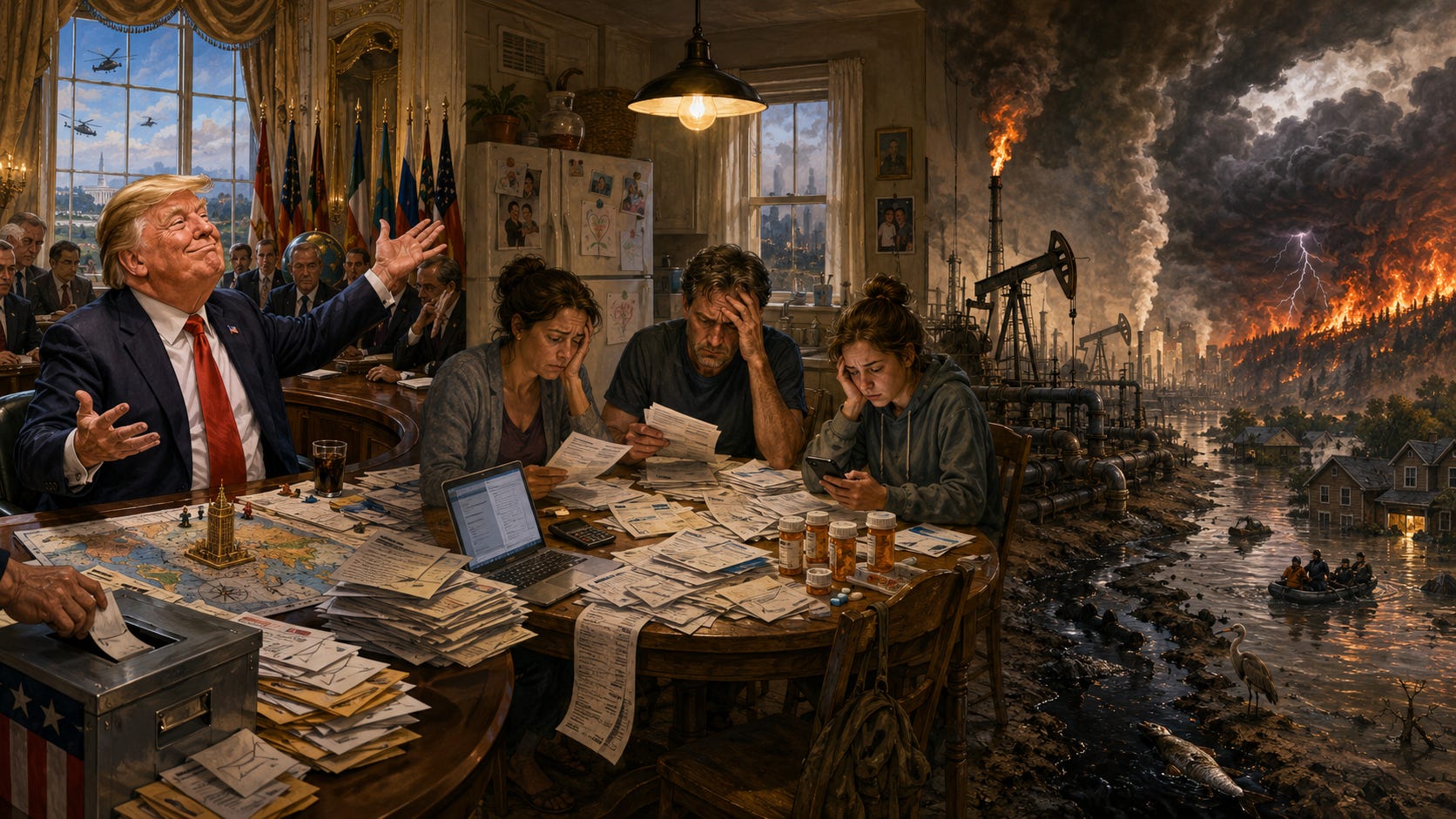
It begins with children, sick people, disabled people, pregnant people, workers, firefighters, poor families, future generations, and anyone who doesn’t have a lobbyist waiting nearby with bottled water and a folder full of exemptions.
Still, there is clarity in days like this. When the mask slips this often, nobody has to wonder what the argument is anymore. One vision says voting should be harder, care should be narrower, science should be optional, pollution should be profitable, and the weather should somehow learn to be more reasonable.
The rest of us are allowed to answer in plain language, with our ballots, our voices, our bodies, our grief, our humor, and our stubborn little insistence on a future where the children get doctors before the oil wells get loopholes.
“One vision says voting should be harder, care should be narrower, science should be optional, pollution should be profitable, and the weather should somehow learn to be more reasonable.”
I’ll go to my grave wondering what upbringing produced persons who share this vision for themselves and their children - so are anti-democracy, anti-science and the scientific method of proof based on evidence, and indifferent to environmental toxins and deadly climate changes.
What is the fear? The goal? The ideology? Whatever it is, they are co-conspirators in the erosion of government of, by and for the people; the undoing of public health safeguards; and worsening threats to quality of life and all living things.
Shanley translates professional political class jargon into the real world costs the class imposes on working families like a boss.