


Good morning! This week at the United Nations, Donald Trump summed up his Venezuela policy with admirable economy: “To the victor belong the spoils.” No humanitarian garnish, just the logic of a privateer who has discovered the teleprompter.
Days later, Norway’s foreign minister, Espen Barth Eide, stood before the same General Assembly and began somewhere very different.
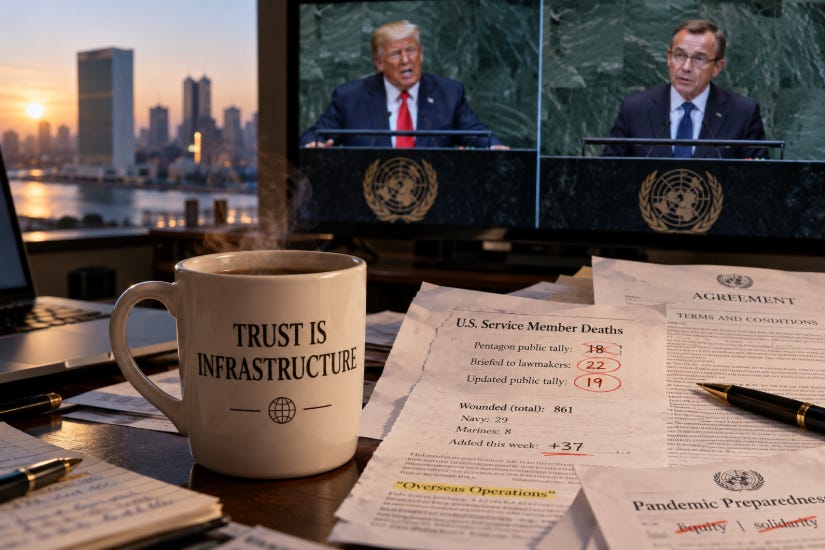
“The old world is dying and the new world struggles to be born. Now is the time of monsters.”
The words, Eide explained, stem from the Italian philosopher Antonio Gramsci (in their popular rendering), written from one of Mussolini’s prison cells during another period of insecurity, collapsing hegemonies and political upheaval. Gramsci had reason to worry. That era ended in catastrophe and, eventually, in the construction of institutions intended to keep raw power from becoming the only rule that mattered. International law, Eide argued, isn’t charity for the weak; it’s a common investment that lowers risk, friction and cost for everyone, great powers included.
Those two speeches frame a question worth sitting with this Saturday. Power can still compel, but what happens when the people across the table, and the citizens back home, stop believing what they’re told?
Start with Trump’s own example. In August he unveiled the Venezuelan oil arrangement as “the biggest oil deal in world history,” a specimen of what the Lords and Serfs Dictionary calls Trumperbole. The Guardian spent the following weeks reading the fine print, and the fine print declines to cooperate.
Venezuelan law, according to legal experts cited by the paper, does not permit 100-year oil concessions; Venezuela itself says the arrangement runs for 25 years. The Pentagon’s supposed 35 percent ownership position was described to lawmakers as warrants: rights to purchase shares, rather than shares already owned. And questions remain about which Pentagon office even possesses the legal authority to hold such an interest.
The administration continues to defend the agreement as a historic opportunity. But an announcement is not the same thing as an enduring arrangement, and that is precisely the distinction worth making.
Former diplomat John Feeley compared the whole thing to the wall Mexico was going to pay for. Apparently even the spoils come with terms and conditions.
Credibility isn’t only an export product. This week the Pentagon’s public casualty tally for the Iran war quietly grew by 37 wounded, 29 Navy sailors and eight Marines, bringing the total to 861. The database doesn’t say when or how they were hurt. More than half of those wounded are now filed under the obscure ‘Overseas Operations’ rather than the war’s own name, a category used since the July ceasefire, which later collapsed. A war the administration prefers not to call a war is keeping its casualties off the war ledger, too.
The Post reported the previous week that six U.S. officials familiar with internal Pentagon casualty accounting said more American service members had died in the Middle East during the Iran conflict than appeared in the public database. Five of those officials said the actual number was at least 22 when the publicly reported figure stood at 18. The public tally has since risen to 19 after another death was recorded, but the larger discrepancy has not been publicly resolved.
Rep. Jason Crow, who heard the higher figure from briefers on Capitol Hill, has now introduced a bill requiring the president to disclose how many troops have been killed and wounded. That such a bill has to exist tells you where we are.
When citizens have to keep refreshing a government website to learn what a war is costing their sons and daughters, the trust problem is already inside the house.
Iran is where leverage and trust part company, and honesty requires admitting that leverage has its uses. Ali Ansari of the University of St Andrews told LBC this week that he thinks the balance has tilted toward Washington. The Navy is shepherding more tankers out of Hormuz than most people realize, and Ansari said Iranian economists are estimating their economy has shrunk about 10% in six months.
If your opponent genuinely believes you may do something extreme, erratic or disproportionately expensive tomorrow, that possibility has to be priced into whatever decision he makes today.
Ansari effectively acknowledges that advantage. But then he identifies its cost.
Iran, he says, is accustomed to Western interlocutors who operate within recognizable rules. With Trump, Tehran confronts someone Ansari describes as “completely unreliable, completely unpredictable.” Iranian leaders therefore have to recalibrate because they cannot assume the old diplomatic rulebook applies.
Iran has now offered to reopen the strait within seven days, with its old conditions attached, and the Wall Street Journal reports Trump has turned it down. Sir Robin Niblett, former director of Chatham House, explained why on Times Radio: Trump’s foreign policy has to look like winning. After a war this expensive, he can’t sign anything that looks worse than Obama’s 2015 deal. Tehran’s hardliners are caught in a mirror image of that trap, having promised their people a victory they can’t deliver. The result is two governments that sold triumph and now can’t afford compromise, while the bill arrives, as Eide put it, at petrol pumps from Minneapolis to Oslo.
Leverage can force someone to make a deal. Trust determines whether they build their future around it. Both sides remember how the last memorandum collapsed, and every new offer is being read through that history.
Then came Xi Jinping’s state visit, for which Trump rolled out so many red carpets that one LBC presenter suggested he practically hoovered them himself. The White House fact sheet delivered ten million tons of annual coal exports to China (Make America Grimy Again, export edition), a new dialogue on artificial intelligence, and not one word about Taiwan, days after Xi made a pointed statement on the island. A rare-earths arrangement was extended just two months, because Washington believes Beijing hasn’t honored its earlier commitments. Dennis Wilder, who once ran China policy at the National Security Council, said the summit’s message was the summit.
Taipei can read a fact sheet. So can Ottawa, Tokyo, Canberra and Brussels. Niblett’s hardest point is that allies can’t write this off as one man’s aberration, because Americans elected Trump twice, so any sensible government has to price in a repeat. He called the past 18-plus months an abusive relationship for America’s partners. Governments in abusive relationships don’t issue press releases announcing that they’ve stopped trusting Washington. They buy weapons elsewhere, lock in critical minerals elsewhere, and cultivate the middle-power partnerships Mark Carney keeps talking about. Lost trust may rarely make a speech, but it sure changes procurement.
On Friday the United States rejected a nonbinding U.N. declaration pledging cooperation on pandemic preparedness. The EU and Italy objected too, the EU mainly over intellectual property, which is a fight about terms. Washington’s complaint was about “divisive ideologies,” and according to an early draft seen by the New York Times, the U.S. sought to strike the words “equity” and “solidarity.” In a pandemic declaration, solidarity is now too divisive for American public health.
The message was delivered by the new CDC director, Erica Schwartz, whose own résumé highlights the drive-through COVID testing she built during Trump’s first term. The same weekend, the Times reported that her agency has lost nearly a third of its staff and all but one of its eleven center directors. HHS says the CDC is being reshaped to advance “the priorities of President Trump and Secretary Kennedy,” with public health bringing up the rear of the sentence. There’s much more to say about that, and a standalone piece is coming. For now, note the pairing: America is stepping away from the table at the same moment it’s losing the capacity to act alone. The declaration will probably pass at a later meeting anyway. The world is learning to route around us.
Back to the General Assembly hall. Eide’s strongest argument wasn’t that rules are morally nicer than raw power. It was the colder observation that rules make everyone else’s behavior predictable, which is worth more to a superpower than to anyone. “Double standards quickly translate into no standards at all,” he warned.
So the week offers two definitions of strength. One says strength means taking whatever victory permits. The other says lasting strength includes keeping the systems other people expect you to honor. The first wins news cycles, while the second wins decades.
Eide also reminded the assembly that the United Nations belongs to its member states, not its secretariat. A republic belongs to its citizens in the same way. Trust squandered by the powerful doesn’t get rebuilt by another declaration that everything is fine. It gets rebuilt by people who keep the receipts.
Somebody at the Post kept checking a Pentagon database until 37 wounded service members became a story. Members of Congress responded with legislation intended to make casualty accounting harder to obscure. County health departments still have to answer the phone when federal capacity falters. None of that is glamorous. No red carpets. No flyovers. No “biggest in world history.”
But that is how institutions are held to account, and how trust, when it deserves to be, gets rebuilt.
In Eide’s words, it is our turn to face the monsters of our time.