

Good morning! Yesterday, Donald Trump stood at the Port of Corpus Christi and gestured toward the water the way a man shows off a prize marlin.
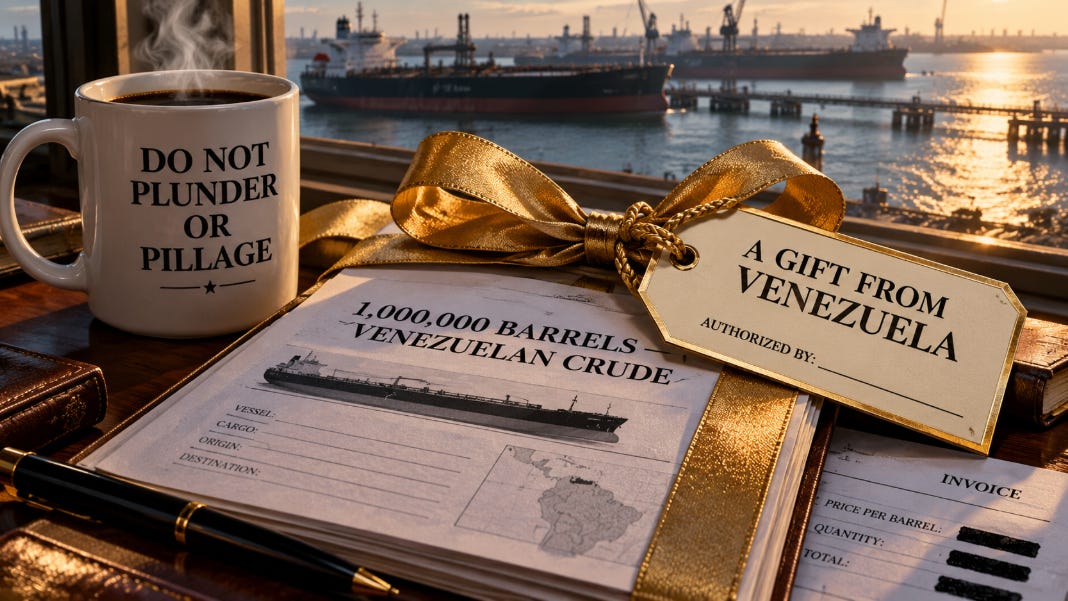
“You have a little ship,” he told the crowd. “See that little ship out there? It’s got 1 million barrels of oil on it from Venezuela.”
He called it “the greatest oil victory in history.” Then he reached for a governing philosophy the Visigoths would have recognized immediately: “To the victor belong the spoils, right?”
The crowd cheered. Somewhere, a copy of the Atlantic Charter quietly curled at the edges.
Trump assured everyone that the oil was being provided “at zero cost to the American taxpayer,” a claim we’ll return to. Then he proposed an even larger acquisition.
“Maybe someday soon it will become a prosperous 51st state,” he suggested. “And instead of a president, we’ll have an election for a governor. How about that?”
More applause.
In little more than a minute, Venezuelan oil had become American war booty, and Venezuela itself a prospective American state. Venezuelans were conspicuously absent from the discussion. When you’re dividing the spoils, it seems, consulting the owners is an unnecessary administrative expense.
To be fair, Trump didn’t invent the idea. He just dusted it off.
America has never been entirely comfortable with its own professed principles. The war with Mexico ended with more than half that country’s territory in American hands. Victory over Spain brought an overseas empire, from Puerto Rico to the Philippines. Marines occupied countries across Latin America and the Caribbean, protecting American commercial interests alongside Washington’s strategic ambitions. Conquest, exploitation and interference run through our history, usually dressed in the language of liberation.
But while the Second World War was still raging, a competing vision was taking shape. In August 1941, months before Pearl Harbor, Franklin Roosevelt and Winston Churchill met off Newfoundland and wrote down what they claimed to be fighting for. Their countries, the Atlantic Charter declared, “seek no aggrandizement, territorial or other.” Its fourth point went further, proposing equal access to the world’s raw materials for all states, “victor or vanquished.”
Even that promise came with an escape hatch. The clause was qualified by “due respect for their existing obligations,” language Churchill had insisted upon to protect Britain’s imperial trade preferences. Apparently, the old empire wasn’t quite ready to surrender the keys. Still, they put it in writing.
In 1945, the United Nations Charter gave those principles legal force, prohibiting the threat or use of force against another state’s “territorial integrity or political independence.” And in December 1962, the United States joined 86 other nations, including Venezuela, in affirming that peoples hold permanent sovereignty over their natural resources, to be used for “the well-being of the people of the State concerned.” The resolution also called for respect for that sovereignty in foreign investment and good-faith observance of agreements freely entered into by sovereign states.
America hasn’t always kept those promises. But they were principles against which its conduct could be judged. Having the power to take something was not the same as having the right to keep it.
Trump has been rehearsing the line for fifteen years. In September 2016, at NBC’s Commander-in-Chief Forum, Matt Lauer asked candidate Trump about Iraq. Trump acknowledged that nobody had won the war, but insisted the United States should have taken Iraq’s oil anyway. He invoked the spoils of victory and concluded, “But I always said, take the oil.”
That evening, CNN’s Anderson Cooper asked retired Army Lieutenant General Mark Hertling whether helping ourselves to another country’s oil might turn the rest of the world against us. “Not if we were in the 16th century,” Hertling replied.
Trump was undeterred. On January 21, 2017, his first full day as president, he visited CIA headquarters and raised the subject again. America should have kept Iraq’s oil, he told the assembled intelligence officers. Then, with a laugh, he added: “Maybe you’ll have another chance.”
Ten years later, he had his victory. On January 3, American forces seized Nicolás Maduro in an overnight operation and transported him to New York to face criminal charges. By August, Trump was announcing what he called “THE BIGGEST OIL DEAL IN WORLD HISTORY!”, claiming the United States had secured majority control of more than 65 billion barrels of Venezuelan reserves at no cost to American taxpayers.
The actual arrangement is more complicated. Venezuela’s interim authorities granted North American Blue Energy Partners, a private company, concessions covering 17 oilfields. In turn, the company granted Washington rights to a 35 percent stake in its corporate parent, extensive oversight of its board, and the right to purchase 20 percent of its production at cost, with first refusal on the remainder. Valuable commercial privileges, certainly. Ownership of Venezuela’s underground oil reserves? Not quite.
There are a few other small complications. Venezuela’s constitution declares its hydrocarbon deposits inalienable public property. The interim government that awarded the concessions operates under Delcy Rodríguez, who was never elected president and assumed power after American forces removed her predecessor.
The 1962 UN resolution affirming sovereignty over natural resources speaks of agreements “freely entered into” by sovereign states. How freely does a government negotiate when the country seeking the benefits has just removed its president by military force?
What were Venezuelans promised in return? Prosperity, mostly. Billions in investment, jobs, royalties and tax revenues, all waiting somewhere in a magnificent future. It was essentially the same offer Trump was making American voters: lower prices, greater wealth, and a $5,000 dividend if they returned Republicans to Congress. On both sides of the border, ordinary people were being asked to wait for prosperity while continuing to pay today’s bills. The commercial rights, meanwhile, were being put in writing now. There was one rather important difference. Americans were being asked to vote for their promised prosperity. Venezuelans hadn’t been given the opportunity to vote for the government negotiating theirs.
When Trump first floated the idea of statehood in May, Rodríguez responded that Venezuela was “not a colony, but a free country.” The message did not survive the journey to Texas.
By the time the president reached Lubbock that evening, the spoils of war were back in gift wrap. “I accepted a shipload of 1 million barrels of oil, a gift from Venezuela,” he told the crowd. “That we are giving to Texas, by the way? I’d like to keep it, but I don’t think that works that way.”
It doesn’t. But it’s revealing that he even entertained the idea. Before leaving Washington that morning, he had told reporters: “They’ve sent me as a gift a boatload of a million barrels of oil, and I’m giving that to the United States of America.” A personal present, generously passed along to the nation. In Corpus Christi, it was the spoils of victory. By Lubbock, he was considering giving it to Texas or keeping it himself. Venezuela was no longer among the prospective owners.
In Trump’s telling, the distinction between public property, private investment and money he can personally promise to distribute tends to disappear. Investment commitments from Japan and the European Union became money those countries “have to pay” the United States. Announcements of future investment, some tentative and some spread over years, became $22.2 trillion the country had supposedly “taken in,” nearly twice the $11.26 trillion in investment announcements his own White House has documented.
Then came his promised $5,000 “Trump dividend,” conditional on Republicans retaining both chambers of Congress. It would cost approximately $1.2 trillion, though Trump estimated $1 trillion. He invoked the $22.2 trillion in the same breath, as though investment commitments could help pay the bill or reduce the national debt. Meanwhile, the tariffs supposedly filling the Treasury’s coffers have produced their own accounting problem: by early October, roughly $126 billion in refunds on duties struck down by the Supreme Court, including interest, had been certified and sent to Treasury for disbursement.
Foreign oil as a personal present. Corporate promises as government income. Someone else’s money invoked to justify a campaign pledge. In Trump’s accounting, the important question is never whose money it is. It’s who gets to hand it out.
Even the oil shipment came with some interesting fine print. The company supplying it initially described the delivery as part of a contract under which the United States purchases crude at production cost. It later revised the announcement: the first million barrels were complimentary, “to recognise the historic nature of the agreement.” Future shipments, however, would still have to be purchased. And the Washington Post, citing two people familiar with the deal, reported that even the first shipment wasn’t free, but priced at $30 a barrel.
Then there was the tanker. The vessel Trump pointed toward, the Angerona, is an Aframax, a class of ship that typically carries somewhere between half a million and 800,000 barrels. The company’s own announcement says the million barrels arrived on two tankers. So the ship chosen to illustrate the greatest oil victory in history apparently couldn’t hold the quantity of oil the president said was sitting aboard it. The symbolism may be more seaworthy than the arithmetic. And according to maritime tracking reviewed by The Maritime Executive, the Angerona hadn’t made a recorded port call in Venezuela for four months.
According to a White House official speaking to Reuters, the government intends to sell the oil to refineries run by ExxonMobil and Citgo, which Reuters describes as Venezuelan-owned. So oil presented as Venezuela’s gift to America will be sold by Washington, in part, to a Venezuelan-owned company.
The immediate question is how much the government will receive for selling it, what the transaction cost, and where the proceeds will go.
In Lubbock, Trump came remarkably close to explaining whose fortune he meant. Texas oil producers, he told the crowd, had made “more money than you have ever made” over the previous seven months. “What took place seven months ago? The war.”
He even supplied the obvious objection himself: “Our country is making a fortune while people have to pay more at the pump.” Then he promised gasoline prices would soon fall. The fortune, apparently, had arrived ahead of the relief.
Gasoline averaged $4.27 a gallon on Tuesday, compared with $2.98 when the Iran war began. Venezuela brought a different bill. Brown University’s Costs of War project estimates that American military operations in Venezuela, the Caribbean and eastern Pacific cost taxpayers at least $4.7 billion through March. Approximately 75 people died in the operation that seized Maduro. None of those figures represents the price of a million barrels of oil. But they belong somewhere in the accounting of the victory Trump was celebrating.
The oil could be called a gift. Military intervention could be called a victory. Private profits could be called national prosperity. Changing the labels didn’t settle who owned what, who paid for it, or who had the authority to give it away.
At Corpus Christi, Trump called Venezuela’s oil the spoils of victory. In Lubbock, he called it a gift.
The first requires power. The second requires consent.
Dear Europe…
It’s 1939 again…
Be prepared…
Dear America…
It’s 1939 again…
You’re on the wrong team…
"...In turn, the company granted Washington rights to a 35 percent stake in its corporate parent, extensive oversight of its board, and the right to purchase 20 percent of its production at cost, with first refusal on the remainder. ..."
Ain't that socialism?