


Every day seems to bring some new act of greed dressed up as realism, some fresh performance of destruction sold as strength. Stay in that atmosphere too long and it does something to the spirit, it narrows the imagination. It makes care feel naïve and stewardship feel quaint. It teaches you, if you let it, to expect ugliness from power and to meet each new outrage with a tired little shrug. That may be one of the worst things this age tries to take from us: not only clean air and water and functioning institutions, but also the sense that repair is still possible, that decency still has muscle, that somewhere people are still choosing to mend what others would happily break. And then, every now and then, the world offers a small correction. A story that opens a window.
This week, Uganda began returning rhinos to Kidepo Valley National Park for the first time since 1983, when poaching wiped them out there. After more than four decades of absence, they are coming back. I keep returning to that phrase in my mind: rhinos are going home. Home, not to a zoo, not to a carefully branded enclosure, and not to some diminished substitute for belonging. Home to a national park where they once lived, to a landscape shaped in part by their presence, to an ecosystem that has carried their absence for forty-three years. There is something almost unbearably moving in that. The simplicity of it and the dignity of it, a living thing returned to the place where it belongs.
And it matters that these are southern white rhinos, not northern white rhinos, whose story remains so painfully close to the edge of irreparable loss. The northern white rhino has been brought almost to disappearance, with only two individuals left alive, both female, both protected in Kenya: Najin and Fatu. That grief belongs in the story too. Not every wound can be undone, and not every absence can be answered in time. But the southern white rhino tells another truth alongside that one. It tells us that protection matters, that patient human effort can still alter the shape of loss. That a species pushed to the brink can, with enough care and vigilance and stubborn love, be brought back from it. Not into fantasy, not into innocence, but into life.
That is why this feels larger than a conservation update. It is not only about wildlife management, it is about refusal. A refusal to accept permanent diminishment as the natural order of things, to treat ecological loss as inevitable, or to let poaching and collapse speak the final word. Conservation, at its deepest level, is not decorative and it is not sentimental, but rather an expression of moral seriousness. It begins with the belief that living systems matter in their own right, that damage is not destiny, and that human beings have obligations beyond convenience and profit.
And while some men still move through public life as if the world were nothing more than a pit to be emptied, somewhere else people are doing the opposite. They are moving carefully, planning for return, and making room for life. There is something profoundly consoling in that. Uganda Wildlife Authority says the animals are being closely monitored as they adapt, with rangers and veterinary teams helping protect them in the park. That kind of care rarely becomes a spectacle. It does not strut, does not pound its chest and it does not mistake noise for significance. It is quieter and steadier than that. But it is real power all the same.
And perhaps that is part of why this story lands so hard. It reminds us that restoration is not flashy, but it is beautiful. It asks us to admit that something precious was lost, to grieve that loss honestly, and then to act as though grief should lead somewhere more loving than resignation. It asks patience, humility, and belief that the world is not a warehouse of resources, but a living web of relationships, delicate and resilient and worthy of defense. Most of all, it asks us to reject the lie that cynicism is the same thing as wisdom.
Spend enough time under the shadow of catastrophic politics and you can begin to feel embarrassed by your own tenderness. By your desire for beauty, balance, mercy, continuity, and repair. You can begin to think hope belongs only to people who are not paying attention. But that is not wisdom, that is injury.
The rhinos matter because they offer a gentler truth. They remind us that the vandals are not the whole story. They remind us that human beings are capable not only of plunder, but of guardianship. Not only of extraction, but of return. Here is a whole apparatus of human effort organized around making a place more whole. Here are wildlife officials, conservationists, veterinarians, park workers, and planners using knowledge, labor, and patience to restore a missing part of an ecosystem. Here is a landscape being treated not as a sacrifice zone, but as something living, something worthy of care.
That matters because the world is full of loud men who want us to believe destruction is the only serious form of power. It matters because it shows another kind of strength altogether: the strength to protect, to repair, to remain faithful to life even after harm has been done.
And maybe that is why this story feels so emotional to me. Because “rhinos are going home” is not just a conservation fact. It is also a sentence about what kind of creatures we still have the chance to be. Not omnivores of ruin, kings of coal, or spectators to collapse mistaking despair for sophistication. But caretakers, witnesses, repairers, and people still capable of returning something living to the place where it belongs.
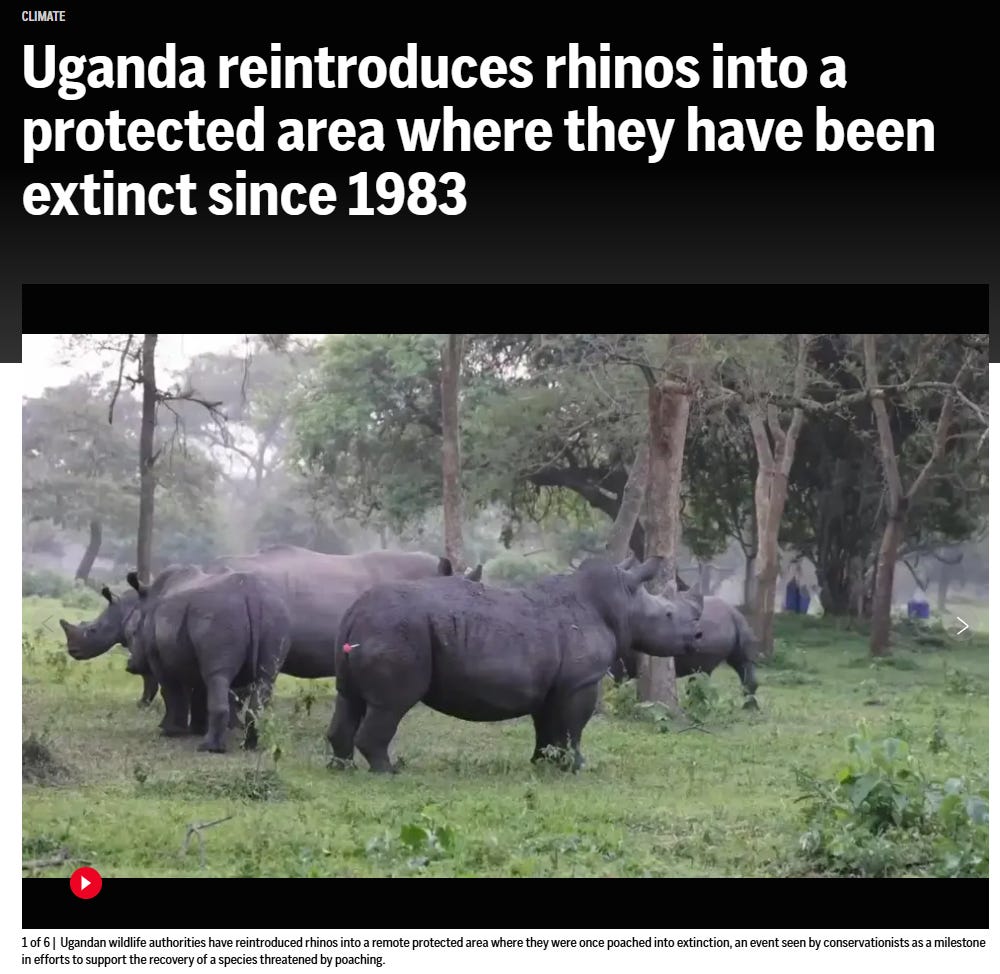
Not every wound can be healed. Najin and Fatu remind us of that with heartbreaking clarity. But the southern white rhino tells us something else: that some losses can be answered, some broken continuities can be mended, and some absences can end. That is not everything, but it is not nothing, it is a kind of hope sturdy enough to lean on.
So let the narcissists preen, let the petty tyrants mistake appetite for vision, because they are not the whole story. Somewhere in Uganda, rhinos are going home. And that means there are still human beings in this world who know how to choose patience over spectacle, care over ego, and repair over ruin. There are still people willing to spend their intelligence and labor on the long, unglamorous work of mending what others were content to destroy. These days, that feels like a beautiful thing to remember.
Hold onto stories like this one, share them, support the people doing the labor of repair. Refuse the cheap glamour of despair, refuse the lie that ruin is the only honest language left. Rhinos are going home, and today, that feels like hope.
You have an eloquent pen (keyboard). How nice to see it used in a message of hope, even if the times rarely allow for one. Thanks.
Thank you for this hopeful message. We must make a concerted effort today (now more than ever) to identify the good that humans are doing and the good they are capable of doing. Our world depends on that hope.