


It has been one of those weeks when the internet seems determined to convince us that civilization is a flaming shopping cart rolling downhill toward a ravine. You open your phone for a weather check and somehow end up staring into the abyss, which now comes with autoplay. It is easy, in that atmosphere, to start believing that cruelty is the default setting, that selfishness always wins, and that the whole human project is basically a very expensive experiment in bad impulse control. But every so often, reality slips in a correction. Not a grand speech, not a perfect ending, just a handful of stubborn facts that say, actually, people are still capable of courage, tenderness, ingenuity, and the kind of decency that asks for no applause.
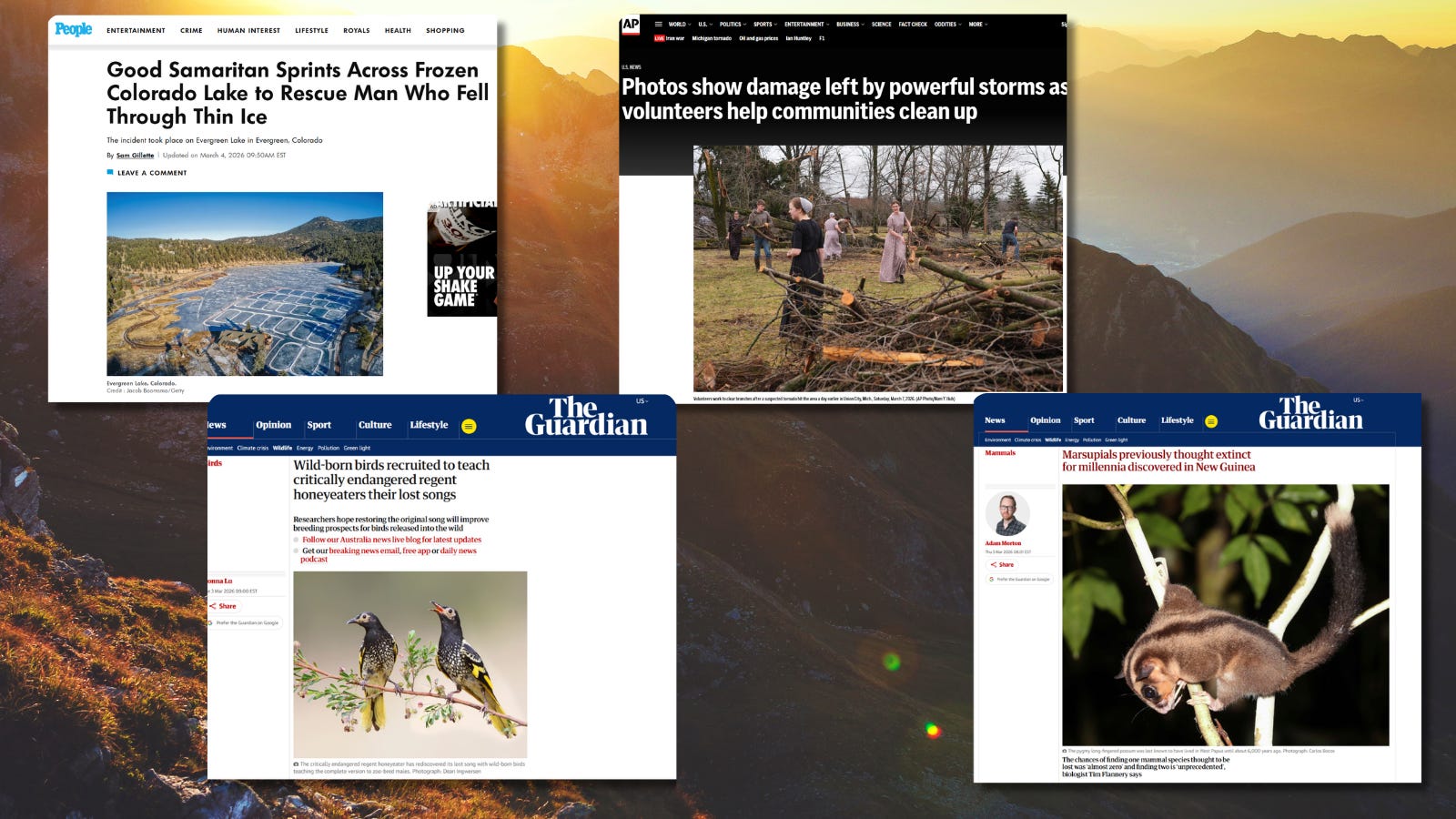
Take Colorado, where on March 1 a man fell through thin ice at Evergreen Lake as a charity event was wrapping up nearby. Another young man saw what was happening, sprinted across the frozen lake, reached the hole, and pulled him to safety. Then, in a move so almost offensively noble that it feels made up by a screenwriter who needed to cut one more scene, he left without giving his name. No brand partnership, no personal manifesto, no thread explaining what this taught him about leadership. Just a stranger deciding, in the space of a few seconds, that someone else’s life mattered more than his own comfort and then disappearing back into the world like the patron saint of not making it about yourself.
That story matters not just because it is dramatic, though admittedly a nameless man sprinting across a frozen lake is a very strong entry in the category of “evidence that people are not entirely terrible.” It matters because it is so fundamentally human in the best sense. Someone saw a person in danger and moved toward him. No committee was formed. No one waited for the perfect conditions or a better angle. In the middle of all our modern noise, all our monetized outrage and daily reminders that attention is a blood sport, there was still this simple, ancient reflex: help.
The same reflex showed up again after storms tore through parts of Michigan and Oklahoma this week. The destruction was brutal, with flattened homes, scattered debris, and whole neighborhoods looking as if a giant hand had swept through and rearranged the basic facts of people’s lives. And yet almost immediately, volunteers were there clearing branches, sifting through rubble, repairing roofs, and helping residents begin the miserable, exhausting work of recovery. This is one of the least glamorous forms of hope, which is probably why it is one of the most convincing. Hope is not always a speech. Sometimes it is a person picking up someone else’s shattered fence panel in cold mud because there is work to do and grief is lighter when somebody lifts with you.
Then there is the story from Australia, which is somehow both scientifically important and emotionally devastating in the nicest possible way. Researchers from ANU and Taronga Conservation Society announced on March 2 that they had helped restore the lost traditional song of the critically endangered regent honeyeater, a bird with fewer than 250 individuals left in the wild. As the population shrank, the birds’ song began to erode too, which is not just sad in a poetic sense but dangerous in a biological one, because birdsong affects breeding and social cohesion. Scientists used recordings and two wild-born male tutors to help young zoo-bred birds learn the older song, and now more than half of the zoo-bred males sing something close to that historic wild version. Imagine caring enough not only to save a species from extinction, but to help return a piece of its cultural memory, as if survival alone were not enough and dignity mattered too.
I keep coming back to that detail because it says something extraordinary about the best version of us. Human beings are capable of reducing the natural world to profit margins and dead zones, yes, but we are also capable of hearing that a bird has forgotten its own song and deciding this is unacceptable. We are capable of responding to loss not with a shrug, but with devotion. We can be vulgar, destructive little goblins, absolutely, but we can also be guardians of fragile things we will never own. There is real hope in that contradiction.
And then, because the universe occasionally likes to remind us that despair is a poor prophet, scientists announced on March 6 that two marsupial species thought extinct for more than 6,000 years had been discovered alive in the rainforests of the Vogelkop Peninsula in Papuan Indonesia. The rediscoveries were reported by the Australian Museum and involved years of detective work, along with collaboration with local and Indigenous communities whose knowledge was crucial to the find. One of the animals is a pygmy long-fingered possum, which sounds like a creature invented by a child who was told to make up the most suspiciously adorable thing imaginable. The other is a ring-tailed glider from a newly recognized genus. What I love about this story is not just the scientific thrill of it, though finding living animals where Western science thought there were only fossils is a fairly emphatic flex by nature. It is the reminder that the world is still more alive than our fear says it is, and that humility is sometimes the beginning of wonder.
Put these stories together and a pattern starts to emerge. Hope is not denial, hope is not pretending the storms did not kill people, or that species are not vanishing, or that the world is not under real strain. Hope is something sturdier than that. It is the fact that again and again, in the middle of danger and damage and loss, somebody runs onto the ice. Somebody shows up with gloves and a ladder. Somebody spends years helping a bird recover its inheritance. Somebody listens to local knowledge closely enough to discover that extinction was not the final word after all.
That, to me, is this week’s proof humanity may not be doomed after all. Not because we are innocent, and certainly not because we are always wise, but because we are still capable of repair. We are still moved by suffering that is not our own. We are still willing, at our best, to protect life we did not create and may never fully understand. The news can make it feel as if history is only powered by greed, violence, and people with microphones. But history is also powered by strangers, volunteers, scientists, caretakers, and the odd anonymous lunatic brave enough to sprint across a frozen lake when another human being needs him. That is not nothing. That is a reason to keep faith. That is a reason to believe the story is not over.
I recently started following you. You’ve made me laugh and cry all in the span of a few paragraphs. Today I subscribed and plan to share. Keep doing what you’re doing. And thank you. You’re leaving the light on for us.
We needed that, Shanley. Thank you.