

Good morning! We’ll start with the small, darkly funny things, because frankly that’s the only way to survive the big, horrifying ones.
Somewhere in Florida, a congressional candidate named Mark Davis woke up, looked at the news, looked at the silence from people in power, and decided to spend a few dollars on a domain name. He bought nazis.us, and pointed it straight at the Department of Homeland Security, the parent agency of ICE. DHS claimed they “successfully blocked” the redirect. They did not. As of this weekend, typing nazis.us still took you to homelandsecurity.gov, which honestly felt less like a prank and more like an accidental user interface test. The stunt worked because it landed on something already festering in the public consciousness: ICE’s reputation is now so radioactive that even Joe Rogan has compared it to the Gestapo, and polling shows most Americans believe the killing of Renee Nicole Good by an ICE agent exposed systemic problems, not a one-off tragedy. When symbolism hits that cleanly, it’s not just satire; it’s a full-blown diagnosis.
If you’re wondering how ICE keeps plowing forward anyway, despite the outrage, despite the deaths, despite the comparisons to secret police forces history did not remember fondly, the answer isn’t absence of backlash, it’s abundance of reward. The ICE agent identified as having shot and killed Minneapolis resident Renee Nicole Good, 37-year-old mother, poet, and wife, has become the beneficiary of a massive crowdfunding outpouring, even as her death has sparked nationwide protests and deep public anger. Multiple online fundraisers set up to support Jonathan Ross, the ICE agent involved in the fatal shooting during a federal operation in Minneapolis, have collectively amassed well into the high hundreds of thousands of dollars and perhaps over a million in total support across platforms, even as critics note that GoFundMe’s own terms of service prohibit legal-defense campaigns for violent acts. Ross’s supporters, including not just ordinary donors but high-profile backers like billionaire Bill Ackman, have contributed to campaigns that explicitly aim to assist the agent who killed Good, while official channels defend the act as self-defense and the Department of Justice has signaled it sees “no basis” for a criminal civil-rights investigation into the killing. It’s hard not to notice the echo of Kyle Rittenhouse here: the same ritual absolution, the same rush to canonize before facts or accountability have had a chance to clear their throats, and the same chilling message that violence in service of power isn’t just tolerated anymore, it’s monetized, celebrated, and padded with cash.
If you’re wondering why everyday Americans are feeling angrier and poorer, despite endless promises of “energy dominance” and “the greatest first year in history,” the Guardian brought receipts. Donald Trump promised, repeatedly, loudly, and on camera, to cut Americans’ energy bills in half within 12 months of taking office. Instead, electricity bills rose 6.7% nationwide last year, gas bills climbed another 5.2%, and the average household paid about $116 more just to keep the lights on. In some places, it was far worse: Washington, DC saw a 23% jump, Indiana 17%, Illinois 15%. Power shutoffs are surging. New York saw disconnections rise fivefold. Families are taking second jobs, cutting groceries, and giving up time with their kids so they don’t freeze in the dark, and when they complain, Trump now insists the affordability crisis is a “hoax.” Which is a bold stance to take against math, utility companies, and winter.
None of this is accidental, because Trump supercharged electricity demand through aggressive AI expansion, blocked renewable projects that would have added capacity, pushed LNG exports that tighten domestic supply, reversed coal plant closures that raise costs, and then slashed energy assistance and efficiency programs right as bills spiked. Prices rose just as experts warned it would happen, and now the administration is pretending it didn’t.
Speaking of inconvenient truths, let’s talk pardons, specifically, the kind that come with loyalty points. Trump quietly issued another batch this week, including one that deserves its own special category: the two-time presidential pardon. Adriana Camberos, a convicted fraudster whose sentence Trump commuted in 2021, promptly went back to committing fraud, was convicted again, sentenced again, and has now been pardoned again. If at first you don’t succeed, apparently try crime, donors, and Trump-connected lawyers. Elsewhere in the pardon pile were political corruption defendants whose family members had donated millions to Trump-aligned super PACs. This isn’t mercy anymore; it’s a loyalty rewards scheme. Fraud is unforgivable unless you’re wealthy, wired into Trumpworld, and politically useful, in which case it’s suddenly a misunderstanding, a hoax, or an attack by the deep state’s bad vibes department.
And now, because no week is complete without Trump chasing a shiny object he believes will validate his soul, we arrive at the Nobel Prize, his preciousss. María Corina Machado, the Venezuelan opposition leader who actually won the 2025 Nobel Peace Prize for standing up to authoritarianism, walked into the Oval Office and handed Trump her medal. While Machado was offering up her prize in hopes of securing U.S. backing, Trump’s CIA director was in Caracas meeting with the Maduro-aligned power structure she fought, because oil deals beat democracy every time in Trump’s version of realpolitik. In the end, Trump got a trophy without recognition, Machado made a sacrifice without leverage, and peace remained as elusive and unimpressed as ever.
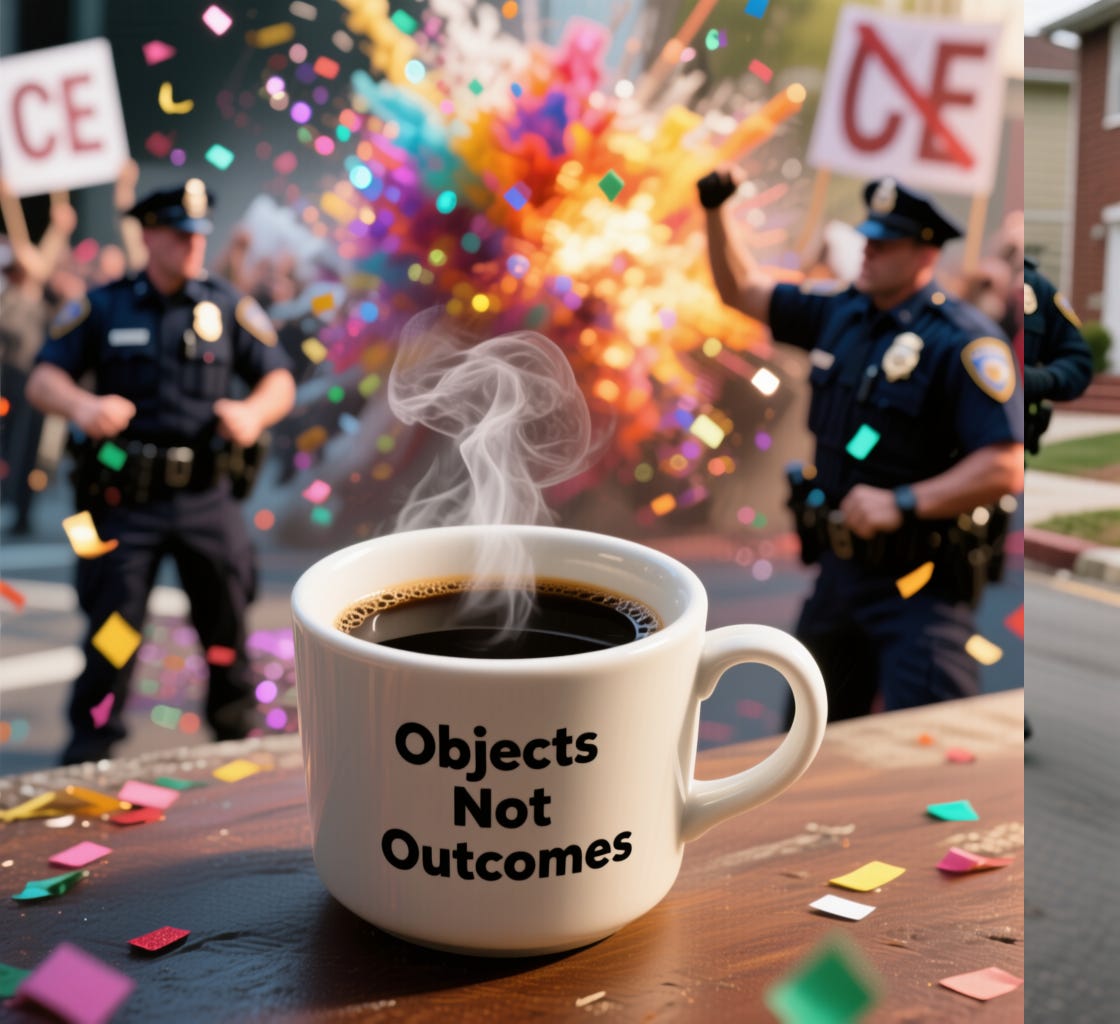
If there’s a throughline to all of this, it’s coherence: objects over outcomes, power insulated by money and myth, while ordinary people absorb the costs in higher bills, broken trust, and a creeping sense that the rules only apply downward. And yet, amid the darkness, there are flickers of resistance, sometimes absurd, sometimes small, sometimes involving glitter bombs tossed at ICE agents or a $12 domain name, reminders that silence isn’t universal and acceptance isn’t complete, even as I’ll be publishing a deeper dive tomorrow morning on how ICE’s atrocities reflect the state of our democracy.
It’s been grim week, but clarity, even when it’s bleak, is still a form of light.
Mary, I read somewhere that media costs i.e. streaming services are up 20% over last year. Those are nasty hidden costs. I just axed two and saved over $300 for this year. It's not just food and electricity, there's the cost of owning a pet which you know. Going to the pet store costs more than the grocery store some weeks. I manage on a fixed income but I know people are suffering. I see the homeless and mentally ill suffering. The weakest members of society will hurt more than those of us who tighten our belts and put on another layer. This man has brought misery to the country.
“Clarity … is still a form of light” - and matters even more when the governing regime spews Big Lies with malicious intent, and legacy media cowers with fear. Why this newsletter is such an extraordinary public service.
We in the majority must make our numbers count with strategic strength. Flood your representatives with demands for action to hold this malignant administration accountable for its ongoing acts of impeachable sedition and criminality.
Speak up, show up in ways that boost the courage of others to join you. Every drop helps fill the stream.