


Good morning! Happy Mother’s Day to everyone celebrating, remembering, grieving, mothering, being mothered, including you single dads doing double duty!
Today’s roundup is going to be brief because I’m spending the day with my kids, which feels like the correct and morally superior use of my time. The news will still be terrible tomorrow. Democracy’s group project will still be on fire. The usual suspects will still be lying into microphones like it’s cardio. So today: a shorter cup of coffee, a few things worth noting, and then I’m logging off to be with the people who made me a mother in the first place.
Unfortunately, before I can go enjoy pancakes and familial affection, we do need to check in on the President of the United States, whose brain continues to be available in real time through Truth Social, like a national security briefing written by a haunted slot machine.
NPR analyzed Trump’s first four months of Truth Social posts this year and found that he posted 2,249 times, averaging just under 19 posts a day. His most common topic was the 2026 elections, followed by Iran and the economy, but the real story is the scattershot obsession. Trump posted 71 times about the 2020 election lie, more often than he posted about tariffs. He posted 68 times about his various Washington, D.C. building projects, including his White House ballroom and proposed arch, more often than he posted about Venezuela, the SAVE Act, or the Minneapolis protests and federal agents. And he posted more than six times as often about his legal grievances as he did about health care policy. Sort of a live feed from the presidential id.
On March 1, the day after U.S. forces bombed Iran and launched a war now dragging into its tenth week, Trump posted 30 times. He did post about Iran, including a threat warning Tehran not to retaliate. But then, because the man has the attention span of a firework in a microwave, he also posted a video portraying Mitch McConnell as the dead guy from Weekend at Bernie’s, praise for his State of the Union, Trump-friendly news coverage, months-old celebrity-adjacent approval fluff, screenshots of people praising him online, and a video about San Francisco from an account called “truthaboutfluoride.”
Again: this was the day after he bombed Iran. It matters because the rest of the world is not treating Trump’s posts as harmless uncle-at-Thanksgiving nonsense. Adversaries, allies, markets, militaries, and diplomats all have to parse the difference between policy, impulse, threat, delusion, performance, and whatever category includes reposting pet videos next to war updates. Former national security adviser John Bolton told NPR that Trump’s ferocious posting about Iran may actually signal weakness to Tehran: if Iran waits him out, Bolton suggested, Trump may “flip right out entirely” and start offering concessions. Bolton’s verdict was concise: “Just being generically crazy does not give you an advantage.”
Regional reporting from Tehran suggests Iran is trying to send two messages at once: it is still leaving the door open to diplomacy, but it wants everyone to understand that its military is prepared for another round of confrontation. According to Al Jazeera’s reporting from Tehran, Iranian military officials are describing the country as fully prepared after attacks on coastal areas and oil tankers, warning that Iran’s “strategic patience” is over and that its forces have “fingers on the trigger.” Military spokesmen are also threatening “surprises” involving new weapons, new methods of warfare, and new arenas of conflict if Iran is attacked again. It feels like the diplomatic equivalent of saying, “We are open to talking, but please note that the flamethrower is plugged in.”
The Strait of Hormuz remains the pressure point, and the rhetoric surrounding it is increasingly dangerous. Tehran is insisting that negotiations are not surrender; Washington is still pressing for a deal, and both sides are behaving like people standing in a room full of leaking gas while debating whether sparks are technically part of the negotiation process. Iran’s president is saying the Iranian nation will not bow before its enemies, while military officials are emphasizing readiness for “hostile action” and “confrontational scenarios.”
No “war or diplomacy.” This is war and diplomacy walking down the same hallway, bumping shoulders, each pretending the other one is not there.
Trump is preparing for a high-stakes meeting with Xi Jinping in Beijing next week, because apparently Mother’s Day weekend needed a little “two most powerful men on Earth compare grievances while the world economy sweats through its shirt” energy.
The agenda is enormous: Iran, trade, Taiwan, artificial intelligence, rare earths, semiconductors, fentanyl, the South China Sea, China’s nuclear buildup, and the case of jailed Hong Kong democracy activist Jimmy Lai. Expectations, however, are modest. The most likely outcome appears to be some limited investment agreements and an extension of the temporary trade truce Trump and Xi struck after last year’s bruising tariff fight.
The more revealing part is the backdrop. Trump enters the summit entangled in a war with Iran, China’s closest partner in the Middle East, while the conflict has helped trigger a global energy crisis and pulled U.S. military attention and resources away from Asia. The war has also depleted American munitions, raising questions among some Chinese analysts about whether the United States could defend Taiwan if Beijing decided to test the moment.
Xi, meanwhile, is not exactly arriving from a position of carefree strength. China is dealing with slower growth, higher energy costs, and the threat of a global recession that could hit its export-heavy economy hard. So the meeting may be less about solving the U.S.-China rivalry than about both men trying to buy time while sharpening the knives behind their backs. Not the kind of thing one wants simmering in the background while trying to enjoy pancakes with the kids.
Speaking of strongmen pretending chaos is strategy, Putin appears to be borrowing from Donald Trump’s favorite playbook: announce that something is basically solved, then let the fine print reveal that nothing has actually changed.
Putin claimed the war in Ukraine is “coming to an end,” but senior Kremlin officials immediately made clear there is no quick peace on the table. Kremlin spokesperson Dmitry Peskov said the United States may be “in a hurry,” but a Ukraine settlement is “too complex” and peace remains “a very long road.” Kremlin aide Yuri Ushakov said negotiations would “probably resume,” but Moscow sees no basis for new trilateral talks until Ukrainian forces withdraw from the Donetsk region, a demand Kyiv has already rejected.
Kyiv Post and Kyiv Independent are reporting the same basic posture from Moscow: Russia is insisting that progress will remain frozen unless Ukraine gives up Donbas, including territory Russia has failed to seize after years of brutal, costly offensives. At the same time, the Kremlin says it expects Trump envoys Steve Witkoff and Jared Kushner to return to Moscow “quite soon” for more talks, despite the fact that Trump’s envoys have reportedly made repeated trips to Russia while still not visiting Kyiv.
That is not exactly a subtle diplomatic signal. It looks less like a peace process than Moscow auditioning for a surrender process with American middlemen in the room.
Ukraine, meanwhile, is calling for an unconditional ceasefire along the current front lines as the starting point for talks. Russia is demanding the entire Donbas region, including territory it could not conquer militarily. So Putin gets to sound reasonable, Trump’s envoys get to look busy, and the actual Russian condition remains: Ukraine must give Russia what Russia could not win.
Classic strongman theater: declare victory-ish, demand surrender-ish, call it diplomacy, and hope everyone mistakes exhaustion for peace.
Which brings us, somehow inevitably, to Trump dressed as a Mandalorian.
Subtlety died of embarrassment sometime around 2016, so the White House marked Star Wars Day by circulating an image of Trump styled as a Mandalorian warrior, complete with armor, halo lighting, an American flag, Grogu tucked into his gear, and a tiny White House glowing in the corner like a nationalist snow globe.
The caption reportedly read: “In a galaxy that demands strength, America stands ready. This is the way. May the 4th be with you.”
The key detail is the White House watermark. This was not just some random MAGA meme scraped from the internet and passed around by a guy named PatriotEagle1776 whose profile picture is a truck wearing sunglasses. This was branded through the official machinery of the presidency. That turns the whole thing from embarrassing fan art into state-sponsored cosplay propaganda.
And the timing is fascinating. The post came as Disney was ramping up publicity for The Mandalorian & Grogu, opening May 22. So the White House essentially used Disney’s own intellectual property to generate either free publicity or a poisoned promotional tie-in for a Disney blockbuster while simultaneously existing in an adversarial relationship with the company.
Lucasfilm had no comment, according to The Hollywood Reporter, which starts to look less like capitulation and more like a cold calculation. Why hand Trump a fight that would only draw more attention to the image days before opening weekend? Disney is many things, but allergic to risk is certainly one of them. Sometimes the mouse does not roar because the mouse has done the math.
Still, the image itself deserves attention because it is not merely ridiculous. It is revealing.
Trump’s political movement constantly tries to appropriate the language of rebellion while behaving like the empire. They cast themselves as freedom fighters while demanding loyalty oaths, targeting enemies, punishing dissent, militarizing civic life, and turning the presidency into a merch table with subpoenas. They want the aesthetics of resistance without the inconvenience of resisting power, because they are the power.
That is why the Star Wars imagery is such a spectacular self-own.
George Lucas built Star Wars out of the visual language of empire, fascism, rebellion, myth, and propaganda. He did not accidentally borrow from authoritarian spectacle; he studied it, repurposed it, and made it legible to modern audiences. The throne room ceremony in A New Hope famously draws on the staging of Leni Riefenstahl’s Triumph of the Will. The monumental symmetry, the ceremonial procession, the massed bodies, the architecture of triumph, Lucas knew exactly what visual grammar he was invoking.
But the point was not to celebrate fascist spectacle. The point was to show how power wraps itself in grandeur, ritual, and heroic imagery. Star Wars is obsessed with how republics become empires, how fear becomes policy, how emergency powers become permanent, how myths can liberate or enslave, and how people convince themselves they are saving civilization while helping build the machine that crushes it.
And now the White House is apparently looking at that entire warning label and saying: great, but what if the emperor had better branding?
The image casts Trump as a mythic protector figure: armored, holy-lit, flag-bearing, carrying Grogu like a sacred child through the snow. It is paternal, militarized, sentimental, and authoritarian all at once. It is not just “Trump is strong.” It is “Trump is the guardian of innocence, the warrior-father, the chosen protector, the man who carries the future through the storm.”
That is not politics. That is cult iconography with a Disney+ subscription.
And it is especially absurd because The Mandalorian itself is a story about a lone warrior who slowly learns that rigid codes and weaponized identity are not enough. Din Djarin’s entire arc is about care breaking through dogma. Grogu is not a prop that makes the armored man look tender. Grogu is the moral center that forces the armored man to become something more human.
So naturally, the White House looked at that and thought: perfect, put the baby in the pouch and make the president look taller.
Fans immediately understood the problem. Earlier this year, Trump had also been depicted with a red lightsaber, the color associated with Sith Lords and villains in Star Wars lore. As one fan put it: “Imagine watching Star Wars and thinking that the ones with the red lightsabers are the good guys.”
Exactly.
This happens when a movement consumes pop culture entirely as branding, not meaning. They see armor and think hero. They see flags and think virtue. They see rebellion and imagine it means being rude to fact-checkers. They see Star Wars and somehow miss the part where the bad guys are the ones obsessed with domination, spectacle, loyalty, and crushing democratic resistance.
Of course, that is the whole trick. Authoritarian movements do not announce themselves by saying, “Good morning, we are here to destroy the republic.” They arrive wrapped in symbols people already love. They borrow the music, the myths, the heroes, the slogans. They call coercion strength and cruelty order. They call surrender peace, propaganda communication, and call cosplay leadership. Then they put a White House watermark on it.
So that is where we are this Mother’s Day: Trump rage-posting through a war, Iran warning that its fingers are on the trigger, Xi preparing to test a distracted and depleted America, Putin pretending his demand for Ukrainian surrender is a peace process, and the White House trying to turn the president into a Mandalorian saint while accidentally reminding everyone that the empire always had excellent graphic design.
The Force is not with this communications shop.
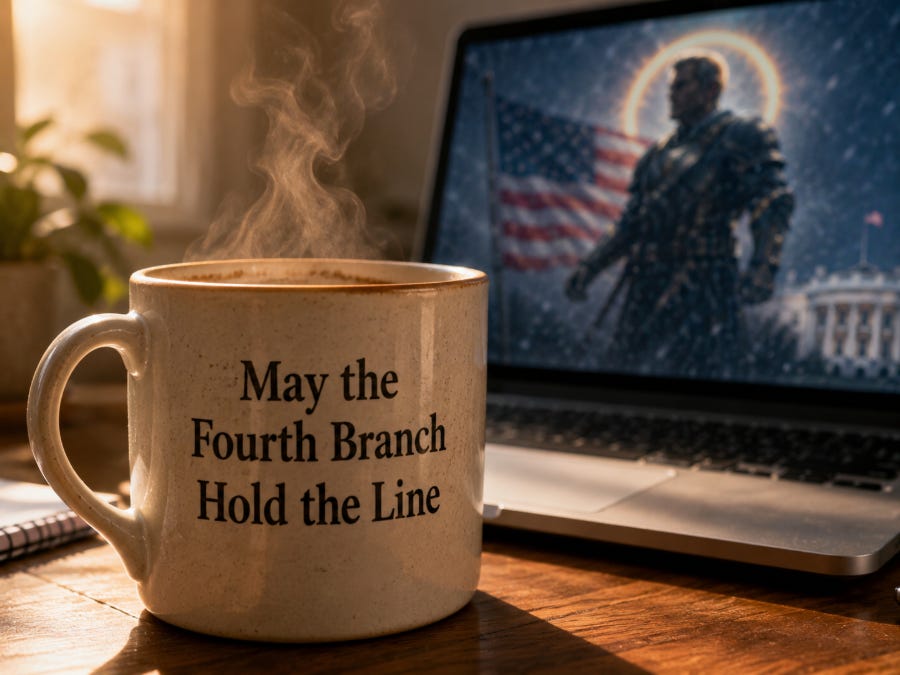
Happy Mother’s Day. Hug your people. Drink something warm. And may the fourth branch of government, exhausted women with coffee and Substack subscriptions, continue to hold the line.
I have no words except that you continue to amaze me everyday. Blessings to you and your family ❤️
Thank you, Mary Geddry! I so appreciate it that your finger is on the pulse of what’s happening. I confess that I am not able to keep up. I need the help of another life force like yours.