


A little boy wanted to play football with his friends again, and people who’d never met him helped make room for that possibility. I’ve been thinking about how much of humanity’s future might depend on our willingness to answer one another that way, to hear what another person hopes for and decide that their hope deserves some help.
There’s something profoundly hopeful about a person who sees a wounded child and begins looking for a way forward with him. There is also something profoundly wrong with making that child wait for someone extraordinary to notice. I want to hold both truths together, because the kindness in this story deserves to become more possible, more ordinary, more available to everyone who needs it.
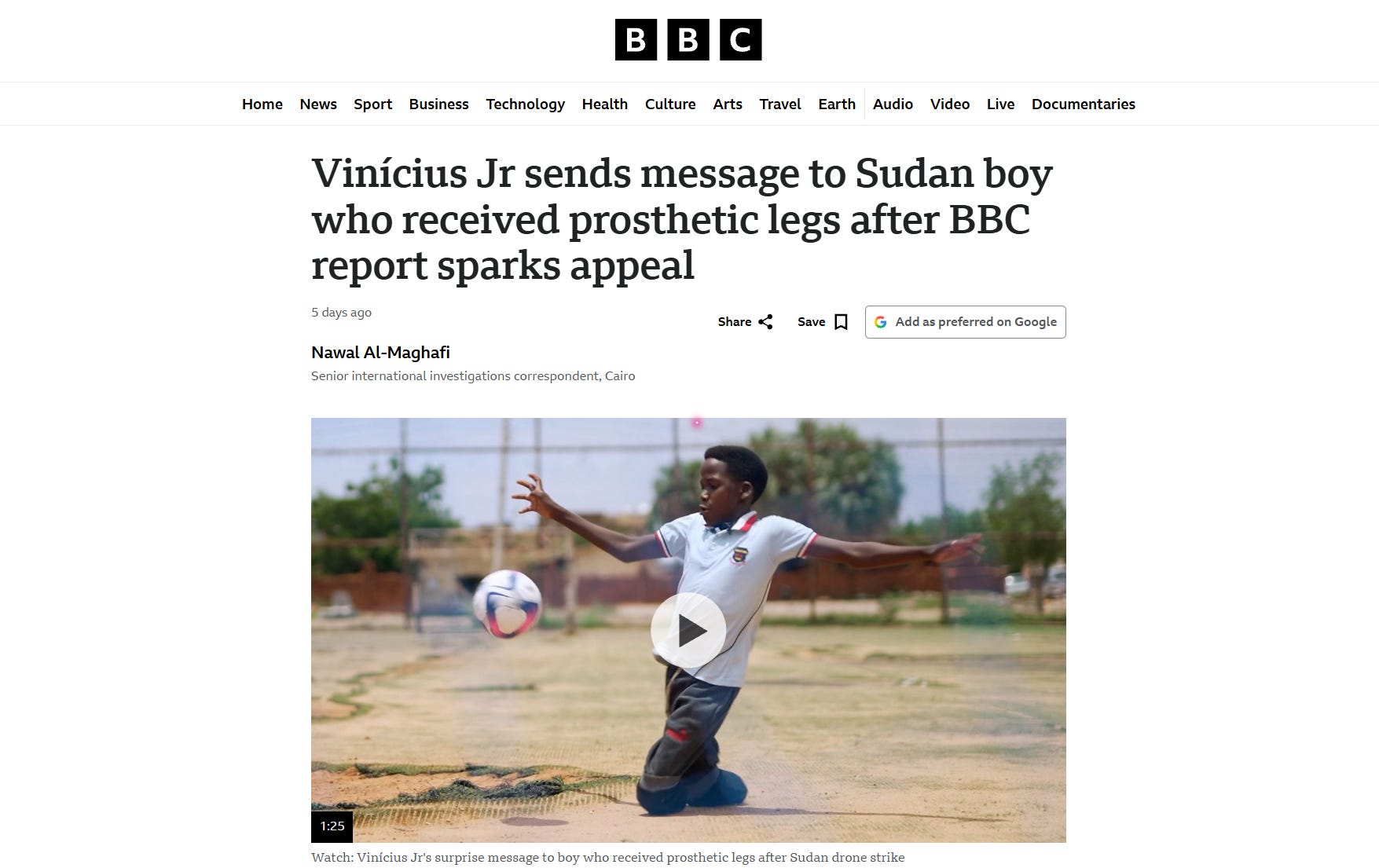
This week’s reminder that hope for humanity may not be lost is about a boy named Zaher, who is 13. In 2024, a drone strike in Khartoum, Sudan, cost him both legs. He and his mother, Habibah, had been selling lentils to survive. When the BBC told his story, he wanted prosthetic legs so he could play football with his friends again.
Dena Latif, a UK-based lawyer of Sudanese origin, saw the report and helped lead a campaign that raised £45,000 for his medical care. After months of planning, Zaher and his mother reached Cairo, where he received surgery, prosthetic legs, rehabilitation, and psychological support. He can now walk and kick a ball.
His favorite footballer, Vinícius Júnior, sent a personal message and invited him to a Real Madrid match. Zaher hopes to become an airline pilot. He and his mother have returned to Khartoum, where they hope he can receive adjustments to his prosthetic legs as he grows. The BBC reported his recovery this week.
I want to hold onto that boy’s future for a moment. I want to think about all the ordinary, beautiful things a child should have room to imagine, the friendships and foolishness, the discoveries, the freedom to become interested in something and then become interested in something else. There should be years enough for him to change his mind. There should be a world around him that welcomes the person he becomes, and people willing to help him find his way through it.
Dena helped make more of that future possible, and I’m deeply grateful that people like her exist. I’m also angry that a child’s access to care required her to become an organizer, a fundraiser, and a person building a route through obstacles that should never have stood between him and treatment. Her compassion gives us something to believe in and something to build toward, a world in which the next person who sees a wounded child can know that help is already coming.
Imagine being able to trust that much in one another. Imagine knowing that, should the worst happen to someone you love, their care would already be a responsibility the rest of us had agreed to share.
We should have reached a point in our existence where protecting children from war matters more than the ambitions of the people who wage it. We know what bombs do to bodies, what displacement does to families, and what terror does to a developing mind. With everything we’ve learned, surely we can ask more of ourselves than another generation of children learning to survive what we already knew would hurt them.
I can’t read about Zaher without thinking about the children in Iran, or the Palestinian children in Gaza. In September 2025, an independent UN commission concluded that Israeli authorities and security forces had committed genocide against Palestinians in Gaza. These are children whose protection should never have become negotiable.
After the February strike on the primary school in Minab, Trump blamed Iran. In September, UN investigators said they had reasonable grounds to believe U.S. forces were responsible and concluded that the attack amounted to a war crime. The Pentagon said its own investigation remained ongoing. Trump’s statements and the later UN findings deserve to be remembered together.
When a school has been struck, the urgent work includes caring for survivors, telling families the truth, and holding those responsible accountable. A government’s desire to protect its reputation can’t take precedence over a child’s need for treatment, or a parent’s right to know why their child will never come home.
And for those who survive, our responsibility has to survive the news cycle. There is so much life still to protect, so much good that care can make possible after the moment when everything changed.
The surgery is followed by healing, by appointments, by equipment that needs replacing, and by the ordinary expenses of a family trying to live through something extraordinary. A child grows, and their needs change. Every time we meet those needs, we help keep a future open. We give someone a little more room for the parts of living that belong to them, beyond the injury and beyond the event that made them news.
That’s why a few sympathetic words can’t be the end of our response. The person who has been wounded still has to wake up in their same life the next morning, and the morning after that. Our care can be there, too, steady enough to become something they can trust while they learn what comes next.
It makes me sick that we can contemplate fortunes so enormous they become difficult to imagine, while an injured child’s treatment depends on whether enough ordinary people can spare something. Care should never be a competition for attention. We have the ability to make helping one another a shared commitment, to put resources behind the compassion that already exists in so many people and let it reach further than any one fundraiser can.
I think about what that would give a parent, the relief of knowing they could stay beside their child while someone else helped carry the practical weight of getting them well. There’s so much tenderness we could make possible simply by deciding that nobody should have to face that weight alone.
I want that for Zaher whether he becomes a pilot or changes his mind a hundred times. I want it for the child whose injuries will never allow them to walk, for the person who can’t tell an interviewer a compelling story, and for everyone whose future looks different from the one they expected. Nobody owes us an inspiring recovery in exchange for being cared for.
And this is where Dena gives me hope, because her response helped other people become part of Zaher’s future. One person’s willingness to act gave others a way to join her, and together their concern became something that could change the course of a life. That’s a beautiful thing to remember when the world feels too large to reach and our own hands feel terribly small.
We rarely get to know how far an act of care will travel. We may never meet the people whose lives become gentler because someone helped us through our own hard season. But I think about how being cared for can change the way we move through the world, how it can teach us what to offer another person, how a kindness we received years ago can still be present in the kindness we give today. There’s no neat place where its usefulness ends.
That’s how I understand hope for humanity. We can take responsibility for one another in ways that leave more possibility behind us than we found. We can teach our children that someone else’s pain matters, give them the experience of being heard when they hurt, and let them watch us follow concern with action. We can elect people who take that responsibility seriously and build systems that keep caring when the volunteers are tired. Every time we make compassion easier to practice, we give it another chance to grow.
The belonging I mean reaches beyond our borders, beyond race and class, beyond the boundaries of our own species. We share this living world with creatures whose pain we can recognize and whose safety our decisions affect. There is something deeply hopeful in our ability to care for a life so different from our own, to understand enough of its needs to offer shelter, protection, or a chance to heal. We can allow that recognition to become part of how we live here together.
A child on another continent belongs to a family as completely as our children belong to ours. A forest matters through all the living things that make their home there. An injured animal has a life it is trying to keep living. The more fully we understand that we’re surrounded by lives that matter, the more opportunities we have to become useful to one another. There is belonging in that responsibility, and there is joy in discovering that something is safer because we were here.
I keep coming back to Zaher having dreams that reach beyond what happened to him. I want him to have ordinary days so full of his own interests that there is little room left for the rest of us and our terrible headlines. I want him to be absorbed in a game, impatient for a visit, delighted by something that nobody thought to photograph. I want the care he received to keep giving him room to be a child, in ways that belong entirely to him.
And I want us to feel the possibility in that, because people helped make it real. The same world that holds so much cruelty also holds people willing to spend their time repairing what they can, people who can recognize a stranger’s child as someone worth showing up for. We can find one another. We can help one another keep going. We can make enough room for care in our laws, our communities, and our daily lives that more children grow up knowing they have a place in the world and people who will protect it.
Dena has given us a reason to believe in that future, and a way to begin moving toward it. Somewhere ahead of Zaher are days he hasn’t lived yet, things he hasn’t learned, people he hasn’t met, and perhaps a sky he will someday fly through. I hope he gets years and years to discover them. I hope we become the kind of world that helps him, and all the children coming after him, feel that they are welcome here, that their dreams have room to grow, and that we will care for them as they find their way.