

Good morning! Another gaping hole in my knowledge of world history was filled this week during a speech on behalf of one of the tiniest republics. At the United Nations on Saturday, the foreign minister of San Marino stood up to speak for a country of about 34,000 people, spread across 24 square miles of an Italian mountainside. That’s roughly one and a half Coos Bays, with twice the population and its own seat in the General Assembly.
San Marino dates its founding to 301 AD, when a Christian stonemason named Marinus fled Roman persecution and settled on Monte Titano. The founding story is part legend, but the independence is real. The republic outlasted the Papal States, the Italian city-state wars, Napoleon, and Mussolini. Its Statutes of 1600 remain the backbone of one of the world’s oldest constitutional frameworks still in force. When Napoleon offered to enlarge its territory in 1797, San Marino politely declined, reasoning that more land would only make it worth conquering. During the Second World War, it took in roughly 100,000 refugees, about seven times its own population.
Geography helped, and so did luck, and being too small to bother with. But Luca Beccari, the minister, offered his own explanation for how it has survived seventeen centuries without an army worth the name: “When power is not enough to protect you, rules matter.”
It’s a simple lesson, and it comes from a country that has never had the option of learning any other one.
Rules usually get noticed when someone wants to weaken or get around them. Yesterday, the United States offered a full day’s worth of examples.
Twenty-five years ago this December, Enron went from one of the largest companies in America to bankruptcy in a matter of months, after investors discovered that the finances management had been describing bore only a passing acquaintance with reality. Congress answered with the Sarbanes-Oxley Act. Executives had to certify their companies’ internal financial controls, and most companies also had to bring in an independent auditor to confirm those controls actually worked. The added cost and irritation were the point, since “trust us” had just cost shareholders and employees billions.
As the Financial Times points out, the anniversary now arrives alongside an SEC plan to exempt most of the companies still subject to that outside check. Any company with less than $2 billion in public float would be spared, along with every company in its first five years of trading, however large. Chairman Paul Atkins, who complained about the requirement as a commissioner two decades ago, describes the change as making IPOs great again. Management would still sign off on its own controls. What disappears is the second set of eyes.
The cost complaints aren’t imaginary, and the GAO estimates attestation accounts for 13 to 19 percent of a typical audit bill. But the case for the second set of eyes is hard to wave away. Companies already exempt from the requirement account for 60 to 80 percent of annual financial restatements, and research cited by the SEC itself found auditors catch control weaknesses that management either misses or describes as less serious.
Enron offered a fairly memorable demonstration of what happens when the people keeping a company’s books are also the only ones vouching for them. The catastrophe fades faster than the remedy does until all anyone remembers about the remedy is the invoice.
Back from Medinah on Sunday evening, Trump folded the Presidents Cup into a larger story. “You know why it’s good?” he asked reporters. “Because our nation is winning.” He cited his “tremendous progress” with Xi Jinping during last week’s state visit as evidence.
That same morning, his ambassador to China had offered a glimpse of what some of that progress involved. Appearing on Fox News Sunday, David Perdue explained that Trump likes to remind Xi that America sells weapons all over the world, then added: “He actually asked President Xi would he like to buy some at one point.”
When the New York Times asked about it, the White House said through an official that there were no plans to sell China weapons. The State Department was more direct: U.S. law prohibits arms sales to China and “there is no offer or plan” to do so.
This is where we are. The president makes the offer; the ambassador announces the offer, and the State Department arrives afterward to explain that the offer cannot actually be offered.
This would be peculiar enough on its own, but it’s also happening while a roughly $14 billion weapons package for Taiwan sits held up at the State Department. Congressional leaders approved the package early this year, and on Wednesday, hours before Xi arrived, a group of Republican senators led by Mitch McConnell pressed the administration to release it along with security aid Congress had already appropriated. Since 1979, the Taiwan Relations Act has committed the United States to making available the arms Taiwan needs to maintain a sufficient self-defense capability.
Perdue also mentioned, almost in passing, that Trump and Xi discuss Taiwan arms sales every time they meet. That runs directly against one of the quiet pillars of American policy in Asia. In 1982, the United States gave Taiwan six assurances, one of which was that Washington would not consult Beijing on arms sales to the island. Asked about that commitment in May, Trump answered, “Well, I think the 1980s is a long way.” He told Fox the same month that withholding the Taiwan sale gave him a “very good negotiating chip.”
Which brings us to the difference between a rule and a chip. A rule exists in part to take something off the table, so it doesn’t get renegotiated every time two leaders sit down together. A security commitment isn’t wholly reassuring if every meeting begins with someone checking today’s odds.
The countries relying on those commitments, Taiwan, the Philippines, and Japan, are in San Marino’s position. They are hardly San Marino, but they share the vulnerability embedded in Beccari’s point: none can dictate Washington’s or Beijing’s behavior, which is exactly why predictable rules and commitments matter so much.
Another little rules question appeared on television this weekend in the form of a 30-second advertisement featuring Trump declaring that he would demolish the “deep state,” drive out “globalists,” cast out communists, Marxists and fascists and “rout the fake news media.”
Across the bottom appeared the helpful disclosure:
Paid for by the U.S. Government.
More than $300,000 was spent airing the ad over the weekend, according to AdImpact. The White House describes these spots as public-service announcements intended to promote patriotism and administration policies. Critics, including former ethics officials and members of Congress, argue that the campaign-style imagery and political rhetoric raise questions about restrictions on using taxpayer money for government publicity or propaganda. No court has determined that this particular ad violates those restrictions.
Then Republican Sen. John Kennedy wandered into the story and accidentally delivered today’s thesis.
“I don’t think any public official,” Kennedy said, should spend public money on ads for themselves.
He then observed that there ought to be a rule against that.
“There probably is a rule,” he added.
Gosh, yes! Welcome to the program.
Then there is the gold.
This morning the New York Times published a remarkable investigation into Trump’s post-Maduro Venezuelan gold rush. In 2019, Trump’s own Treasury Department sanctioned Minerven, Venezuela’s state-owned gold producer, as part of a campaign against a gold industry riddled with corruption, criminal gangs, environmental destruction and military exploitation.
After Maduro’s removal, the administration reversed course. In March, ten Venezuelan gold bars were stacked in the Roosevelt Room while aides took photographs and joked about keeping them. That same day, the administration issued a policy allowing traders to import Venezuelan gold, with the first supplies coming from Minerven, which was still designated a U.S. national security threat at the time.
The gold moved quickly. The due diligence did not. According to the Times, shipments began before the trading giant Trafigura or any independent auditor had visited the mines. Reporters in the mining town of El Callao then found brigades of miners working on Minerven’s own property and paying protection to the Tren de Guayana gang. One brigade leader said 20 percent of his team’s gold goes to the gang each month, under an arrangement so routine locals simply call it el sistema. Another share goes to Minerven, which melts it down along with the gold it sells to Trafigura. Trafigura says its auditor has found no evidence of extortion or illegal actors at the sites, but the upshot of the Times’s reporting is that bars bound for the United States contain at least some gold tied to a criminal gang.
Now hundreds of millions of dollars’ worth of that gold is sitting in warehouses, because refiners won’t touch it without being able to certify that the supply chain is clean. This is almost perversely perfect. The administration changed the sanctions policy, brokered the contract, put the gold on airplanes and staged a victory lap in the Roosevelt Room, but it could not manufacture trust on command, and somewhere downstream, somebody still has to put their name on the proposition that this gold isn’t financing gangsters.
The rule that looked like an obstacle to the transaction turns out to be what makes the transaction possible.
Before we leave the Department of Things Going According to Plan, a brief visit to Iran.
Trump told Axios on Sunday that he expects another round of talks this week, a day after he rejected Tehran’s latest proposal: a seven-day ceasefire to reopen the Strait of Hormuz and resume nuclear negotiations, in exchange for releasing frozen Iranian assets, waiving sanctions on Iranian oil and lifting the U.S. naval blockade. Then he explained what was wrong with it. “It is what we would have agreed to maybe a year ago,” he said. “They overplayed their hand.”
Trump’s point is that the United States is in a stronger position now and deserves better terms. But the quote also contains an awkward admission. Seven months into the war, Iran is still offering roughly what Washington says it would once have accepted, only now the Strait of Hormuz is closed, the blockade is in place and the bill keeps growing. God Mode, Interrupted has provided its own pull quote.
It never hurts to remember that Washington once had negotiated restraints on Iran’s nuclear program in writing. The 2015 agreement capped enrichment, slashed Iran’s uranium stockpile and put its nuclear infrastructure under extensive international monitoring. Trump walked away from it in 2018. Eight years later, after seven months of war, Washington is again trying to negotiate limits on Iran’s nuclear program, only from a vastly bloodier and more expensive starting point.
Iran’s foreign minister told NBC on Sunday that Tehran is prepared for the war to resume but ready for diplomacy, and that the choice belongs to Trump. Whatever he decides, force has changed a great deal about this conflict without delivering a deal better than the one already on the table. Tomorrow’s terms are not guaranteed to beat yesterday’s.
Which brings us back to San Marino.
Rules are often dismissed as bureaucracy because bureaucracy is what they look like after everyone has forgotten the disaster that produced them.
That may be the real pattern running through today’s stories. The rules aren’t sacred because institutions never make mistakes, regulators never overreach, or laws never become outdated. Rules can and should be examined, amended and sometimes discarded.
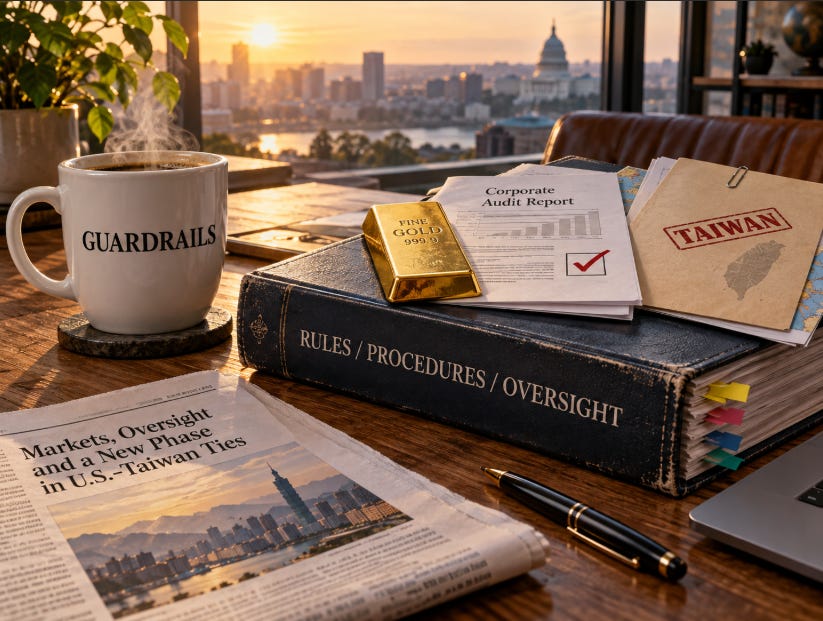
But it is worth remembering what problem they were designed to solve before announcing that the problem has disappeared. Guardrails look completely unnecessary while everyone stays on the road.
San Marino has survived more than seventeen centuries without God Mode. Its strategy has been much less glamorous: dialogue, law, institutions and a remarkably durable memory of what happens when the strong are permitted to make up the rules as they go.
The world’s oldest surviving republic may know something about survival after all.
Good work, ma’am. Thank you for this.
'He told Fox the same month that withholding the Taiwan sale gave him a “very good negotiating chip.”' That sounds one baby step away from what he got impeached for the first time. No specific quid pro quo, but "negotiating chip" sure implies one.