


By Wednesday morning, Jack Smith’s Senate testimony had made it across the Atlantic.
On LBC, the British talk radio station, the host and Washington commentator Simon Marks spent several minutes on the hearing. They savored Missouri Senator Eric Schmitt’s failed attempt to catch Smith in a lie, played the exchange for listeners, and laughed at the reveal. Marks called it a blunder so crass it deserved a wider audience. Not one sentence of Smith’s opening statement made the trip. Even the joke arrived a little scrambled, with the Iowa Hawkeyes relocated to Maryland.
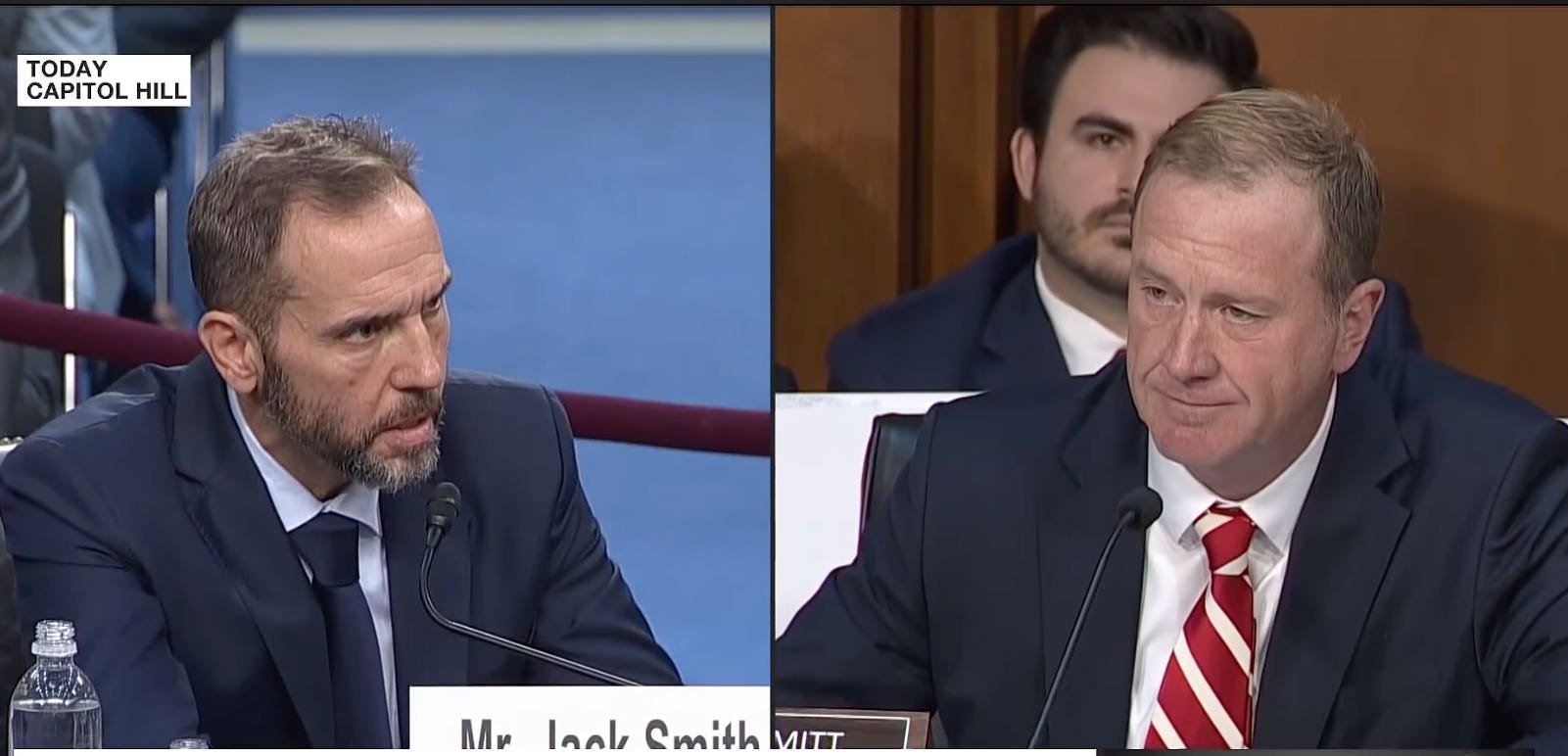
Much of the American coverage followed the same gravitational pull. Schmitt held up a poster board of text messages and accused Smith of attending an Atlanta Hawks game on February 3, 2024, the day after Fani Willis acknowledged her relationship with a fellow prosecutor. Schmitt’s theory was that Smith had been in Atlanta at an especially convenient moment to coordinate with Willis. Schmitt told him he had “already perjured” himself and called him “a total dirtbag.” Then Smith got a proper look at the poster. He had been at a women’s college game in College Park, Maryland, watching Caitlin Clark and Iowa play Maryland, with his Marshals Service detail beside him. Schmitt’s team appears to have confused the Hawks with the Hawkeyes. Afterward, Schmitt joked that nobody knew Smith was a Caitlin Clark fan. He did not apologize.
A senator built a conspiracy theory around a basketball game, accused a former federal prosecutor of perjury before letting him see the evidence, called him a dirtbag, and then discovered the whole thing hinged on the difference between the Hawks and the Hawkeyes.
That’s funny, and it also had precisely the effect Raskin identified. The Senate Judiciary Committee had convened the hearing to put the prosecutor on trial, and by nightfall the spectacle surrounding Smith was crowding out what Smith himself had said.
So here is what he said.
Smith opened by describing a nearly 30-year career spanning Republican and Democratic administrations. “I am not a politician, and I have no partisan loyalty,” he said. “I believe there is no role for politics in the proper administration of justice.”
Then came the sentence the hearing should have been remembered for:
“Our investigation developed proof beyond a reasonable doubt that President Trump engaged in serious crimes against our nation.”
If anything from those four hours was going to ricochet across television, newspapers and social media, this was the consequential claim. Not because Smith hasn’t said it before but because the prosecutor who had spent two years examining the evidence was telling Congress, under oath, that his team believed it had enough to prove its charges at trial beyond a reasonable doubt.
Instead, the Hawks went viral.
Smith said he stands by his decision to charge Trump. If asked to prosecute a former president today on the same facts, he said, he would do so regardless of whether that president was a Republican or a Democrat. The charging decisions were his, but the indictments were not his word alone: grand juries of ordinary citizens in two separate districts heard the government’s evidence and returned them.
He summarized both cases in a few plain sentences. Rather than accept his defeat in 2020, Trump engaged in a criminal scheme to overturn the results and block the lawful transfer of power. After leaving office, Trump illegally kept classified documents at Mar-a-Lago and repeatedly tried to obstruct justice to hide that he still had them. Highly sensitive national security information, Smith reminded the committee, was stored “in a bathroom and a ballroom” where events and gatherings took place.
The most striking part of the statement wasn’t about Trump’s past conduct. It was about the present.
Smith told senators the rule of law faces challenges unlike any in our lifetime. People are threatened with criminal prosecution because they are seen as having opposed the president. Predetermined outcomes increasingly override the Justice Department’s long-standing values. “History teaches that the rule of law is rarely destroyed all at once,” he said. More often it erodes through attacks on the institutions and public servants sworn to uphold it, and since January 2025, he said, the country has watched exactly that, including the vilification of the agents, prosecutors and staff who worked for him.
“I myself have been threatened with jail by the president of the United States,” Smith said. “I will not be silenced by continued threats of prosecution from the president or others.”
He ended on the public servants who have kept their oaths under extraordinary pressure. “While fear may be contagious,” he said, “courage is as well.”
Pressed by Sen. Richard Blumenthal, Smith reaffirmed his earlier House testimony that Trump was the person most responsible for January 6. The attack was foreseeable to him, Smith said, and when it happened, Trump exploited it to further his conspiracy. Smith confirmed the indictment’s account of pressure on state officials to ignore the true vote count and of fraudulent elector slates in seven states. The witnesses his office planned to call, he said, included Republicans who had wanted Trump to win but put country before party, along with police officers who defended the Capitol, more than 140 of whom were assaulted.
Smith also explained why his office sought secrecy orders during the investigation, a sore point for Republicans on the committee. The concern was never that members of Congress would obstruct justice, he said. It was that Trump and his associates would, because they already had. He cited Trump’s attacks on Gen. Mark Milley, which Smith described as suggesting Milley should be put to death, and the vile, racist death threats that Georgia election workers Ruby Freeman and her daughter received after Trump targeted them.
There was one place Smith would not go. When Blumenthal turned to the classified-documents evidence and pressed him about the storage depicted in the indictment, Smith eventually retreated to the precise formulation: “The indictment lays out the allegations.” He went no further.
That restraint was deliberate. Much of the nonpublic evidentiary record behind the documents case is reflected in Volume II of Smith’s final report, which Judge Aileen Cannon has permanently barred from release. Her February order forbids the Justice Department, and anyone acting with it, from sharing outside the department not just the report but “any information or conclusions” in it or its drafts. Cannon herself has described Volume II as containing detailed and voluminous nonpublic discovery, including interview transcripts, search-warrant materials, business records, phone toll records, video footage and grand-jury subpoena material. The Knight First Amendment Institute and American Oversight are challenging her orders in the Eleventh Circuit, where oral argument is scheduled for November 2.
So Congress spent four hours publicly interrogating a prosecutor who remained under court order not to disclose much of the nonpublic evidence from one of the two cases they were interrogating him about.
A former special counsel testified under oath that his investigation developed proof beyond a reasonable doubt that Donald Trump had engaged in serious crimes against the country. He stood by both prosecutions. He said he would bring them again on the same facts regardless of party. And he testified that the president had threatened him with jail.
Those were the words from this hearing that warranted sustained attention.
Instead, everyone learned the difference between the Hawks and the Hawkeyes.
This piece is so good. And Jack Smith is a hero.
I take a different view. While it is true that Mr. Smith's opening statement and the following questions from Democratic senators laid out the real history, as we know, lies travel around the world while truth is still putting on its pants. So you need something faster than lies, and that is mockery and humiliation. And that mockery and humiliation is what will be remembered, as it should - because this was a sham and no facts from Mr. Smith or the Democrats was going to overshadow the din of the right wing Wurlitzer. BUT, laughter and mockery was louder. And that is now what people WILL remember - a sham being exposed for what is was, not by boring facts but by the blindness of the persecutors to not check to see if maybe there was a WOMEN'S basketball game on that night. And there is something very satisfying about that. Once again, a woman was ignored by some men and it came back to bite them on their asses. Or perhaps some other part of their anatomy.