

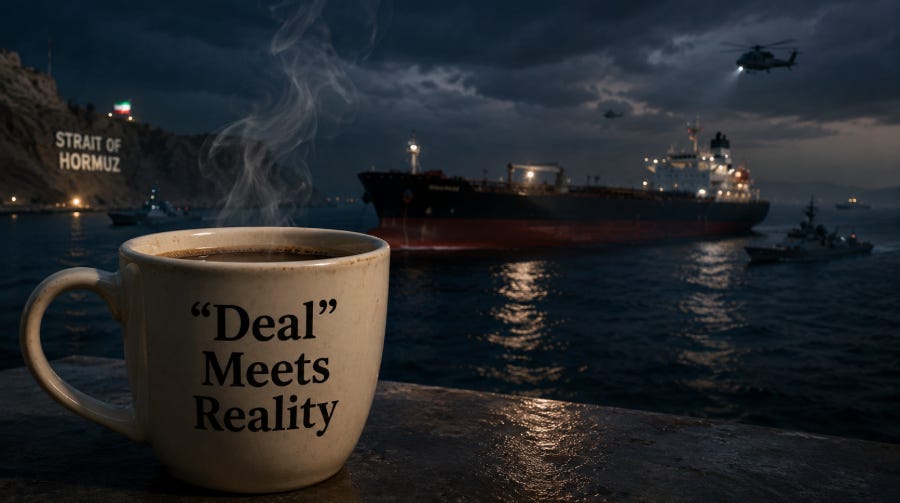
Good morning! We begin today with the world’s most heavily air-quoted “deal.” That is not just me being theatrical before coffee. A striking number of foreign headlines have started putting quotation marks around the word deal when describing Trump’s new memorandum of understanding with Iran, which tells you almost everything you need to know about the state of international confidence. This is not yet a peace agreement so much as a diplomatic object wrapped in bubble wrap, held together with mutual suspicion, maritime anxiety, and the desperate hope that nobody reads the fine print before Friday.
Trump, naturally, is selling it as victory. The MoU is “all signed.” The Strait of Hormuz will be open. Oil will flow. Markets will rise. Iran will not get a nuclear weapon. The Middle East has been remade. Please admire the beautiful document you are not allowed to see yet.
The rest of the world, less fluent in Mar-a-Lago séance language, appears to be saying: wonderful, but is this a deal, a pause, a framework, a ceasefire extension, a tanker-release program, a sanctions negotiation pregame show, or just a very expensive way to discover that Iran has leverage?
The answer appears to be yes.
The immediate news is that the MoU has reportedly been signed electronically, with a ceremonial signing expected Friday in Geneva. A small number of Iranian vessels have begun moving through the Strait of Hormuz after the U.S. began lifting its blockade. Iranian media say three Iranian oil tankers and two cargo ships have passed through, which is real movement and not nothing. In a crisis built around energy chokepoints, shipping insurance, mines, and presidential chest-thumping, five vessels moving through open water is the geopolitical equivalent of a pulse.
But a pulse is not a recovery.
What is happening in Hormuz is not a magical reopening. It is a carefully watched test. Tehran has been demanding what it calls tangible verification on the ground, because Iran’s operating assumption is that American promises age like unrefrigerated shellfish. From Iran’s perspective, ships passing through the strait are not merely logistics; they are proof that Washington has started doing something concrete. The Americans, meanwhile, would very much like everyone to understand that this is not a reward, not a concession, not sanctions relief, and definitely not evidence that Iran successfully grabbed the global economy by the windpipe and made the White House negotiate.
For Washington, alas, the optics have entered the chat.
The Strait of Hormuz was not blockaded before the war. The war created the blockade. Iran responded by demonstrating that it could disrupt one of the most important arteries in the global economy. Now the first deliverable of Trump’s “deal” is to restore traffic through the very waterway whose disruption helped turn his war from a show of strength into a political and economic liability. This is a little like setting your kitchen on fire, holding a press conference when the sprinklers turn on, and announcing that your administration has achieved historic moisture.
Then there is the darker wrinkle, and it is not hypothetical. The strait does not become safe simply because some traffic resumes. It has instead entered the condition shipping people dread most: dark, nervous, semi-normal transit. Vessels are already moving with their transponders switched off, going “dark” to avoid becoming someone’s target, which is why the U.S. military’s count of recent crossings runs well above what commercial trackers can actually see. The traffic Washington points to as proof the strait is reopening is, in significant part, ships hiding. Trump himself described the mechanism without seeming to notice, telling reporters that “a lot of oil is coming into the world that people don’t even know about.” People don’t know about it because the ships are trying very hard to make sure nobody does.
The head of the International Maritime Organization put it less cheerfully, warning that the strait remains too dangerous for commercial shipping, with no credible security guarantees and seafarers already killed, injured, or detained. On the day Trump called the waterway “totally safe, secure, and pristine,” roughly two vessels were transiting against a normal baseline of more than ninety a day.
A politician can declare a waterway open. Lloyd’s, shipowners, captains, naval commanders, and the people actually sailing through it get a vote. And if their vote is “we’ll go, but quietly, slowly, with transponders dark and one hand hovering over the panic button,” then Hormuz is not back to normal. It is open in the way a nightclub is open after a brawl: technically accepting traffic, spiritually still sweeping up glass.
Europe is already trying to figure out what role it can play. Macron and Starmer are reportedly looking at an international maritime mission to help remove mines and reassure shipping. That sounds tidy until one remembers that Iran has made clear it expects any demining, navigation, or maritime security work in the strait to be coordinated with Tehran. So the next flashpoint could be the very mission designed to prevent flashpoints. Diplomacy remains undefeated at producing sequel hooks.
Then there is the sanctions question, which is where the whole “deal” starts wearing Groucho glasses.
Iran wants sanctions relief and access to frozen assets. Of course it does. That is the prize. Before the war, Tehran did not have much leverage to force those issues onto the table. After more than 100 days of conflict, a battered but surviving regime, and a near-shutdown of Hormuz, suddenly sanctions relief and frozen funds are central to the next stage of talks. Iranian officials can now tell their own public that, yes, the country suffered, but the war forced Washington to discuss things it had previously kept locked away in the diplomatic basement.
Washington is trying to frame this very differently. U.S. officials say Iran does not get bonus points simply for signing the MoU. Sanctions relief and frozen assets, they insist, will be separate, conditional, phased, and performance-based. Iran must behave. Iran must comply. Iran must show progress on the nuclear file. Iran must not treat the signing ceremony like an ATM.
So Iran says: prove you will keep your promises.
Washington says: prove you deserve relief.
That is basically the whole agreement standing in front of a mirror arguing with itself.
The FT’s read is especially useful here because it cuts through the victory confetti. Trump once promised there would be no deal except “unconditional surrender.” What he has now is a 60-day truce of convenience. Iran did not surrender. The regime survived. Its military and infrastructure were damaged, yes. Its leadership was hit, yes. But the state did not collapse. The IRGC remains central. Mojtaba Khamenei has replaced his father. Iran’s missile, drone, and proxy architecture has not been resolved by this MoU. The nuclear issue has not been settled. The enriched uranium question has been deferred into the next phase. Missiles, drones, and regional proxies remain the large angry furniture in the room.
Far from unconditional surrender, we have conditional ambiguity with a Friday ceremony.
The reported nuclear language is also less sweeping than Trump’s victory lap suggests. Iran reaffirms that it will not develop nuclear weapons, which is a position Tehran has long maintained. The hard part is not the slogan; it is the stockpile. Iran has enriched uranium, including material near weapons-grade levels. The question is what happens to it, who verifies it, whether it is diluted, moved, monitored, or used as a bargaining chip until everyone involved develops a stress rash. Those negotiations begin after the MoU is formally signed. In other words, the deal has solved the nuclear issue in the same way putting “clean garage” on your calendar solves the garage.
Former President Obama has now weighed in, and his comment lands like a very polite brick through the window of Trump’s victory lap. In an interview with ABC’s Robin Roberts, Obama said it is “doubtful that any agreement that arises is going to be significantly different or a significant improvement from the deal that we had in the first place.”
That is the ghost of the JCPOA wandering back into the room, looking around at the smoke, the ships, the mines, the sanctions talk, the 60-day negotiating window, and asking whether everyone enjoyed the scenic route.
Trump tore up Obama’s Iran deal in his first term, spent years denouncing it as a humiliating bribe, then launched a war supposedly designed to eradicate Iran’s nuclear program. Now the main nuclear questions remain unresolved, Iran has once again agreed in principle not to pursue nuclear weapons, and the hard bargaining over enrichment, verification, uranium disposal, sanctions relief, and frozen assets has been pushed into future talks.
When JD Vance says this is nothing like the JCPOA because the Obama deal “bribed” Iran, the obvious response is: lovely, but if this ends with phased sanctions relief, oil waivers, frozen-assets negotiations, nuclear monitoring, and Iran reaffirming commitments it had already made, then the branding may be different while the diplomatic skeleton looks awfully familiar.
Call it JCPOA with airstrikes. Call it the Trump Deluxe Edition. Call it whatever makes the commemorative coin easier to sell. But Obama’s structural point stands: the United States started a war, killed a head of state, shut a strait, spiked the global economy, and may be reassembling a version of the agreement it already had.
Lebanon remains the place where this entire arrangement could trip over its own shoelaces.
Iran and Pakistan have framed the ceasefire as applying to all fronts, including Lebanon. Netanyahu has said Israeli forces will remain in southern Lebanon as long as necessary. Israeli officials continue to signal that they reserve freedom of action wherever they perceive threats. Hezbollah and Israel are still trading fire. Displaced Lebanese are returning not to peace, but to destruction with a side order of uncertainty.
This is a problem because Lebanon is not a footnote. It is the test of whether this MoU is a regional de-escalation framework or merely a bilateral pause between Washington and Tehran while Israel keeps its own calendar. If Lebanon is included, Israel is already challenging the agreement. If Lebanon is not included, Iran and Pakistan have been overselling the scope. Either way, the “deal” has a geography problem.
Then we arrive at the economy, where the NYT has helpfully walked in with the bill and a facial expression that says nobody is leaving this restaurant happy.
The first economic problem is immediate and domestic. Trump promised that once the Iran situation was resolved, oil and gas prices would drop like a rock. Oil futures have indeed fallen on the news of the MoU, and markets have rallied because markets enjoy hope, liquidity, and not having the Persian Gulf behave like a locked escape room. But gas prices do not fall as quickly as presidential adjectives. Shipping backlogs do not clear overnight. Fertilizer shortages do not politely disappear because the White House needs a midterm message. Food prices can rise on a lag. Inflation can keep moving even after the shooting slows.
That is the kitchen-table trap. Trump can point to lower oil prices from the wartime peak. Voters will compare today’s gas and grocery bills with what they paid before the war. “Better than the worst moment of the crisis I created” is not exactly a bumper sticker.
The broader NYT economic argument is even more damning. The Iran war may have permanently altered the global economy. The energy order is being reshaped. Countries dependent on Middle Eastern imports are accelerating the search for alternatives. Some are turning back to coal in the short term, because nothing says strategic resilience like wheezing into the future. But over the longer term, the shock is likely to accelerate investment in renewables, batteries, energy efficiency, and nuclear power.
And who is best positioned to benefit from that transition? China dominates much of the manufacturing base for solar panels, wind turbines, batteries, grid equipment, transformers, high-voltage cables, and the software needed to manage modern energy flows. So while Trump wages war in the Gulf and tries to kneecap renewable projects at home, Beijing gets to sit back like the world’s most patient hardware store owner during hurricane season. The U.S. destabilizes the oil order; China sells the tools for the next one. Incredible work. No notes, except perhaps “stop doing that.”
The war has also shaken confidence in the Gulf’s stability brand. The UAE, Saudi Arabia, Qatar, Kuwait, and others have spent years marketing themselves as secure hubs of finance, energy, logistics, tourism, sport, and global business. Iran’s strikes and threats have revealed vulnerabilities that glossy airport ads cannot airbrush away. If Qatar’s gas infrastructure can be hit, if Saudi petrochemicals can be targeted, if the UAE’s aura of safe luxury can be punctured, then investors, insurers, and governments will price that risk. The money may still come, but it will arrive with more conditions, higher premiums, and a nervous glance toward the exits.
The U.S. security guarantee has also taken a hit. For decades, one of the core assumptions of the global economy has been that the United States Navy could keep the sea lanes open. Iran has now demonstrated that it can disrupt the Strait of Hormuz, anyway. Iran has proven asymmetric warfare to be effective, a major strategic revelation, and not one Washington wanted the world to learn in real time.
The macro picture is bleak. Global growth forecasts are being revised downward. Inflation is rising again. Central banks that had hoped to cut rates are now facing pressure to hold or raise them. Higher rates make public debt more expensive. Governments will spend more on household relief and defense. Poorer countries, especially in Asia, are already seeking emergency help to absorb the shock. Businesses hate uncertainty, and the Iran war has sprayed uncertainty across energy, shipping, investment, security, and diplomacy like a malfunctioning lawn sprinkler.
So when Trump says the deal is done, the economy hears: define done.
Is the war ending? Maybe.
Is Hormuz reopening? Partially.
Is oil falling? From the peak, yes.
Are prices going back to where they were? Not quickly.
Is inflation solved? Absolutely not.
Is the nuclear issue settled? No.
Are sanctions relief and frozen assets resolved? No.
Is Lebanon pacified? Please be serious.
Has Iran lost all leverage? The entire structure of the MoU suggests the opposite.
That is why the quotation marks around “deal” are not just punctuation; they are an editorial diagnosis. The foreign press is not denying that something has been signed. It is questioning whether the thing being sold as a deal actually does what the word implies. A deal usually suggests resolution. This looks more like a ceasefire extension, a maritime reopening mechanism, a sanctions bargaining framework, and a political flotation device for a president who needs gas prices to stop punching him in the midterms.
The tragedy is that a pause is still better than escalation. Stopping the bleeding and ships moving is important. Diplomacy, even ugly diplomacy, is preferable to another round of missile strikes, blockades, and civilian suffering. But we should be clear-eyed about what has happened. Trump did not force Iran into unconditional surrender. Iran did not emerge unscathed. Israel did not achieve its maximal objectives. The Gulf did not become safer. The global economy did not bounce back. The U.S. did not demonstrate effortless command of the seas. China did not lose. Lebanon did not get peace.
What we have is a fragile MoU that may buy 60 days, reopen part of a waterway, lower the immediate temperature, and push the hardest questions into the next room.
The morning bottom line is this: the “deal” is real enough to move ships, markets, diplomats, and headlines. It is not yet real enough to restore trust, settle Lebanon, neutralize Iran’s nuclear leverage, undo the economic shock, or make Trump’s promise of a quick rebound come true.
The war may be pausing. The bill is just getting started.
Marz and I need a romp!
If China profits most form this "reset," so be it. Increasing the use of renewable energy is first and foremost.
When can we expect the Victory Parade? And will it be in Washington or Tehran?