

Good morning! Today, I’m going to depart from the usual format to talk about something I suspect many of us have been thinking about for some time. This is not a diagnosis, and I want to be clear about that from the outset. But after Trump’s grotesque Truth Social post about Robert Mueller, and as we watch the attack on Iran unfold in chaos, I think it is worth confronting a possibility that should concern every one of us.
Disinhibition is the loss of the internal brake that keeps a person from saying or doing the most impulsive, cruel, or reckless thing that comes into their head. It can look like open cruelty, inappropriate disclosures, rage without restraint, or rhetoric that feels increasingly unfiltered and unmoored. It is also one of the hallmark features clinicians associate with behavioral-variant frontotemporal dementia, though no responsible observer can diagnose that from public behavior alone. That said, many licensed professionals have publicly raised concerns about exactly this pattern in Trump’s behavior. I would add only this: I am not sure Trump ever had much of a normal inhibition filter to begin with. What may be changing is not his nature, but his ability to conceal it.
We are left with conjecture because Trump’s true condition is being so artfully concealed. What made reporting from January so unnerving was not that it proved some hidden diagnosis. It was that it revealed a White House treating Trump’s health as a stage-managed propaganda exercise. When Ben Terris arrived at the Oval Office, he found two doctors literally holding pages labeled TALKING POINTS. That image alone says more than any formal statement could. Trump’s health was not being discussed as a matter of public accountability, but as a message to be controlled, polished, and sold.
What they were selling was not merely fitness. It was mythology. Stephen Miller insisted the only honest headline would be “The Superhuman President.” Karoline Leavitt claimed Trump’s public nodding-off episodes were really “active listening.” Marco Rubio described him like some tireless force of nature haunting Air Force One while younger men hid under blankets, hoping not to be caught asleep. Again and again, the people around him did not respond to visible signs of age with candor. They responded with flattery, exaggeration, and the sort of loyalty theater more common to a court than a democracy.
The article also quietly documents the very things this mythology is trying to cover: the swollen ankles, the bruised and bandaged hands, the puffy eyes, the hearing loss, the weekend naps, the refusal to exercise, the terrible diet, the moments when he appears to drift off, and the strange defensiveness whenever his health comes up. Those physical signs sit alongside a long pattern of public behavior that is crude, inappropriate, and increasingly unrestrained, from telling a reporter “quiet, piggy,” to bringing up Pearl Harbor with Japan’s prime minister, to his recent Truth Social post about Robert Mueller, which began, “Good, I’m glad he’s dead,” before descending into the kind of vindictive public gloating that most people, even in politics, would still have enough restraint not to publish. Terris is careful not to claim more than he can prove, and that restraint makes the reporting more credible, not less. He does not hand readers a neat diagnosis. He shows readers something more troubling: a visibly aging, volatile president surrounded by people whose instinct is not to level with the public, but to mythologize him into invincibility.
Trump appears increasingly erratic and disinhibited, while those closest to him remain committed to denying weakness at all costs. Many watching from the outside have begun to wonder whether they are seeing not just ordinary aging, but a more disturbing loss of judgment, restraint, and emotional control. In any ordinary leader, that would be alarming. In a president currently prosecuting a war, escalating conflict, and commanding America’s weapons, it becomes something else entirely. It becomes a national security issue disguised as image management.
Cruelty distorts judgment. For a man already prone to cruelty, it teaches a leader to confuse punishment with policy and vengeance with leadership. Even more unsettling is when that cruelty is paired with a visible loss of restraint.
Obviously, I am not talking about a formal diagnosis, but that is where Donald Trump now appears to be. Without access to his medical chart, his scans, or the whispered conversations happening behind closed doors. None of us should claim certainty, but we are not blind. We are seeing is a man who seems less and less able to restrain cruelty, rage, and reckless rhetoric. And that alone should terrify us, because this is a man with his fingers on America’s weapons.
This is why the question of Trump’s mental state cannot be brushed aside as gossip or armchair speculation. We are not talking about a retiree embarrassing himself at a family gathering. We are talking about a president overseeing war, issuing ultimatums, threatening civilian infrastructure, and holding the power to expand a regional conflict with incalculable human consequences. If there is any truth at all to the growing concern that Trump is becoming less able to restrain his impulses, then what we are witnessing is not merely a personal decline. It is a national security threat.
Trump is now trying to rebrand war with Iran the way he rebrands every mess he creates: first as a triumph, then as someone else’s cleanup problem. After spending weeks boasting that the U.S. was “ahead of schedule,” he suddenly started floating the idea of “winding down” operations, as if this whole thing were a weekend landscaping project and not a region-wide catastrophe spiraling toward an infrastructure war. The problem for him is that Iran has not collapsed, has not surrendered, and has not conveniently handed him the made-for-TV victory montage he clearly expected. Instead, Tehran is still firing missiles, still finding ways to penetrate Israeli defenses, and still proving that even after weeks of U.S. and Israeli strikes, it retains enough capacity to make this war uglier, costlier, and much harder to package as a win.
Now we’ve entered the truly dangerous phase: mutual threats against the systems that keep the region alive. Trump has issued a 48-hour ultimatum demanding that Iran reopen the Strait of Hormuz or face U.S. strikes on Iranian power plants, “starting with the biggest one first.” Iran responded by warning that if its own energy infrastructure is hit, then energy sites, oil facilities, and even desalination plants across the Gulf will become legitimate targets. So this is no longer just a war of airstrikes and missile barrages. It is sliding toward a war on electricity, water, shipping, and the basic machinery of civilian life across the Middle East. That is a spectacularly horrifying place to be, especially when one of the men holding the matches keeps changing his objectives every six hours.
The military reality is colliding headfirst with Trump’s messaging. Iranian missiles struck Dimona and Arad overnight, injuring large numbers of people and demonstrating that Tehran can still land painful blows even near one of Israel’s most sensitive strategic areas. Whatever else has been damaged, Iran’s ability to retaliate has not been “obliterated.” That matters because the White House keeps talking as if destroying enough launchers or bases will somehow produce political surrender on demand. But Iran appears to have defined victory far more simply: survive, endure, and keep raising the cost. And that, for Trump, is the nightmare scenario. He can destroy infrastructure. He can terrorize markets. He can bark orders at allies to police Hormuz after largely freezing them out of the decision-making. But he cannot force reality to obey the Truth Social post.
The economic shock is becoming its own battlefield. Hormuz remains the central chokepoint of the war, with traffic severely disrupted and energy markets rattled by the possibility that this crisis gets even worse. Saudi and Emirati bypass routes can soften the blow, strategic reserves can buy a little time, and sanctions waivers can temporarily shove more oil onto the market, but none of that replaces the importance of the strait itself. Gulf states are now staring at the obvious conclusion: American bases did not protect them from becoming targets, and the regional order they were trying to stabilize is being dragged into a scorched-earth confrontation anyway. In other words, Trump may be eyeing an exit, but the war he launched is already mutating into something broader and nastier than the quick victory he sold. He wants to call it an excursion, but the region, the entire world is living with the consequences.
One more thing, because this matters. Another massive No Kings mobilization is planned for Saturday, March 28, with organizers and local outlets reporting thousands of events nationwide. Marz and I will be there. People should go and show up in force. But we also need to be honest about the limits of polite weekend outrage in the face of a government that is now dragging the country toward a wider war and a possible economic calamity. Since the last wave of protests, Trump has not moderated; he has attacked Iran. He has escalated, threatening Iranian infrastructure, deepening the regional crisis, and fueling an energy shock that is already rattling the global economy.
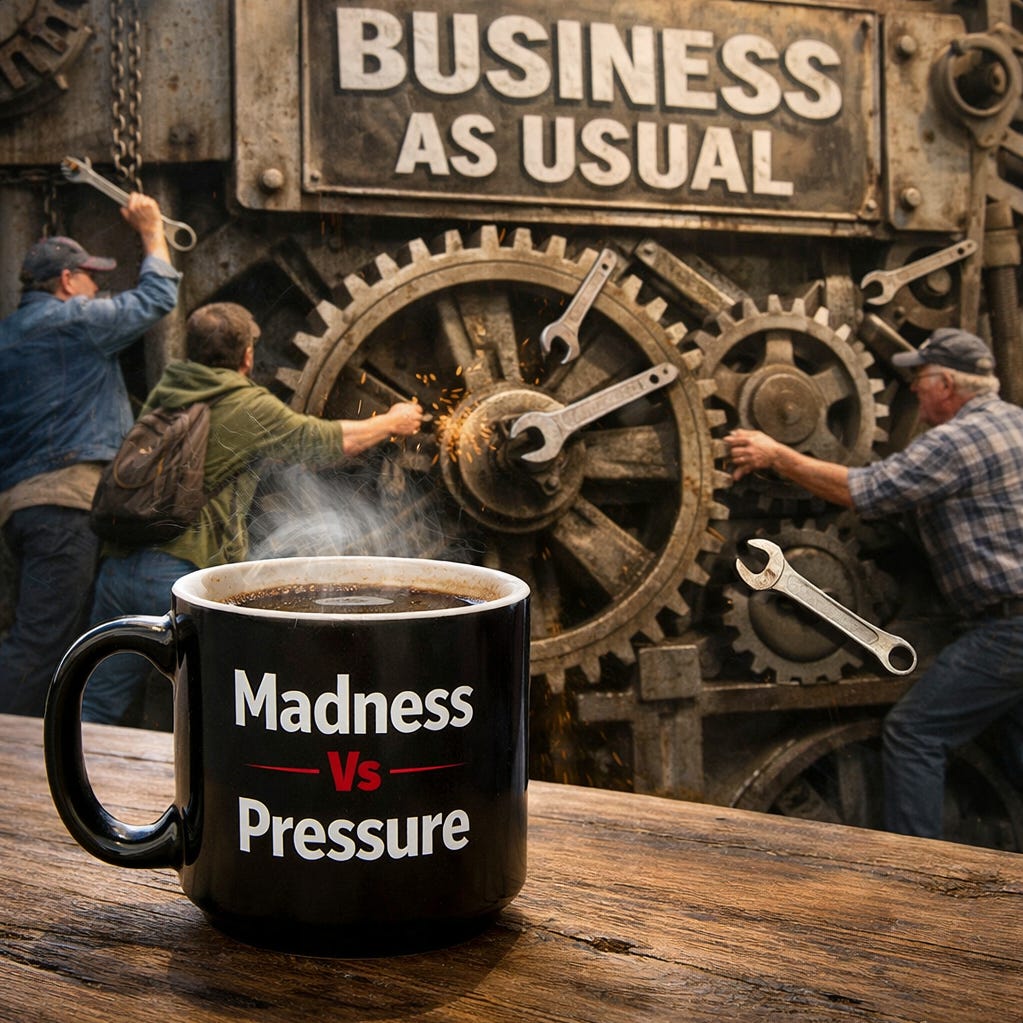
So this cannot end with one more Saturday rally and then a quiet Monday morning while the machinery of authoritarianism goes back to work. We need sustained, visible, peaceful pressure that reaches the people with actual power: weekday actions, packed town halls, constant phone lines, local business pressure, labor pressure, general strikes, civic disruption that is nonviolent but impossible to ignore, and a level of public refusal that makes “business as usual” politically unbearable. Lives are now hanging in the balance, the lives of American troops, the lives of civilians across the Middle East, and the lives that will be wrecked if this spirals further. Weekend crowds can show the size of the opposition. What changes history is when ordinary people make it impossible for the system to pretend nothing is happening.
The world is literally depending on us now, begging us to show what real Americans are made of. So yes, go on March 28. Fill the streets, loudly, peacefully. Show the size of the opposition in unmistakable numbers. But then wake up on Monday and act like the emergency is real, because it is. Lives are on the line. The lives of our own troops, the lives of civilians across the Middle East, and the lives that will be shattered if this spirals even further. Waiting for a handful of Republicans to suddenly discover a conscience is not a strategy. Pressure is the strategy.
My Dear President Cheapshot,
As if the world needed any more evidence to support what a demented, vile, self-centered son of a bitch currently occupies the Oval, you publicly offered your thoughts on the passing of former FBI Director Bob Mueller.
Shameful.
As I understand it, bombing civilian infrastructure is a war crime, unless that infrastructure is direcly involved with the military. So bombing power plants that don't directly power Iran's war effort would be a war crime.
Maybe it's time for the military to obey their oath to the constitution and refuse to bomb civilian infrastructure. Military leaders need to be in front of this, not leaving it to pilots or other junior staff.
There would be trouble, but just imagine if Trump ordered a nuclear strike on Iran. Would they obey? I hope not