


There is no role Donald Trump enjoys more than the one where he wrecks the furniture, strolls back into the room with a solemn expression, and expects praise for not smashing the lamp on his second pass. He has built an entire political career on this particular form of self-flattering absurdity. First he creates the ugliness, then he moderates it slightly, then he waits for the standing ovation that is supposedly owed to a man of such tremendous restraint. It is the logic of the mob boss who wants a thank-you card because he only broke one kneecap. It is also, in miniature, exactly what played out in the bizarre little drama over Iran and the 2026 World Cup.
The sequence is what makes it funny, because the sequence is always what makes Trump ridiculous. On March 3, when asked whether Iran should be allowed to play in a World Cup co-hosted by the United States, Mexico, and Canada, Trump offered the sort of response one imagines from a casino owner who has just been informed that diplomacy exists. He said he “really didn’t care.” Not exactly the language of a gracious statesman preparing to welcome the world. Not even the language of a man pretending to care about the grandeur of international sport. It was petulant, bored, and casually imperial, which is to say it was perfectly on brand.
Then came the pivot, because with Trump there is always a pivot from brute force to theatrical benevolence whenever he senses that benevolence might photograph better. A week later, FIFA president Gianni Infantino emerged from a meeting with him carrying the reassuring message that Iran was, “of course,” welcome to come compete in the United States. “Of course” is such a marvelous phrase in this context because it comes wrapped in fake inevitability and counterfeit grace. It makes the whole thing sound civilized, as if nobody had been threatened, excluded, bombed, banned, or turned into a geopolitical prop five minutes earlier. “Of course” is what one says when one wants credit for generosity while frantically hoping nobody notices the velvet rope, the armed guards, and the guest list composed by people who confuse domination with order.
It was a perfect Trumpian tableau. First the shrug, then the soft-focus magnanimity, then the implied request for admiration. Look at the great man, rising above petty conflict for the love of the beautiful game. Look at him setting aside animosity so that football may unite humanity. Look at him behaving, for one brief and miraculous second, like a functioning host of a global event rather than a nightclub owner deciding which faces belong past the cordon. It was the kind of scene that only works if everybody agrees to participate in the fiction. Iran, gloriously, did not.
The next day, Iran’s sports minister said participation in the World Cup was “not possible.” Not “awkward,” not “under discussion,” not something to be evaluated by committee after a productive round of consultations. Simply, “not possible.” The bluntness of the response was what gave it its comic timing. Trump and Infantino had barely finished arranging the lighting for the magnanimity photo op before Iranian officials came in and kicked over the set. It was, in essence, a rejection not just of the invitation but of the story Trump was trying to tell about the invitation. He was prepared to cast himself as the large-souled host, dispensing grace to a nation in crisis. Iran’s answer was that it had no interest in playing grateful guest in his vanity pageant.
And honestly, who could blame them. The alleged generosity on offer was fraudulent from the start. The United States had not suddenly become some radiant temple of open borders and cosmopolitan fellowship. Under Trump’s travel restrictions, athletes and official team delegations could receive an exception tied to major sporting events, while ordinary nationals from Iran still faced broad restrictions on entering the country. In other words, the arrangement was never “you are welcome.” It was “your team may come provide content, spectacle, and valuable television inventory, but your people can remain a problem.” That is not magnanimity, that is event logistics dressed up as moral elegance.
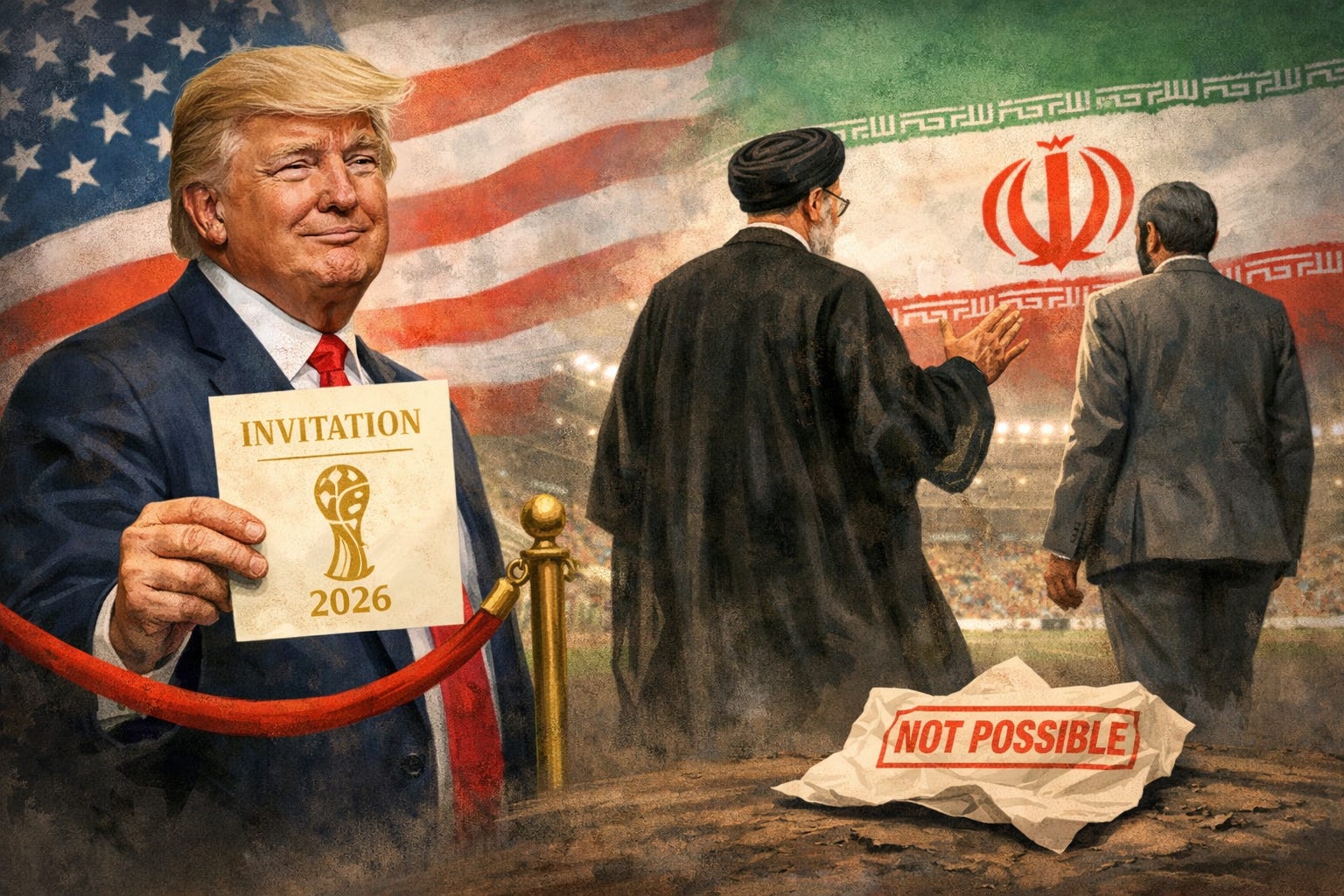
Once you see the structure clearly, the whole thing turns from pompous to farcical. Trump wanted the credit associated with tolerance without surrendering any of the machinery of exclusion that makes the performance necessary in the first place. He wanted the optics of sportsmanship while preserving the politics of hostility. He wanted to look like the bigger person while remaining exactly the same petty, border-obsessed impresario who turns human movement into a ranking system. The implied message was not that conflict had been transcended, it was that elite athletes remain useful enough to receive temporary permission slips, while everyone else gets to continue existing as a security abstraction.
That distinction matters, and it matters especially because the entire modern sports-industrial complex depends on pretending not to notice it. FIFA, with Gianni Infantino in his natural role as the world’s most shameless apostle of polished nonsense, loves to sell the fantasy that football hovers above politics like a sacred international mist. The World Cup unites, the game belongs to everyone, the tournament transcends conflict. This kind of rhetoric would be much easier to take seriously if it were not constantly colliding with the grubby realities of visas, restrictions, sanctions, wars, host-government ego trips, and the deeply revealing question of which kinds of foreign bodies are considered useful enough to admit. When FIFA says the game is for everyone, the fine print often reads like a private-members club brochure.
That is why Iran’s response landed with such satisfying force. It punctured the mood music, declined the emotional choreography, it refused to let Trump cosplay as a generous global patriarch for the afternoon. There is something almost old-fashioned about how blunt it was, because we are so accustomed now to the diplomatic language of concern, review, consultation, and process that the words “not possible” feel refreshingly rude. They do not flatter the host, do not protect the sensibilities of the international organizers, and they do not preserve the ceremony. They simply announce that the ceremony is fraudulent and that the invited party has no obligation to help stage it.
The funniest part is that Trump almost certainly imagined this as a win. You can almost see the appeal from his perspective. After years of turning borders into a personal fetish object, he gets to pose as the grown-up who can set politics aside for sport. After years of marketing cruelty as seriousness, he gets to momentarily borrow the costume of lenience. After years of insisting that foreigners are a threat until they become useful, he gets to sound gracious because he has decided not to interfere with a television event. It is the same cheap dramatic structure every time. He narrows the field of what counts as acceptable, then basks in admiration when he chooses not to narrow it quite as far as he could have.
What he did not seem to account for was that Iran had no reason whatsoever to reward that performance. No reason to pretend that a selective carveout inside a broader regime of exclusion was some noble offering, no reason to help him launder hostility into hospitality, and no reason to stand under the lights while Trump collects credit for behaving marginally less vindictively than the character he had written for himself the week before. Trump wanted a scene in which he looked broad-minded and history looked grateful. Instead, he got a rejection that made his whole routine look vain, contrived, and a little pathetic.
That is the larger lesson of the episode, and it extends well beyond Trump, though he embodies it with his usual gold-plated vulgarity. Powerful countries, political leaders, and international sports bodies all love the fantasy that they can brutalize with one hand and curate a healing spectacle with the other. They love the idea that pageantry can neutralize power, that a tournament can bleach out the politics of the host, and that any invited country should be honored to help complete the picture. What they hate is being reminded that invitations are not morally impressive when they are issued from inside an architecture of domination. Being allowed in is not the same as being welcomed, and being welcomed is not the same as consenting to the story the host is trying to tell about himself.
So yes, Trump wanted credit for letting Iran in. He wanted the glimmering little side benefit of appearing civilized, he wanted to look, for a moment, like the bigger man. Iran’s answer was that he could keep the credit, keep the performance, keep the self-congratulation, and keep the script. It was a lovely little humiliation, not because it changed the world, but because it ruined his favorite scene. He did not get to be the benevolent patriarch of the World Cup. He got to be what he so often is when the theater breaks down and the audience stops cooperating, which is just another vain man in an expensive suit, holding an invitation nobody particularly wants and wondering why nobody is thanking him for the privilege.
Who decided Melania Trump should preside over a UN security council meeting about children in war zones, two days after we bombed a girl's school in Iran, killing 160 children? Why do they think ANYONE should take us seriously? It would be hilarious if it wasn't so tragic.
I'm still surprised that the World Cups were not canceled in America. The rules should be the same as the Olympics. Sports are for the athletes, not politics, especially from those countries that suppress their citizens. Iran, Russia, Cuba and now the United States should not be allowed to play