


This week, I was reminded that hope can arrive looking remarkably like another thing going wrong, which I would respectfully suggest is a terrible system. A handwritten note would be lovely, or perhaps a small basket of muffins, but apparently sometimes the message comes through a broken waterline and a phone call from the pediatrician.
A few weeks ago, our main waterline broke, and we spent a tremendous amount of money replacing the entire house’s pipes with PEX. There was digging, there was frustration, and there was the newly familiar experience of owning a home that occasionally presents you with an invoice for continuing to exist. My husband worked his tush off, my brother came to help, and our front yard briefly became an excavation site for money we had previously imagined spending on other things.
At the time, I was grateful for the people helping us and considerably less grateful for the plumbing. I understood that owning the ground being torn apart was a privilege, especially after everything we had been through to keep it, but I would also have appreciated the privilege of leaving it alone. Then Ezra tested positive for lead exposure, and suddenly those new pipes meant something different.
His blood lead level was slightly elevated, and we’re working with his pediatrician on follow-up and with public health and the city to investigate the water. The old pipes were still here because hauling them away was on the list, and our list has become less of an organizational tool and more of a historical record of our intentions. My husband and I tested them, and the tests indicated lead. A test of water coming from the main raised concerns, too, so we’re still working to establish the source and find a solution.
In the meantime, we’re drinking, cooking, and brushing our teeth with water purchased by the gallon. Our kitchen has acquired a small municipal supply department, and apparently I am its director, purchasing agent, and most vocal dissatisfied customer.
I’m hopeful that Ezra is going to be okay, and we’re following through with his care, but there is something terribly unsettling about discovering that an ordinary act of caring for your children might have exposed them to something harmful. You turn on the faucet because someone is thirsty, because dinner needs to be made, because there are little teeth to brush before bed. You’re doing the things love asks you to do, and you want so badly for those things to be enough.
I wish he’d never been exposed. I wish we’d found out another way. But I also keep looking at him and thinking that, without his test, we might never have known to ask these questions, and our family could have continued using the water without realizing there was a reason to investigate it. To explain why that thought reaches so deeply into me, I have to go back to my grandfather.
When he died in February of 2024, my husband and I were struggling financially, and I couldn’t see how our lives were going to get easier. Grandpa was grouchy, sarcastic, well-read, and deeply loved. During his last weeks, Mom would call me to help get him back into bed, and I would stay beside him afterward. I sometimes wondered whether he was finding ways to get a few more minutes with me.
When Mom called that morning to say she thought he had passed, I hurried over. Sitting beside him, I felt an inexplicable certainty that another child would somehow help save us. My husband and I couldn’t make sense of it, and eventually put the thought aside.
Nearly a year later, despite birth control, I was pregnant. We spent months considering names before choosing Ezra, meaning helper. His arrival led me to work with Mom and helped set in motion the fundraiser that saved our home. Writing became my work, and a future I couldn’t see began taking shape.
I still don’t have an explanation that would satisfy someone asking me to show my work, and I’m generally a person who appreciates being able to show my work. All I know is that I sat beside someone I loved at the end of his life and felt, for a moment, that there was something waiting for us beyond everything I was afraid of.
Now that something is a little boy, my sweet mister boy, generally delighted to be alive unless the people responsible for snacks and affection have failed to interpret his instructions promptly enough. He has no idea how much of our world changed around his arrival, how many possibilities came back into view, or how often his mother looks at him and thinks about her grandfather. And now, because of him, we know to investigate the water.
I can’t call his exposure a gift, because I would take it away from him in a heartbeat. But I can be grateful that we know, grateful that we can act, and grateful that the pipes inside our house had already been replaced before we understood what else might be wrong. I can look back at that expensive, exhausting trench and see more than I could while we were standing beside it.
It makes me wonder how much of our lives we are only able to understand later, after the dirt has settled and something we thought was merely another hardship becomes part of the reason we made it through.
I have been thinking about that while reading about a place in Salinas, California, where people have spent years working toward something they can now finally walk through.
According to Big Sur Land Trust, more than 7,000 residents participated in planning, advocacy, and other work behind Ensen Community Park. Its 67-acre restoration area is scheduled to open today, September 20, with wetlands, grasslands, more than 12,000 native plants and trees, and 1.7 miles of trails. The project brings nature closer to neighborhoods that have historically had limited access to green space, and the landscape will continue to need care as it matures. Already, 68 bird species have been documented there, along with frogs, toads, and a family of gray foxes, who apparently reviewed the development and found the accommodations acceptable.
I keep imagining what it would feel like to have helped make that place possible and then see a bird using it as though it had always been there. You might remember the meetings, the uncertainty, the long stretch when there was still more to do than there was to admire, but the bird has found what it needs and is getting on with being a bird. There’s something wonderful about that, about a human decision becoming another creature’s ordinary life.
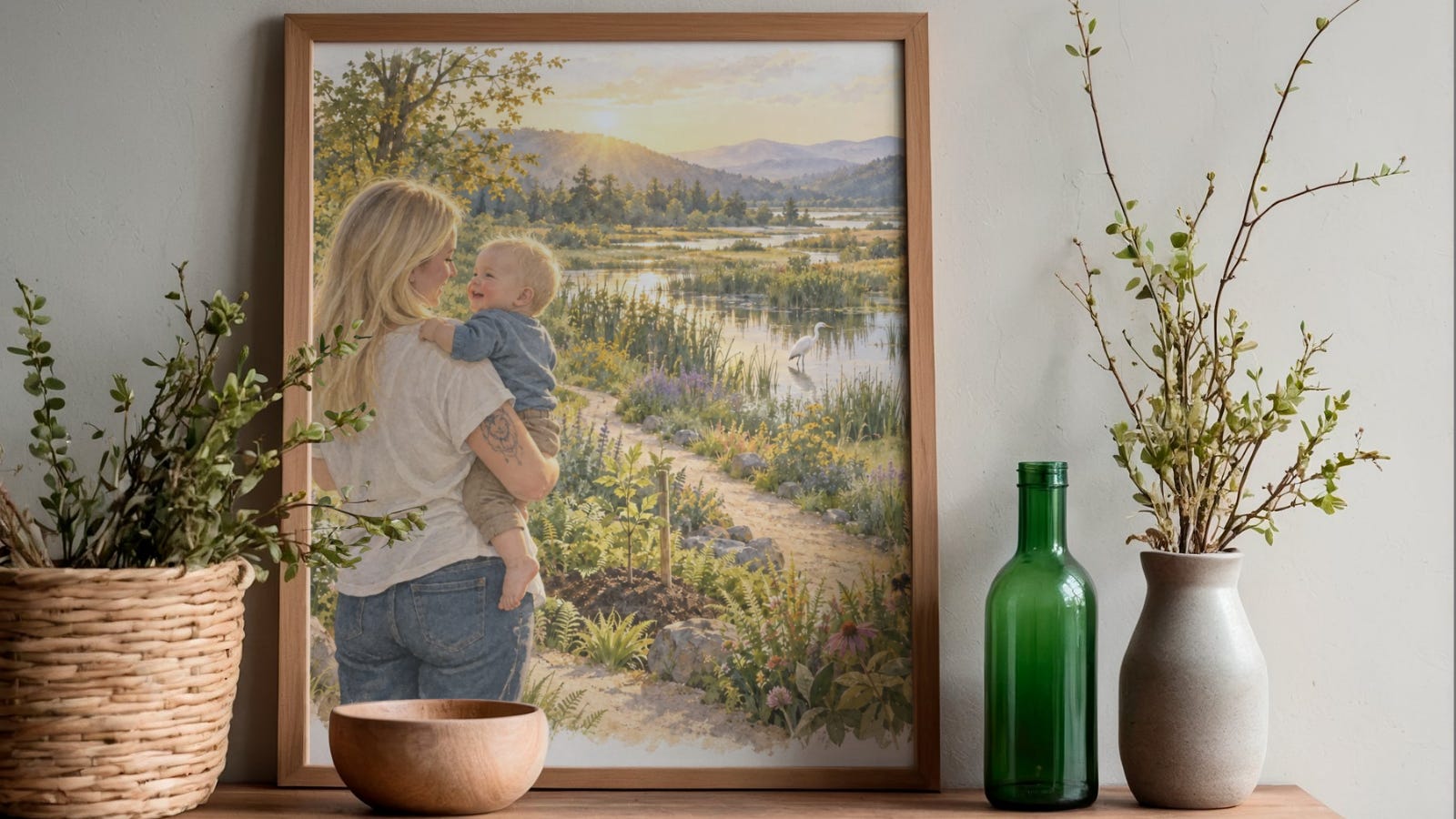
And someday a child may walk those trails with someone they love and carry that afternoon with them for decades. They may remember the water, a fox disappearing into the plants, or a parent stopping to help them see something they would otherwise have missed. They won’t need to know who attended which meeting or how long the work took, because the gift will already be there, waiting for them to live inside it.
I know what it is to have a place you love depend on other people caring about its future. I know how different the ground feels beneath your feet when you can finally stop wondering whether you will have to leave it. So when I read about thousands of people helping bring a landscape back, I think about all the lives that will unfold there, all the small happiness that has been given somewhere to happen.
Meanwhile, in Somerset, England, volunteers are learning to use scythes to help protect the rare shrill carder bee, which is the kind of news that makes me feel humanity may still be qualified to supervise itself. English Heritage is training people at Muchelney Abbey to care for its meadows using the traditional tools. The Times reports that the slower cutting gives wildlife more opportunity to escape than mechanical mowing, allowing people to manage the grass with greater care for the creatures living in it.
Somewhere, the local hobbits have formed a conservation committee, and I am relieved that somebody sensible has taken charge. My husband will also be relieved to know that I have managed to read this story without ordering a scythe, although I can’t make any promises about my future development. I love that someone decided this bee was worth learning something for. That its continued existence deserved time out of a human day, a change in habit, and the willingness to be a beginner at something because another life might benefit.
The volunteers may never see every bee their work helps, just as the people who helped create the park will never meet every child who loves it. There’s no way to stand at the beginning of an act of care and see everything that might come after it, which seems like a very good reason to be generous with the care we offer.
My grandfather couldn’t have known the little boy I would eventually hold, and the people who helped our family keep our home couldn’t have known every ordinary happiness their kindness would make possible. They helped us have somewhere to go on living, and living, as it turns out, keeps producing things worth being here for.
There are gardens to plant, anniversaries to reach, children to watch becoming themselves, and mornings when a baby calls for you as though your arrival is the only remaining requirement for a satisfactory universe. There are also broken pipes, frightening phone calls, and days when you need someone else to help you remember that the whole story hasn’t happened yet.
This week, we’re still finding answers. I would love to be able to tell you that everything is resolved, but for now there is another gallon of water to buy, another question to ask, and a little boy who deserves to get on with the important business of growing up while we handle the rest.
He has already helped us find our way toward so much. I want him to have years in which he gets to be the one receiving the gifts, discovering a beautiful place someone restored before he could walk, hearing stories about the people who loved him before they met him, and learning how much goodness was here waiting for him all along.
I still think about my grandfather and that strange moment when, in the middle of losing him, I felt certain that our family had a future I couldn’t yet imagine. Today I can hold a piece of that future in my arms, and he is warm, loud, hungry, happy, and completely unaware that his mother occasionally finds his existence almost too beautiful to bear.
We have more work to do, and I’m sure I will complain about some of it, but I am so grateful that we get to be here doing it. Somewhere in California, foxes have found a home in a place people brought back to life, somewhere in England, people are learning to leave a meadow kinder than they found it, and here in Oregon, we are taking care of the little boy who helped us believe in tomorrow before we knew what tomorrow could hold.
If you’d like to leave a little extra love for our family’s projects, plants, and everyday adventures, you can chip in here.
Right now, those adventures involve new pipes, lead testing, and enough bottled water to suggest we’re preparing to cross a desert, but underneath it all is the life we fought so hard to keep: children growing, dreams taking root, and two parents trying to make this little piece of the world safe and beautiful for them.
I’m currently flying to FL from western Canada to be by the bedside of my ailing father. My mother died 12 days ago. I’m feeling so heavy yet reading your words, Shanley, is like a little miracle. You’re an amazing writer! I can see, feel, just about smell, what you’re describing. Thank you, yet again, for putting a smile on my face with all the hope you write about. As well as care in my heart, for all that you & your family are going thru. I wish I could help. And perhaps, I’ll find a way to. Take good care and please keep us updated. Your voice is important.
I appreciate all you are doing to share your land with nature. There's actually a program through National Wildlife Federation to certify your property as a habitat. Here's a checklist of the basic information - https://www.nwf.org/-/media/PDFs/Garden-for-Wildlife/Certified-Wildlife-Habitat/NWF_Garden-Certification-Checklist.pdf
I worked as a volunteer ambassador for the program for more than a decade. Adding the right native plants and features can exponentially increase species diversity.