


Good morning! Happy Father’s Day to everyone who is celebrating, remembering, enduring, avoiding brunch traffic, or quietly wondering whether “World’s Best Dad” mugs are covered under the Geneva Conventions.
It is Sunday morning, and the world has decided to observe the holiday by handing us a full tray of geopolitical contradiction, diplomatic theater, and one municipal paint job that has somehow become a morality play about civilization itself. Nothing says “restful weekend” like JD Vance attempting Middle East diplomacy while Donald Trump threatens to bomb Iran harder from his phone.
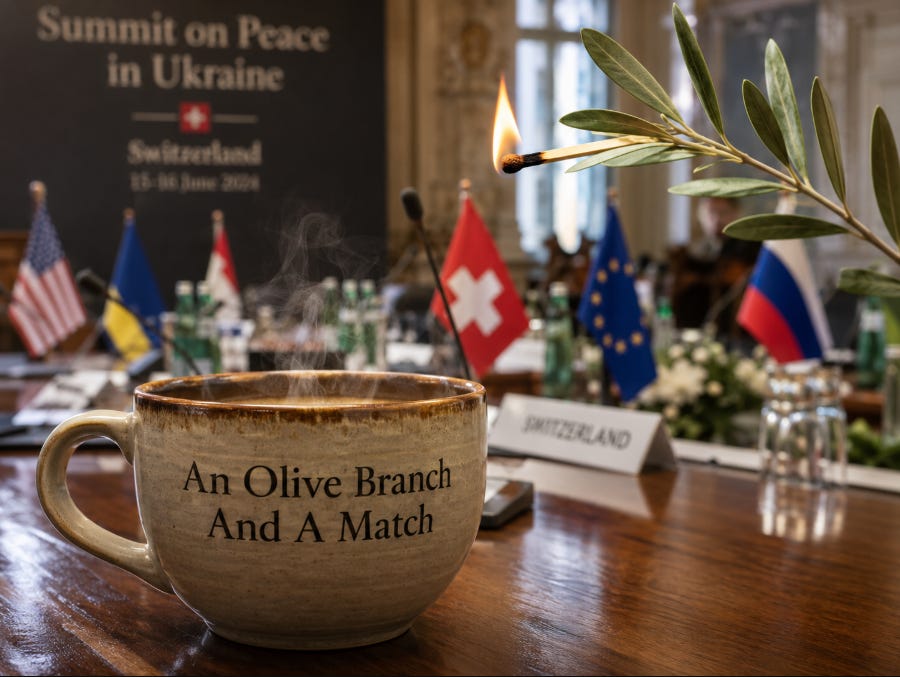
The main story this morning is Switzerland, where high-level talks between the United States and Iran have begun under Qatari and Pakistani mediation. The stated aim is to salvage and advance an interim deal to end the expanding regional war, reopen or stabilize passage through the Strait of Hormuz, and keep the fighting in Lebanon from blowing up whatever diplomatic scaffolding remains. A small agenda: nuclear issues, oil flows, sanctions, frozen assets, Hezbollah, Israel, Lebanon, global markets, and whether the Middle East can be transformed by people who appear to have arrived with more slogans than specialists.
The accusation is not entirely invented. Iran has armed, funded, and cultivated allied militias across the region. It represses its own people. It has played a destabilizing role for years. But the United States has now taken whatever regional instability Iran helped create and turned it into a global quagmire: a war threatening oil flows through the Strait of Hormuz, a Lebanon ceasefire dependent on Israel’s restraint, markets watching shipping lanes, Gulf states scrambling, Europe absorbing the fallout, and a nuclear negotiation being staged as if slogans can substitute for expertise.
That is what Vance seemed not to understand, or not to admit. Peace talks are not cable-news panels. The words matter differently when the person across the table is the person you need to sign the deal. Calling Iran a “driver of regional instability” while offering an “outstretched hand” is not diplomacy; it is blame and olive branch in the same breath. Sometimes that can work, but only if handled with discipline. This was a press statement cosplaying as statecraft.
The problem is larger than tone. If the administration truly wanted to de-escalate, it would not send Vance out to narrate historic progress while Trump threatens to hit Iran “harder” from his phone. It would not pretend that Hezbollah is merely a remote-control device in Tehran’s pocket while Israel remains in southern Lebanon and openly reserves the right to keep operating. It would not inflate a fragile negotiation into a “first time in history” breakthrough while fielding a delegation that looks, from the outside, more political than technical.
Iran may have helped light regional fires. Washington, however, has arrived with gasoline, cameras, and a marketing strategy.
That grandiosity is the tell. The Switzerland meeting may matter. It may matter a great deal. But inflating it into a civilizational first does not make the delegation look stronger. It makes the packaging look desperate. Former U.S. ambassador Matthew Bryza put his finger on the problem, describing the visible American team as “so thin, so small, so tight,” and questioning whether the United States has the technical and diplomatic bench required for nuclear and regional negotiations of this complexity. On the Iranian side, by contrast, the delegation appears built for the machinery of negotiation: foreign policy, parliament, banking, oil, sanctions, and the nuclear file. On the American side, the public-facing cast is Vance, Steve Witkoff, and Jared Kushner, which is less an arms-control delegation than a group text with lapel pins.
While Vance was in Switzerland talking about peace, Trump was on Truth Social threatening more war. Iran, he posted, must stop its “highly paid proxies in Lebanon” from causing trouble, or the United States will hit Iran “very hard again,” only harder. This arrived shortly after Vance praised “great progress.” There is the administration’s foreign policy in miniature: one man extends the outstretched hand; another lights the hand on fire and calls it leverage.
Lebanon is not a side issue; it is the hinge. Iran has made clear that progress in the talks depends on Israel respecting the ceasefire framework and halting its operations in Lebanon. Israel, meanwhile, is not exactly behaving like a country preparing to pack up and leave. Its army chief has been in southern Lebanon telling troops to remain ready for renewed combat. Israeli officials say they will not withdraw from their security zone. Hezbollah has taken losses, Israeli soldiers have been killed and wounded, and Lebanese civilians continue to pay the price. A ceasefire in which one side continues occupying territory and preparing further operations is nothing more than a pause with branding.
Trump’s formulation also simplifies the conflict in a way that is politically useful and analytically dangerous. Hezbollah is backed by Iran, yes. But it is not a toaster plugged into Tehran. It has Lebanese roots, Lebanese incentives, and a local war in front of it. If Israel is striking southern Lebanon and holding Lebanese territory, Hezbollah does not need an Iranian permission slip to see its own reasons to fight. Treating the whole situation as Iran remotely operating “proxies” allows Trump to threaten Tehran directly while ignoring the fact that Israel is also capable of derailing the talks. Basically, it is a blame diagram drawn with a Sharpie.
A better reading of the morning is this: procedural progress may be real, but the political environment is still combustible. Qatar and Pakistan have done the hard work of getting people into the room. Iran has sent serious people. The U.S. may have technical experts somewhere, perhaps hidden behind the curtains. But the visible performance is unstable. Vance is selling history. Trump is selling threat. Israel is selling permanence in Lebanon. Iran is selling compliance as conditional. Somewhere under all of this, actual negotiators are presumably trying to make the details survive the egos.
Back in Europe, Giorgia Meloni has discovered the great truth of Trump-era alliance management: eventually, the leopard eats the face of the person who wrote the foreword.
Meloni was supposed to be Trump’s bridge to Europe. She was the friendly nationalist, the ideological cousin, the leader who could talk to Washington while Brussels held its nose. She attended Trump’s inauguration, cultivating the relationship. She took the photo opportunities, absorbed the provocations, and tried to turn personal access into diplomatic leverage.
Then Italy said no. Rome refused to allow U.S. military aircraft involved in the Iran campaign to use Italian bases without proper legal and parliamentary process. Meloni also defended Pope Leo after Trump attacked him for calling for peace. For a while, she tried to manage the fallout with restraint. But Trump, being Trump, mistook restraint for permission. He reportedly told an Italian journalist, in an interview La7 aired only as a dubbed translation, that Meloni had begged him for a photo at the G7, a claim she called fabricated. Then he repeated the insult online and attacked her popularity.
It is worth quoting what he actually posted, because the line tells on itself. “She is doing poorly in Italy with her level of popularity,” Trump wrote on Saturday. “Now after the United States defeated Iran militarily, she wants to be friends again in order to get her ‘numbers up’. No thanks!!!” Set aside the playground cadence for a moment and notice the claim buried in the middle: the United States defeated Iran militarily. This is the same man who, the very next morning, posted that if Iran did not rein in its proxies in Lebanon, the United States would “hit Iran very hard again, just like we did last week, only harder.” Both things cannot be true. You do not need to threaten to defeat a country you have already defeated. A war that is over does not require a sequel, much less one promised “harder.” In two posts roughly a day apart, Trump claimed total victory and threatened renewed bombing of the same adversary, the Switzerland talks happening in the space between, as if to underline that the war he says he won is the war he is still negotiating to end. The “defeated Iran” line is not a description of reality. It is a trophy he needs for the Meloni story to work, because the insult only lands if proximity to him is something worth begging for. He has to have won in order for her to be crawling back.
For Meloni, this was not merely personal. It struck at the core of her political brand. She presents herself as the defender of Italian dignity, sovereignty, and national honor. When Trump suggested she had groveled for proximity to him, he did not just insult her; he insulted the image she sells to Italy. And for a nationalist politician, honor is not decorative. It is infrastructure.
The Financial Times framing is especially useful here because it captures the electoral calculation. Trump is toxic in Europe now, even among parts of the right. Meloni’s closeness to him brought Italy tariffs, economic blowback from the Iran war, energy disruption, diplomatic humiliation, and a public attack on the Pope. As investments go, this was less “privileged access” than buying a timeshare in a burning casino.
Now Meloni has an opening to recast herself as the smaller-country leader standing up to the bully, a politically potent narrative. The small woman leader of a less powerful country defending national dignity against the American president is exactly the sort of image that can travel across party lines. Italians across the spectrum can dislike Meloni and still dislike watching their prime minister humiliated by a foreign leader.
There is a catch, and it is a serious one. Meloni does not get to pretend she just met Trump yesterday. She invested in this relationship and tried to make herself his European whisperer. She tolerated much of what others warned was intolerable because she believed proximity would produce leverage. Now the relationship has produced very little except blowback. So her task is delicate: she must look principled without looking discarded. She must make it seem as though she repudiated Trump, not that Trump humiliated her first and forced the pivot.
That may be the broader lesson for Europe. Personal access to Trump is like weather. Sometimes it is sunny. Sometimes it hails golf balls. It is not a substitute for collective leverage, shared European policy, or institutional resilience. Meloni tried to be Trump’s bridge to Europe. Trump treated the bridge like a leash.
Because America is apparently determined to provide comic relief in the form of public-works collapse, we have the Reflecting Pool.
The Trump administration’s grand refurbishment of the Lincoln Memorial Reflecting Pool has produced peeling blue liner, floating material, algae, embarrassment, and now a cyclist. A former Olympic competitor, David Hearn, was arrested on a misdemeanor charge of destruction of government property after he says he touched a piece of the liner that was already detached. Trump and his allies have leaned into a vandalism narrative, suggesting sabotage by opponents rather than a failed repair job.
This is almost too perfect. The project was supposed to be a patriotic makeover, complete with “American flag blue” pool coating. Instead, the blue coating began coming apart, which is what can happen when civic symbolism is installed with campaign-rally energy and apparently not enough quality control. Rather than ask why the liner was peeling, the preferred narrative became: vandals. Saboteurs. Enemies of beauty. The Resistance has apparently moved from mass protest to aquatic craft supplies.
To be clear, there may have been actual vandalism around the area. That should be investigated. But an arrest is not proof that sabotage caused the pool failure, and touching already-detached material is not the same thing as single-handedly destroying a federal monument. The timing is the key. If the liner was already visibly peeling before the cyclist became a political trophy, then the arrest does not rescue the administration from the underlying question: why was the pool falling apart?
This is the domestic version of the foreign policy story. When something fails, find a villain. If the talks are shaky, blame Iran. If Lebanon burns, blame proxies. If an ally asserts sovereignty, attack her dignity. If the Reflecting Pool peels, arrest the cyclist and cue the social media outrage. The operating principle is simple: never absorb responsibility when you can stage a morality play.
That is the through-line this Father’s Day morning. In Switzerland, the administration wants credit for peace while threatening escalation. In Europe, Trump is punishing an ally who stopped behaving like a subordinate. At home, a botched patriotic beautification project is being converted into a sabotage narrative. Different stages, same reflex: personalize, exaggerate, blame, and never admit that the thing you built may be coming apart because you built it badly.
So enjoy the day if you can. Call your dad if that is a good thing in your life. Remember him if that is where the day takes you. Take the walk, make the breakfast, sit with the people you love. The world will still be ridiculous when we get back, and with any luck, the Reflecting Pool will not have been blamed on Hezbollah by dinner.
Would it not be a respectable use of US Park Service funds to just, you know, let the water be green, put in some turtles (and logs for them to sun on), some bulrushes and cattails and a whole lot of ducks to paddle around in them, wait for some eagles to come and keep the ducks on top of their game, seed the place with some frogs and fish, let the blue herons come with that beautiful dance step that they have, rename it all as, I dunno, The National Audubon Pool, invite children across the nation to do the same in their towns and neighbourhoods, and let that gesture of renewal be a mirror of the United States? Cuz that would be pretty darned great. And so many kids would love it. Now, I'm not a US Citizen, but I sure think that USAmericans live on a beautiful stretch of Earth that, let's be honest, is also often in need of a bit of love. Want an example? I suggest Leavenworth, WA. It's a not-so-pretty faux German resort town sitting on an ancient Indigenous fishing site, that has, nonetheless, done a wonderful thing reclaiming the old logging grounds on the Wenatchee River below town. Much of what I describe above is going on there, plus a lot of deer, and deer are very fine people, too, except when they eat my green peppers. I mean, not just the peppers. The whole plant! Ripped out by the roots! I plant the peppers in the back yard now. The front yard? I keep it nice for the deer.
Canoeist, not cyclist…. https://www.yahoo.com/news/us/articles/david-hearn-us-olympian-denies-115820250.html