

When I finally put the kids to bed and take in that deep breath of relief as I lay another day to rest, my brain does this extremely scientific thing where it attempts to process the entire state of the world through the glow of a rectangle. I call it “doomscrolling,” though “marinating in anxiety” is probably more accurate. My thumb moves like it’s training for the Olympics, my face takes on the expression of someone watching a horror movie while pretending it’s “fine.” Somewhere nearby, my laundry sits in a basket like a quiet indictment. Those nights, I promise myself a calmer close to the week, something grounded, something sustainable, something that didn’t involve me whispering, “Are we… okay?” into the void. I make tea, I open my phone anyway. The void says, “No.”
So, last night, I did the only reasonable thing: I looked for evidence. Not evidence that everything was perfect, just evidence that goodness hadn’t packed up and moved to another planet. And I found it, scattered like small lanterns across the globe: ten little stories about humans doing what we do when we remember we belong to each other. The kind of stories that don’t erase the hard things, but make them feel less like a permanent forecast.
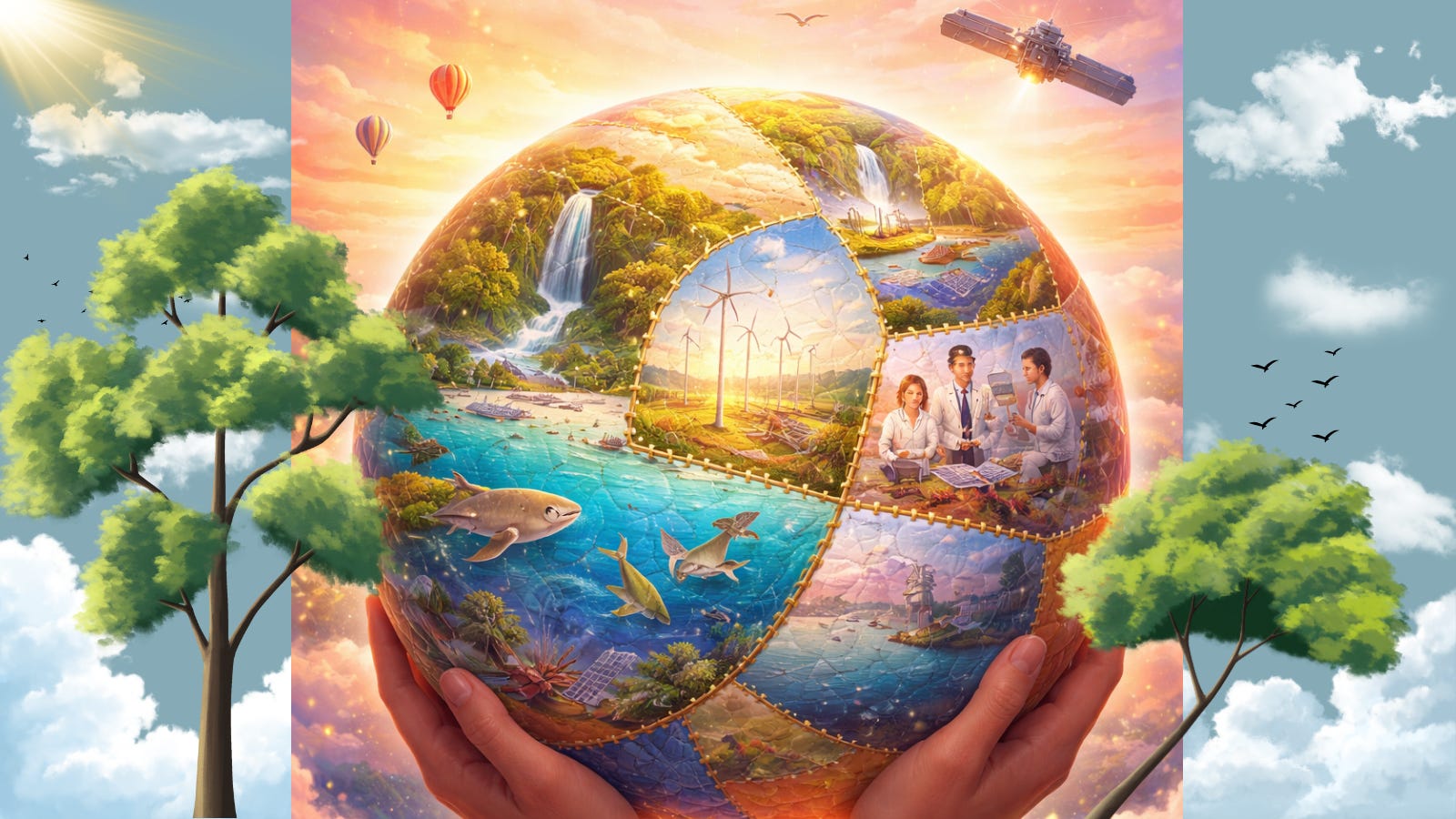
At first, I read them like headlines, quick, neat, and tidy. But then something strange happened. The stories began to feel less like news and more like a quilt: different patches, different textures, stitched together by the same stubborn thread. Hope. I set my tea down and let the quilt unfold.
The first patch was the ocean, wild, massive, and frequently treated like a background prop in the grand drama of human life. Except it isn’t. It’s the main character. The lungs, the pantry, and the weather-maker. The big blue “we’re all in this together,” whether we admit it or not. I read that nations had finally put protections into motion for the high seas, those enormous stretches of water that belong to everyone and, for a long time, were protected by… vibes. The idea that people from different places, with different politics and different priorities, could agree on something as complex as safeguarding the open ocean felt almost mythical. Like spotting a unicorn, except the unicorn is a legally binding framework and it swims. I pictured a tired negotiator, wrinkled suit, stale conference coffee, staring out at the sea at the end of a long meeting and thinking, “We did it. We actually did it.” Somewhere, a wave slapped a rock in applause.
And then the second patch: sharks. Not the cinematic kind with ominous music and perfect dental hygiene. Real sharks, doing shark things, like keeping ecosystems balanced and reminding fish not to get complacent. In Thailand, endangered leopard sharks, bred with care, raised with patience, were being released into the ocean. It’s hard to describe why this made me emotional without sounding like someone who has cried at a commercial about paper towels, but here we are.
Imagine being the person who opens the gate and watches a shark glide out, not into captivity, not into a tank, but into its own story. Imagine the quiet of that moment: the water swallowing the shape of something precious, returning it to where it belongs. Imagine knowing you helped put a creature back into the world rather than taking it away. We talk so often about what we’re losing, sometimes we forget we can also return things.
The quilt tugged me south next, to the very tip of the Americas, where wind has the audacity to have opinions. I read about land being protected, wild places being made official, given a kind of legal shield so they can keep being themselves. Chile, at the edge of the world, preserving a place where the maps feel like they end and the Earth keeps going anyway. A national park is a bold statement. It says: “This matters more than profit. This deserves to outlive our current moods. This is not ours to use up.” I’ve always loved the idea of parks as humanity’s better angels made visible. We are capable of building skyscrapers and also of saying, “No, actually, let’s leave this forest alone.” Both are feats, one just has better air.
Then came the energy story, and I laughed out loud because my brain tried to picture “wind and solar” as underdogs in a sports movie. In this version, fossil fuels wear leather jackets and sneer a lot, and renewables are a scrappy team of misfits with a montage. There’s dramatic music, someone runs up a hill carrying a solar panel. At the end, wind and solar overtake fossil fuels in electricity generation, scoreboard flashes, crowd goes wild, someone sprays champagne that is, importantly, not made of crude oil.
It’s not that the problem is solved, but that the momentum is real. It’s that the future isn’t a single leap; it’s a thousand decisions in the same direction. It’s policy and engineering and people at their kitchen tables choosing what they can. It’s the long game paying off in inches, then feet, then miles. My tea had gone lukewarm, my heart had warmed anyway.
The next patch was about learning, millions of people gaining access to skills for the changing world, including AI training that isn’t locked behind expensive doors. There’s something deeply human about teaching each other. Not in a grand, ceremonial way, but in the practical, “Here, let me show you” way. I imagined a classroom where someone who never thought of themselves as “techy” learns how to use new tools responsibly. I imagined a middle-aged dad who’s been laid off and is terrified, sitting with a notebook and realizing, mid-lesson, that he’s not obsolete. I imagined a young person thinking, “If this is the future, maybe I can shape it instead of being crushed by it.” A sustainable, grounded future isn’t just solar panels and protected forests. It’s people having the chance to adapt without being abandoned.
From learning, the quilt stitched itself to health, because hope isn’t just big systems. It’s also bodies, breath, blood, and the quiet heroism of waking up and trying again. There was news about better treatment options for people with COPD, a condition that steals breath like a thief in the night. If you’ve never watched someone struggle for air, you might not understand how sacred a deep breath is. It is not just oxygen, it’s dignity, the ability to laugh without coughing, or walking to the mailbox without planning it like an expedition.
Then another story: researchers targeting the immune system to reduce the risk of future heart attacks. The heart is such a dramatic organ, constantly thumping like it has somewhere to be. When something goes wrong, it doesn’t just hurt; it shakes your sense of time, before and after, fragility and gratitude tangled together.
Medical progress can feel abstract until you imagine one person, someone’s mom, someone’s best friend, being told, “We have a new way to help you.” Until you picture a doctor smiling in that careful, professional way that still can’t hide relief. Until you imagine the patient driving home and noticing the sky, really noticing it, as if it’s been upgraded.
The quilt got a little funny again when I read about smartwatches helping detect atrial fibrillation more effectively for certain groups. We live in a world where your wrist can say, politely, “Hi, your heart rhythm is being weird,” and then you can call a doctor instead of becoming a cautionary tale. Is it slightly ridiculous that we’ve turned accessories into early warning systems? Yes, but is it also kind of beautiful? Absolutely. The watch isn’t magic. It’s the result of people testing, measuring, verifying, and choosing to care about strangers they will never meet. It’s engineers and clinicians and study participants and regulatory reviewers and a thousand tiny acts of responsibility.
And then, because the universe loves contrast, space. A satellite launched to help monitor disasters. I always get emotional about satellites, which is perhaps not a sentence I expected to write in my life, but here we are. There’s something poetic about putting a careful eye in the sky so we can respond faster when the Earth is in trouble. Fires, storms, floods, these things don’t ask for permission, but we can still prepare, can still see, we can still organize help.
I imagined the satellite unfolding its panels like a patient origami, sunlight catching on metal, and down on Earth, a scientist whispering, “Please work, please work, please work,” like a prayer. Then it does work, and because it does, somewhere a warning comes earlier, an evacuation happens sooner, a rescue gets there in time. Hope isn’t only prevention, sometimes it’s response.
The last patch was another health story: a potential new treatment approach for chronic hepatitis B showing positive results in late-stage trials. Hepatitis B is one of those long, heavy burdens people carry quietly, sometimes for decades. To live with a chronic infection is to live with an invisible question mark hovering over your future. Every checkup can feel like a cliffhanger. So, I imagined someone hearing this news and feeling, maybe not celebration yet, but possibility. A loosening, a tiny lifting of weight they’ve gotten used to calling normal.
When I finished reading, I realized my thumb had stopped moving. The rectangle in my hand wasn’t feeding me panic anymore. It was feeding me proof: the world is complicated, and also full of people trying. Not perfect people, not constant heroes. Just people, doing human things, agreeing to protect something bigger than themselves, bringing animals back into the wild, and launching tools that help us respond to disasters.
All of it adds up to a quiet argument against despair. The turmoil in the news is real. The harm is real; the grief is real. But it is not the only real thing, there is also a steady countercurrent: effort, repair, care, and cooperation.
A more sustainable future doesn’t arrive because we wish for it, it arrives because we take steps toward it. Sometimes those steps are international treaties and national parks. Sometimes they are researchers in labs and nurses in clinics. Sometimes they are ordinary people learning new skills, voting for better policy, choosing different energy, or staying engaged even when it’s exhausting.
It’s late by this point, and my tea is cold, and my laundry still has not achieved consciousness and folded itself. But my chest feels lighter than it did an hour ago. Outside, the world is still the world. Messy, loud, unfinished. And inside it, so are we. Unfinished, too. Capable of harm, yes. But also capable of turning toward each other, over and over, saying: “Not this way. Another way.”
Maybe that’s the good still left in humanity, not that we never fall apart, but that we keep stitching. We keep making quilts out of scattered scraps. We keep lighting lanterns. We keep returning sharks to the sea and protecting the edges of the Earth and building cleaner grids, we keep trying.
And for today, for the close of the week, that feels like enough to let myself believe in a more positive future. Not because it’s guaranteed, but because it’s being built, by regular people with a shared belief that there is more to this world than pain.
I read this just after I returned from a coffee date with a group of women. Our topic of discussion was "what is a super power you have or wish you had." We generally don't go to the political realm but today we leaned in a bit. We experienced a sense of solidarity that felt good, even as we just danced around the topics that arose. So, I so appreciated your words today and your focus on the positive. It's so easy to drift over to the dark side and only complain. But you brought light in today.
Thank you!! My chest feels lighter as well!! We (I) must continue to believe in the good...and it does exist, every day. Sometimes it just takes another thoughtful caring person to send out a reminder.