

Many Americans are already wading into their annual open-enrollment rituals only to discover that their health-insurance premiums have ballooned to the point of absurdity. What does that mean for the average working-class family? For nearly five million of them, it means going uninsured or cutting essentials from the budget; and an estimated seven million may lose their Affordable Care Act (ACA) coverage altogether.
Before we go any further, let’s clear up some misinformation with a brief installment of “ACA Changes for Dummies.” Contrary to the rumors, the Affordable Care Act is not “ending.” It’s a permanent law. What is expiring are the enhanced premium tax credits; unless, of course, Congress decides to remove its collective head from its collective…well, you know.
An Advance Premium Tax Credit (APTC) refers to the subsidy you receive based on your projected annual income. The government pays this amount directly to your insurance plan to reduce your monthly premium. At tax time, you must “reconcile” your actual income with the estimate you provided during enrollment. Starting with the 2026 tax year, repayment caps vanish, meaning if your income ends up higher than expected, the entire difference can come back to bite you; hard.
The expiration of enhanced subsidies will dramatically raise premiums for millions who buy coverage on the ACA marketplace in 2026. A recent KFF analysis estimates the average subsidized premium would nearly double; from about $888 to $1,900; a staggering 114% increase.
But wait, there’s more. Individuals earning above 400% of the federal poverty level will once again lose eligibility for any premium tax credit at all. And without repayment caps, anyone; regardless of income, could face hefty tax bills if their earnings shift unexpectedly. Nothing says “work hard and get ahead” quite like a system that punishes you for improving your circumstances.
For many families, this dilemma is already painfully familiar. Whether through an employer or the marketplace, premiums and deductibles have climbed so high that people are intentionally keeping their incomes lower to avoid losing coverage. The American Dream, reimagined: earn more, lose more, and feel grateful for the privilege.
Once upon a time, policymakers acknowledged the plight of working Americans who earned too much for Medicaid but too little to meaningfully afford employer or marketplace insurance. They created a safety valve. Now, those same Americans might as well be yesterday’s trash awaiting pickup, or perhaps more accurately, they’re the added zeros padding shareholder dividends in the private insurance industry.
The Congressional Budget Office (CBO) projects that without extending these subsidies, millions of currently insured marketplace enrollees, largely middle-class, working Americans, will become uninsured in the coming years.
Meanwhile, as congressional lawmakers continue to debate these extensions to no real effect, families are left agonizing over impossible choices: make the car payment or insure their children? Feed the household or pay the deductible? For many, it now seems more rational to keep a roof over their heads and risk medical debt rather than risk owing the federal government. In today’s healthcare landscape, debt to a hospital almost feels like the better option.
But the buck doesn’t stop with families. We haven’t even begun to reckon with what this means for the healthcare system itself. Hospitals and healthcare providers are projected to face an estimated $7.7 billion increase in uncompensated care costs in 2026, as more Americans become uninsured and unable to pay for services they nonetheless still need. Add to that a collective loss of more than $32 billion in revenue from reduced health spending, and the broader economic consequences become impossible to ignore: a projected loss of nearly 350,000 jobs nationwide.
To understand what that actually looks like; not in theory, but in real life; let’s take a trip to rural America. On the Southern Oregon Coast, nestled between fir trees and sandy beaches, sits Bay Area Hospital (BAH). It primarily serves Medicare and Medicaid patients, programs that reimburse hospitals well below the actual cost of care: about 56 cents on the dollar for Medicaid and 82 cents for Medicare. Pair that with sharply rising operating expenses; a 40% increase in costs between 2020 and 2024; and you have a hospital already operating on the edge. The expiration of ACA subsidies doesn’t push it closer to the cliff; it shoves.
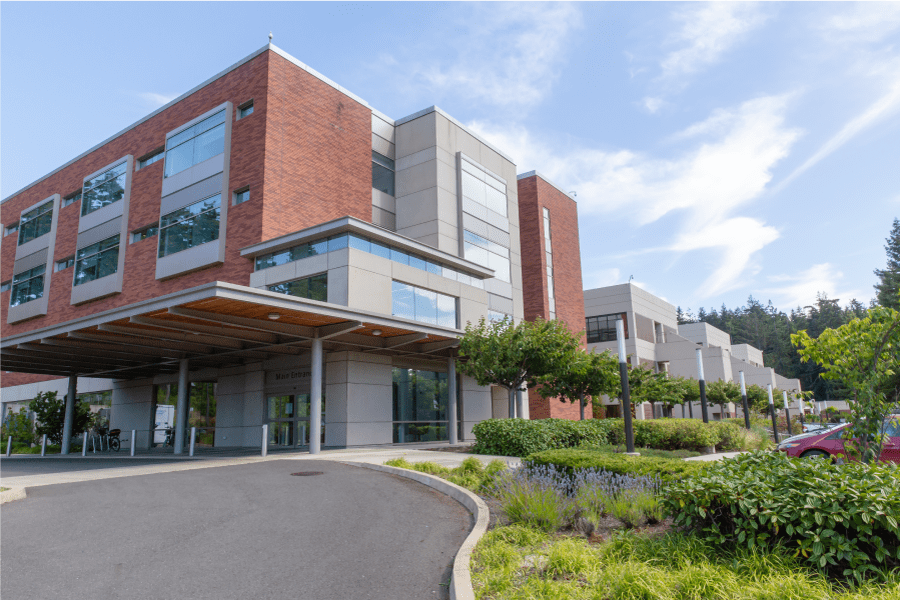
The most immediate impact for BAH would be a sharp rise in uncompensated care. When families lose insurance because premiums become unaffordable, they don’t stop getting sick or injured. They still show up, often in emergencies, and hospitals are legally required to treat them, reimbursement or not.
In Fiscal Year 2024, BAH reported $5.5 million in losses from uncompensated care, commonly referred to as “bad debt.” On top of that, the hospital absorbed approximately $318 million in shortfalls from government programs that paid less than the cost of care; what are known as “contractual deductions.”
That’s a lot of numbers, so let’s translate them into people. The Oregon Health Authority estimates that roughly 111,000 Oregonians enrolled in the ACA Marketplace will see reduced financial assistance, while 35,000 residents earning above 400% of the federal poverty level will lose assistance entirely once subsidies expire. The county BAH calls home is particularly vulnerable: nearly 29% of its population is over age 65, and a large share relies on Medicare or Medicaid. Because of its rural location, BAH doesn’t just serve one county; it functions as the medical backbone for the entire Southern Oregon Coast. A geographical area larger than the entire state of New Jersey. Without BAH many members of this region wouldn’t just be looking at traveling to a different hospital on the other side of a bustling city, they would be facing hours of travel time. Enough travel time that it wouldn’t just be a fuel bill, they’d be taking the day off work, finding daycare for their children, and for some, it would simply mean not receiving care.
While smaller Critical Access Hospitals exist in the region, none have the same capabilities. In 2025, approximately 139,000 Oregonians were enrolled in the ACA Marketplace, including 31,000 rural residents, many of whom live in Southern Oregon. According to the Congressional Budget Office, premiums in rural areas are expected to rise an average of 90% if subsidies expire. These enrollees are disproportionately older adults, small business owners, and gig-economy workers, people without employer-sponsored coverage who rely entirely on the Marketplace.
Many people don’t truly consider what it means to live in rural America. For those in larger cities, “rural” is often described as undeveloped. But for us, it’s simply reality. There are no freeways connecting our towns; only one-lane highways with alarming crash statistics. There’s no Target or Trader Joe’s, just local farmers markets that operate three months out of the year and overpriced produce at our 900-square-foot Safeway.
Decent-paying desk jobs are rare. Instead, our workforce is made up of farm hands, mill workers, loggers, schoolteachers, and nurses. People in rural communities do high-risk, low-reward work every day just to put food on the table. Because of the nature of this work, our communities need access to high-quality trauma care; not as a luxury, but as a necessity.
Now consider this: BAH reported a $24 million operating loss in Fiscal Year 2025, with $5.5 million already attributable to uncompensated care and hundreds of millions lost to underpayment. Any meaningful increase in uninsured patients could be the proverbial straw that breaks the camel’s back.
So, what happens if that camel collapses? BAH is the largest hospital on the Oregon Coast, a 172-bed acute-care facility, and the only Level III trauma center in the region. It serves as a regional referral hub for surrounding Critical Access Hospitals, handling complex cases those facilities simply aren’t equipped to treat. Without it, access to care would evaporate. Thousands of residents would face long-distance travel for emergencies, or no care at all.
And the damage wouldn’t stop at healthcare. If BAH were to close, the economic shockwave would ripple far beyond Coos Bay. A regional economic impact study commissioned by the Hospital Association of Oregon estimates that BAH alone contributes $356 million annually to the local economy and anchors a healthcare ecosystem generating $555 million in total regional economic activity. Its closure would threaten the viability of the entire network.
The South Coast healthcare sector supports more than 3,000 jobs, 1,100 of them directly tied to BAH. A closure would represent the largest mass layoff in the region in decades. Economic multipliers suggest that for every hospital job lost, two additional jobs disappear in retail, real estate, food services, and other local industries; potentially triggering the loss of 2,000 additional jobs as spending power dries up.
The South Coast economy also depends heavily on retirees, who make up nearly 30% of the population, well above the state average. Retirees choose communities with reliable healthcare. Without BAH, the region becomes fundamentally unsafe for older residents, risking housing sell-offs and cutting off the inflow of retirees who help sustain the local economy. Tourism, another major economic driver, would also suffer, as a lack of emergency trauma care raises real safety concerns for visitors.
And the cascade continues. Businesses may leave because they can’t recruit employees without access to healthcare. Families may relocate due to rising travel costs for routine and emergency care. The cost-of-living climbs, disposable income shrinks, and money steadily drains out of the community.
There was a time when people entered healthcare not only because they wanted to help others, but because it was a stable calling. People always need healthcare, right? Today, that calling has been swallowed by a corporate power struggle, one waged far from the communities that bear the consequences.
Everything outlined here is real: a real hospital, real numbers, real families, in a small and beautiful rural region, largely unaware of the devastation quietly approaching.
My children were born at that hospital. I took it for granted, like so many do, never fully appreciating what it meant to my community until the possibility of losing it became real. Maybe policymakers will save billions, or trillions, on paper. But even if they do, how could it possibly be worth this? How could it be worth the heart and soul of a community filled with smart, strong, funny, beautiful people who trusted a system that promised to protect them?
A system that today, frankly, we wouldn’t trust as far as we could throw a feather. It won’t stop with a hospital in rural Oregon, this same story will be told across the country. How many communities must be sacrificed before the people who actually sustain this country matter more than added zeros and inflated egos? We must stand up and demand change; before a roadmap to widespread disintegration is permanently etched into policy. We demand change by joining fights already in motion, such as Healthcare-NOW, by electing leaders who fight for their communities instead of signing their demise. And by standing united and saying: my mother, my brother, my neighbor do not deserve this.
Your assessment is spot on, accurately describing the crisis in healthcare across the nation. Healthcare as a vital responsibility of government is under direct assault by the GOP with the perverted notion that marketplace capitalism and the private sector would provide better service.
We are reaching the a tipping point of wealth sequestration amongst the few and the evisceration of the middle class for the many. The pain experienced by the vast majority of Americans is not only very real in terms of affordability but now, health maintenance and reduced life expectancy are in the crosshairs.
These crises are unsustainable. The Trump administration and GOP dominated Congress are simply pouring volatile accelerants onto our burning civil order. The betrayal of public service has been reprehensible. This new year wil force confrontation and demand remunerative actions.
As Groucho Marx said, “I resemble that remark.” When I moved to the Oregon coast, I chose a house only blocks away from Bay Area Hospital because after years of caring for elder loved ones, I knew better than to grow old far away from a hospital. If/when BAH closes, I will have to uproot my life and move to or near a big city. And I’m one of the lucky ones because I can afford to move, because my roots in the community aren’t so deep that moving would tear apart my family. I fear for all those I’ll leave behind. The myopia and failure to legislate to fix this problem are a huge abdication of duty on the part of lawmakers at the state and federal levels.