

Saturday night in Vandalia, Ohio, the President of the United States stood before a packed arena and asked Ohio voters to do something revealing. “If you don’t mind,” he said, “please pretend that I’m on the ballot.”
Under the Constitution he cannot be elected president again, a detail that did not stop him from musing later in the evening about “the four more year thing.” The people actually on Ohio’s ballot are Jon Husted, appointed to JD Vance’s old Senate seat and now facing Sherrod Brown, and Vivek Ramaswamy, running for governor against Amy Acton. Trump’s own diagnosis of their problem was refreshingly candid: when he isn’t running, he said, “they draw 44% less people.” Hence the pretending.
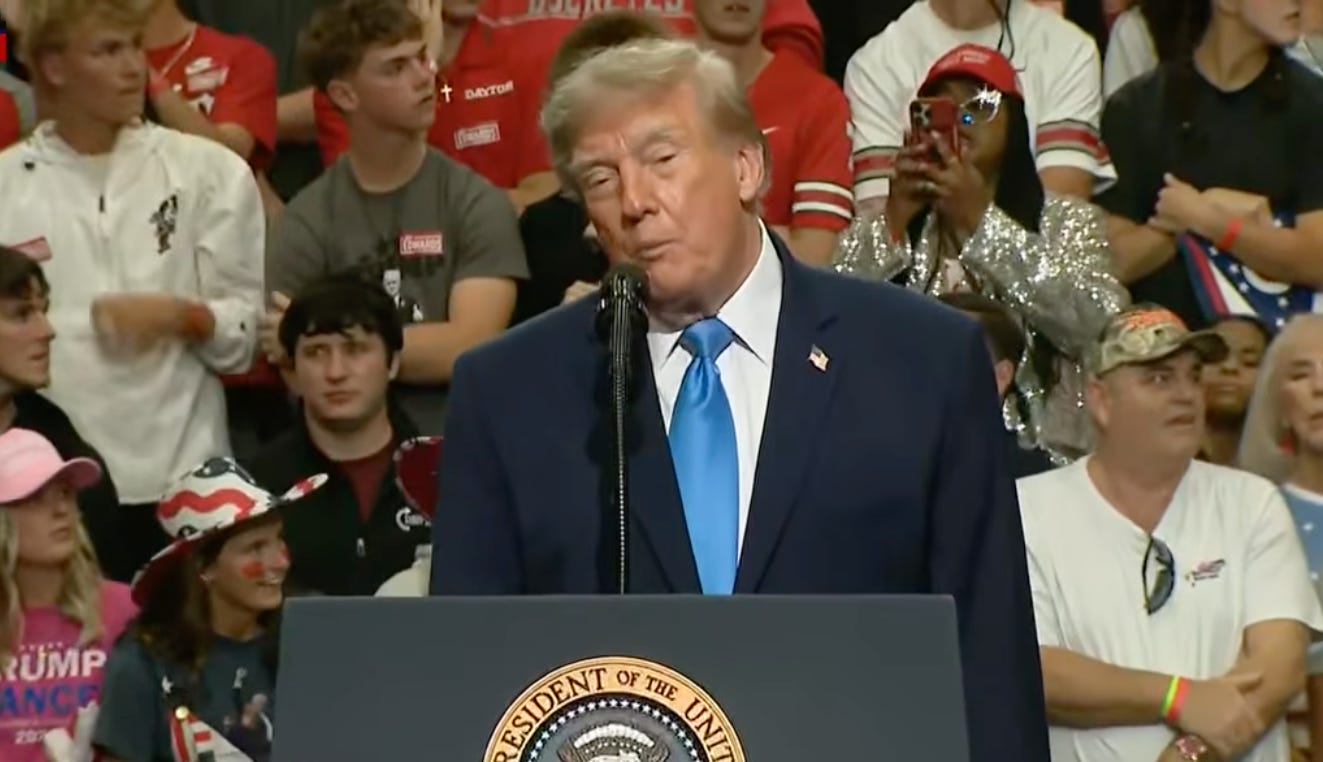
It was a long night. Trump congratulated Ohio State on its win, gushed over Jon Gruden in the front rows, and informed the crowd that Husted once had “17 interceptions, a record” as a college defensive back, a figure he credited to Gruden and returned to so often you’d think the Senate seat came down to a pick-six. Then he got to business, and the business sorts neatly into three piles: the offer, the threat, and the bill nobody on that stage wanted to discuss. What follows covers all three, along with a White House gaggle earlier that day and the TIME interview published Thursday, with enough checked facts to answer anyone who repeats any of it back to you.
The headline act was money, and it came with strings. “If Republicans win the House of Representatives and the US Senate,” Trump announced, “I am going to give all adult citizens in the United States… $5,000.” He called it the Trump dividend, priced it himself at about $1 trillion, and declared that “only I can make this promise.” Nobody else would make that offer, so that part, at least, is true.
As for paying for it, Trump had the math ready. “The Trump dividend is approximately cost $1 trillion,” he said. “But we have a record setting 21 trillion… being invested in our country in just 15 months. So when you look at 21 trillion coming in and we have 1 trillion very easily affordable.”
To be clear, a company announcing plans to build a factory or data center does not deposit the project cost into a federal checking account. Yet Trump slid from one bucket to the other as though Ford building a plant means Treasury Secretary Scott Bessent can stroll over to the ATM and withdraw the construction budget. Trump’s dividend may require a new branch of mathematics.
Tariffs got credit too, with Trump claiming “we’ve taken in trillions and trillions of dollars.” We have not. In February the Supreme Court ruled 6–3 that Trump could not use the International Emergency Economic Powers Act to impose those tariffs. By the end of July, Customs reported that roughly $100 billion in tariff refunds had completed processing and been sent to Treasury for disbursement.
The dividend had company. He touted nearly a million $500 Obamacare “refund checks,” about 70,000 headed to Ohio, which he said the Democrats “stole” and his fraud hunters “caught,” without offering a single detail.
Trump then offered proof that he already knows how to distribute money: the $1,776 “Warrior Dividend” paid to members of the military last December. “Everyone said that couldn’t be done,” he recalled.
Except Congress had already done the part involving money. The IRS says the payments came from $2.9 billion Congress appropriated to supplement military housing allowances. Trump chose the symbolic $1,776 amount and announced the payments, but the funds did not materialize from tariffs, dealmaking or executive pixie dust. Congress appropriated them. Trump did wonder aloud whether he’d timed it right: “Maybe I should have waited a year to be honest… before the election.”
Congress is optional, in Trump’s view, right up until somebody has to write the check.
Always transactional, Trump reminded Ohioans that his administration is establishing a new United States Space Academy. An August executive order created a presidential commission to develop recommendations for the academy, including how it would operate. The order itself explicitly notes that implementation may require legislation and depends on congressional appropriations.
Ohio officials would very much like it located there. Trump offered encouragement. “If we win the midterms,” he told the crowd, “Ohio will be very, very strongly considered.”
Trump did not frame the decision around site selection, infrastructure, workforce or national-security criteria. He framed it around winning the midterms, and then he got more explicit.
The day before the rally, Trump had approved a major federal disaster declaration for Ohio after severe storms and flooding in August. The declaration followed a request from Republican Governor Mike DeWine and made federal assistance available for recovery efforts in affected communities.
At the rally, Trump described Republican Senator Bernie Moreno calling him repeatedly asking for money for Ohio, and said Husted does the same. Husted, he said fondly, is “a pain in the ass… He always wants money.” Then came the civics lesson. “You know when you are president,” Trump explained, “you have a lot of power over states.”
Then he considered what might happen if Amy Acton defeats Ramaswamy for governor. “I don’t know anything about her,” he said. “She’s never going to call me. I’m never probably going to work the same way. You just can’t. It’s just human nature.” And then: “I’m not going to help her probably. She hates me, I guess… I don’t even know who else she is.”
A few minutes earlier, the same man had told the same crowd that Acton “shut it down and almost destroyed” Ohio during COVID. He knew enough about her to attack her, and nothing at all once he was explaining why she’d be on her own.
There’s no political-science seminar required. Republican officials call him, have relationships with him, and ask for money. Their Democratic opponent, he says, probably would not receive the same help. So there it is, on tape, from the man himself: Republican officials have relationships with him, call him for money, and get his attention. Elect their Democratic opponent, he says, and “I’m not going to help her probably.” Ohio voters may want to factor that into their storm preparedness.
Trump has spent much of his second term showing how much he is willing to do without Congress. Executive orders, tariffs, settlements, regulatory pressure, company-specific negotiations and emergency authorities have become central instruments of his presidency. So why care so much whether Republicans keep the House?
Trump answered that himself when TIME asked what he’s preparing for if Republicans lose it: “They’ll probably go after me and I’ll go after them.”
The rest of that interview was a fist. Asked by TIME on Sept. 28 whether he would rule out declaring a state of emergency before the midterms, Trump answered: “I don’t rule anything out or in. We’ll see.” Then he brought up the Insurrection Act himself (“You mean the Insurrection Act?”), and when TIME said yes: “No, I’ve never used it. I could use it. A lot of people think I should use it sometimes.” Asked whether he’d pardon members of his administration before he leaves: “Yeah, sure I’d do that.” Three answers, zero reassurance.
Lay his statements on a calendar and the drift is hard to miss. In February, asked about a draft emergency order making the rounds among his allies, he said he’d never heard about it. In August, when a right-wing TV host pitched the idea on air, he mused that “stranger things have happened.” By late September, nothing was off the table. Meanwhile The Atlantic reports that Peter Ticktin, an old military-school classmate who is not part of the administration, has been urging him to declare martial law around Election Day. In fairness, the same reporting says more seasoned advisers would talk him out of it. If you hear someone claim his “advisers” are plotting martial law, the accurate version is one outside friend pushing and the professionals pushing back.
In Vandalia he kept it lighter, which is to say worse. He described this as “our second term, probably you could say third term,” and explained: “We just don’t want the results of the second.” That is the 2020 “rigged election” lie, now folded into his term count. Later he circled back to “the four more year thing,” which he said he’d “love to do.” The 22nd Amendment would like a word.
He never mentioned martial law, the Insurrection Act or an election emergency in Vandalia. He did keep pouring the foundation. The 2020 election was rigged, and Democrats “cheated like hell.” People who oppose his voter-ID and proof-of-citizenship laws do so for “one reason… They want to cheat.” And Republican wins must be “too big to rig,” a phrase he accused Kamala Harris of stealing from him.
Then there’s the bill nobody on that stage wanted to discuss: the cost of the war he and Israel launched on Feb. 28. On Friday the G7 agreed to release up to 100 million barrels of emergency oil and diesel stocks, with diesel averaging a record $6.37 a gallon. Trump promptly dropped his threatened ban on U.S. diesel exports and announced it had never been seriously under consideration, a little over a week after saying of that very ban, “I’ve called for that.” Never serious, except for the part where he called for it.
At Saturday’s gaggle he went bolder: “Oil is right now lower and it’s been lower than it was under the Biden administration.” He can make that comparison work if he chooses the 2022 spike. But on October 1, WTI crude was $99.77 a barrel and Brent $114.82, well above much of the Biden period. At the pump Saturday, regular gasoline averaged $4.38 nationally and diesel $6.36. A year earlier, regular was $3.15. Oil may be below one Biden-era peak. That is not the same thing as Americans paying less for energy. If anyone tells you oil is cheaper than under Biden, ask them when they last filled a diesel tank.
The same gaggle produced this: Iran has “virtually given up any plans of a nuclear weapon.” Days earlier he told TIME that renewed bombing after the midterms is “possible.” Iran is either done with nukes or due for more bombs in November, and he hasn’t explained how it can be both.
Some of the headline statistics Trump cited Saturday are real. That isn’t the same as proving Americans are living through the golden age he described, and it says nothing about who deserves the credit.
The Census numbers are legitimate. The official poverty rate fell to 10.2 percent in 2025, the lowest since the series began in 1959. Hispanic poverty hit a record-low 13.9 percent. Real median household income rose 2.6 percent to a record $87,460.
They are also narrower than his pitch implies. The official poverty line rests on a 1960s-era formula that ignores whether you rent in Mississippi or Oregon and doesn’t account for housing, childcare or medical bills. Census itself calls it a statistical yardstick. Its Supplemental Poverty Measure, built to capture those costs, put poverty at 13.1 percent in 2025, statistically unchanged from the year before. And a record median only means the household in the middle did better. Income at the 10th percentile didn’t rise significantly from 2024; income at the 90th did.
Then there’s what that income has to cover. Freddie Mac’s average 30-year mortgage hit 7.28 percent on October 1, up from 6.95 percent two weeks earlier and 6.30 percent a year ago, after dipping below 6 percent earlier this year. A family can out-earn its counterpart from a few years back and still watch a first home slide further out of reach, with rent, insurance, utilities and groceries pulling the same direction.
That’s why the Federal Reserve’s latest survey reads like a report from a different country. Only 73 percent of adults said they were doing okay or living comfortably, a figure stuck there since 2022 and below its pre-pandemic level. Fifty-eight percent said higher prices had left them worse off. Sixteen percent hadn’t paid all their bills the previous month, and nearly a quarter of renters fell behind on rent at some point during the year.
The manufacturing figure plays the same framing trick. Factory employment is up 72,000 since December, but December was the bottom of a three-month slide that had just shed 32,000 jobs. Start the clock at the trough and any rebound looks heroic.
None of this makes the good numbers imaginary. It makes them statistics: a poverty rate that fell while rent didn’t, a record median that skipped the bottom of the ladder, a factory comeback measured from its own low point. The spreadsheet knows what households earn. It doesn’t know what it feels like to shop for a mortgage at 7.28 percent.
Trump recast everything into “the greatest numbers” anyone has ever seen, declared that America has “almost no inflation,” claimed millions of federal employees had been fired, and insisted virtually every state is booming. The inflation line has a problem, and it comes from Trump himself. In September the Federal Reserve, chaired by his own pick, Kevin Warsh, voted unanimously to raise interest rates, and when TIME suggested the Fed was worried about an overheating economy, Trump corrected them: “No, they’re concerned for inflation.” As for the “millions” of fired federal workers, about a minute later the number shrank to “150, 200,000.”
He also returned to data centers, an issue we have been following because communities around the country are increasingly worried about the enormous electricity, water and infrastructure demands associated with them.
Trump insisted Ohio stands to make enormous amounts of money and warned that if Americans resist data centers, China will take them instead. He praised Husted’s proposal intended to protect local ratepayers from infrastructure costs associated with the facilities. AP notes that the projects have become politically contentious in Ohio precisely because of concerns about utility bills, farmland and environmental impacts. Trump claimed Democrats blocked Husted’s bill “only because we wanted it.” It did fail 57 to 43, but Senate Democrats said they opposed it because it didn’t go far enough, and according to CNN, an August memo from the Senate Republicans’ own campaign committee warned that data centers are “the anchor hanging around Husted’s neck.”
Trump also reminded everyone that artificial intelligence is now officially “Super Intelligence,” because the republic had run short of nouns. He wasn’t kidding: a Sept. 29 executive order directs federal agencies to no longer acknowledge the terms “artificial intelligence” and “AI,” and the only public consultation it cites is a Truth Social poll.
Saturday also brought the usual climate material. Global warming was a hoax. Scientists changed the name to climate change because the planet started cooling. Ice caps are getting bigger. For the record, scientists have used both terms for decades, the planet has kept warming, and polar ice has been shrinking, not growing.
The claims were familiar enough that even the misinformation appeared to be on tour.
Then came immigration, crime, prescription drugs, transgender athletes, sanctuary cities, tariffs, Venezuela, China, Joe Biden, Barack Obama, the media, the media again, and for good measure, “The Snake,” Trump’s favorite decades-old song lyric about a woman who takes in a snake only to be bitten by it, now rededicated to immigrants in Springfield, Ohio. He called Springfield “a quaint little town of 32,000 people” that “took in 35,000.” The city has about 60,000 residents and between 12,000 and 20,000 Haitian immigrants, most of them here legally under Temporary Protected Status until it ended in July.
For anyone who hears the reruns repeated at the dinner table, a few comebacks. The Venezuela raid he says killed “nobody” left 83 dead by Venezuela’s count, including 32 Cuban soldiers; no Americans died. Venezuelan oil he says brings in “billions of dollars a day” produced about $13 billion in U.S.-controlled sales from January through July, which is tens of millions a day. Drug prices cannot fall “700%” unless pharmacies start paying you to take your pills. The murder rate is at a genuine 75-year low, not a 125-year one. And Biden’s border saw roughly 10.8 million encounters, which are not entries, rather than “25 million people” from “prisons” and “mental institutions.”
Underneath all the reruns, Saturday contained something worth noticing. Trump is increasingly presenting the midterms not simply as a choice between Republican and Democratic policies, but as a transaction with Donald Trump personally.
Why should Trump care deeply about control of Congress if he has become accustomed to governing around it?
Because Congress may be considerably less optional when somebody else wants to inspect how he maneuvered around it.
There are still thirty days until November 3.
TIME reports his advisers are planning a sprint through 32 competitive districts between now and then. Saturday alone gave us a White House gaggle, ninety minutes in Vandalia, dozens of checkable claims, a trillion-dollar dividend promise, another round of 2020 election denial, a federal academy dangled before Ohio, and a remarkably candid explanation of how the president thinks political relationships and federal assistance intersect.
Buckle up!
I’m thinking that if Donald Trump were asked how many fingers he had on both hands, he’d answer 12 and then add, “Nobody’s ever seen anything like it.”
Chicago during the Prohibition era: Political machines and figures connected to Al Capone used money, favors, intimidation, and election fraud to influence voters and officials.