

Good morning! Two days before Mark Carney’s negotiators packed their bags and went home, JD Vance was at a private fundraiser describing the Canadian prime minister as a “very sweet guy” who liked to “puff his chest out” and threaten to “out-tough Donald Trump.” The Canadians always folded in the end, Vance told the room. He found the whole performance “hilarious.”
The recording leaked. Forty-eight hours later, Carney’s government walked away from the table entirely, and two of North America’s most integrated economies started imposing tariffs on each other.
It is worth sitting with the arithmetic here. Vance’s joke rested on a single assumption: that Canada, like nearly everyone else who has sat across from this administration for the past nineteen months, would eventually climb down. It was not an unreasonable bet. It has paid off often enough to become something close to doctrine. This time it didn’t, and the miscalculation has put an $872 billion-a-year trading relationship into open conflict.
Half a world away, the same week, the White House was making a version of the same bet against South Korea, scaling back joint military exercises that have underwritten the alliance for decades while Trump openly complained that Seoul had not done enough to help with a war in Iran that it had no obligation to join. Republican Senator Thom Tillis warned that reducing the exercises could free up North Korean troops to support Putin’s war in Ukraine. Dan Fried, a former assistant secretary of state under George W. Bush, said the decision would unnerve NATO, frighten Taiwan and embolden Beijing, all from one decision about military drills.
Neither of these is really a story about Canada or South Korea. They’re stories about what an alliance is worth in a White House that has come to treat every commitment as a chip to be cashed rather than a promise to be kept and about what happens on the day someone finally declines to pay up.
Canada
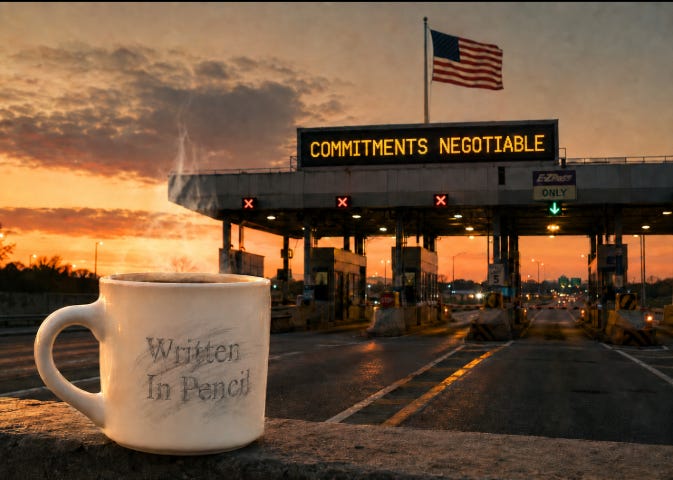
The break came fast, but the tell had been visible for weeks. When Canadian and American negotiators sat down this summer, the demands on the table went well beyond tariffs, reportedly touching Canada’s protections for the French language and its control over its own trade agreements with other countries, including the EU. Ottawa had watched enough of these negotiations play out elsewhere to draw a conclusion: concessions here would not end the demands, only invite the next round. Carney said as much himself, more elegantly than the moment required. Washington’s signature, he told a room of officials, is “sometimes written in pencil.”
By the weekend, the last-ditch talks had collapsed, retaliatory tariffs were moving in both directions, and Ontario’s premier had settled on a considerably less diplomatic register, inviting the American president to “kiss my ass.” Much of what happens next depends on timing neither side fully controls: Canada’s tariffs land in two weeks, the harshest American measure, a 50 percent tariff on Canadian vehicles, not until early 2027, leaving a buffer that is either room for a deal or a countdown to one that never comes. Ottawa, for its part, appears to be betting on the November midterms doing the work that negotiation didn’t.
South Korea
If Canada’s dispute is nominally about trade, Seoul’s punishment has been stripped of even that pretense. Frustrated that South Korea had not sufficiently supported the war against Iran, a war South Korea had no alliance obligation to join, the administration announced it would scale back joint military exercises that have anchored the alliance for over seventy years, while floating new outreach to Kim Jong Un on the strength of what the president called his “very good relationship” with the North Korean leader.
The reaction crossed party lines in a way little else in Washington currently does. Senator Jack Reed, the top Democrat on the Senate Armed Services Committee, called the decision “inane,” warning that it tells the world “America’s commitments are negotiable.” Tillis pointed to the more literal cost: fewer joint drills could leave North Korea with more troops available to support Putin’s war in Ukraine. Fried supplied the fullest accounting; the decision, he said, undermines South Korea, undermines Japan, frightens Taiwan, unnerves NATO, and emboldens both Beijing and Pyongyang. Five relationships damaged by one announcement about war games, over a war that was never South Korea’s to fight.
The other signatures of 2018
None of this is without precedent, which is itself the point. In May 2018, the United States withdrew from the Joint Comprehensive Plan of Action, the Iran nuclear deal, while Iran was, by the account of analysts who were there at the time, still living up to its terms. What gets lost in the domestic retelling, where the withdrawal is filed simply as a campaign promise kept, is who else signed that agreement: not just Iran, but the United Kingdom, France, Germany, China, and Russia. Five other governments had invested their diplomacy and credibility in a multilateral settlement. One government withdrew unilaterally and then restored sanctions powerful enough to cripple the bargain the others were still trying to preserve.
Ross Harrison, the Middle East Institute scholar who watched the fallout up close, calls the withdrawal what it was in professional terms rather than political ones: not a policy disagreement, but “diplomatic malpractice.” Eight years and one shooting war later, Washington may ultimately find itself negotiating merely to restore a condition that existed before the war began: an open Strait of Hormuz. Meanwhile, the governments whose multilateral agreement Washington crippled in 2018 have had eight years to draw their own conclusions about what any future American signature is worth.
What connects a trade dispute with Canada, a military drawdown in Korea, and a nuclear deal shredded in 2018 is a doctrine whose premise has become increasingly explicit. “If you listen to really anybody in state, treasury, or commerce,” Drew DeLong, head of corporate statecraft at the Kearney Foresight think tank, put it, “you will hear the phrase ‘economic security is national security.’” A fairly anodyne-sounding formulation until combined with this administration’s habit of treating dependence as leverage: once economic and security relationships bleed into one another, there is almost nothing left that cannot be put on the negotiating table.
It is Trump’s toll-booth presidency in its mature form. A toll booth does not care about the history of the road, the trust built over decades of travelers, or the promises made to the people who paved it. It only asks what you are willing to pay right now to keep moving. Seventy years of alliance with Seoul, the integration of the Canadian and American economies, the signatures of five governments on a nuclear agreement; none of it functions here as an asset to be preserved. Each is inventory, priced and repriced according to whatever the administration needs collected that week.
There is an echo of the same instinct in Scott Bessent’s intervention in the bond market this month. Treasury says rising long-term yields do not reflect the fundamentals and has begun buying more long-dated debt to push borrowing costs lower, even as Kevin Warsh’s Federal Reserve insists that market prices contain information policymakers should not suppress. Jason Furman, who chaired the Council of Economic Advisers under Barack Obama, warned that it would have “a whiff of fiscal dominance” if monetary policy began bending to the government’s debt-management needs. The analogy is not exact, but the institutional instinct is familiar: a mechanism designed partly to constrain political discretion is valuable only until the constraint becomes inconvenient. NATO, the USMCA, the JCPOA, the South Korea exercises, different institutions serving different purposes, but all built to stabilize expectations, bind governments to predictable behavior, and make commitments more credible than the preferences of whoever happens to hold office. Their friction is part of what makes them valuable.
The distinguishing feature of a toll booth, though, is that it only works as long as there is no practical way around it. That is the wager underneath all of this: that Canada cannot replace the American market, that Seoul has too much invested in the American security guarantee to resist its conditions, that Britain and France and Germany have no choice but to keep returning to Washington regardless of what Washington did to the last agreement. For decades, those assumptions were largely true. The mistake is believing they must remain true. As the next section shows, America’s allies are already spending money, political capital and time building the bypasses.
What allies do next
Leverage only works as long as the other side has nowhere else to go. That assumption is now being tested in real time, and it is not holding up evenly.
Canada’s answer has been the clearest. Carney has said publicly what the trade rupture only confirmed: “We cannot depend on traditional alliances when the rules of the game have fundamentally changed.” Talks with the European Union for a deeper security and economic partnership are set to begin this fall. No one seriously argues Europe can replace what Canada does with the United States; the two economies are bound by geography in a way no trade agreement can undo. But that was never really the point. The point is that Ottawa is building bypasses it once had little reason to consider urgent, and building them in public, as a message as much as a policy.
Asia’s response has been quieter but, in the long run, potentially more consequential. Analysts already describe the exercise drawdown as one entry in a longer pattern draining allied confidence in American security guarantees, confidence that, once spent, does not restock on command. Some of that erosion is showing up as adaptation. Asian allies are strengthening bilateral and minilateral defense relationships with one another, many of them originally encouraged by Washington, but increasingly valuable precisely because they reduce the number of regional security functions resting on a single American guarantee. Some of it is leverage handed to Beijing, which needs no encouragement to exploit every new doubt about Washington’s reliability. And some of it, more darkly, is appearing in speculation, not policy, but no longer unthinkable, that Northeast Asian states might eventually conclude the only guarantee that a change of mind in Washington cannot revoke is one they possess themselves.
Europe’s posture sits somewhere between the two, shaped by memory rather than a single incident. The JCPOA withdrawal is eight years old, not long in the life of a security relationship, and European officials who watched Washington abandon a multilateral agreement they had helped negotiate in 2018 hardly need to be taught that American commitments can change with American administrations. What has changed since then is not the theory; Europe has known what this administration was capable of since Trump’s first term, but the acuity of the vulnerability. As Jacob Funk Kirkegaard, a senior fellow at the Brussels-based Bruegel think tank, argues, the acute fear that helped drive Europe toward a trade accommodation with Trump in 2025, when abandonment of Ukraine felt like a live possibility, has receded. What remains is a colder, more durable calculation: that American commitments can no longer be treated as permanent simply because they were made, and planning accordingly is no longer optional.
None of these responses undoes the leverage the United States still holds. Canada still needs the American market more than the reverse. South Korea still depends heavily on the American security guarantee. Europe still relies on capabilities that the United States cannot be replaced overnight. But each response is a small, compounding investment in alternatives to a system that derives much of its power from everyone continuing to believe they have no better option.
A toll booth works until enough travelers decide the road is no longer worth the price. More often, though, they do something less dramatic: they start looking for side roads, funding bridges and keeping a map in the glove compartment. It is not obvious anyone in Washington has finished doing that math.
In Closing
DeLong, watching the Canada rupture unfold, offered a prediction that sounded almost like a dare: “Ten years from now, this is going to be taught in classrooms.” He meant it as a lesson in bifurcation, two paths splitting apart, with no guarantee they reconverge. But there is a narrower version of that same lesson closer at hand, one that does not require a decade of hindsight to see.
Carney’s phrase reaches well beyond the trade dispute in which he used it. A signature in pencil is provisional, revisable by whoever holds the eraser, and everyone at the table knows it. Canada is now planning around that uncertainty. South Korea has been given another reason to price it into its security calculations. Britain, France and Germany learned in 2018 that even an agreement they had helped negotiate, and still wanted to preserve, could be crippled when Washington changed its mind. The lesson was never that American commitments were worthless. It was that their permanence could no longer be assumed.
The bet underneath all of it, that there is no other road, that everyone eventually climbs down, is not wrong yet, just less reliable. An administration that has built its foreign policy around treating other countries’ dependence as American leverage may be the last to notice what happens when those countries begin treating American reliability as a risk to be priced, diversified, and insured against.
If America’s commitments are negotiable, its allies will eventually negotiate their dependence on America.
Well-observed points of the stupidity of our current federal executive branch, which can be described as dangerous, completely uncalled for, and shattering to America's world standing.
The ahole is a mob boss and that’s the way he “negotiates.” He’s a petulant bully who never matured past age 3. Tantrums are what he has been taught work. You and Shanley write gorgeous essays full of keen analysis and wit. I hope he doesn’t destroy this democracy (and the Kennedy Center) before we get him out, if he doesn’t stay in the bunker after his term ends. He seems to want to destroy democracy here and abroad. We have a lot of cleaning up to do.