


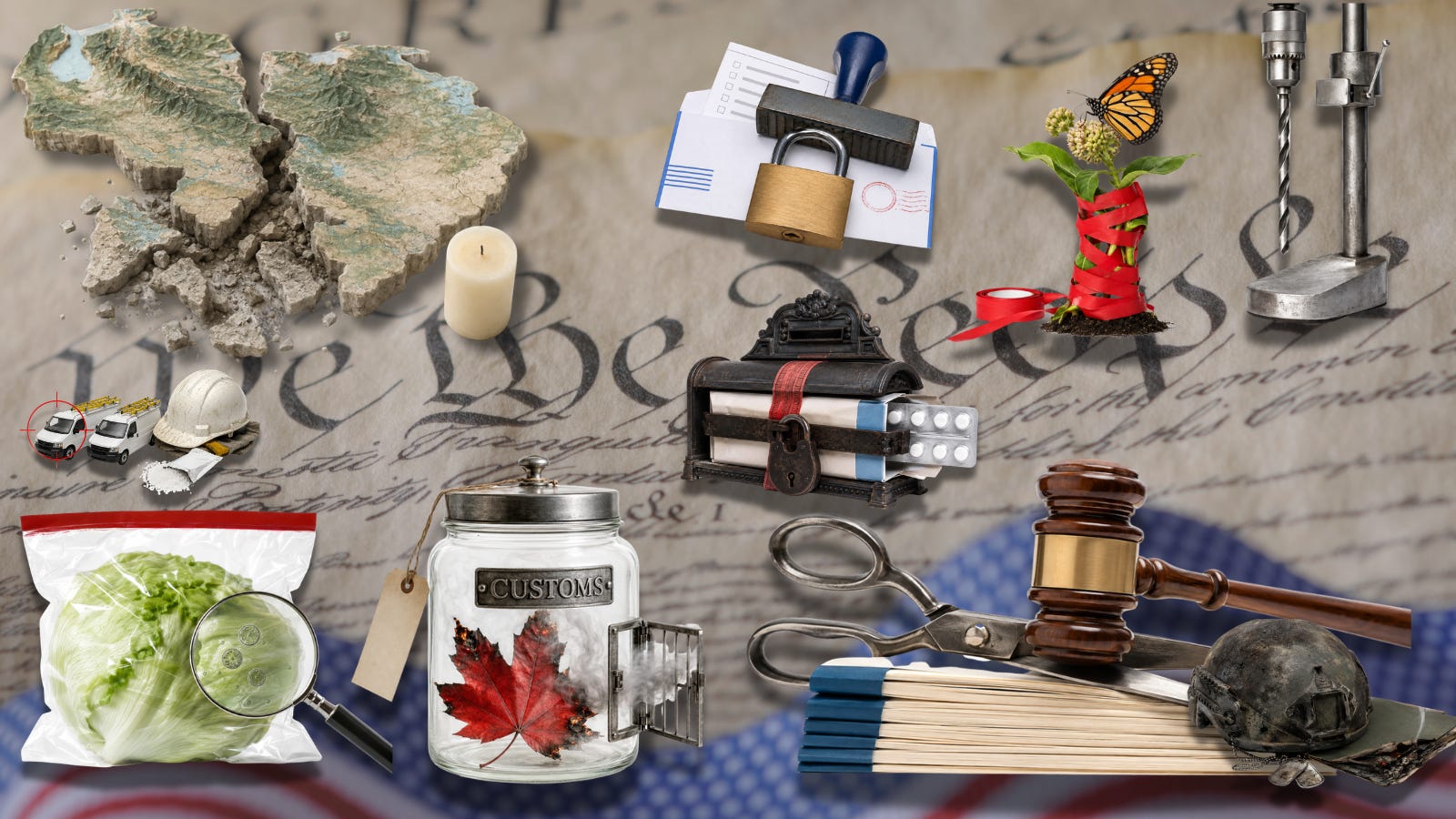
The federal government’s Department of Threat Identification has enjoyed another productive week. After careful study, officials have determined that America is endangered by mail ballots, threatened species, abortion medication, state election workers, federal research grants, and a Mexican construction worker driving a van that looked vaguely similar to another van.
The department has not yet reached a conclusion about the expanding war, the contaminated food supply, or the smoke turning the nation’s capital the color of an old ashtray, although Canada may soon receive a tariff for allowing the wind to cross an international border without filing the appropriate paperwork.
The most serious news came from Jordan, where two American service members were killed, one remains missing, and four were wounded after Iran attacked a base housing American forces. These are the first American deaths from direct Iranian fire since the latest round of fighting began, and they arrive as both countries accelerate toward the war President Donald Trump keeps describing as a success.
The United States has now conducted seven consecutive nights of strikes against Iran. Tehran has suspended its commitments under the peace agreement signed only last month and is attacking American installations and regional infrastructure. Bridges, power facilities, ports, oil routes, and water systems have all entered the targeting conversation, which is a diplomatic term for the moment everyone stops pretending civilians will somehow remain outside the blast radius.
Trump has promised that additional strikes will force Iran back to the negotiating table, although the table appears to be on fire, the chairs have been vaporized, and one of the negotiators is currently launching ballistic missiles at Jordan. This is the familiar administrative theory that if a policy fails, the sensible response is to perform more of it at a higher altitude.
While American troops are dying in a war Congress didn’t declare and the public was never asked to approve, acting Attorney General Todd Blanche has found time to address another grave national emergency: the continued existence of abortion medication in the mail.
During Blanche’s confirmation hearing on Wednesday, Senator Ted Cruz asked whether he would reconsider the Justice Department’s current interpretation of the Comstock Act, a federal anti-obscenity law passed in 1873. The law originally treated pornography, contraception, abortion, sexual information, and various other examples of human knowledge as items from the same forbidden catalog.
Congress passed it when women couldn’t vote, telephones hadn’t yet been patented, and modern medicine was still several discoveries away from reliably washing its hands. Naturally, the Trump Administration believes it’s precisely the legal instrument required to govern reproductive health care in 2026.
Cruz asked Blanche whether the law declares every article “designed or adapted or intended for producing abortion” to be nonmailable, and whether Blanche would carefully review the Justice Department’s 2022 opinion allowing abortion drugs to be mailed when the sender does not intend them to be used unlawfully.
“Yes,” Blanche replied.
Cruz then asked whether Blanche would ensure the “faithful enforcement of the Comstock Act and other federal pro-life acts.”
“Yes,” Blanche replied again, presumably because “I would like to think about whether a Victorian anti-vice statute should be used to govern modern obstetrics” was unavailable to him.
Blanche did not explicitly promise to outlaw abortion medication, but he promised to reconsider the legal interpretation stopping the government from doing exactly that. Under the current Justice Department position, mailing mifepristone or misoprostol is not a crime merely because the drugs can produce an abortion. Both have lawful medical uses, including miscarriage management, and even states with abortion bans generally permit the procedure in limited emergencies.
Anti-abortion activists want the government to discard that distinction and interpret Comstock literally. Under the narrow version, pharmacies and telehealth providers could be prohibited from mailing abortion medication directly to patients. Under the broad version, manufacturers could be prevented from shipping the drugs to clinics, hospitals, or pharmacies anywhere in the country, including states where abortion is protected by law.
The broadest reading could also reach instruments used in procedural abortions, such as suction catheters and dilators, along with ordinary medical supplies that have multiple purposes. It would create something resembling a national abortion ban without requiring Congress to debate, pass, or accept responsibility for one.
This is increasingly how American policy is made. If the public will not authorize the desired cruelty, the administration searches the federal attic until it finds an antique statute covered in dust and moral panic. The law is then carried downstairs, polished with the phrase “faithful enforcement,” and introduced as though Anthony Comstock personally left it to us in his will.
The administration is applying a similarly inventive understanding of federal authority to elections. On Friday, Homeland Security Secretary Markwayne Mullin threatened to withhold federal election funding from states that refuse to participate in the administration’s voter-roll operation. He also suggested that election officials could face fines, penalties, or prison if they failed to comply.
“If the election officials, once we gave them the information they need to secure their elections, and they chose not to, then those individuals can also be held accountable,” Mullin said.
The administration has offered no evidence that foreign actors changed votes in an American election, and courts have repeatedly rejected its attempts to obtain complete, unredacted state voter files. This has not discouraged federal officials, who have adopted the investigative principle that an absence of evidence proves only that the conspiracy has become exceptionally good at filing.
A federal appeals court also gave the administration a temporary victory in its effort to impose new restrictions on mail voting. The proposed Postal Service rule would require states to provide lists of approved absentee voters and would allow the Postal Service to refuse to handle ballots from states that decline.
Another federal injunction remains in place, so the proposal can’t yet take effect. Still, the objective is now clear: the administration intends to protect elections by threatening election officials, seizing voter information, and possibly preventing ballots from reaching voters. It’s the democratic equivalent of protecting a library by confiscating the books.
Federal immigration enforcement is producing its own contradictions. On July 7, an ICE officer shot and killed Lorenzo Salgado Araujo, a 52-year-old construction worker who had lived in the United States for 35 years and was reportedly close to obtaining legal status.
The Department of Homeland Security initially said Salgado Araujo had rammed a federal vehicle and “weaponized” his van. A new account from the U.S. attorney does not mention a collision or say that the officer feared for his life. It does reveal that agents had been searching for two Guatemalan men in a similar van and believed Salgado Araujo and his passengers matched their description.
Federal agents stopped the wrong vehicle, killed its driver, detained his brother, and then announced that small bags of a suspicious white crystalline substance had been discovered inside. The family’s lawyer says the substance was an electrolyte salt mixture the construction workers used to remain hydrated in the Texas heat.
There is something almost unbearably representative about this sequence. The federal government mistook one man for another, mistook a work van for a weapon, mistook hydration salts for narcotics, and then asked the public to mistake the resulting death for public safety.
The same administration is now reducing protections for species threatened with extinction. The Interior Department has canceled automatic safeguards for newly listed threatened plants and animals, meaning each species will require an individualized protection plan before receiving meaningful protection.
Those plans can take time, which is famously abundant among populations approaching extinction. A second change requires officials to consider economic consequences when determining whether an area is critical habitat. Oil, gas, mining, and development interests will therefore have additional opportunities to argue that an animal’s continued existence has become financially inconvenient.
Interior Secretary Doug Burgum said the Endangered Species Act had been used “to stop almost any new project in America,” thereby driving up costs and weakening national security. Monarch butterflies and alligator snapping turtles must now demonstrate that remaining alive will produce an acceptable quarterly return.
The administration has already narrowed the legal definition of “harm” so that destroying an animal’s habitat may not count unless the animal is immediately killed or injured. Under this reasoning, burning down someone’s house is harmless provided they escape through a window and die somewhere less legally relevant.
Meanwhile, actual smoke is covering much of the United States. More than 900 wildfires are burning across Canada, sending dangerous air into over a dozen American states. Washington’s monuments disappeared into the haze while Trump blamed Canada, accused it of negligence, and floated tariffs in response.
The atmosphere has apparently joined NATO, immigration, universities, judges, and American voters on the growing list of entities the president believes can be disciplined through import taxes. The possibility that climate change has created longer, hotter, more destructive fire seasons remains outside the administration’s preferred range of explanations, largely because carbon dioxide cannot be threatened with prison and doesn’t have a governor Trump can insult online.
The American food supply has also produced a threat that is considerably more tangible than the quarter-million imaginary foreign voters currently occupying the president’s attention.
Federal health officials have linked shredded iceberg lettuce served at Taco Bell locations in five states to part of a record Cyclospora outbreak. Taylor Farms is removing all iceberg lettuce sourced from central Mexico from the American market, while investigators determine whether the contaminated supply reached additional stores, restaurants, or distributors.
The Centers for Disease Control and Prevention has confirmed 1,645 domestically acquired cases in 34 states, with more than 5,100 additional reports awaiting analysis. At least 141 people have been hospitalized, and the true number of infections is believed to be higher.
Cyclospora causes prolonged gastrointestinal illness and does not reliably disappear when produce is washed, which means the nation has finally found something in a Taco Bell ingredient that even satire can’t improve.
There are still functioning institutions inside this increasingly elaborate production. On Friday, a federal judge barred the administration from using an obscure regulatory clause to cancel billions of dollars in federal grants for public safety, disaster preparation, food security, clean water, and scientific research.
Twenty-three states had challenged what they described as a nationwide “slash-and-burn campaign.” Judge Indira Talwani agreed that the administration’s interpretation lacked support in the text, regulatory structure, and history of the provision, while also violating constitutional requirements governing federal spending. It was a useful reminder that words retain meanings even when the president finds those meanings administratively inconvenient.
Beyond our borders, the death toll from the June earthquakes in Venezuela has now surpassed 5,000. Recovery workers are still finding bodies beneath collapsed buildings, while tens of thousands of families live with injuries, displacement, and the particular grief of waiting for someone who may never come home.
That disaster deserves more than a passing line, but American news now arrives in such quantity that even enormous human suffering must compete for space with a president attempting to tariff Canadian smoke and an attorney general nominee promising to consult the reproductive wisdom of 1873.
The threat assessment isn’t merely mistaken; it’s ideological. This administration sees danger wherever people retain autonomy and protection wherever power might profit. Voters are dangerous because they can remove leaders. Election officials are dangerous because they can refuse orders. Reproductive medicine is dangerous because it allows women to govern their own bodies. Wildlife protections are dangerous because they impose limits on extraction. Immigrants are dangerous because fear makes violence easier to excuse.
War, contaminated food, collapsing ecosystems, and climate-driven fire are different. Addressing those threats would require competence, restraint, cooperation, and an acceptance that reality can’t be prosecuted into submission.
The government hasn’t failed to identify what threatens the country. It has simply decided that the country and the administration are no longer the same thing.
My Dear Mr. President:
Will you take time to attend the repatriation ceremony at Andrews Air Force Base to honor the two American soldiers who died recently in Jordan as a result of an Iranian missile attack or are those individuals, in your mind, now simply losers?
Regards,
Thank you for the time, research, knowledge, creativity and work you put into these essays.
I believe your posts are brilliant.