


Good morning! Donald Trump wants to arrive in Beijing this week as the man who ended a war, tamed Iran, humbled China, reassured the Gulf, managed Israel, and restored American dominance through the sheer force of his own conviction that pointing at cameras and calling things “beautiful” constitutes a foreign policy.
Regrettably for Trump, reality keeps rudely refusing to board the plane. The Strait of Hormuz is still contested. Iran’s mosquito fleet is still intact. Gulf allies are questioning whether America’s security guarantee comes with a deductible the size of their oil infrastructure. Satellite imagery shows Iranian and Iranian-backed forces hit 18 U.S.-linked military sites across seven countries. Chinese firms have just been sanctioned for allegedly helping Tehran target American forces. And Benjamin Netanyahu, who helped sell Trump on the fantasy of an easy Iran war, has, in the words of one former Israeli diplomat, “screwed” Trump “pretty badly,” and been screwed in return, leaving both men trapped in a failing enterprise neither can publicly abandon. Other than that, Mrs. Lincoln, how was the grand bargain?
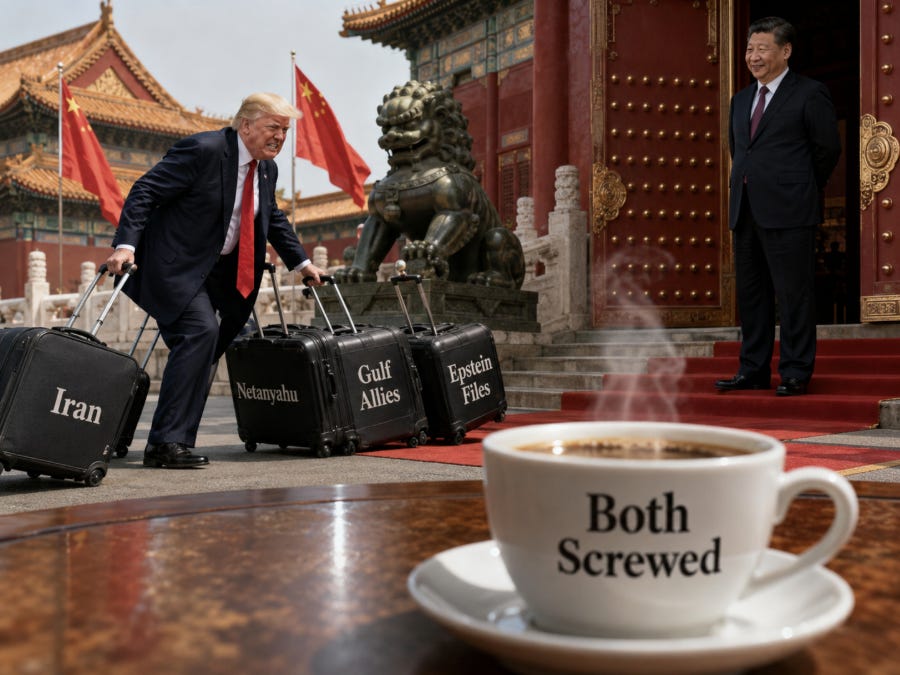
The Financial Times has a long and useful look at Trump’s upcoming visit to China, and the central theme is that Trump is walking into Beijing in a very different world than the one he pretends to command. He wants a spectacle, deals, soybeans, Boeings, and a trade truce. He wants a headline that lets him claim he personally stabilized civilization between lunch and dessert. He likely wants a hug from Xi Jinping, who normally reserves physical warmth for Vladimir Putin, but we’ll come back to that.
China is no longer behaving like a supplicant in the American-led order. It has leverage, and it knows it. The FT notes that China’s pressure over critical minerals helped force the U.S. to unwind extreme tariffs that had reached 145 percent, puncturing Trump’s favorite fantasy that America “holds all the cards.” That era, one expert told the FT, is “gone, I would say for ever.” The “I would say” is doing a lot of work in that sentence. It sounds like someone who wished they didn’t have to say it.
This is the danger of Trump’s foreign policy in its purest form. He mistakes personal flattery for strategy and believes relationships between superpowers work like Mar-a-Lago dinner seating charts. He imagines that if Xi calls him “my friend” and perhaps compliments the drapes, then America has won. Meanwhile, China is looking at rare earths, semiconductors, Taiwan, Iranian oil, advanced manufacturing, and the long game of replacing American dominance with something far more favorable to Beijing.
Trump wants to walk into China as Nixon with a Truth Social account. Instead, he may arrive as the president asking Xi Jinping to help him clean up the war Netanyahu helped sell him.
And then there is this. The U.S. has now sanctioned Chinese commercial satellite companies for allegedly helping Iran target U.S. forces in the Middle East. According to FT reporting, the State Department targeted three Chinese groups — The Earth Eye, MizarVision, and Chang Guang Satellite Technology — accusing them of providing satellite imagery that helped Iran conduct military strikes against American forces and allied facilities. One of the companies had already been tied in FT reporting to Iranian access to Chinese satellite capabilities, and another had reportedly supplied imagery to Iran-backed Houthi rebels targeting U.S. warships in the Red Sea.
So Trump is heading to Beijing hoping Xi can help stabilize Iran while Washington is simultaneously accusing Chinese firms of helping Tehran make the war more dangerous. That is not diplomacy on easy mode. That is a Jenga tower made of tariffs, satellites, oil shipments, Taiwan concessions, Iranian drones, and Trump’s desperate need for a win he can’t define.
The Taiwan piece is especially ominous. Chinese officials reportedly want Trump to change U.S. language from not supporting Taiwanese independence to saying Washington “opposes Taiwanese independence.” That may sound like diplomatic hairsplitting, but it would be a major rhetorical concession to Beijing. And Trump has already shown he is willing to soften criticism of China when he thinks it might help him get a trade deal. FT reported that during Trump’s first term, he told Xi the U.S. would tone down criticism of Beijing over Hong Kong protests to help revive trade talks.
Asian allies worry that Trump might sell out Taiwan for a soybean receipt and a compliment about his golf swing, because they are reading the man’s résumé.
The connective tissue between Beijing and Iran comes from The Guardian’s analysis of the deteriorating Trump-Netanyahu alliance. Former U.S. ambassador Daniel Shapiro told The Guardian that Trump wants the Iran war “more or less behind him” before he sits down with Xi, because otherwise he arrives in Beijing in the weak position of asking China to pressure Iran into accepting terms it has not accepted. Trump does not want to look like a supplicant. Unfortunately for Trump, looking like a supplicant becomes difficult to avoid when you are, in fact, showing up needing help.
The war is not behind him. The strait is still contested. The mosquito fleet is intact. Gulf states are fracturing. U.S. bases have been exposed as vulnerable fixed targets. And China, the country Trump needs for leverage over Tehran, is also the country whose companies Washington has just accused of helping Tehran target American forces. This is the inevitable outcome when foreign policy is run by men who think “dominance” means starting a fire, declaring it beautiful, and then asking the arsonist next door if he has a hose.
The New York Times adds a devastating visual-investigation layer to all of this. Amid competing Iranian propaganda and U.S. talking points, the Times analyzed satellite imagery and verified that Iranian and Iranian-backed forces hit 18 military sites in seven countries where the U.S. operates. The Times cross-checked Iranian-released imagery against European commercial satellite imagery because U.S. officials had asked American satellite companies to restrict or remove imagery from the region — not merely restrict future releases, but retroactively remove images going back to early March. The Times found that the images showing damage were not fake, though some Iranian claims about what was hit still needed correction.
Trump has been trying to minimize Iran’s response as a “trifle.” A trifle. As in dessert. As in something you might serve after dinner, not something involving dead American service members, damaged radar systems, destroyed buildings, hit communications infrastructure, and attacks across the U.S. footprint in the Middle East.
The Times described this as the widest-ranging attack on U.S. military sites in the region ever. Some of the strikes killed American service members, including six at a makeshift command post in Kuwait and one in Saudi Arabia. Satellite imagery showed strikes on communications infrastructure at the U.S. Fifth Fleet base in Bahrain, radar systems, warehouses, fuel tanks, shelters, and even aircraft. The loss of aircraft alone likely runs around one billion dollars, according to analysts at the Center for Strategic and International Studies. A single radar system damaged in Jordan costs approximately five hundred million dollars to repair or replace. Analysts told the Times that the attacks likely did not cripple America’s offensive capabilities against Iran, but they did reveal new vulnerabilities in the U.S. regional posture — and a price tag that makes “trifle” an interesting word choice.
The United States can still hit Iran hard. Nobody serious doubts that. But Iran does not have to beat the U.S. military in a conventional war. It only has to survive the punch, expose the costs of America’s footprint, and make every base, ship, radar system, fuel tank, and allied facility part of the target map.
The FT’s piece on Iran’s “mosquito fleet” makes the same point at sea. Trump bragged that Iran’s navy was “lying at the bottom of the sea, obliterated,” which is a little like declaring you solved a mosquito problem by punching a parade float. Iran’s conventional navy may be battered, but the real threat in Hormuz is the IRGC’s asymmetric force: hundreds of fast-attack boats hidden in coves, caves, tunnels, and along Iran’s rugged southern coast, backed by drones, missiles, mines, and geography.
These boats do not need to sink an aircraft carrier. They do not need to defeat the Fifth Fleet. They need to make merchant shipping nervous, insurers twitchy, and energy markets unstable. Experts cited by FT estimate that the IRGC has between 500 and 1,000 operational armed speedboats of varying capabilities, plus more than 1,000 drone boats and missile batteries deployed along the coast. The U.S. can destroy boats when they come into open water, and it has destroyed some. Protecting almost every vessel passing through Hormuz is vastly more expensive than forcing the world to wonder whether the next vessel might be hit. That is the grim genius of asymmetric warfare. You do not beat the giant. You make the giant spend billions swatting mosquitoes.
Trump keeps measuring victory by what he blew up. Iran is measuring survival by what it can still threaten. While Trump pretends all of this is under control, Gulf states are reading the fine print on America’s security guarantee.
The Wall Street Journal reports that Arab Gulf monarchies are deeply worried that any deal to end the war will focus on Washington’s main concern, Iran’s nuclear program, while leaving intact the threats they actually fear most: Iran’s conventional missiles and allied militias. Gulf states that hosted major U.S. military installations and relied on American protection saw those bases become targets, and they now realize they had little sway over U.S. military actions that directly affected their own security.
The “America protects its allies” brochure has some fine-print problems. Gulf states hosted U.S. bases assuming the bases would deter Iran. Instead, the bases helped make them targets. They watched Washington launch strikes without fully accounting for their security concerns, then watched U.S. officials downplay Iranian retaliation as “low harassing fire” and “trifling” — characterizations that land differently when your oil infrastructure is part of the damage assessment.
The result is a regional scramble. The Gulf monarchies are divided over how to approach Iran, Israel, and the United States. The UAE was heavily targeted and is leaning closer to Israel while also signaling more go-it-alone instincts — it recently announced it would leave OPEC, a striking signal that regional cooperation has lost its appeal. Saudi Arabia and Qatar are looking to other powers for support, including Pakistan, South Korea, Ukraine, China, Russia, and Turkey. Oman is urging continued diplomacy with Iran. The Abraham Accords normalization project, already damaged by Gaza, has been further shaken by the Iran war and by doubts about U.S. protection.
That list of countries Gulf states are now courting is its own editorial. When your security guarantor launches a war without consulting you, gets your infrastructure targeted in the retaliation, and then calls it a trifle, you begin returning other people’s calls.
Then there is Netanyahu.
The Guardian’s Julian Borger adds the element that has been strangely under-discussed: the Trump-Netanyahu alliance is showing signs of strain because both men are trapped inside the same failed enterprise. Netanyahu publicly insists that he has “full coordination” with Trump and that the two speak almost daily. But Israeli press reports suggest Israel has been left out of U.S.-Iran cease-fire efforts and Pakistani-brokered peace talks. Israeli officials reportedly had to use intelligence assets to figure out what Washington was negotiating.
When a politician keeps insisting everything is coordinated, that is usually a good time to check whether the furniture is being loaded into separate moving trucks.
Netanyahu spent decades pushing the U.S. toward war with Iran. He helped coax Trump into abandoning the 2015 nuclear deal, which in turn helped Iran expand its nuclear program. This year, Netanyahu reportedly sold Trump on the idea that war with Iran would be easy: the economy was broken, the public was ready to revolt, the Revolutionary Guards were overrated, and the regime was an overripe fruit ready to fall. One former Israeli diplomat described Netanyahu essentially telling Trump that, together, they could win in three or four days.
Three or four days.
It is amazing how often catastrophic foreign policy decisions begin with very confident men promising that a war will be quick.
They were wrong on every count. The Iranian people did not rise up. The regime did not fall. The Revolutionary Guards were not too weak to hit back. Iran inflicted serious damage on U.S. bases and Gulf monarchies, closed or contested the Strait of Hormuz, and triggered a global economic crisis. By late March, according to one former Israeli diplomat quoted by The Guardian, Trump was showing signs of deep disappointment with Netanyahu.
This is where Alon Pinkas’s logic is so elegant and grim. Trump cannot publicly blame Netanyahu without admitting he was manipulated into a war. Netanyahu cannot break with Trump without losing his last external lifeline. So they are locked together in a failing enterprise, each man prevented from accountability by the other’s presence. Think a hostage situation with flag pins.
That loops us right back to Beijing. Trump wants to sit down with Xi as the master dealmaker. But if Iran is not stabilized, he sits down as the man who needs China — Iran’s key oil customer and a superpower with its own agenda — to help pressure Tehran into terms Trump has not been able to secure. That is a man arriving at the negotiation table with smoke on his suit and someone else’s fire extinguisher on his Christmas list.
Back home, the Trump administration is dealing with these minor matters of war, global energy disruption, vulnerable U.S. bases, fractured alliances, and Chinese leverage by doing what any serious government would do: turning public office into a monetized lifestyle channel.
Kash Patel allegedly handed out custom bourbon bottles with his name on them while conducting FBI business. Because apparently the Federal Bureau of Investigation now comes with a tasting room. Defense Secretary Pete Hegseth faced scrutiny over military helicopter flybys near Kid Rock’s Nashville home. Citizens for Responsibility and Ethics in Washington asked the Defense Department inspector general to investigate. The IG’s office reportedly said Hegseth “decided not to pursue this matter.” Usually inspectors general investigate agency leaders. In this version, the agency leader tells the watchdog whether the watchdog may watch.
Transportation Secretary Sean Duffy, meanwhile, has been filming a family road-trip series for seven months, sponsored by Toyota, Shell, Royal Caribbean, and United Airlines — companies that, by the purest coincidence in the history of coincidences, might have business before the Transportation Department. Duffy says a road trip “fits any budget,” which is a bold thing to say while Americans are staring at gas prices tied to Trump’s Iran war fallout.
The Trump administration has discovered a bold new theory of public service: every cabinet job is just a brand partnership waiting to happen. Somewhere, an ethics lawyer is chewing drywall.
Scott MacFarlane has reporting on the legal fight over Trump’s White House East Wing ballroom that is both ridiculous and genuinely alarming. The National Trust for Historic Preservation, which is challenging the project, has filed a response accusing the Justice Department of making multiple false statements in a federal court filing — statements, the Trust says, that DOJ’s own counsel know to be false. DOJ claimed the Trust had been shown detailed non-public plans by top military and Secret Service officials. False, says the Trust. DOJ claimed the military asked the Trust not to sue because of the facility’s top-secret nature. Also false.
The Trust’s summary of DOJ’s filing is worth quoting directly: “What’s been filed by the Department of Justice may be standard fare for a social media post, but in a federal court filing, it’s neither appropriate nor permitted.” The filing cited the specific bar conduct rule prohibiting false statements to a court. These were not junior attorneys. The response notes the DOJ filing was signed by three of its most senior lawyers, none of whom had appeared in the case before.
When the Justice Department stops acting like the people’s lawyer and starts acting like Trump’s personal reply guy, this is what happens. Court filings start sounding like 3 a.m. rage posts, and everyone is supposed to pretend this is normal.
One final detail: the ballroom was supposed to be free. Then donor-funded. Then paid for by Trump himself. There is now a congressional request for one billion dollars in taxpayer money for the security portion alone. Nothing says “self-funded vanity project” like asking the public to cough up a billion dollars so the president can have a ballroom.
That is the Trump doctrine today in miniature. Abroad, he mistakes escalation for dominance and then needs rivals to help manage the fallout. He lets Netanyahu sell him a fantasy war, watches Iran survive it, watches U.S. bases get hit, watches Gulf allies fracture, watches Hormuz remain unstable, and then heads to Beijing hoping Xi will help him turn the page before anyone notices the page is on fire.
At home, his cabinet treats public office like a content studio, his Justice Department files courtroom arguments that read like Trump’s comment section, and taxpayers are being asked to finance the security apparatus around a presidential vanity project that was definitely, absolutely not supposed to cost them a thing.
The summit may or may not happen. The war may or may not end. The ballroom will almost certainly get built. And somewhere in a cove along Iran’s southern coast, a fast-attack boat is waiting to see how it all turns out.
Such a brilliant and eloquent analysis, thank you.
Nice summary! I liked when you slipped in the part about a golf swing compliment…Remind me again how many trips to the golf course Obama took?