

Good morning! The week begins with Donald Trump in an all too familiar position: the world is complicated, the consequences of American policy are sprawling across several continents, and the president is absolutely certain he has everyone exactly where he wants them.
Also, somebody touched the Reflecting Pool.
Trump’s public schedule is relatively light today. The most conspicuous official event is the swearing-in of Todd Blanche, his former personal criminal-defense lawyer, confirmed as attorney general over the weekend by a 50–49 Senate vote. But Trump’s Truth Social feed spent Sunday evening bouncing from golf and horse racing to personnel announcements, Iran’s collapsing currency and, with the solemn urgency usually reserved for an incoming ballistic missile, another “ALERT” concerning the Lincoln Memorial Reflecting Pool.
The United States is fighting a war that has distorted global energy flows, placed an international maritime chokepoint in jeopardy, consumed enormous quantities of sophisticated weaponry, and pushed allies to reconsider assumptions about American military capacity. Trump’s attention, meanwhile, can still be captured with laser-like intensity by peeling pool coating.
There is satire available here, but the satire keeps colliding with actual policy.
Trump’s big international message as the week begins is that Washington is now “low-keying it” with Iran. After reportedly being close to another major military offensive only a week ago, he told Axios that the United States is “only semi-negotiating” and is instead watching Iran struggle with inflation and a shortage of money. Axios reports that an arrangement governing traffic through the Strait of Hormuz has already been negotiated among Iran, Oman and the United States but remains pending after Tehran introduced additional demands.
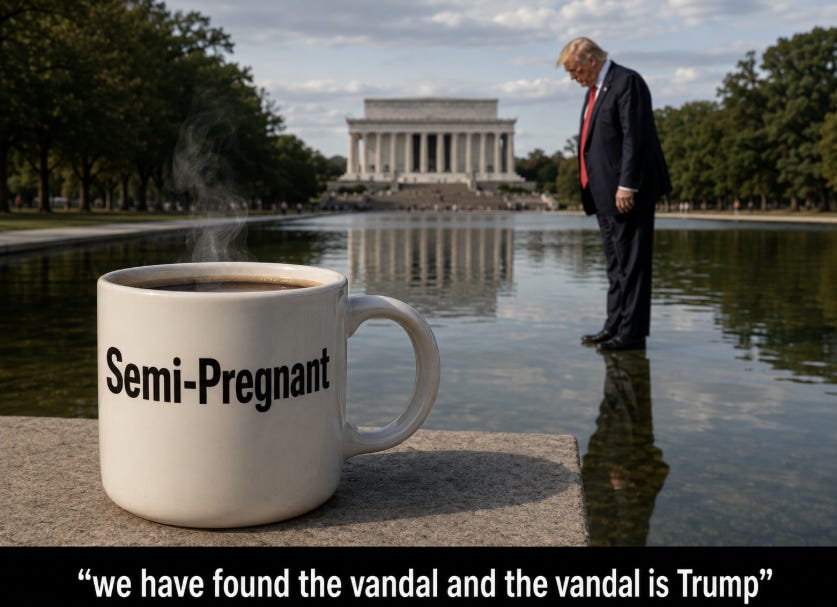
“Only semi-negotiating” is a splendid contribution to the diplomatic lexicon, roughly in the family of being semi-pregnant. There is now a state between negotiating and not negotiating in which the parties negotiate an agreement, exchange conditions through intermediaries and haggle over implementation while maintaining that nothing so vulgar as negotiation is occurring.
The political purpose of the language is clearer than the semantic purpose. Trump needs the retreat from another bombing campaign to look like dominance rather than restraint. He is not waiting because the military option has become costly or because Iran has demonstrated leverage over Hormuz. He is waiting because Iran is broke. Hence Sunday night’s emphatic Truth Social graphic: IRAN HAS NO MONEY.
If a deal eventually appears, the victory speech is already written. Whatever Tehran actually extracts at the negotiating table: sanctions relief, changes to the blockade, a role in managing Hormuz, or simply an American decision not to resume large-scale bombing, will be edited out of the story. Trump’s version will be much simpler: Iran was broke, he waited, and they folded.
Tehran is preparing an entirely different movie using the same footage.
Iran’s latest demands include sanctions relief, access to frozen funds, compensation for war damage, an end to the naval blockade, and broader military concessions. Publicly, it looks like Tehran has responded to months of war by handing Washington a surrender document and inviting the United States to sign its own name at the bottom. But H.A. Hellyer of RUSI made an important point in a France 24 interview: most of these demands have antecedents in an earlier memorandum to which the Americans had already agreed. He also argues Iran brought a much more experienced negotiating team and is now using Hormuz to demand the highest possible price before relinquishing its leverage.
Hellyer actually calls the current package something close to a capitulation document, but he does not think Iran expects Washington to accept every item. His reading is bargaining maximalism rather than diplomatic suicide: start with everything, concede what must be conceded, and discover how much America will pay to make Hormuz cease being a daily problem.
Trump’s cheerful description of Iran’s economic misery runs into the physical geography of the Persian Gulf. Treasury Secretary Scott Bessent has been suggesting that Iran’s use of Hormuz as a chokepoint will ultimately defeat itself, as Gulf exporters build enough pipeline capacity that Hormuz becomes merely another body of water.
Sal Mercogliano, whose day job involves actually paying attention to ships, is unimpressed. The UK Maritime Trade Operations data he cites shows AIS-detected transit running roughly 90 percent below the pre-conflict baseline, with commercial vessels abandoning or altering planned transits in response to attacks. Yet oil is still emerging from the Gulf, which may sound like vindication for Bessent until one examines how. Mercogliano cites TankerTrackers identifying a fleet of at least 56 tankers operating in “digital darkness,” conducting ship-to-ship transfers in the Gulf of Oman under US military protection before returning for another load.
If a maritime chokepoint requires military protection, transponders switched off, offshore cargo transfers and a small naval-operational bureaucracy to keep the oil moving, declaring that chokepoint “irrelevant” feels a little like declaring a bank robbery irrelevant because the armored car successfully escaped.
Hellyer arrives at almost the same conclusion from the diplomatic side. Gulf states will unquestionably accelerate alternative routes through Saudi Arabia, the Red Sea and Fujairah. But his wording is considerably more sober than Bessent’s: Hormuz cannot be replaced completely; its importance can be substantially diminished.
Iran’s weaponization of Hormuz may eventually reduce Iran’s leverage over Hormuz, because everybody else will spend fortunes designing that vulnerability out of their economies. But if your adversaries spend fortunes redesigning the regional energy system because you demonstrated you could choke it, it is difficult to argue your leverage was imaginary.
The same adaptation is now visible on the military side.
Trump’s public theory of the conflict is an attrition story in which only Iran is being attrited. Tehran has inflation, Tehran lacks money, therefore time belongs to Washington. Attrition has two columns in the ledger, and the United States has expended large numbers of expensive, difficult-to-replace weapons during the Iran war. Defense analysts emphasize that the larger strategic danger is not America’s ability to keep fighting Iran today, but what remains available for the next high-end conflict afterward.
Peter Apps, in an LBC discussion, made an important distinction that gets lost whenever the argument collapses into “America is running out of missiles.” The United States remains overwhelmingly militarily powerful. The problem is that some weapons being consumed in Iran are precisely the scarce, long-lead-time weapons planners would also want available for defending Europe or fighting a Pacific war. Iran therefore has an attrition theory of its own: it doesn’t have to defeat the US military conventionally, only make it repeatedly spend sophisticated interceptors on cheaper threats, forcing Washington to ask after each exchange how many it wants to reserve for Taiwan, or Europe, or whatever comes next.
Iran can print more rials. The United States cannot print a PAC-3. Someone has to build it.
Hellyer’s France 24 interview supplies another uncomfortable component: in his assessment, the administration entered the Iran war from a poor strategic position, expected the regime to prove more brittle than it did, and failed to adequately anticipate what Tehran would do with Hormuz. He believes Washington has now moved, incompletely, toward recognizing that additional bombardment will not automatically produce Iranian capitulation.
Trump’s “low-keying it” rhetoric now looks less like a new strategic insight than the branding operation that follows a strategic discovery. “We have decided that economic pressure is superior” sounds much nicer than “we tried the other thing and discovered some problems.”
Hellyer also emphasizes an actor who disappears from Washington-versus-Tehran storytelling: the Gulf Arab states, who are not interested in remaining supporting characters in a months-long contest to discover whether Iranian economic endurance expires before American patience does.
Everybody is adapting to constraints. Washington is issuing press releases about how unconstrained it is.
Which brings us, inevitably, back to the Reflecting Pool.
The Department of Justice did not merely quietly lose interest in David Hearn. Prosecutors moved to abandon their felony vandalism case after obtaining information that, in their own account, showed the widespread damage was associated with a flawed, rushed installation and significantly undermined the evidence on which Hearn had been indicted. The judge has dismissed the case but has not yet finally determined whether that dismissal should be with prejudice, which would prevent the government from bringing the same prosecution again.
Trump nevertheless returned to the case Sunday night, again accusing Hearn of vandalism while now acknowledging there had been at least some contractor error.
Three other people were also prosecuted over the pool and subsequently had their charges dropped. Justin Carreno’s attorney says Carreno lost two jobs as a consequence of the arrest. So Trump’s “ALERT” is not just an elderly man arguing with a pool liner. His own Justice Department formally backed away from the vandalism theory after the evidence changed. A court is still considering how completely to close the door against another prosecution. People who encountered pieces of failing coating have already been arrested and suffered real consequences. And the president is once again using his platform to insist the original accusation was right after all.
Trump is trying to relitigate in the court of public opinion what his prosecutors could no longer sustain in the actual one.
The institutional timing is exquisite. Today Trump is due to ceremonially install Todd Blanche as attorney general, elevating his former personal defense lawyer to permanent command of the Justice Department. Trump also announced this weekend that another longtime legal ally, Will Scharf, will become White House counsel on September 1.
And hovering over that increasingly personalized legal architecture is the president demanding that everyone please take another look at the guy near his pool.
The disparity of scale is just so Trumpian. The Strait of Hormuz is functioning through extraordinary military and commercial improvisation. Iran is trying to convert maritime disruption into sanctions relief and strategic concessions. Gulf economies are considering infrastructure changes that could take years and cost fortunes. European planners are asking what American munitions depletion means for their own defense. American negotiators are hunting for an arrangement Tehran and Washington can each describe as the other side’s surrender.
The president is conducting CSI: Reflecting Pool.
Trump’s rhetoric is about mastery: Iran is broke, American stockpiles are fine, Hormuz can be made irrelevant, and Washington can afford to wait. The reality is finite missile inventories, improvised shipping routes, limited pipeline capacity, sanctions bargaining, and allies already adapting to a world in which American power has costs and limits.
Trump still has leverage; Iran’s economy is under severe pressure and Tehran plainly wants to cash in its Hormuz advantage while it lasts. But this is not simply a matter of waiting for the other side to collapse.
The president’s preferred story is simple: Iran is broke, America is strong, and eventually it all works out.
Somewhere between that story and reality is a very important piece of blue paint.
It's worth recalling that the Strait of Hormuz is a transit lane for more than just crude oil. Agricultural products, fertilizer, helium - there are other important products shipped through that strait. It's not clear to me if these products have any pipeline alternatives.
https://unctad.org/publication/strait-hormuz-disruptions-implications-global-trade-and-development
All this - every problem Trump's war of choice has wrought - can be summed up in two words: Epstein files.