


If you want the cleanest way to understand why the Epstein story keeps smelling like something is being managed, not merely released, you do not start with a name. You start with the rhythm, because the rhythm is the tell.
First, in late January 2026, the Justice Department rolls out its public Epstein database with the kind of formal language that is supposed to calm you down. It is transparency, it is compliance, it is redacted, it is a public service, and if anything sensitive slipped through, please email us, as though the public accidentally became the last quality-control checkpoint for a scandal built on exploitation. The DOJ even spells it out in its own disclaimer language: “In the event a member of the public identifies any information that should not have been posted, please notify us immediately by email… so we can take steps to correct the problem as soon as possible.”
That is not me accusing anyone of malice. It is me noting what the system asked for, because what a system asks for tells you what it expects. If the plan is “we will publish a massive archive and hope the public helps us spot what should not be there,” then the plan is not actually “we have control,” it is “we have a deadline.” Or, more realistically, it’s: let’s frantically upload everything including victim information but first make sure we cover up Trump’s name, but not so many times that it looks suspicious, just a few hundred thousand.
On February 1, 2026, the administration starts trying to steady the narrative about the rollout, with Deputy Attorney General Todd Blanche defending the release and insisting, “We took great pains… to make sure that we protected victims,” while also promising fixes when victims or their lawyers flag problems.
On February 9, 2026, as if to prove that the Epstein story is now a full-service marketplace for leverage, Ghislaine Maxwell reappears not as a defendant with answers, but as a person offering the concept of answers in exchange for personal benefit. She invokes the Fifth, repeating, “I invoke my Fifth Amendment right to silence,” and the whole moment reads less like testimony and more like a reminder that in this story, even silence can be monetized. If that feels grotesque, it should. Survivors become background scenery in a bargaining drama where the main characters are prestige, punishment, and who gets to walk free.
On February 14, 2026, Attorney General Pam Bondi and Todd Blanche send Congress a formal report under the Epstein Files Transparency Act, and the most important line in it is also the one that sounds like it was written specifically to stop everyone from asking the question we are all asking. “No records were withheld or redacted on the basis of embarrassment, reputational harm, or political sensitivity,” they write.
On February 18, 2026, if that was not enough to make you feel uneasy, the stories start coming out that show what the Epstein operation looked like up close, and they are not dramatic in the way people expect. They are dramatic in the way an office is dramatic, which is to say they are grimly organized. The Cut publishes reporting that makes clear Epstein had something like a maintenance protocol for the women he exploited: Gynecological appointments booked, tests ordered, treatment arranged, money paid, repeat providers revisited, and the whole thing carried out with a familiarity that is almost worse than secrecy, because secrecy implies shame and this did not read like shame.
The most chilling detail is not a medical term. It is the way the habit is discussed inside the circle, like the answer to “who do we send them to” is a normal operational question, like a vendor list. It is the kind of detail that turns “network” into something you can picture as a living workflow, not a conspiracy mood board. It is also the moment where you realize how much abuse depends on the same boring tools the rest of society uses to keep life running: scheduling, referrals, billing, and the quiet authority of professionals who, in any other context, would be the adults in the room.
On February 24, 2026, right when the public is still absorbing that, we get the second machine in this story, and it is not made of appointments. It is made of documents. NPR drops a report that is essentially about absence. Not about a new scandalous photo or a surprise confession, but about missing pages and missing interview records, and the way those absences show up when you follow the numbering on documents that are supposed to exist in sequence. The reporting, as presented, does not claim it proves an allegation true. It claims something more basic and more dangerous for institutional credibility: that the public database looks incomplete in a way you can measure, and that the missing chunk is connected to politically explosive material involving President Trump.
Then, still in that same late-February window, the reporting describes documents being taken down and later restored, at least in part, tied to a key witness in the Maxwell case. The government explanation, as reported, is that removals happen when victims or counsel flag documents for additional review and redaction. That can be both true and still combustible, because the moment you normalize “we post, we pull, we repost,” you have created an information environment where nobody outside the building can tell the difference between protecting victims and protecting reputations.
In the days that follow, congressional pressure ramps up immediately. Democrats start demanding answers about what is missing and why, and what legal justification is being used, and whether the public release is being curated in a way that defeats the whole purpose of a transparency law. Republicans claim to be investigating without committing to what investigation would require, and Comer tells reporters, “We’re looking into the accusation made by the NPR,” adding, “We don’t know the answer to that.”
This is where the story gets weirdly modern, because the fight is not only about what happened years ago. It is about who controls the present tense. It is about whether “transparency” means the public gets the record, or whether it means the public gets whatever the government can safely distribute without creating a mess that would embarrass it, endanger victims, or invite lawsuits.
The timeline then hits the part that would be funny if it were not so dark: the country starts staging depositions like a civic ritual, as if the public is going to be satisfied by the spectacle of powerful people sitting under oath while the actual files remain a jigsaw puzzle missing half its pieces. Hillary Clinton appears for a deposition on February 26, 2026. Bill Clinton follows on February 27, 2026.
Democrats call for Trump to testify too, because if the committee is going to establish a precedent that former presidents get hauled in, then the sitting president should not get to live above the rule it is inventing in real time. When that question hits the room directly, Comer later recounts a moment from the Clinton deposition where Garcia asked, “Should President Trump be called to answer questions from this committee?” and Clinton replied, “That’s for you to decide.”
Which, do not get me wrong, I think the more people deposed, the better. We should put everyone with relevant knowledge under oath and on the record, because survivors deserve a system that treats their lives like evidence, not gossip. But we also do not need to turn this into a sideshow. If this is going to be done at all, it should be done like a real investigation, with clear lines of inquiry and visible standards, not like a political power play where the point is the headline rather than the answer.
Meanwhile the underlying question, the one that matters to victims and to anyone trying to understand institutional competence, still hangs there: is the record complete, and if it is not complete, who decides what the public is allowed to see and why.
Then February 28, 2026 arrives, and the timeline takes a hard left into geopolitics, because the United States and Israel launch Operation Epic Fury against Iran. The news cycle becomes saturated with strikes, retaliation, and the kind of national-security urgency that does not merely dominate the day, it colonizes it.
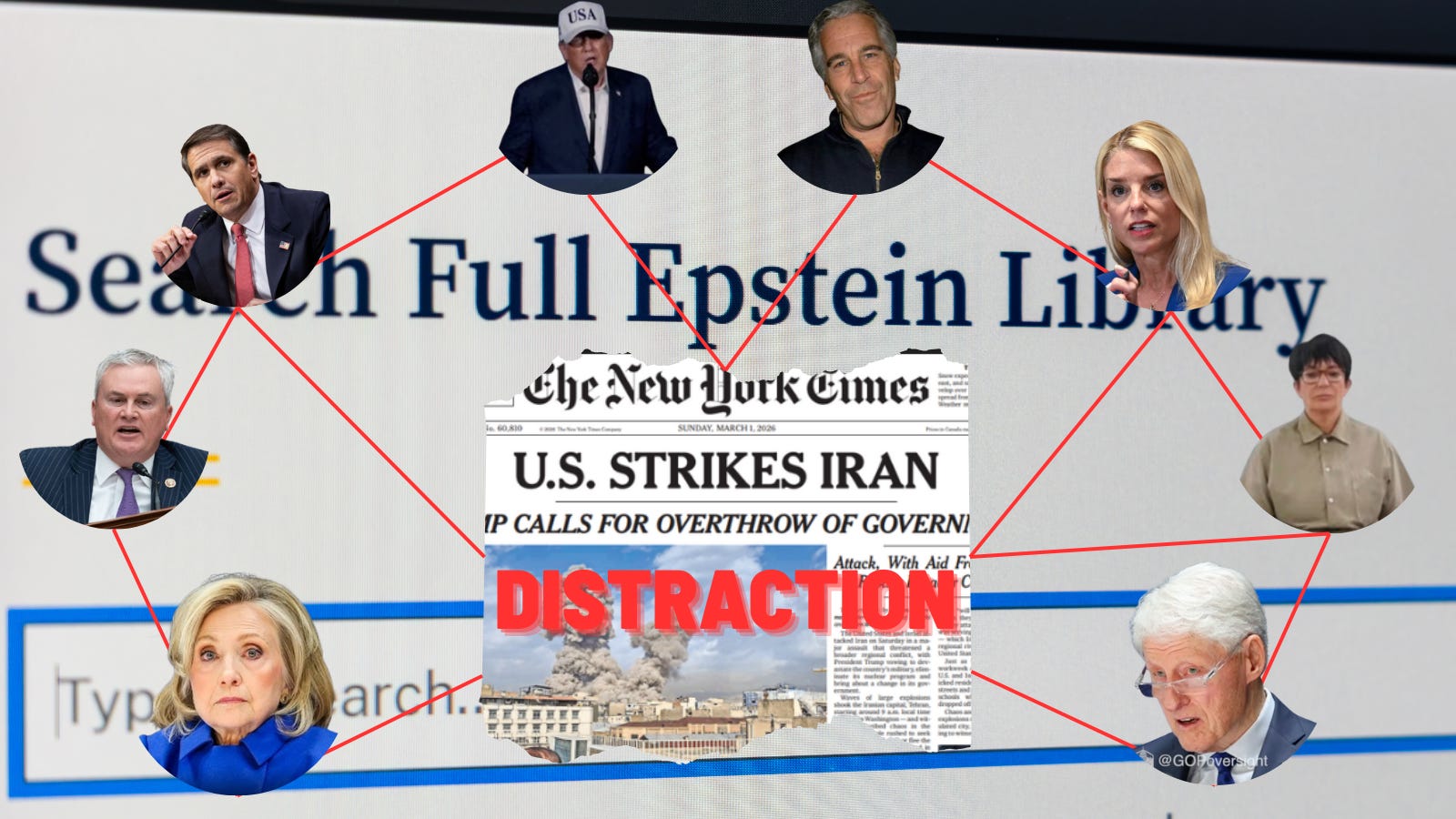
Now, I am going to say this the responsible way, because that is the kind of ending these times need, not the reckless kind. I cannot prove motive. I cannot claim any foreign military action happened “so that” a president would not have to answer domestic questions. That would be a declarative claim about intent, and I do not have access to intent.
What I can say is that it is hard to ignore how perfectly a war-footprint headline can solve a domestic accountability problem without anyone ever admitting they meant it to. It is hard to ignore how the public’s attention can be redirected, not with persuasion, but with scale.
In the first week of March 2026, the Justice Department effectively confirms the broader reality that the public set is not stable yet. Tens of thousands of files are reportedly taken offline for review, with assurances that they will be redacted and released.
At that point, the timeline has established its pattern so clearly that you can almost predict the next steps, because the pattern is now the product. The pattern is: release, outrage, gap, explanation, re-review, and promises of future completeness. In the meantime, the public is left arguing about motive while victims get the familiar experience of being surrounded by attention and still feeling like the system is not built for their clarity.
So, here is the hot take, and it is not a conspiracy theory, it is a diagnosis of incentives. Epstein’s operation, as newly illuminated, looks like a brutal form of administration. It had protocols. It had repeat providers, it had routinized care used as maintenance, and it had people around him who treated the logistics as normal enough to joke about.
And now the public-facing afterlife of Epstein is also administration. It has portals, disclaimers, redactions, removals, restores, offline reviews, and a system that keeps asking the public to treat gaps as either understandable or irrelevant. The problem is that gaps are neither. Gaps are the environment where suspicion thrives, and in this case suspicion is not a hobby, it is a predictable response to a scandal defined by delayed accountability.
This is also why it feels naive to insist the only question is whether the government is protecting Trump. That might be part of it, or it might not be, and anyone who tells you they know for sure is selling you certainty they cannot cash.
Another possibility, one that is almost more alarming because it is less cinematic, is that the government is not prepared to admit how difficult it is to map what Epstein built, especially if what Epstein built was never just a list of men but a set of roles distributed across ordinary systems. If the network was partly made of respectable routines, then dismantling it requires more than releasing documents. It requires showing what was investigated, what was followed, what was verified, what was closed out, and what remains open, and it requires explaining those decisions in a way the public can audit without turning into amateur archivists.
If you cannot or will not show that work, then the public’s most cynical interpretation wins by default, even if it is wrong. That is not fair to the people trying to do real investigative labor inside institutions, but it is also not a mystery. It is the predictable consequence of asking people to trust a process they cannot see, in a scandal where “trust us” has historically been the first lie.
The only people who cannot step out of that fog are the victims, because fog is a media condition and their lives are not. If the system wants to be taken seriously, it has to stop confusing “we posted something” with “we explained anything,” and it has to stop treating accountability like a content drop that can be paused, pulled, and re-released until the public gets bored. Because boredom is the real escape hatch, and power knows it.
The victims deserve their justice. It’s not a hard concept..
Thank you. But oh boy there is still a whole lot of something that needs to be brought into the light.