

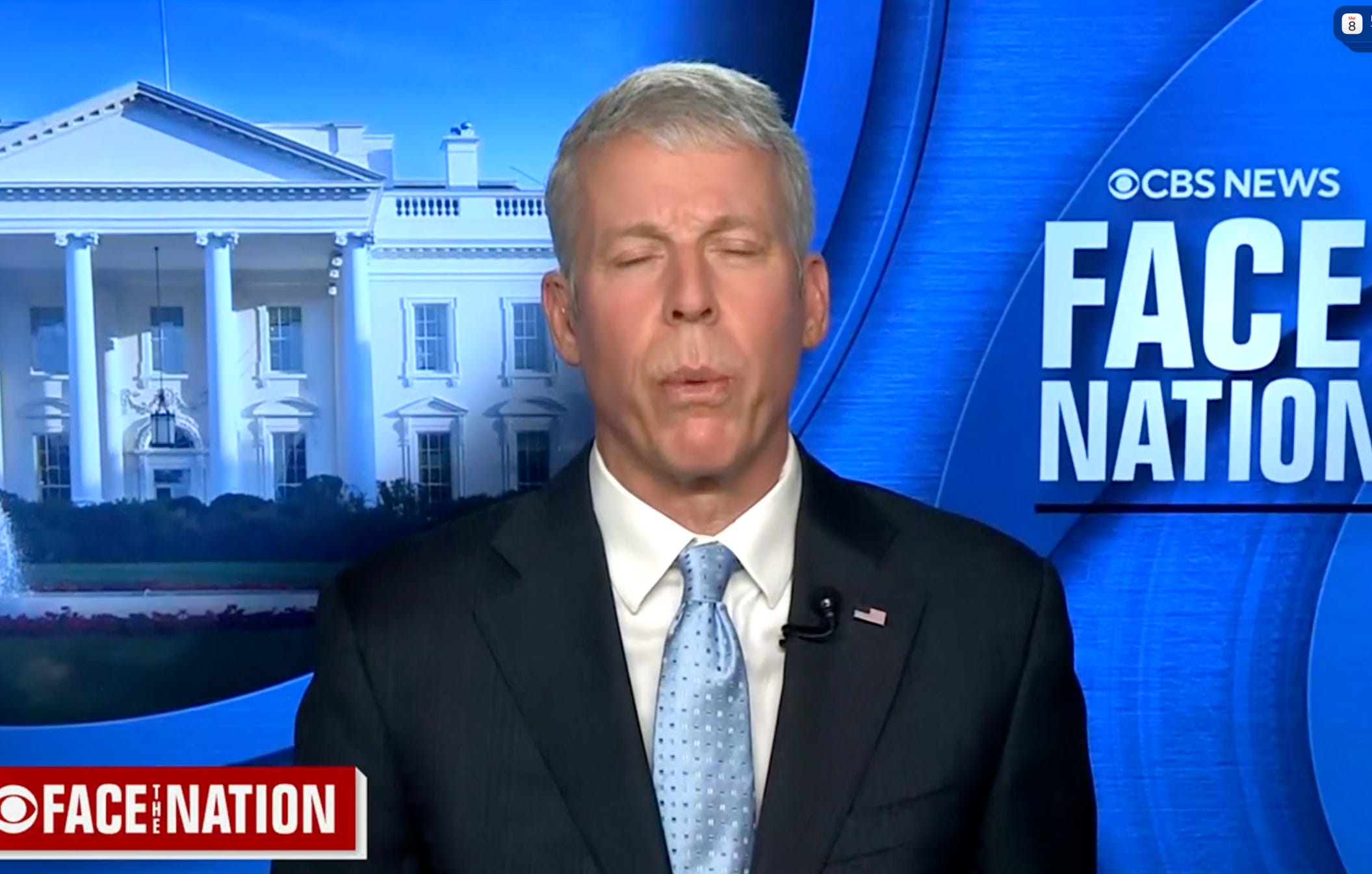
They are trying so hard to sell this as a minor inconvenience. Just a little blip, a brief disturbance, teensy-weensy whoopsie in the global energy system while the usual chest-thumping men set fire to another region and call it strategy. Energy Secretary Chris Wright goes on television to assure everyone that any spike in gas prices will be over in weeks, not months, as though the American public is supposed to hear “weeks” and respond with calm gratitude while watching the price board jump at the pump and the grocery bill quietly mutate into a hostage note.
That is the real scam. Not just the war or the oil spike. The scam is the insistence that the public experience of inflation begins and ends with whatever number is flashing on cable news graphics that day. We are told to focus on whether crude retreats from the panic peak, whether tanker traffic resumes, whether the official people in expensive suits can go back on television and announce that everything is stabilizing. Ordinary people do not live inside a CNBC chyron, they live in kitchens, in checkout lines, in monthly budgets that already looked like battlefield triage before another gaggle of pyromaniac foreign policy geniuses decided to play regime change roulette with one of the most important energy chokepoints in the world.
Now comes the delicious little punchline: so much for regime change. After all the posturing, all the blood-soaked fantasy talk, all the usual delusions about cleansing fire and democratic rebirth, Iran appears to have responded by replacing one Khamenei with another. The regime did not collapse, it reproduced spectacularly, a dynastic continuity under bombardment. It’s the clerical version of a franchise renewal. The grand result of this latest march of the war hawks is Khamenei 2.0, a wider regional conflict, and oil above $100 a barrel. Great job, MAGA, world-class stuff. If the goal was to harden the regime, rally the security state, and hand the global economy another inflationary brick to the face, then yes, mission accomplished.
Matt Randolph’s analysis cuts through the official nonsense far better than the administration’s soothing patter. Wright is selling the best-case scenario because that is his job. He is not there to describe how price shocks actually work their way through the real economy; he is there to stand in front of the cameras and tell people not to panic while the administration hopes the fire burns out before the polling gets worse. Randolph, by contrast, is talking about the mechanics of how this actually lands on ordinary people. He is talking about spare capacity, logistics, refinery outages, shut-in production, and the simple reality that oil markets do not run on magical patriotic vibes. As he put it, “global oil markets want spare capacity to be happy.” That cushion matters because, in his words, “we’ve destroyed the spare capacity.” Once that buffer is gone, the fantasy that prices simply glide back to where they were before the war starts to sound like a bedtime story for cable-news viewers. These markets run on buffers and excess capacity. They run on intact infrastructure, storage that is not maxed out, shipping lanes that are actually functioning, and a market that believes there is enough slack in the system to absorb shocks without losing its mind.
“Diesel moves everything,” Randolph explains. That is the part the television optimists always try to glide past. Even if the spike cools later, the costs diesel pushes upward across food and freight have a nasty habit of sticking. Even if the shooting stopped tomorrow, even if traffic through the Strait of Hormuz partially resumed, even if some of the panic premium drained out of crude, that does not mean the world somehow snaps back to the conditions that gave you cheaper oil before the war. That world has already been damaged. Infrastructure has been hit, refineries are offline, and LNG exports have been disrupted. Shipping has been snarled, and risk has been permanently repriced, at least for the foreseeable future. Wright is talking as though this is a traffic jam that clears when someone waves the cars through. Randolph is describing a bridge collapse. Those are not the same problem.
Now the rubble is becoming measurable. Reuters reports that Iraqi oil production from its main southern fields has collapsed by 70 percent, falling from about 4.3 million barrels per day to just 1.3 million because the Strait of Hormuz is effectively blocked, storage is full, and tankers are no longer arriving. This is no longer about market fear or speculative panic, but about barrels that cannot move, storage that cannot stretch, and a system that is starting to seize up exactly the way Randolph warned. The administration keeps talking like this is a brief traffic jam. That looks less convincing when one of the world’s major oil producers is being forced to shut down production because the export route is functionally broken. This is what destroyed spare capacity looks like in the real world.
Even if oil prices do come down from their panic spike, even if gasoline cools off at some point, diesel has already done what diesel always does: it starts infecting everything else. Diesel moves the economy. It moves food, freight, farm equipment, construction materials, deliveries, supply chains, the whole glorious machine. When diesel jumps, the effects are immediate. Fuel surcharges appear, shipping costs rise, food costs rise; businesses adjust prices upward with astonishing speed and zero shame. When diesel later eases, those same prices almost never gracefully float back down to where they were before. Funny how that works.
This is one of the oldest rackets in American economic life. Rising energy costs are treated as an emergency justification for immediate price hikes, but falling energy costs are treated as a fascinating philosophical question for future consideration. Once businesses discover that consumers have been trained to absorb the higher price, the incentive to reverse course evaporates. Contracts lag, supplier pricing lags, retail pricing sticks. wage adjustments, where they happen at all, arrive late and halfhearted. The result is that fuel shocks do not simply hurt in the moment; they ratchet the whole price structure upward. The pump may cool off eventually, the grocery aisle usually does not.
That is why Wright’s “weeks, not months” reassurance feels so hollow. He is speaking in the language of headline volatility, while Randolph is speaking in the language of lived inflation. Those are two very different conversations. A spike in crude can be temporary, but the damage it does to the cost of living often is not. That is the part the administration does not want people dwelling on, because voters do not actually grade presidents and cabinet secretaries on the theoretical future path of benchmark crude. More appropriately, they grade them on whether eggs, produce, soda, rent, school supplies, and every other dull necessity of life keep getting more expensive while Washington insists the situation is basically under control.
Maybe that is the bleak little joke at the center of all this. The same crowd that never stops sermonizing about markets, discipline, efficiency, and the genius of private enterprise has once again helped trigger exactly the kind of geopolitical chaos that private enterprise loves most: the kind where it gets to raise prices instantly, blame world events, and then keep the extra margin long after the official emergency has faded. The war hawks light the match, the oil market explodes, diesel surges through the system, corporations hike prices with patriotic sorrow in their voices, and then months later we are all supposed to clap because gas fell twenty cents while the weekly grocery bill remains perched on a cliff edge.
This is not just a short-term gas price story, or a cable-news commodities story. This is a story about how war destroys the conditions that keep energy affordable, how price shocks ripple outward through diesel into every corner of daily life, and how those shocks almost never unwind as neatly as the people who caused them would like us to believe. But people know what they see, that when fuel prices jump, everything jumps with them. When fuel prices later ease, the relief is always strangely incomplete. People know, despite the blizzard of official spin, that bombing your way into another Middle East crisis was never going to produce cheap oil, stable prices, or democratic transformation.
Great cause-and-effect analysis. If we - the US, the world - had actually gone hammer and tongs at solar energy, windmills, new hydraulic power systems, and viable biofuels when they started making headway two-plus decades ago, where would we be now?
Brilliantly analyzed and written. Reality is not a propaganda video.