


The strangest thing about America’s second Trump term isn’t the chaos itself. Chaos is practically a brand extension at this point. The strangest thing is watching the old rituals of democracy and diplomacy continue to shuffle along like haunted animatronics in a theme park that’s already been condemned.
The flags are still there, dinners are scheduled, and speeches are written. The invitations still go out. But the shared civic space those rituals were supposed to represent is evaporating in real time. The White House, once, at least in theory, the people’s house, is increasingly operating like a private club with a bouncer and a guest list.
Take the annual governors’ gathering in Washington, one of the last remaining bipartisan forums where red-state and blue-state executives sit in the same room and pretend, for a few hours, that they all inhabit the same country. The unglamorous plumbing of the republic.
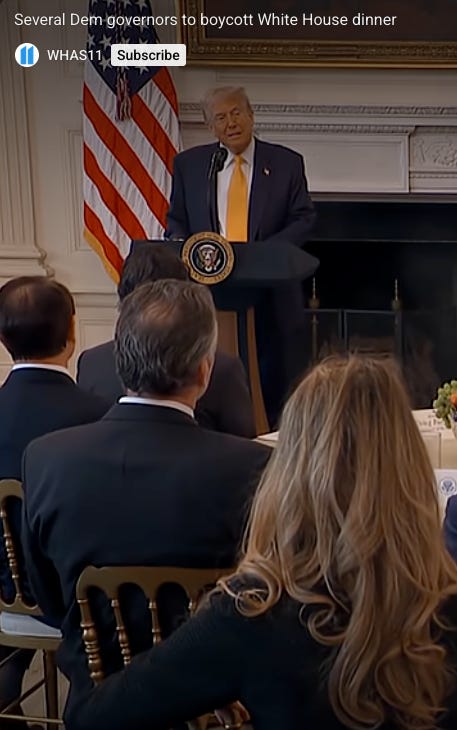
Naturally, the Trump White House decided to blow it up. This year, Democratic governors were reportedly excluded from the traditional White House events surrounding the National Governors Association meeting. Republican governors only. The NGA, a group whose entire mission is to represent all 50 governors, essentially backed away from facilitating the meeting. Democratic governors announced they would boycott the dinner. Even Oklahoma’s Republican governor Kevin Stitt, trying desperately to play the role of the adult in the room, urged unity while Washington grew “distracted by politics,” as if this were some unfortunate weather pattern rather than the deliberate strategy of the administration.
The White House response was pure Marie Antoinette detachment: the president has discretion to invite whomever he wants. It’s the people’s house, yes, but also his home, so…sorry, Democrats, maybe try the Olive Garden down the street.
The fracture doesn’t stop at the statehouse doors. Across the Atlantic, Northern Ireland’s First Minister Michelle O’Neill announced that Sinn Féin will not attend St Patrick’s Day events at the White House. The reason isn’t petty partisanship, it’s Gaza. O’Neill called it genocide and said bluntly: this is not the time for shamrocks and photo ops.
Her deputy, Emma Little-Pengelly, will go anyway, because the office matters, because engagement is duty, because Trump is “the most influential leader in the world.”
And that’s the split screen of this moment. Not long ago, proximity to a U.S. president was currency. You showed up, smiled, and shook hands. Even if you disagreed privately, you kept the disagreement wrapped in diplomatic gauze. Access was power, and no one wanted to be frozen out of the room.
Now? Leaders are calculating something different. Michelle O’Neill isn’t afraid of being punished for staying away. She isn’t tiptoeing around the optics. She’s willing to say “genocide” out loud and decline the invitation, publicly and without hedging or whispering. That’s new.
For years, Trump’s brand relied on dominance, the idea that even his critics had to orbit him, had to seek his favor, had to measure their words carefully lest they incur retaliation. But I feel something has shifted. Governors are boycotting White House dinners. European leaders are openly warning that MAGA culture wars are not theirs. Members of Congress are debating whether attending the State of the Union dignifies dysfunction. The fear of exclusion used to discipline behavior. Now exclusion is worn as a badge.
Even St Patrick’s Day, that soft-focus diaspora ritual where everyone pretends history is just parades and Guinness, has turned into a test of moral distance. The issue now is whether standing next to Trump on camera still confers prestige, or whether it costs you credibility.
Back home, the same drama is playing out in the Capitol, where Trump is barreling toward his State of the Union address while the Department of Homeland Security slides into a funding lapse. There is something almost performance-art perfect about it: the president standing beneath the frescoes of democracy declaring that the state of the union is strong while TSA agents work without pay and FEMA stares at an empty wallet.
Republicans, privately, are fretting. It doesn’t exactly scream “functioning GOP trifecta,” one House member admitted, which is the kind of understatement you offer when the ship is taking on water but you’d rather not spill your cocktail.
Democrats are debating whether to attend at all. Senate Democrats have discussed boycotting. House Democrats are being urged by Hakeem Jeffries to either skip the event or sit in “silent defiance,” because last year’s heckling, signage, walkouts, and the ejection of Al Green turned the chamber into a reality show reunion episode.
This year, leadership wants restraint. No theatrics. Just the cold, dead-eyed stare of disciplined opposition. That’s where American democracy is: not debating policy, but debating stagecraft. The State of the Union as hostage negotiation over optics.
And then, as if on cue, we pan outward to Europe, where Secretary of State Marco Rubio arrived at the Munich Security Conference with what was widely described as a “reassuring” speech. Reassuring in the way a doctor is reassuring when they say, “Well, at least it isn’t stage four.”
After last year, when J.D. Vance strolled into Munich and informed European leaders that their greatest threat was not Russia but “the threat from within” (wokeness, presumably, lurking in the shadows with pronouns), Rubio sounded almost soothing. He spoke of shared heritage, shared civilization, the West as a noble inheritance. The chair of the conference joked about the “sigh of relief” in the hall.
Rubio got a standing ovation. Europe’s foreign press immediately asked the obvious question: was that applause for Rubio, or for the fact that he didn’t spit directly into the punch bowl?
The Atlantic’s Thomas Wright pointed out that Rubio’s speech was less notable for what it said than for what it didn’t. Rubio scolded Europe for faith in institutions, for borders, for managed decline, but barely named Russia or China as the central threats of this moment. It is the geopolitical equivalent of giving a fire safety lecture without mentioning that the building is currently on fire.
Europe, Wright notes, has been rearming rapidly. Non-U.S. NATO members have increased defense spending dramatically over the past decade. Europe has provided more aid to Ukraine than the United States. The EU has tightened asylum rules and begun de-risking from China.
Rubio’s narrative of a complacent Europe being rescued by Trumpian renewal is not just inaccurate; it’s insulting. More importantly, it’s strategically backward. The real story of this era is authoritarian alignment: Russia, China, North Korea increasingly cooperating to reshape the world order. Yet the administration seems allergic to naming the threat, as if Putin is Voldemort and speaking his name might summon him into the ballroom.
The Guardian’s Nathalie Tocci goes further. Rubio’s warmth, she argues, is not reassurance but a trap.
Vance was crude, Tocci writes, but Rubio is coherent. And coherence is more dangerous, because the underlying message is the same: the West is not defined by democracy or human rights or the rule of law, but by ethno-cultural bonds, tradition, religion, nationalism. Rubio is selling a civilizational renaissance that sounds suspiciously like a MAGA culture war with better tailoring.
If the rules-based order is foolish, if institutions are cloud castles, then what remains is empire: pay up, Europe, but understand that Washington calls the shots, and may collude with Russia or China if it suits the imperial center.
Europe, Tocci warns, cannot afford to press snooze just because the tone softened.
At home, governors’ gatherings unravel because the White House can’t tolerate bipartisan tables. Abroad, St Patrick’s Day becomes a boycott stage. Congress debates whether to show up or sit silently while DHS shuts down. In Munich, Rubio offers “reassurance” that Europe hears as a velvet glove over the same nationalist fist.
It is not just polarization. It is the slow collapse of shared civic space, domestically and internationally, under an administration that treats institutions as props, allies as dependents, and legitimacy as something you either perform loyalty for or withdraw from entirely.
I'd like to see Ds sit silently when he/it enters and then leave quietly 7-8 at a time every minute. Pissing tramp off would be the goal. Show him exploding on camera icing on cake.
Don't go and don't watch this vile man pretending to be the leader of the world. We are way past our elected leader's just holding up signs of protest. Just don't go! His insults fall on only the ear's of those who still lick his boots.