


Good morning! There are days when the news arrives like a neatly arranged buffet of democratic decay, each tray labeled for our convenience: spectacle, war, markets, profiteering, corruption. Today is one of those days.
Trump has turned the presidency into a pay-per-view event, the Iran war into a global shipping crisis, the oil market into a roulette table, and the pardon power into what looks suspiciously like a VIP checkout lane for well-connected criminals, victims not included.
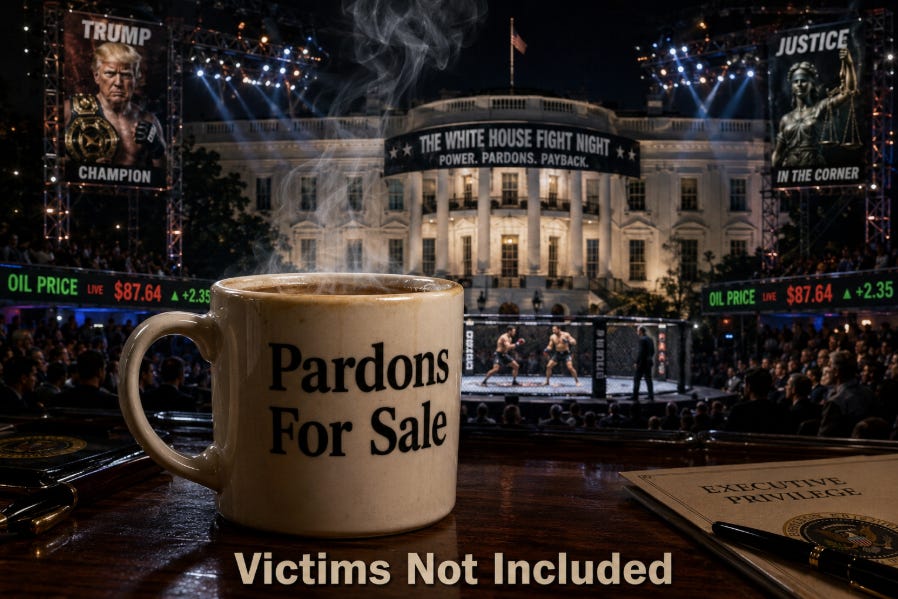
Trump creates chaos, performs dominance, declares victory over problems he made worse, and ordinary people get stuck with the bill while insiders, oil companies, cronies, and clemency-seekers figure out where to send the invoice.
Let’s start where Trump wants us to start: with the show.
Trump held what was billed as an unscheduled Oval Office event with UFC fighters, but it played less like official business and more like a soft-launch for a White House-branded cage match. Surrounded by fighters and friendly faces, Trump previewed UFC Freedom 250, a June 14 event on the South Lawn, promising 4,000 seats near the front door and tens of thousands watching on big screens across the street. He called the fighters “warriors,” praised their toughness, showed off promotional images, and basked as guests thanked him, flattered him, and credited him with helping legitimize the UFC years ago.
The dynamic peaked when a fighter’s manager declared Trump “the greatest president of all the time in any country in any world in any time.” Trump’s response was not modesty. “I like him,” he said. “I made a good move by asking him to say that.” He knew exactly what he was doing. He always does.
It was exactly the kind of public appearance Trump now seems to prefer: controlled visuals, handpicked admirers, a cheering section, and just enough press access to pretend accountability wandered in voluntarily.
Trump described the event as free and open, tens of thousands of ordinary Americans watching on big screens in the park across the street, the greatest show on earth; your country is invited. What he did not mention is that a separate tier exists for less ordinary Americans. MMA reporter Ariel Helwani revealed this week that a limited number of seats at the White House event are available as a “Partner Investment” $1.5 million per package, bundled with floor seats to UFC 329 in July, where Conor McGregor is expected to make his comeback, and offered exclusively to what Helwani described as “influential people.” Most of the 4,300 seats are reserved for military personnel. The public gets the big screens. The influential people get the front row and a McGregor bonus.
The event is projected to cost over $60 million and TKO does not expect to turn a profit. The $1.5 million packages are not really about recouping costs. As always, access is the product.
The White House is supposed to be the seat of government. Trump keeps treating it like a venue he forgot to monetize the first time. The South Lawn becomes a fight arena. The Oval Office becomes a green room. The presidency becomes another licensing opportunity, only now with nuclear weapons and a guest list, and apparently a VIP tier for those who know how to ask.
And because reality has terrible timing, reporters eventually asked about Iran. That is when the fight-club metaphor stopped being funny and started being accurate.
Trump discussed Iran using the same framework he had just applied to UFC: submission, toughness, pride, domination, opponents who need to be tested. He claimed Iran’s ships were blown apart, its air force gone, its leaders dead, and the United States had essentially won — while also warning that if negotiations failed, the bombing could resume at a higher level. When a reporter noted that Iran had fired on US ships just days earlier, Trump was unbothered. “A few days ago,” he said, “is a long time ago in the world of war.”
When foreign policy gets filtered through pay-per-view masculinity, war becomes a fight card and diplomacy becomes trash talk. The President of the United States stood with actual fighters and somehow sounded less grounded than the people who get punched in the face for a living.
Now for the substance behind the spectacle. The United States is waiting for Iran’s response to the latest American proposal to end the war, with Tehran expected to convey its reply through Pakistan, a key mediator. Iran’s foreign ministry says messages are still being exchanged through the Pakistani intermediary, while another Iranian official dismissed the reported American proposal as essentially a “list of American wishes.” Pakistan, meanwhile, says it is optimistic about an agreement “sooner rather than later.”
That would be delicate enough if the United States were being led by someone capable of holding a single position for more than the shelf life of a gas station sandwich. Unfortunately, Trump is doing what Trump does: saying there have been “very good talks,” claiming “we’re in good shape,” threatening more attacks, then floating optimism again before anyone has had time to update the map.
The contradiction is not just rhetorical. It is operational. Marco Rubio went to the White House briefing room and confidently declared that Operation Epic Fury, Trump’s branded war campaign against Iran, was “over,” and that the administration had moved on to “Project Freedom,” which he described as a humanitarian effort focused on ships and crews stranded around the Strait of Hormuz. He was in high spirits, joking with reporters, calling on them by the color of their blazers, and at one point advising Iran’s leaders to “check yourself before you wreck yourself,” a reference to Ice Cube’s 1992 classic that late-night television spent considerable time appreciating. Whether Rubio intended the full implication, that he was about to be wrecked himself, is unclear. Three hours later, Trump paused Project Freedom. Then, the next morning, Trump suggested Epic Fury was not over after all, warning that “the bombing starts, and it will be, sadly, at a much higher level and intensity than it was before.”
Rubio’s 90s rap detour turned out to be the most coherent policy statement of the day. The word “sadly” is doing a lot of work in that threat, the performative reluctance of a man who does not sound remotely reluctant.
So the secretary of state and national security adviser announced one policy, the president contradicted it almost immediately, and the world was left trying to parse whether America is ending a war, escalating a war, pausing a war, or simply live-streaming the president’s mood disorder with aircraft carriers.
Meanwhile, the U.S. military is not exactly sitting this one out. Trump has assigned roughly 50,000 troops across the Middle East, aircraft carriers, destroyers, Marines, paratroopers, special operations forces, and warplanes, all still positioned as the White House sends contradictory signals about whether the war is over, paused, continuing, or merely awaiting a better slogan.
And the emerging deal, if there is one, may not solve the things the war was supposedly fought over. David Satterfield, former U.S. ambassador and senior State Department official who served in Trump’s first term, is brutal on this point: the possible agreement may amount to nothing more than a commitment to keep talking, without resolving Iran’s nuclear program, U.S. sanctions, or the status of the Strait of Hormuz. That is quite a journey: start a war over nuclear weapons, destabilize global shipping, hand Iran leverage over one of the world’s most important energy routes, and then declare victory over a promise to schedule more meetings.
Instead of 4D chess, we have a man knocking over the board, selling tickets to the mess, and insisting the pieces are exactly where he wanted them.
The international reaction is becoming harder to ignore. Trump may want to treat allied bases and airspace as extensions of Mar-a-Lago valet parking, but other countries appear to have noticed that joining an improvised war could have consequences. An internal Pentagon email, reported by Reuters, characterized the European refusals as reflecting “a sense of entitlement on the part of the Europeans.” The allies, apparently, had the nerve to think their territory was their own.
Spain has been one of the clearest refusals. Madrid closed its airspace to aircraft involved in Operation Epic Fury and barred use of the U.S.-Spanish bases at Rota and Morón by fighter jets or refueling aircraft participating in the Iran war. Spanish Defense Minister Margarita Robles left little room for interpretation: “Neither the bases are authorized, nor, of course, is the use of Spanish airspace authorized for any actions related to the war in Iran.” That is not diplomatic hedging. That is a NATO ally telling the United States no, on the record, in plain language.
Italy has also drawn a line. U.S. military aircraft headed toward the Middle East were denied permission to stop at Sigonella in Sicily, with Rome indicating the request had not received prior authorization. Italy has tried to frame the issue procedurally, but the effect is the same: America asked, and an ally said no.
Austria, citing neutrality, has rejected U.S. military overflight requests tied to the Iran war. Poland has refused to redeploy Patriot air-defense systems to the Middle East, saying its priority is protecting Polish territory and NATO’s eastern flank. And France, rather than joining Trump’s now-paused Project Freedom, has moved its carrier group toward the region as part of a separate European defensive effort — with Macron emphasizing de-escalation, freedom of navigation, and international law. Europe is not sitting out the crisis. It is running a parallel operation with a different set of principles.
Then there is Saudi Arabia, which may be the most revealing case. Trump halted Project Freedom after the Saudis refused access to their airspace and bases, including after a call with Crown Prince Mohammed bin Salman failed to resolve the disagreement. That lines up with the broader picture: Gulf partners want a resolution and the Strait reopened, not another impulsive U.S. operation that Iran interprets as escalation. Instead of a coalition, we have a permission slip crisis.
For years, Trump sold America First as strength. Now we are watching the practical version: America increasingly alone, discovering that global military power depends on other people’s territory, other people’s parliaments, other people’s voters, other people’s legal systems, and other people’s willingness to be dragged into your mess.
The strategic damage is glaring. Before this war, the Strait of Hormuz was open. It was not a negotiating issue. Now Iran has demonstrated that it can constrain the strait, absorb economic pain, rattle global markets, and force the world to bargain over shipping access it previously took for granted. David Satterfield, former ambassador and senior State Department official who served in Trump’s first term, assessed the prerequisites for successful negotiation and concluded: “I see virtually none of this as obtaining in this particular conflict.” Not a partisan attack; that is a diplomat who worked for this president, choosing his words carefully, and running out of ways to be kind about what he is watching.
The author of The Art of the Deal may have turned an Iranian nuclear dispute into a global chokepoint crisis, given Tehran new leverage, alarmed Saudi Arabia, irritated Europe, destabilized oil markets, and still somehow found time to host a UFC promo in the Oval Office. Pure management material, if the thing being managed is collapse.
Now we get to the part where the chaos starts looking less like incompetence and more like a business model. Oil dropped by $7 in a single session even though the Strait of Hormuz remained constrained, tankers were still stranded, and there had been no real change in supply or demand fundamentals. The reason was not a signed peace deal, nor the strait reopening, or ships moving freely again. It was Trump saying the war might be nearing an end.
Before that news reached the public, energy analyst Matt Randolph reports that $920 million in short positions were placed on oil futures at 3:40 a.m., producing a reported $125 million profit when prices fell. Randolph notes this was allegedly the fifth such pattern since the war began: presidential statement, market move, suspiciously timed trading activity.
That sentence that should stop the room. A president whose statements can swing oil prices is already dangerous. A president whose statements swing oil prices after somebody appears to have placed enormous bets in advance is something else entirely.
To be clear: there is no public investigation yet proving who placed those trades or why. But the question is obvious enough to need a spotlight. Who knew before the rest of us knew? Who had the confidence to put nearly a billion dollars on oil falling before the public had the information that would move the market?
Because normal families do not get to hedge against Trump’s next sentence. Small businesses do not get a 3:40 a.m. whisper before fuel prices move. Airlines, truckers, grocery stores, commuters, and households absorbing the cost of a war they did not start have to live in the volatility, while someone else gets to trade it.
Randolph’s point hits hard: we are not watching a war; we are watching a trading desk with cruise missiles.
Trump creates uncertainty. Markets lurch. Somebody profits. Everyone else pays more for gas, food, shipping, and the basic ability to plan a week ahead. It is absolute chaos, but with beneficiaries.
Shell arrived this week to remind us that even perfectly legal capitalism can look morally obscene when the world is on fire. The oil major reported $6.92 billion in adjusted profit for the first quarter, its biggest quarterly result in two years and up almost a quarter from a year earlier. Its traders and refineries benefited from the same Middle East conflict that has upended gasoline, diesel, and jet fuel markets globally. Refinery profits alone jumped to more than $2 billion during the period.
Shell’s CEO Wael Sawan described the world as sitting with a “hole of 1bn barrels” as a result of the war. That is the kind of thing that sounds apocalyptic until you remember that volatility is not bad for everyone. Traders benefit from sharp price swings because chaos creates spreads, arbitrage opportunities, and demand for hedging. Shell is not hiding that the turbulence helped. It is reporting it as a quarterly result.
To be fair, Shell is also taking damage. Its Pearl gas-to-liquids plant in Qatar was struck by Iranian missiles, repairs may cost around $500 million, and the company expects gas production to fall at least 30 percent in the second quarter. But even there, the company says higher gas prices can offset weaker volume.
That is the neat little war trick. Facilities get hit, production drops, markets tighten, prices rise, and somehow the balance sheet finds a way to smile.
The basic architecture is: Trump creates the chaos. Insiders may be trading the chaos. Oil majors monetize the chaos, and families pay for the chaos. The public gets instability. Shareholders get hydrated.
Having toured the foreign-policy disaster, the allied backlash, the oil-market casino, and the corporate windfall, we arrive at the domestic corruption wing. Senate and House Democrats have opened an investigation into whether Trump’s pardons and commutations were driven by pay-to-play dynamics. They are looking at clemency granted to figures including Binance founder Changpeng Zhao, Nikola founder Trevor Milton, and former private equity executive David Gentile, among others, and asking for contracts, lobbying records, communications with federal officials, and documents showing whether lawyers, lobbyists, influencers, or Trump-connected intermediaries helped secure clemency.
The White House denies wrongdoing, of course, because the first rule of any corruption scandal is that everyone involved insists the word “corruption” is very unfair to the paperwork.
The procedural damage alone is significant. Liz Oyer, the former Justice Department pardon attorney, has said the Trump administration “appears to be working around” the DOJ rather than with it, bypassing more than a century of institutional vetting practices. “This was a departure from over 100 years of practice,” Oyer said, meaning there is no paper trail, no institutional check, and no inconvenient career official asking whether the recipient of presidential mercy happened to have recently donated to the right causes.
The victim angle is the gut punch. These are not just acts of mercy for wealthy supplicants. In multiple cases, clemency wiped away restitution owed to the people harmed by the crimes in the first place.
Trevor Milton, the founder of Nikola, was pardoned after he and his wife donated at least $3 million to Trump’s 2024 campaign and allied groups; his pardon let him off the hook for roughly $680 million in restitution to defrauded shareholders. Lawrence Duran’s commutation wiped away $87 million in Medicare-fraud restitution. David Gentile’s commutation erased $15.5 million connected to a Ponzi scheme that cost thousands of victims more than a billion dollars in life savings.
Congressman Dave Min put it plainly: “Now the victims get hit twice, because not only are the people that defrauded them not serving their time, not paying their debt to society, they’re literally not paying their debts to the people they defrauded.”
Effectively, the victims pay twice. First, they were defrauded. Then the justice system assigned repayment. Then Trump arrived with the presidential pardon power and said: actually, never mind.
Pardons for sale, victims not included. That phrase captures the whole moral rot. Wealthy get access, the connected get mercy, and the fraudsters get debt relief. The victims get a civics lesson in how power actually works when Trump is holding the pen.
That is where today’s stories converge. The UFC event is not separate from Iran. Iran is not separate from the oil trades. The oil trades are not separate from Shell’s windfall. Shell’s windfall is not separate from the pardons. They are all expressions of the same governing philosophy: public power as private opportunity.
Reminds me of the famous Juvenal quote about who is going to guard the guards?
Right now it is a free for all griftapalooza for those in the club.
Ohhhhh Mary! All of this and I'm going crazy over the low-information voters in the Governor's race in California. I fear Trump's choice may win unless we wake up and get behind one candidate. I am ranting on my computer daily, minute by minute. I'm a vote for Tom Steyer even though he's a billionaire. He has done extremely positive things with his money since 2012 in climate change, healthcare, etc. The change of heart and change of emphasis should be welcomed by a Democratic Party that has, for the most part, been slave to oil, gas, big Pharma and Tech companies for years. Well........here I go again! My rant knows not when to stop! Thanks for reading , I think!