


Good morning! On Friday, the President of the United States went to the Situation Room to decide whether to end a war.
It was his war, the one launched on February 28th to decapitate Iran’s leadership, then recast as a campaign to strip its nuclear program, then as a fight to force open the Strait of Hormuz, the objective sliding so often that PolitiFact built a timeline just to track it. Now a draft deal sat waiting for his signature: a sixty-day ceasefire, a gradual reopening of the strait, twenty-four billion in frozen Iranian assets unfrozen, a three-hundred-billion-dollar fund that Tehran calls reconstruction and Washington’s own diplomats call an investment fund, because the two sides cannot agree on what the central provision of their own agreement is supposed to mean. He flew to the room, weighed it, and did not sign.
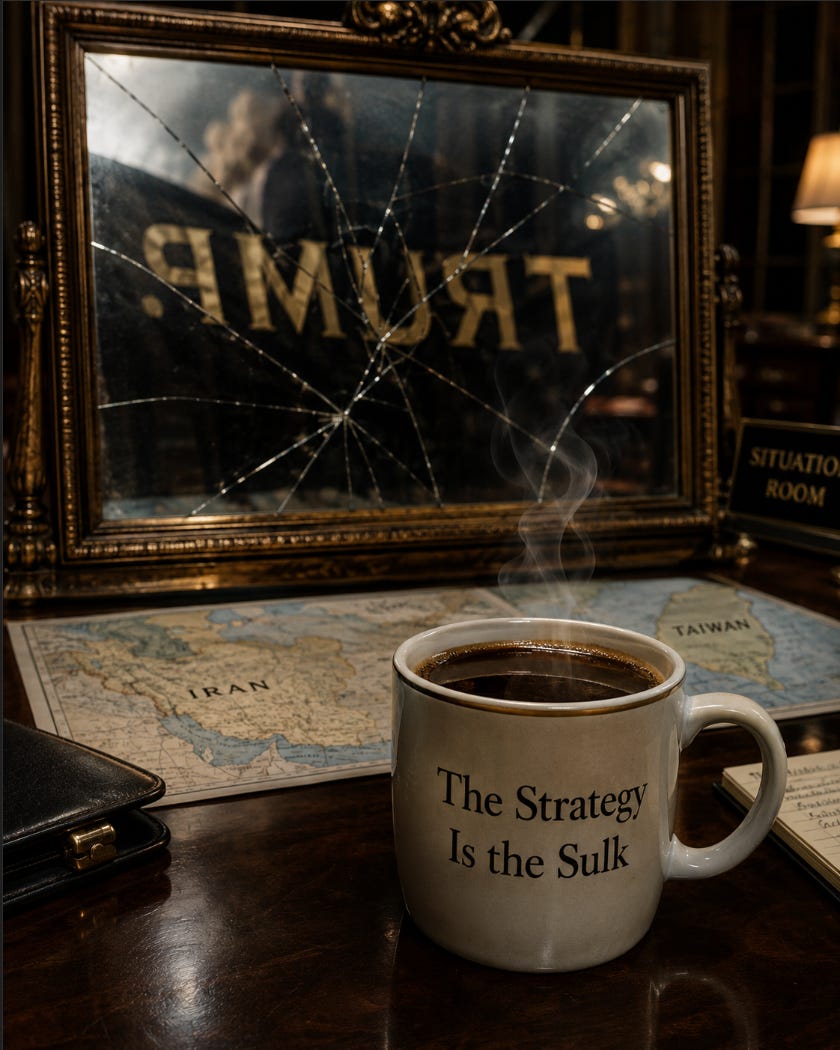
Then he went home and posted into the night, a six-hundred-word essay defending the renovation of a reflecting pool against the New York Times, and, more disgustingly, a fresh round of attacks on the woman a federal jury found he sexually assaulted, a woman his own Justice Department is now criminally investigating.
This is the week as it actually unfolded: the largest questions a president can face and the smallest grievances a man can nurse, occupying the same twenty-four hours, drawing what appeared to be equal energy. It raises a question that America’s allies have started asking out loud, even if Washington’s press mostly hasn’t. Not whether the strategy is any good, but whether there is one.
This same week, a federal judge ordered the President to take his name off the Kennedy Center. His board, the one he reconstituted last year after firing the trustees he inherited, installing loyalists, and electing himself chairman, had voted to rebrand the national memorial as the Trump Kennedy Center. Judge Christopher Cooper, in a ninety-four-page opinion, found the move unlawful and gave the administration two weeks to strip the name from the façade, the signage, the website. His reasoning was not complicated. The center’s founding statute names it for one president, and “Congress gave the Kennedy Center its name,” he wrote, “and only Congress can change it.”
The President’s response told you more than the ruling did. He posted a midnight essay attacking the judge by his former president’s middle name, recast a decision about who holds naming authority as a plot to leave the public in physical danger, and then announced that if he could not run the institution his way, he would instruct the Commerce Department to hand it back to Congress entirely. A judge had just reminded him that only Congress can name the building; within hours he proposed giving the building to Congress, not as deference, but as a sulk. The man who said he took “great pride in taking over a losing institution” was now trying to give back a building he would no longer be permitted to call his own.
Now widen the lens, because the same move was playing out a few miles away, in a far more consequential arena. In a House hearing on the Baltic states, a Pentagon witness referred, twice, to “the Department of War.” Representative Jim Costa stopped him. It is the Department of Defense, Costa said, until Congress changes the name, “it’s the law,” whatever “imaginary illusionary” thoughts some of his colleagues entertained. He was correct, and not pedantically so. Last September, the President signed an executive order styling the department the “Department of War” and authorizing Pete Hegseth to call himself Secretary of War. But the order changed nothing in law. It conceded as much in its own text: the statutory names remain controlling, the order acknowledged, because only an act of Congress can alter them. The Pentagon is still, legally, the Department of Defense. The branding simply went ahead without the law, and a bill to make it real sits pending in Congress, an admission, in legislative form, that the name on the letterhead got there by assertion rather than by right.
Two institutions, one week, the same rebuke. A judge and a congressman, independently, telling the executive the same thing: naming is a power that belongs to Congress, and you do not acquire it by deciding you have. It is a small pattern, visible in miniature, the preferred name applied first, the legal authority for it treated as paperwork to be backfilled later, or never. The pattern does not stay small.
Here is where assertion meets a harder limit than a judge. On May 22nd, the acting Secretary of the Navy, Hung Cao, told a Senate subcommittee that the administration had paused a $14 billion arms package to Taiwan, the largest ever contemplated for the island, to conserve munitions for the war in Iran. His exact words contained their own small collapse: the pause was necessary, he said, “to make sure we have the munitions we need for Epic Fury, which we have plenty.” We are pausing because we need them; we have plenty of them. Both halves of the sentence, delivered in a breath.
That contradiction did not stay contained inside one official’s testimony. It metastasized across the administration. An anonymous official told Reuters the opposite of Cao, that the sale was unrelated to the Iran war entirely, that the military had “more than enough munitions” for all the President’s goals. Hegseth himself had already assured Congress that worries about munitions were exaggerated, that the United States had ample supplies of everything. So the government offered three answers to a single question, and they could not all be true: the sale is paused because stockpiles are strained (Cao), the sale is unrelated to any strain (Reuters’ source), there is no strain (Hegseth). Either the cupboard is bare and Taiwan is being shorted to feed the war in Iran, or it is not and the pause is about something else, and the something else is not hard to locate. Cao confirmed the freeze a week after the Taiwan package took center stage in the President’s summit with Xi Jinping in Beijing.
The strain, for what it is worth, appears real. Defending Israel from Iranian missiles consumed roughly two hundred high-end THAAD interceptors, about half the entire American stockpile, alongside some hundred more SM-3 and SM-6 interceptors. Half the THAAD inventory is not “plenty” in any language. It is the kind of figure that turns a reassurance into a tell.
Which brings us to Singapore, and the spectacle of watching a Defense Secretary try to hold all of this together in front of the people it most alarms. At the Shangri-La Dialogue this week, Hegseth delivered a speech assuring Indo-Pacific allies that America could “do two things at one time,” wage its Middle Eastern war and pivot to deter China, without shorting the region. A British analyst put the obvious contradiction to him directly: your own Navy secretary just said the Taiwan sale was paused to preserve stocks for Iran, so how do you square that with promising allies expedited arms? Hegseth’s answer was not to square it. He said he would “very much decouple the two,” declared the stockpiles fine, and in a very Trumpian way, dismissed the reporting as “false reporting with the wrong motives” before pivoting to praise the President’s patience on Iran. Asked to reconcile his own department’s sworn testimony with his own pitch, he called the testimony false and changed the subject.
In the same session, he turned to lecture. New Zealand, climbing from one percent of GDP toward two, he called a “free rider,” two percent is “freeloading.” Allies who invoked long friendship he warned that friendship was not enough, that they had “better have the same capabilities we do” or the alliance was “meaningless.” This from the official whose government had just paused the largest deterrent package in Taiwan’s history to the partner sitting most directly in Beijing’s path. The posture was step up or be judged free riders. The practice was: we cannot fill the order right now. The gap between the lecture and the delivery is the strategy, visible in the space where a strategy should be.
Which returns us to the war itself, the one that was meant to be the strategy’s proof.
Recall what it was for. On February 28th, American and Israeli forces struck Iran in an operation that killed the Supreme Leader within its opening hours. The stated purpose, in those first days, was regime change, remove the theocracy. Then the purpose became the nuclear program. Later it became forcing open the Strait of Hormuz after Iran closed it. Then, when the strait stayed shut, it became a naval blockade of Iranian ports. Each shift was narrated as resolve. Taken together, they describe something else: a war in search of an objective it could actually achieve, its goalposts moved so often that tracking them became a journalistic genre.
Three months on, here is the position the United States is negotiating from. A sixty-day ceasefire it has not signed. A strait that, under the draft, reopens, though the two sides cannot agree whether the blockade lifts in thirty days, as Iran insists, or never, as Washington’s negotiators rebut. Twenty-four billion dollars in Iranian assets to be unfrozen, with the United States scrambling to route the money through Qatar so the President can avoid the appearance of paying cash to Tehran, a maneuver the same officials would have called ransom a year ago. And the three-hundred-billion-dollar fund at the center of it, which Iran describes as reparations for being bombed and American diplomats describe as an investment opportunity, the gap between those two words standing in for the gap between what each side thinks it is signing.
This is what allied observers keep circling, the ones with actual access to this administration. Edward Luce, the Financial Times’ US national editor, who has interviewed the President several times since the war began, put it plainly on British radio this week: there is no plan in Trump’s head, only an end goal that keeps changing. Whenever the deal closes, Luce argued, the United States will begin from a worse position than it occupied on February 27th, the day before the war it started. That is the whole indictment in a sentence, and it requires no theory of the President’s mind. A war launched to improve America’s strategic position has, on the evidence of the deal meant to end it, degraded that position instead. The strategy can be assessed by its own product. The product is a country negotiating to get back to where it started, minus the leverage, the allies’ trust, and the munitions.
A second voice on the same program argued the reverse. Gwyn Prins, a British scholar of military strategy, insisted the chaos is the plan, that the President is executing a long-designed strategy through Henry Kissinger’s “madman theory,” unpredictable on purpose, terrifying by design. It is a serious-sounding case, and it is worth noticing why it is so seductive. It explains everything. The shifting goals become feints; the contradictions become misdirection; the sulks and the midnight posts become performance. Every piece of evidence that there is no plan gets absorbed as proof of a deeper one. Luce had a word for this: sanewashing, the projection onto the President of a multidimensional intelligence that the record does not support. The madman theory cannot be disproven, which is precisely its weakness. A strategy that looks identical to its own absence is not a strategy you can credit. It is a strategy you have to take on faith.
That is the through-line, finally, in all of it. The name on the Kennedy Center, applied before the authority to apply it. The Department of War, branded ahead of the law that would make it real. The Taiwan package, paused behind three incompatible explanations. The war whose purpose changed with the season. In each case the assertion comes first and the justification is assembled afterward, or never, and we are asked, each time, to supply the coherence ourselves, to assume that beneath the improvisation sits a design we simply cannot see.
The allies have largely stopped assuming. They were not consulted before the war began, and they have been reluctant to back the deal meant to end it, and they have started saying in public what Washington’s own press still mostly frames as a question. It is not, in the end, a hard question. A strategy reveals itself in deeds, as the President’s defenders like to say. Look, then, at the deeds. The man flew to the Situation Room to decide the fate of a war, and came home to post about a reflecting pool. The deed is the answer.
What I assume (and you know where ASSume gets you) is that Trump has no strategy.
Even Kissinger's unpredictable strategy is a form of strategy, but Trump doesn't have it.
This regime has no strategy: he has no plan, no policy, no scheme. None.
He. Has. No. Strategy.
Thank you for your attention to this matter.
trump does have a strategy. his strategy is simply to immortalize himself, self-aggrandizement, and self-enrichment... he and his family filthy rich privately, and a cult of personality publicly. every one of his actions is aimed at manipulating the public's attention toward something, away from something, all with the goal of bringing glory to himself. shrouds of his face drape government buildings, the ballroom, the arch, the gold paint all over the white house, putting his face on passports, money, his signature on government funds out to the less fortunate... all hail Caesar! clearly the war in Iran did not get him what he wanted, so he tires of it... his rantings about the peace president did not get him the notoriety he wanted, so pivot to declaring war on Iran, Venezuela, Cuba, threatening allies like Greenland Oman, etc. he so wants to be seen as rich, smart, brilliant, a ladies man, powerful, feared... he now uses the US as his stand-in stunt double.. throwing his ample weight around NATO, and now in Asia, threatening those terrible aggressors like New Zealand while losing face in China, Iran, and being BFF with Putin. like Netanyahu, he has no plans for leaving office, just plans to ensure he can stay there... we are now "the baddies". most Americans are angry and embarrassed, others apparently like looking like an odd mix of a bully and a clown. trump is owned by the oil companies and is moving through the country giving away taxpayer money to kill off renewable energy projects that would save Americans bunches of money. Renewables are taking about 0.5 BB dollars a day from the oil companies and that number is growing. trump has decided to side with the oil companies over his own voter base. I see column after column talking about how they have no plan, they dont know what they are doing, etc. they know exactly what they are doing, people are too horrified by the implications to admit it, his followers are too blinded to see it, and the press is too cowed to report it. not to sound too much like a cheerleader, but thank you, and all the independent commentators who keep speaking out. the rest of us should be forwarding your columns to everyone we know...