

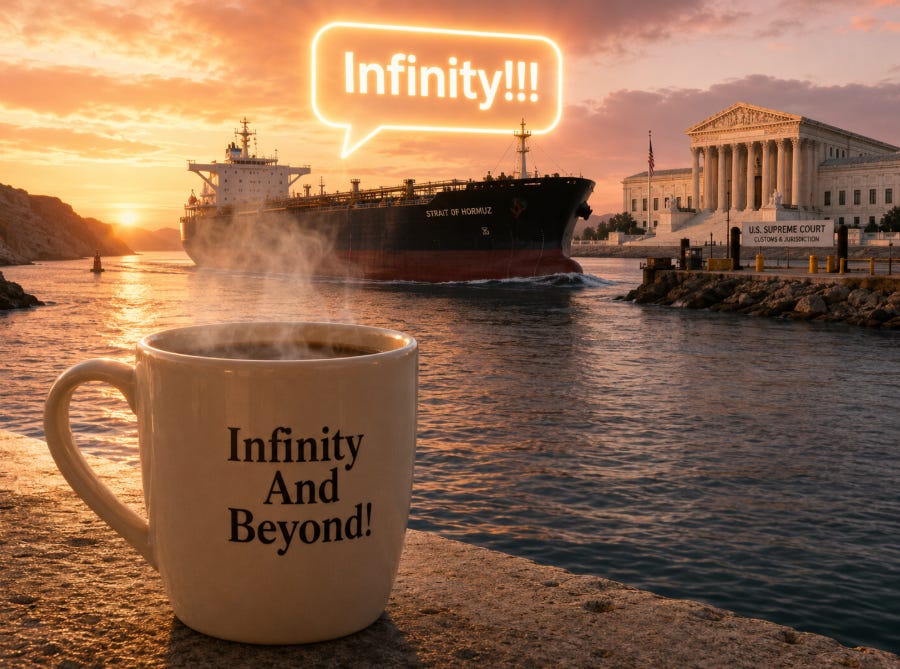
Good morning! Welcome to another perfectly normal day in which global oil markets, whether nuclear inspections exist in this reality or merely in Trump’s posts, the United States Supreme Court, the Pentagon budget, Elon Musk’s valuation machinery, and the phrase “Infinity!!!” are all somehow part of the same news cycle. Historians may one day call this period “late imperial jazz hands.” For now, coffee will have to do.
The big story remains the very delicate, very noisy, and very possibly imaginary-in-parts U.S.-Iran de-escalation deal. President Trump is declaring that Iran has “fully and completely” agreed to the “highest level” nuclear inspections “long into the future,” adding, for constitutional and diplomatic rigor, “Infinity!!!” That is certainly one way to describe a nonproliferation framework. Another way would be to wait for Iran, the International Atomic Energy Agency, or literally anyone else in possession of a clipboard to confirm it.
Iran, inconveniently, is not confirming it. Tehran’s foreign ministry says there were no detailed nuclear discussions and no plan for IAEA inspections of nuclear facilities damaged by last year’s U.S.-Israeli attacks. So Washington is saying “major milestone,” while Tehran is saying “no new commitments,” which leaves the rest of us standing between two press podiums like children of divorced parents trying to figure out who is picking us up from school.
This is now the central contradiction in the talks. Either there is a private understanding Iran is not ready to sell domestically, or the Trump administration is inflating a procedural maybe into a historic yes, or both sides are doing that charming diplomatic thing where everyone agrees to the same sentence and then spends the next 48 hours pretending it means whatever their audience most wants to hear. The technical term for this is “constructive ambiguity.” The household term is “lying with stationery.”
The Strait of Hormuz, meanwhile, is open-ish. Traffic is moving again, crude is getting out, and Trump is boasting that oil is flowing at record levels. Shipping data appears to show a real pickup in traffic, though still far below prewar norms. A backlog remains, risks persist, and shipping companies are still navigating a region where “moderate threat level” is apparently what passes for good news. The U.S. says the naval blockade is off, while the ships remain nearby. In short: “we removed the blockade, but it’s waiting just offstage.”
Iran and Oman are also discussing the future “administration of navigation” through Hormuz, including possible services, costs, and maritime management. That may sound bureaucratic, but it is potentially enormous. Iran has been clear that it does not necessarily want the strait to return to prewar conditions after the 60-day negotiating window. In plainer language: Tehran may have paused the chokepoint crisis, but it has not abandoned the idea of turning geography into recurring revenue. Global shipping executives, who tend to prefer their international waterways without surprise subscription fees, are understandably alarmed.
The money dispute is just as foggy. Trump says any released Iranian funds or sanctions relief will go into U.S.-controlled escrow and be used exclusively to buy food and medical supplies from the United States, including corn, wheat, and soybeans from American farmers. This is a very Trumpian formulation: sanctions relief, but make it Iowa. Iran, however, says the assets are Iranian and Iran will decide how to use them. So the same pot of money is being described in Washington as a humanitarian escrow account with a patriotic farm-to-table garnish, and in Tehran as sovereign assets coming home. Same transaction, two domestic audiences, zero shared adjectives.
There is, to be fair, a real de-escalatory structure taking shape. The U.S. has temporarily eased oil sanctions. Iran appears to be seeking access to frozen funds. Mediators Qatar and Pakistan are still involved. Rubio is heading through the Gulf to discuss the memorandum of understanding and Hormuz. Iranian officials are in Oman and Pakistan working the regional track. So this is not pure theater. It is theater wrapped around real machinery, which is somehow more unsettling, because the machinery is operating while everyone argues about what the instruction manual says.
Lebanon remains the loose wire hanging out of the wall. Israeli forces reportedly killed two people in southern Lebanon near Nabatieh, while Israel says it struck armed fighters posing a threat and Hezbollah says the attack was a blatant ceasefire violation against civilians. Iran has warned that further Israeli attacks in Lebanon could jeopardize the talks. That matters because the U.S.-Iran framework seems to depend not only on Washington and Tehran restraining themselves, but on Israel and Hezbollah not blowing up the room while the diplomats are still arranging the chairs.
This is the fragile genius and obvious madness of the current arrangement. The U.S. and Iran are trying to stabilize the nuclear issue, the Strait of Hormuz, sanctions relief, and Lebanon all at once. It is less a peace process than a diplomatic Jenga tower assembled during an earthquake. Every piece depends on the others. Hormuz depends on sanctions relief. Sanctions relief depends on nuclear assurances. Nuclear assurances depend on inspections no one can agree have been agreed. Lebanon depends on Israel and Hezbollah not doing exactly what they have been doing. Other than that, very straightforward.
Now, because every victory needs a bill, the Pentagon is reportedly seeking roughly $80 billion from Congress, mostly to cover the cost of the war on Iran. The administration is simultaneously presenting this as a triumph of strength, diplomacy, deterrence, and dealmaking, while the Defense Department wanders up to Capitol Hill with an $80 billion receipt and the facial expression of a waiter who knows the table ordered too much wine. Asking Congress for emergency money after declaring everything went beautifully takes hubris.
This will set up a domestic fight of its own. Republicans will be asked to fund a war that Trump is already describing as a successful prelude to peace. Democrats will have to decide how hard to press on the cost, the legal basis, and the contradictions in the diplomacy. The White House will presumably argue that the money is necessary because the operation was historic, decisive, and completely under control, which is an argument that sounds better if you do not look directly at the invoice.
At home, the Supreme Court is preparing to decide several cases that could define the outer edge of Trump’s power. This is the domestic version of the same question playing out overseas: does Trump actually have the authority he keeps announcing that he has? Abroad, he says Iran agreed to “Infinity!!!” inspections. At home, he wants the Court to bless a sweeping view of presidential authority over citizenship, immigration protections, independent agencies, and even the Federal Reserve.
The birthright citizenship case is the biggest constitutional swing. Trump wants to redefine the 14th Amendment so that some children born in the United States to undocumented immigrants or temporary visa holders would not automatically be citizens. That is not a tweak. That is taking a crowbar to a foundational understanding of American citizenship and calling it executive interpretation. The Court’s conservative majority has shown plenty of sympathy for executive power, but even this Court may hesitate before letting a president rewrite the meaning of citizenship by order.
Then there is the question of whether Trump can fire a Federal Reserve governor. Presidential control over independent agencies is one thing; presidential control over the central bank is another. The Fed is not just another alphabet-soup agency. It is the institution markets watch with the nervous reverence usually reserved for volcanoes and cardiologists. Giving a president freer rein to remove Fed officials would be a seismic shift. Even some justices who like a muscular executive may look at that and think, perhaps the toddler should not be handed the interest-rate flamethrower.
The independent-agency cases could also reshape the administrative state. Trump is asking, in effect, whether Congress can really create agencies whose leaders are insulated from firing at will by the president. A broad ruling for Trump would weaken the old model of semi-independent commissions and concentrate more control in the White House. The slogan version is simple: fewer independent agencies, more one-man remote control.
The immigration-protection cases add another layer. The administration wants to strip protections from hundreds of thousands of immigrants, and the Court must decide how much room agencies have to do that and how much courts can review. This is where executive discretion often goes to put on sunglasses and drive too fast. If the Court gives Trump broad deference, the human consequences will be immediate and large. If it reins him in, it may mark one of the clearest limits yet on his second-term expansion project.
The domestic and foreign stories are not separate. They are mirrors. In both, Trump is trying to convert assertion into authority. He announces that Iran has agreed, that money will be spent a certain way, and that the strait will stay open. He announces that citizenship means something different. He announces that independent officials serve at his pleasure. The question, everywhere, is who still has the power to say: prove it.
Markets are also doing their part to reintroduce gravity. SpaceX, fresh off its blockbuster Wall Street debut, reportedly shed hundreds of billions in market value as its rally reversed. Higher bond yields are pressuring frothy tech valuations, and investors have begun asking rude little questions about revenue, debt, losses, and whether attaching an AI division to a rocket company automatically justifies a valuation big enough to have its own weather system. It turns out “AI plus rockets plus vibes” is not, strictly speaking, a substitute for cash flow.
This is not to say SpaceX’s aerospace achievements are unimpressive. They are genuinely impressive. But the market was not only valuing rockets. It was valuing the Musk cinematic universe: rockets, satellites, AI, X, Grok, data centers, financial engineering, and whatever trillion-dollar total addressable market happened to be walking by. For a while, investors applauded. Then bond yields rose, the music changed, and everyone remembered that gravity is one of the few forces Elon has not yet tried to rebrand. Musk appears to remain a trillionaire, but only in the way a mansion remains standing after losing a wing in a mudslide.
The week’s comic relief, if that is the right phrase, came from Trump’s quantum executive-order event. The actual policy was meaningful: new orders aimed at advancing U.S. quantum computing, sensors, networks, and post-quantum cryptography. These are real issues. Quantum computing could eventually threaten today’s encryption systems, and post-quantum security is not optional if governments want their secrets to remain secret.
The event itself was a magnificent variety hour. Trump described quantum at roughly the level of “computer but haunted,” then wandered through Iran, oil, Venezuela, NATO, farmers, the Reflecting Pool, Biden’s signature arm, and whether anyone properly appreciates his uncle’s radar-adjacent legacy. A serious technology announcement somehow became a guided tour through every open browser tab in the presidential mind. The quantum part was important. The rest was performance art with Cabinet witnesses.
Today’s theme, if there is one, is institutional gravity. Markets are pushing back on hype. Iran is pushing back on Trump’s version of the deal. Shipping companies are pushing back on Hormuz tolls. Hezbollah and Israel are pushing the ceasefire to the edge. The Pentagon is pushing Congress for $80 billion. The Supreme Court is preparing to decide how much of Trump’s domestic agenda is actual authority and how much is just volume.
The ships are moving faster than the truth abroad. At home, the executive orders are moving faster than the Constitution. And everywhere, the central question is the same: when Trump announces reality, who still gets to check the math?
Dont know about you but for my money Witkoff and Kushner would be the last guys on the playground when teams for Jenga were chosen. We seem to keep forgetting who these central “players” are. God forbid we should put the fragile stability of the world in their grasping, greedy and completely unskilled hands.
Thank you Mary.