


On Friday, an Iranian missile barrage struck Muwaffaq Salti Air Base in eastern Jordan. Two American soldiers were killed. A third is missing. Four more were wounded and airlifted to hospitals in Amman.
It was the fourth Iranian attack on U.S. forces in Jordan in five days. The base had already been hit once that week, wounding roughly twenty American troops as they scrambled for cover in bunkers. This time, at least one missile got through.
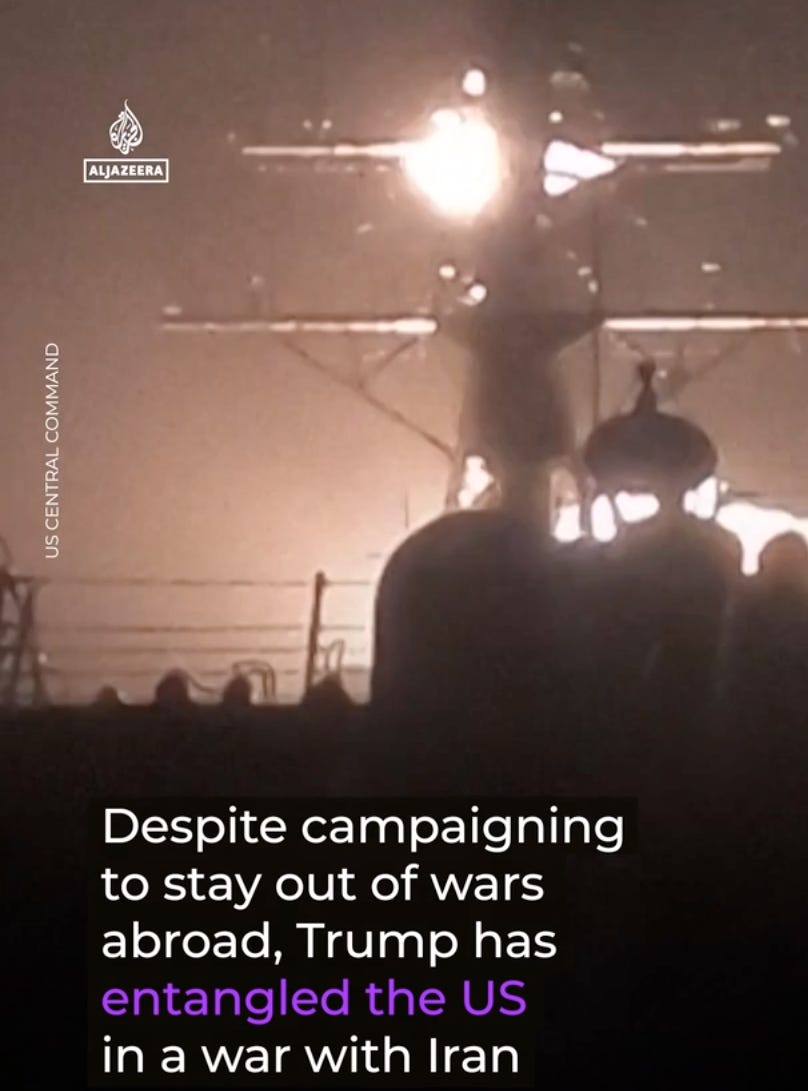
The deaths bring the American toll in this war to sixteen. More than four hundred U.S. service members have been wounded since Washington and Israel opened the campaign against Iran on February 28. Iran’s Health Ministry says at least fifty people have been killed during the current escalation alone, part of a war now approaching its fifth month.
The ceasefire President Trump signed last month is, in the words of Iran’s supreme leader, “worthless and invalid.” He is not wrong that it has collapsed. Overnight, Iran said American projectiles struck the construction site of a nuclear power plant in the country’s southwest, while the United States attacked coastal surveillance systems, air defenses and Iranian forces near the Strait of Hormuz. Iran struck a Kuwaiti power and desalination plant for the second time in two days and fired missiles toward Jordan’s Red Sea port of Aqaba. Iranian authorities say roughly ten thousand people are without reliable water because American attacks damaged bridges, pipelines and desalination infrastructure.
On Saturday, as news broke that two more Americans had been killed, the president was golfing at Bedminster, New Jersey. Reached briefly by telephone, Trump called their deaths “a very sad thing” before returning to his defense of the war and dismissing Iran’s declaration that the ceasefire had collapsed.
Trump will spend Sunday at MetLife Stadium beside Gianni Infantino, preparing to present the World Cup trophy. The trophy is an appropriate prop. It offers the kind of world Trump understands: one winner, one loser, a glittering object raised above the crowd and cameras recording the triumph from every angle.
It was Infantino, in fact, who handed Trump his last trophy. In December, three weeks after the Nobel committee passed him over for a Venezuelan opposition leader, FIFA presented Trump with its brand-new, first-ever Peace Prize. There was no nominating process, no named finalists, no criteria beyond what Infantino wished to award. Trump called it “one of the great honors of my life” and credited himself with ending eight wars, one of which the Indian government says he had nothing to do with.
Six weeks later, a ninth war is still finding new things to break.
Congress could begin restraining this war tomorrow. On paper, it would take only three Republicans joining the opposition to produce a House majority and four to do the same in the Senate. Both thresholds have already been crossed once this year. In May, four Republican senators supported advancing a war-powers measure. In June, four House Republicans joined Democrats to pass one, 215 to 208.
Trump called them the “Four Republican Losers,” rejected the resolution on the grounds that his administration considered it unconstitutional and continued bombing. Congress has not mounted another serious attempt since.
A narrow majority alone may not be enough to overcome a presidential veto or compel a president determined to defy Congress. But it would force every member to choose publicly between constitutional responsibility and Donald Trump.
Congress is not powerless to restrain, but it has repeatedly chosen not to use its power.
Robin Wright, who has covered Iran since 1973 and lived in Beirut during the disastrous American intervention there, was recently asked what she thought was driving Trump’s Iran strategy. Her answer had little to do with Iran. Trump, she said, “seems much more absorbed in what does the Reflecting Pool in Washington look like” and in erecting buildings and arches bearing his imprint. “And this is a tragedy.”
She was talking about a fountain.
She was also, whether she knew it or not, describing how this administration responds to every failure it cannot spin: not by acknowledging it, learning from it or changing course, but by finding somebody else to blame, or something shinier to place in front of the cameras.
This is a story about that pattern, and about what it costs when the failure in question is not a paint job, but a war.
The Reflecting Pool is a useful place to begin because the stakes should have been so small.
Trump ordered a hurried, no-bid renovation of one of Washington’s most recognizable public spaces. When the new coating began peeling in large sheets, the obvious response would have been to find out what went wrong and fix it. Trump chose a different one. He announced that vandals had attacked him.
Not the pool, exactly. Him.
In May, he boasted the liner was so strong a knife couldn’t cut it. By June, the same liner had apparently been slashed for hundreds of feet with a knife or box cutter, the number drifting from 290 feet to 300 yards depending on the telling. The only constant was that Trump could not have been wrong.
The Washington Post’s forensics team found something less cinematic: seven coating failures, all along seams where sections of the rushed job met. Experts called it a textbook application failure. The contractor, Atlantic Industrial Coatings, then described the repairs as warranty work, an odd word choice for damage supposedly inflicted by criminals, since warranties cover a company’s own defects, not vandalism. The administration has used both explanations simultaneously and expects no one to notice the contradiction. Interior Secretary Doug Burgum praised the contractor’s “fantastic job” and awarded it the repair work, too. The contractor keeps the contract, Trump keeps the story, and somebody else gets prosecuted.
That somebody is David Hearn, a former Olympic canoeist who says he touched a piece of coating that was already peeling. He was charged with a felony carrying up to ten years. A former federal judge who reviewed the case said proving Hearn caused the damage would be difficult if the liner was already failing, and that at first blush, the prosecution looked like a scapegoating.
The U.S. attorney overseeing the case wasn’t interested in that nuance. Asked whether the pool was damaged before Hearn touched it, she said: “Oh, he damaged it all right.”
Pirro is not a prosecutor following evidence toward a conclusion. She is a courtier assuring the king that his enemies are real.
The Cultural Landscape Foundation has since asked a federal judge for emergency access to the drained basin, warning that repairs now underway could destroy the evidence before anyone can examine it. Preserving evidence should be unremarkable unless it risks interfering with the ending Trump has already written.
The pool is a seven-acre version of the 2020 election. Same mechanism, smaller stakes: an outcome he cannot accept, an enemy invented to explain it and officials willing to make the invention official. Neither vandalism nor election fraud appears to have been a considered strategy. Both explanations arrived instinctively, the moment reality produced a result Trump could not tolerate.
The scale changes. The reflex does not.
Joe Biden defeated Trump by more than seven million votes and won the Electoral College 306 to 232. The loss had to become a crime. Election workers became conspirators. Voting-machine companies became racketeers. Republican officials who certified accurate results became traitors. Every failed lawsuit proved that judges were corrupt, and every absence of evidence demonstrated how expertly the evidence had been hidden.
Six years later, Trump remains unable to stop excavating the graveyard of his own defeat.
Even Senator John Cornyn, a Texas Republican and member of the Senate Intelligence Committee, could not identify the point of Trump’s Thursday-night presentation. There was not much new, Cornyn said, and “the bottom line is none of this would have changed the outcome.”
That should be the end of it. Nothing Trump released altered a single vote, much less seven million of them.
But accepting the outcome would require him to say the words that his entire public life has been organized to avoid: I lost.
Trump spent decades creating and promoting the fiction that he had graduated at the top of his Wharton class, although the available honors records did not place him there. When the hurried conversion of his new presidential aircraft reportedly left it without all the defensive systems needed for a sensitive flight near a war zone, the public explanation became an act of generosity: he had switched aircraft so American troops could admire the new one. Reporters who described the underlying security concerns were subpoenaed.
The plane was ready; the journalists were the problem.
The pool was perfect; the vandals were the problem.
The election was his; the voters were the problem.
The economy reveals the same compulsion without even the fig leaf of ambiguity. There is no seam to inspect, no disputed liner and no warranty language to parse. There is only what Trump says and what his own government’s numbers say, and the two repeatedly fail to occupy the same numerical universe.
The investment claim is the clearest example. The day after his inauguration, Trump said the country had “already secured nearly $3 trillion” in new investment. By May, the figure was “close to $10 trillion.” In December, it became “around $18 trillion.” At the NATO summit in Turkey this July, Trump announced $19.2 trillion, a “world record,” naturally, because even his imaginary numbers require a trophy. The total had grown by roughly a trillion dollars a month for a year and a half, an acceleration curve found nowhere in economics outside the mouth of the man reporting it.
During that same period, the White House’s own tracking page never claimed more than $10.6 trillion. Even that figure was generous. Bloomberg Economics examined the listed projects and found closer to $7 trillion in potentially credible investment commitments, many of them still aspirational, stretched across multiple years or dependent upon foreign-government promises of questionable feasibility. Some projects Trump claimed as products of his presidency had been announced or initiated under the previous administration. When CNN’s Daniel Dale called the $19.2 trillion figure “fiction” in real time, he was not being unkind. He was reading the White House’s own website.
The wage story operates the same way. On May 4, Trump’s Treasury Department assured bond markets that “worker wages continue to outpace inflation.” Five weeks later, the government reported that consumer prices had risen 4.2 percent over the previous year while average private-sector hourly earnings had grown only 3.4 percent. Inflation-adjusted hourly earnings had fallen 0.7 percent from a year earlier. Trump’s administration announced that wages were winning; its own statistics quietly recorded the loss.
The June employment report added just 57,000 jobs, while the previous two months were revised downward by a combined 74,000. The unemployment rate dipped from 4.3 to 4.2 percent largely because fewer people entered the workforce and more unemployed people stopped looking, not because a great hiring boom had suddenly materialized. Trump had already supplied the governing philosophy a few weeks earlier when asked about rising prices: “I love the inflation.” Even accidental honesty finds him eventually.
None of this required an invented vandal. There was no felony case to manufacture against a tariff whose costs, according to Stanford economic research, are now passed through to consumers at a rate exceeding 50 percent. There was simply a number, repeated more grandly every few weeks, regardless of what the number underneath it was doing.
Sometimes Trump needs a culprit. Sometimes applause is enough. Either way, reality is expected to surrender.
The danger increases as reality becomes less willing to cooperate. Trump’s first response is usually bluster: the project is perfect, the economy is historic, the war is won, the election was his. When the boast survives, he moves on. When facts begin closing in, however, the performance grows louder and the response more desperate. Numbers inflate. Explanations shift. Critics become conspirators. A setback that might once have required another lie begins to require punishment.
The more thoroughly reality disproves him, the less strategic he becomes. He does not reconsider the premise or adjust the plan. He reacts, often reflexively, to the humiliation of being contradicted. The failing pool produces vandals and felony charges. The lost election produces a six-year hunt for traitors. Weak economic figures produce ever more extravagant claims of records no one else can see. Each collision with reality narrows his options because admitting error, the one response that could end the cycle, is the option he cannot tolerate.
This would merely be exhausting if Trump were still a man calling newspapers from his office and pretending to be his own publicist. He is now president of the United States. His escalating need to preserve the fiction of personal infallibility is backed by prosecutors, federal investigators, military power and the nuclear arsenal.
That is what makes the Iran war so dangerous.
Trump has always approached conflict as a test of dominance. His preferred method is intimidation: threaten something wildly disproportionate, convince the other party that resistance will be ruinously expensive and never acknowledge when the threat fails. It is the governing philosophy of the “late, great Al Capone,” as Trump has called him, the old protection-racket promise that cooperation will be rewarded and refusal may result in something regrettable happening to your business, your country or your water supply.
Such methods can frighten a subcontractor, exhaust a litigant or force a creditor to accept less than he is owed. Countries are different. Countries have armies, missiles, national myths, internal factions and their own leaders who fear humiliation.
Iran has not responded to American coercion by submitting. It has responded by widening the battlefield.
Robin Wright, who has covered Iran for more than half a century, says Trump has declared the war over, successful or nearly over more than thirty times. Instead, it has become a regional war. American strikes have expanded beyond military targets into infrastructure. Iranian attacks have spread across the Gulf and into Jordan. In Washington, Wright said, there is a sense of despair because no clear exit strategy is visible.
The administration’s objective has shifted almost as often as Trump’s description of the Reflecting Pool gash.
The campaign began with Iran’s nuclear program. It moved toward regime change, despite official denials that regime change was the goal. Then came relentless bombardment, followed by diplomacy and a memorandum of understanding so vague that both sides interpreted it differently. Now the immediate dispute centers on shipping through the Strait of Hormuz and whether Iran may impose restrictions or charges on vessels passing through it.
Trump still invokes nuclear weapons whenever the old justification is required. At other moments, he claims Iran’s enriched uranium is buried so deeply that it no longer poses a threat. Wright describes an administration “all over the map” about its goal, strategy and endgame.
Trump is having to face that his war of choice against Iran, even the tearing up of the JCPOA, was a mistake and now he is casting about looking for a war raison d’être.
Retired Lieutenant General Mark Hertling describes the American campaign as having entered a third and more dangerous phase. Early attacks sought to blind Iran by destroying radar, air defenses and command networks. The next phase targeted launchers, ammunition depots, aircraft and military facilities. Now the United States is striking transportation hubs, bridges, industrial capacity, fuel distribution and other systems that allow Iran to regenerate military power.
Those targets may possess military value. They also sustain civilian life.
Bridges carry weapons, but they also carry food.
Pipelines support military facilities, but they also move water.
Electrical systems power radar and command networks, but they also run hospitals, refrigeration systems and desalination plants.
The distinction between degrading military capacity and collectively punishing a population becomes less visible with every new target list.
Hertling posed the essential question: What strategic objective do these attacks accomplish? If the answer is that Iran is being struck because it disobeyed what Trump demanded, then escalation is driving policy instead of policy directing military operations. He warned that both sides are widening the range of targets toward a point where total war could become the result, even though neither may consciously want it.
Wars become self-propelling this way.
Iran attacks a base, so the United States strikes infrastructure. The United States strikes infrastructure, so Iran attacks an oil facility or desalination plant. Americans die, so Pete Hegseth says their deaths only “stiffen our resolve.” More Iranians die, hard-liners gain strength and retaliation becomes an obligation of national honor.
Each side insists the next escalation was forced upon it by the previous one.
Eventually nobody can explain the original objective, but everyone can recite the latest grievance.
This is particularly dangerous with Trump because climbing down is not part of his political vocabulary. He understands winners and losers, dominance and humiliation, trophies and defeat. De-escalation requires accepting an imperfect result and allowing the other side to claim something too. Trump’s entire method is built around denying the other party that satisfaction.
The memorandum failed. Rather than admit that it was badly drafted and return to negotiations, he resumed bombing.
The bombing failed to force submission. Rather than reconsider whether coercion could achieve the objective, the target list expanded.
Iran retaliated. Rather than recognize the predictable consequences of expansion, the deaths became another argument for resolve.
At each stage, the failure of the strategy becomes the justification for intensifying it.
This is not strength. It is a gambler doubling the bet because admitting the previous wager was foolish would be emotionally unbearable.
Only the chips are human beings.
Nothing before us establishes that Trump is preparing to use a nuclear weapon. It would be irresponsible to claim that he is, just as it would be irresponsible to pretend that the possibility has no place in the discussion.
Dr. John Gartner has warned repeatedly that Trump’s psychology creates a danger of nuclear escalation. Gartner’s remote assessment is an opinion, not a diagnosis established through a personal examination, but the underlying concern does not depend upon accepting every conclusion Gartner draws.
The president commands the world’s most powerful nuclear arsenal. American policy does not absolutely rule out first use. The man holding that authority has demonstrated, across decades and subjects both momentous and absurd, that he interprets contradiction as betrayal, retreat as weakness and public embarrassment as an injury requiring retaliation.
A nuclear crisis demands precisely the qualities Trump has spent his life rejecting: patience, proportion, humility, tolerance for ambiguity and the confidence to change course when a strategy fails.
It requires advisers willing to say no.
Trump has instead surrounded himself with people who treat bad news as a loyalty test.
Pirro declares a defendant guilty before trial because Trump requires a vandal.
Burgum calls failing workmanship fantastic because Trump requires a triumph.
Hegseth treats American deaths as fuel for further escalation because Trump requires resolve.
The purpose of the courtier is not merely to flatter the ruler. It is to remove every fact that might force the ruler to confront himself.
That may work in a ballroom. It may work during a cabinet meeting in which everyone takes turns praising the president’s unmatched wisdom. It does not work when missiles are flying and two countries are moving up an escalatory ladder neither knows how to descend.
The question is not whether Donald Trump wants nuclear war.
The question is whether a man who experiences retreat as humiliation can be trusted to stop climbing before he reaches the final rung.
Congress was designed for precisely this moment.
The Constitution did not give one person an unrestricted power to begin and widen wars according to personal instinct. The war power was divided because the framers understood that ambition must counter ambition and that the decision to place the nation at war was too grave to leave to the temperament of a single executive.
Congress has spent decades surrendering that responsibility in increments, usually while insisting it remains deeply concerned about the process.
Concern is Washington’s most renewable resource.
Members issue statements. They request briefings, appear on Sunday programs and announce that they have many questions. A letter is drafted, stern adjectives are selected and the missiles continue flying.
The present Congress needs only a handful of Republicans to break that ritual. They do not need to become liberals, endorse the Iranian regime, or deny America’s right to protect its personnel. They need only acknowledge that a war approaching its fifth month, spreading across multiple countries and targeting increasingly vital infrastructure requires clear objectives, lawful authorization and an exit strategy.
Congress can force recorded votes under the War Powers Resolution, refuse authorization for a wider conflict and condition or prohibit funding for offensive operations it has never approved. Public testimony should be compelled from Hegseth, Marco Rubio and the officials responsible for drafting the failed memorandum. Lawmakers can also demand a clear explanation of what victory means, how the administration intends to achieve it and what limits, if any, it recognizes.
They can also require congressional authorization before the first use of a nuclear weapon in this conflict.
None of those actions guarantees that Trump will comply willingly. He has already dismissed one House war-powers resolution as unconstitutional and continued the campaign. A narrow congressional majority may not be enough to overcome a veto. But that is an argument for greater pressure and larger majorities, not for legislative surrender.
Republican members should be asked a simple question:
Would five months of war without a stable objective, even after the ceasefire he celebrated collapsed, be enough?
Would another hundred dead Americans be enough?
If the answer is that no evidence could ever justify changing course, then Congress is not exercising oversight. It is participating in the same cult of infallibility that turned a peeling pool liner into a felony prosecution.
The demand from citizens should be equally simple. Call every representative and senator and insist that they use those powers now. Require a public vote and a public answer. Make every member place a name beside the decision to continue or restrain this war.
Do not accept “we are monitoring the situation.”
The situation is missiles.
Do not accept “we support the troops.”
Supporting the troops means more than sending them into danger and praising their sacrifice afterward.
The time to prevent a wider war is before it becomes one.
War is not a trophy ceremony.
There is no clean final whistle. No official walks onto the field to announce that one side has won and the other must accept the score. Wars end through exhaustion, negotiation, compromise, collapse or catastrophe. Often they end with both sides claiming victory and families on both sides burying the evidence that nobody won.
The smoke over New York and New Jersey may thin before kickoff. The smoke over the Middle East will not.
Two more American soldiers are dead. A third remains missing. Hundreds have been wounded. Water systems are failing. Bridges are burning. More warplanes are moving toward the region, and the president directing them has shown no consistent objective beyond compelling the other side to submit.
Trump will stand beside the trophy anyway, his second from Infantino, because trophies never contradict him.
Congress must do what his courtiers will not...
I have read that the joint Chiefs of Staff has already denied Trump‘s desire to use a nuclear response.
The paragraph about the purpose of the courier, and the paragraph that followed, almost made me cry. You write so well. Great essay.