


By the time Donald Trump prepared to leave Turkey, the world had been given the full touring production: the NATO summit as tribute dinner, Ukraine as a distressed mineral portfolio, Syria as strongman restoration theater, Iran as a personal betrayal with missiles, Greenland as an imperial fixation with a real-estate brochure, and American foreign policy as one long interrupted sentence trying to remember where it left its verb.
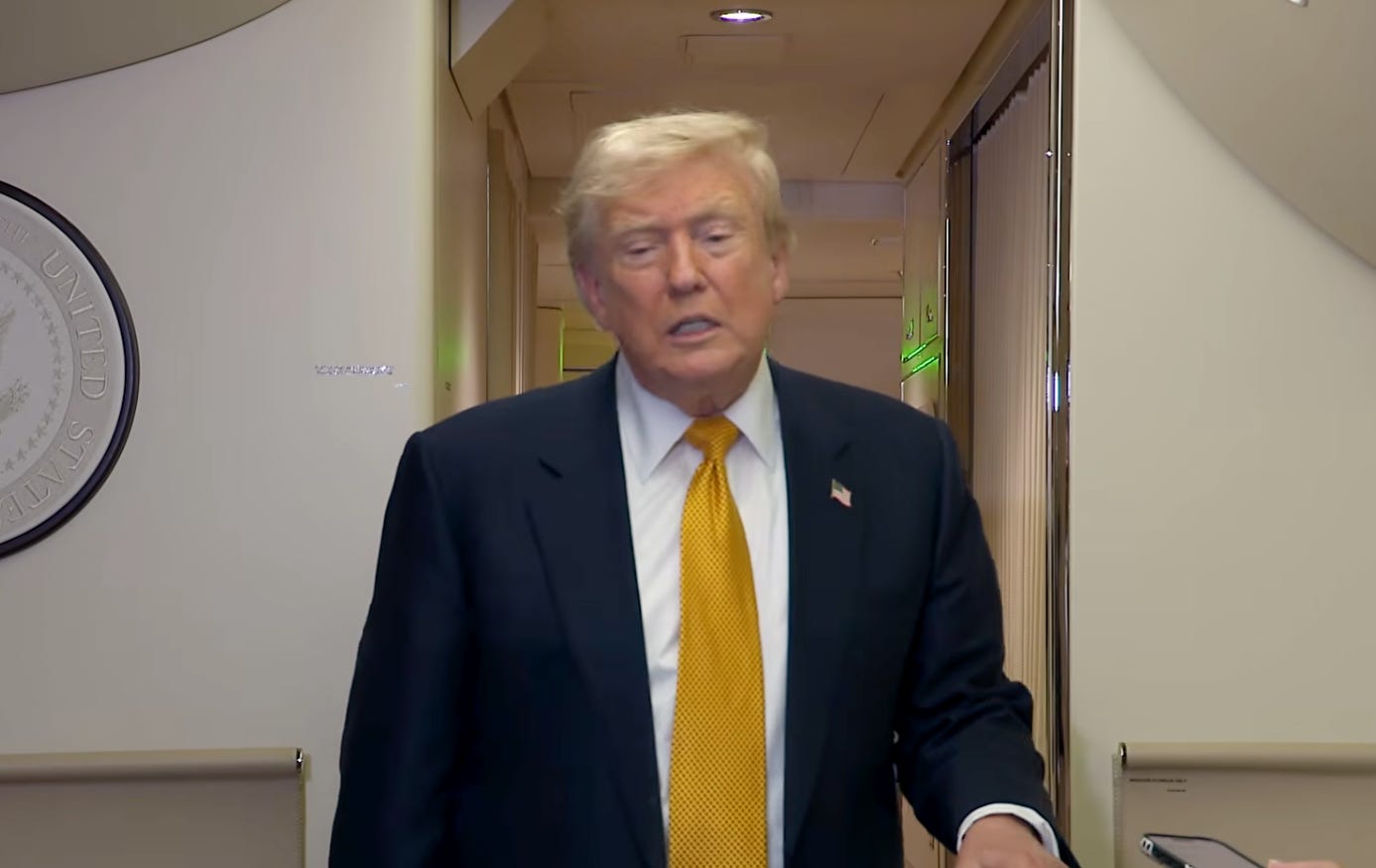
Even the departure became a parable. Reporters asked why there had been a plane change and whether there had been a security concern. No, Trump said, no issue, no security concern; they had simply sent the other plane ahead so people at the Air Force base could see it. Then a reporter asked why the press had been told to close the window blinds, and Trump said perhaps they were on a “dangerous leg,” because of “the bad guys,” the same thing Iran might have been thinking of trying. Was there a credible threat? Trump said he has threats all the time, that he is number one on Iran’s list, and then reassured the press corps with the words every traveler longs to hear from the man controlling the itinerary: “If I go, you go.”
There it was. No security issue. Also, maybe Iran. No danger. Also, close the blinds. Enjoy the flight.
This was the summit stripped to its essence: contradiction delivered as confidence, danger processed as self-drama, and every question pulled into the gravitational field of Donald Trump’s ego before it could reach an answer.
He insisted, repeatedly, that there had been “love in the room.” Not respect, not shared purpose, not hard negotiations among countries with competing interests. Love. Grown leaders, in Trump’s telling, had confessed their affection. America was respected again. The laughter had stopped. The room was unified, tremendous, beautiful, almost mystical in its devotion. By his account, this was less a NATO summit than an international intervention staged by people who had finally admitted that he had been right about everything.
This may have come as news to Giorgia Meloni, who appeared to spend much of the summit demonstrating the diplomatic power of peripheral vision. Trump had already reignited his feud with the Italian prime minister before arriving, and the visible awkwardness between them made a useful little puncture wound in the “love in the room” balloon. Meloni’s real contribution was not body language, it was policy.
While Trump wandered around declaring that allies had not been “there for us” on Iran, Meloni explained the grown-up version. Italy, she said, had honored its commitments as serious nations do, but it had drawn a clear line from the start of the Iran conflict: Italy would not participate in attacks on Iran.
Meloni, in Trump’s view, was being “terrible.”
That was the whole NATO rupture in miniature. Trump treated allied refusal as personal betrayal. Meloni treated it as national sovereignty. Trump tested the alliance for loyalty. Meloni described Italy’s strategy as rooted in national interest, Western unity, parliamentary process, and the refusal to let fluctuating personal relationships dictate state policy. Asked about the feud, she declined to feed it. She said she would not return to the topic, did not regret investing politically in Western unity, and would not change Italy’s strategy because of personal ups and downs.
It was the closest thing modern diplomacy offers to patting a tantrum on the head and returning to the agenda.
The problem was not merely that Trump rambled. Trump’s rambling is now priced in, like humidity in August or Mar-a-Lago chandeliers in a national-security briefing. The rambling revealed the operating system. More than just wandering off topic, he was translating every topic into the only categories he seems to understand: flattery, grievance, dominance, money, betrayal, force, and himself. While everyone else was dealing with states, Trump was dealing with feelings.
At NATO, the central subject was supposed to be alliance security: Russia’s war, European defense spending, Article 5, Ukraine’s survival, Iran’s escalation, the Strait of Hormuz, Turkey’s role, the future of deterrence. Trump heard all of that and concluded that the important thing was that people used to laugh at America and now they do not. NATO, in his mind, is not a defensive alliance rooted in mutual obligation. It is a loyalty program in which European countries are expected to pay more, buy American weapons, praise him in private, and show up for whatever war he has decided is really a “denuclearization” exercise this week.
Or, as he later put it, “dnuking.” Then “dnucarization.” The English language was not consulted.
When allies hesitated to join the Iran conflict, Trump took it personally. Spain had been “very bad.” The United Kingdom had given an answer “not in the spirit of Winston Churchill.” Italy had not been there for us. NATO was unified, he said, except for the allies he was publicly scolding because they declined to treat an American war of choice as a mandatory group project.
By the gaggle en route home, Spain had been processed through the Trump forgiveness machine. He said Spain had “come back all the way” and had been “very generous” after he told them he was going to stop trading with them. Spain, he said, had “honored a request for lots of payments.”
The alliance was unified, yes, in the way a customer becomes unified with a cashier after the card finally goes through.
This is what happens when a man who thinks in tribute gets custody of an alliance. He cannot understand the difference between collective defense and personal service. Article 5 is not a punch card. NATO does not exist so Donald Trump can invade the global comment section and demand backup. But he has always measured relationships by who praises him, who pays him, who obeys him, and who makes him feel large. So when countries act like countries instead of members of his club, he reads it as disloyalty.
Then there was Greenland. Asked on the way home whether he would pull more U.S. troops out of Europe, Trump said he had not made a final determination. “A lot’s going to depend on Greenland,” he said, and also on Iran, because when allies had a chance to help, they did not.
The decision, in his telling, did not hinge on Russia, NATO force posture, the security of the eastern flank, or the balance of deterrence in Europe.
It hinged on Greenland.
European security, in the American president’s mouth, became leverage for a territorial fantasy and punishment for insufficient enthusiasm about his war. Instead of thinking like a member of an alliance, he was thinking like a landlord deciding whether the tenants had been grateful enough.
Former U.S. ambassador to NATO Ivo Daalder, watching the whole thing from the Canadian side of the border, supplied the adult translation. Trump’s Greenland claims, he said, were not merely upsetting; they were factually wrong, including Trump’s claim that the United States had “given back” Greenland after World War II. But Daalder’s larger point was even more damning: allies have learned to listen to Trump’s words, discount the noise, look at actions, and move on. Sounds more like adaptation than respect.
Daalder described the summit dynamic perfectly. Inside the room, Trump was apparently genial, pleased, surprised that the other leaders were good leaders of their countries, and surrounded by all that alleged love. Then the cameras came on, and he did what he does: belittled people, went after them, and tried to make himself look stronger by making others look weaker. Most leaders, Daalder suggested, had essentially figured out the posture: get through the meeting, ignore the performance, keep doing the work.
The Lithuanian foreign minister had reportedly hoped for a boring meeting. In the Trump era, boring is not an insult. Boring is containment.
The Ukraine bilateral was worse, because there the contrast between reality and Trump’s brain was almost indecent.
Volodymyr Zelenskyy came prepared to discuss survival: air defense, drones, negotiations, the possibility of peace, the tools Ukraine needs to keep Russian missiles from turning cities into rubble. Trump came prepared to discuss “great land,” “great assets,” “great people,” and minerals. Sitting beside the president of a country fighting for its existence, he described Ukraine as having “tremendous potential” and reminded everyone that the United States now had “a little stake” in the country because of rare earths.
Zelenskyy talked about air defense.
Trump talked about asset value.
Zelenskyy talked about drones.
Trump talked about land.
Zelenskyy talked about how to bring peace.
Trump talked about how Ukraine could be rebuilt, how refugees in Poland might return, how the country had beauty and potential, how the United States could someday take advantage of the minerals “at the right time.”
There are many ways to describe a democracy under invasion. “Great land” is one of them, if you are appraising it.
The most revealing thing about Trump’s view of Ukraine is that he appears to see no contradiction between praising Ukrainian courage and admiring Vladimir Putin’s supposed sincerity. He said Putin wants to end the war. He said he has a good relationship with Putin. He said everything he has done with Putin has been “okay” and “good.” He said that if a deal is made, Russia will be happy and get on with other things, because apparently once Moscow is emotionally fulfilled, it will stop invading its neighbors and maybe take up woodworking.
At one point, the confusion became almost too on-the-nose. Trump appeared to conflate Zelenskyy and Putin, then tried to glide past the error by saying he was speaking to Putin later and inviting reporters to give him a question for the Russian president. Elsewhere in the day’s wreckage, he managed to refer to missiles from what the transcript rendered as the “Islamic Republic of Japan.” The geography of the crisis was apparently less important than the performance of being in command of it.
Asked how Ukraine could be protected from future Russian attack, Trump said they would work on a security package, with Europe watching and the United States helping. Then he immediately undermined the premise by saying he did not think Russia would attack again after a deal. Russia, he suggested, had had enough. It would be satisfied. It would move on. The man was not offering deterrence. He was offering mood forecasting.
Zelenskyy, meanwhile, tried to explain the actual war. Russia’s advantage had changed, he said, because Ukraine had moved faster technologically. The battlefield was shifting into the sky. Ukraine was striking logistics, weapons, petrol, and diesel supplies to reduce Russian capacity without mass human losses. He described adaptation, asymmetry, technological pressure, and the effort to survive against a larger army. Trump described two kids fighting in a park.
That was his analogy for Russia’s invasion of Ukraine. Two kids in a park who do not like each other and sometimes have to be allowed to fight.
One child, in this parable, did not annex the swing set.
That is Trump’s mind under strain. It reaches for the smallest possible container for the largest possible catastrophe. A war of conquest shrinks into a schoolyard scuffle. Security guarantees collapse into “Russia respects us.” Sovereign territory becomes land, assets, minerals. Zelenskyy, the president fighting for national survival, becomes a difficult character who nevertheless has done “an amazing job” with American equipment. And Putin, who launched the war, becomes a man who wants peace because Trump says he can feel it.
The proposed Patriot licensing arrangement had the same fog around it. Trump made it sound like a clever shortcut: let Ukraine or Europe make Patriots themselves. They are ingenious. They can figure out complexity. Then nobody can complain America is not giving them enough. A “little birdie” told him this was being discussed, though he admitted the company had not yet been informed.
Daalder supplied the reality. Even if Raytheon agreed, producing those interceptors inside Ukraine could take two years. Ukraine does not have two years, he said, not two months, not two weeks, not even two days, because Russian ballistic missiles and drones are killing Ukrainian civilians now.
Trump offered a production concept. Ukraine needs air defense before the next siren.
That is the recurring obscenity of this whole trip. Trump is always selling a future that flatters him while someone else is bleeding in the present.
The Syria bilateral revealed the same machinery from another angle. There, Trump praised the “highly respected president of Syria” for unifying the country in about a year and a half. Syria, he said, had been “a real mess,” a “very disjointed place,” and this strong leader had brought it together. He was respected by everybody, including Trump. The United States had lifted sanctions, Trump said, and Syria had become very stable in an amazingly short period of time.
There was no visible interest in what “unified” meant. No question of political reconciliation, or accounting for prisoners, refugees, minorities, destroyed cities, militias, security forces, accountability, or civil society. No sense that a country shattered by war might need something more complicated than a strong person impressing Donald Trump.
When Trump says “unified,” he does not mean healed; he means controlled.
That is why the praise came so easily. In Trump’s world, strength is legitimacy. If a leader imposes order fast enough, speaks gratefully enough, and gives Trump credit, the details become decorative. The Syrian president thanked him for lifting sanctions; Trump said he was proud of him. A reporter asked whether Syria would be removed from the state sponsor of terrorism list, and Trump replied, “I think I will. Yeah, I think I will. Why wouldn’t I? He’s done a great job.”
“Why wouldn’t I?”
That sentence should be bronzed and hung in the lobby of the Trump Doctrine Institute, assuming the contractor gets paid in advance.
Why wouldn’t I? There had been no formal review cited, no statutory finding offered, no visible assessment from intelligence agencies, diplomats, Congress, regional partners, or human-rights monitors. Why wouldn’t I? He’s done a great job. Strong man. Good job. Unified country. Thank you, Mr. President.
Erdoğan, too, received the familiar Trump treatment. Strong man. Good man. Friend of mine. Fantastic job. Beautiful airport. Perfect roads. Militarily powerful. People leave him alone. Trump spoke of Turkey like a resort guest praising the shuttle from arrivals. He praised the infrastructure, the personal relationship, the strength, the order. Again and again, the signal was unmistakable: he admires leaders who dominate their countries and flatter him while doing it.
Then came Iran, where the whole apparatus turned from embarrassing to dangerous.
An LBC segment offered the cleanest contrast. The host played Trump declaring the ceasefire, the memorandum of understanding, “over.” Trump said he no longer wanted to deal with Iran. “They’re scum. You know what scum is? They’re scum. They’re sick people. They’re led by sick people.” Vicious, violent, liars, cuckoo. He said he had made a deal, everyone had agreed, no nuclear weapons, and then Iran had gone outside, told the press the subject had never come up, and as far as he was concerned, that was the end of it.
Then Marc Sievers, the former U.S. ambassador to Oman, came on and tried to describe the actual problem. He walked through the thing Trump had flattened into an insult: that Washington and Tehran read the memorandum’s Hormuz clause in incompatible ways, Iran claiming the right to decide which ships pass and by which route; that there is a real split inside the Iranian system between a civilian leadership that wants out from under economic pressure and an IRGC still willing to fire on shipping and on its Gulf Arab neighbors; that the strait has to be reopened to international traffic before anyone gets back to the nuclear question.
Sievers saw factions. Trump saw scum.
Sievers saw a strategic choke point. Trump saw a broken promise.
When it came to Trump’s claim that Turkey had considered joining the war on Iran’s side and been talked out of it, Sievers said plainly that it made no sense to him, that he couldn’t square it with anything he knew, though he allowed there might be a backstory he wasn’t aware of. It was the quietest and most damaging kind of commentary: not outrage, not mockery, just a career diplomat trying to locate the president’s statement somewhere in known reality and finding no address for it.
Trump, meanwhile, kept turning Iran into a personal story. Asked whether talks would resume, he said he did not care. They could talk, but they were wasting their time. “My whole life is deals,” he said. “That’s how I became president. I guess that’s a deal, too, right?” Then came the autobiography: he made a lot of money, had great success, tremendous success, everything he did was successful. Only after polishing his own statue did he return to the matter of Iran: liars, cheats, sick people, killers.
Asked about diplomacy, Trump gave his résumé.
This is the key to the whole performance. Trump does not understand diplomacy as a process among states with interests, factions, pressures, histories, and leverage. He understands it as a transaction among personalities, a crude ledger of loyalty and insult: who honors the deal, who cheats him, who praises him, who disrespects him, who pays, who takes advantage, who makes him look strong, and who makes him look foolish. There is no room in that model for internal regime divisions, maritime law, shipping lanes, allied constraints, nuclear verification, or the long, patient work of preventing escalation.
So Iran becomes “dnuking.” The war is not a war; it is denuclearization. Regime change is not the purpose, except maybe it is “the ultimate regime change” if the first group, second group, and next group are gone. Negotiations are possible, except he does not want them. Oil is dropping like a rock, except it goes up when he bombs things. Iran’s military is destroyed, except it may need to be hit again tonight. They are weak, but also terrifying. They cannot do anything, but they may assassinate him. They are finished, but the war may continue because “they deserve it.”
By the gaggle, the ratio had changed again. Earlier, he said the United States would hit ten times harder. Then he said twenty to one. “Every time they hit us we’re going to hit them 20,” he told reporters, before adding that he did not know whether this meant a return to full-scale military conflict, but that America would win very quickly. Iran, he said, wanted a deal “so badly,” but he did not know whether they were “worthy” of one.
Foreign policy by exchange rate.
Diplomacy as moral audition.
War as customer discipline.
It is a mood disorder with a battle group.
The most chilling part was how casually he spoke about force. He said the United States could knock down every bridge in Iran in one day. It could take out electric plants. It could hit desalination facilities, though he would “hate to do that.” He said maybe the United States would take over Kharg Island. He described telling forces not to hit the oil pipes because maybe America would take over the island later. He talked about hitting Iran again that night, normally something he would not reveal, except “there’s not a thing they can do about it.”
The line between military command and barroom boasting vanished. He was not explaining objectives. He was demonstrating dominance. We can do this. We can do that. We can hit bridges, power, water, islands, boats, radar, leaders. We can hit them again. We can hit them ten times harder, twenty times harder, whatever number floats to the top of the sentence. There is not a thing they can do about it.
A man who cannot think strategically discovers that the military can make his emotions visible from space.
Then came the number that should have stopped the room. Iran, he said, had “killed 54,000 people as of now that were protesting.” The day before, he had put it at 52,000. The figure moved two thousand overnight, the way a real number never does and a rhetorical one always can.
The underlying atrocity is real. Iranian security forces killed thousands of demonstrators in the deadliest repression in the country’s modern history. But Trump’s number overshot even the highest estimates, misdated the massacre, and turned murdered democrats into a prop for the war he was now selling. Their deaths did not appear in his mouth as horror. They appeared as evidence, ammunition, and self-justification.
He also kept turning war into a product demonstration. American equipment works. Patriots work. Tomahawks work. Venezuela’s systems did not work. Iranian planes burned on runways. Ships went to the bottom of the sea. Radar vanished. Leaders disappeared. NATO countries want American weapons. Defense companies are building more plants. European and Canadian defense spending will support American jobs. Lockheed, Northrop, Boeing, Raytheon, Rheinmetall, Barracuda missiles, Patriot facilities, drone technology, munitions: the battlefield became a showroom and the dead became marketing collateral.
Meloni’s press conference again offered the adult-world counterpoint. She agreed Europe must spend more on security, but she did not reduce that to buying American kit or pleasing Trump. Italy, she said, had reached 2.8 percent of GDP in defense and security spending and would honor its commitments, but it would set its own timing, methods, and priorities based on Italy’s context and capabilities. Europe, she said, needed to guarantee its own security “so as not to depend on anyone.” This was sovereignty before it was defense.
She also did something Trump almost never does: she asked what spending is for. Not just how much. What. Supply chains. Critical infrastructure. Cybersecurity. Energy. Rail sabotage. Border protection. Raw materials. Industrial capacity. Research. Skilled jobs. Strategic production. The risk, she said, is that countries increase defense spending only to “finance our own dependency.”
Trump sees rare earths and thinks extraction. Meloni sees rare earths and thinks sovereignty. It is the difference between a country and a quarry.
To be fair, there is a real debate here. Europe does need to assume more responsibility for its own defense. Trump is not the first American president to say so. But the difference is that serious leaders understand burden-shifting as strategy. Trump understands it as a bill he personally resents. Serious leaders understand supply-chain independence as sovereignty. Trump understands it as leverage. Serious leaders understand defense spending as an industrial, technological, and democratic-policy choice. Trump understands it as proof that people finally listened to him.
The same salesman’s brain appeared whenever the economy came up. He claimed $19.2 trillion was being invested in the United States. Trillion with a T. Six times more than ever before. The largest amount in history. Toyota leaving Mexico. The biggest automobile plant. Tariffs did it. Steel revived. Aluminum reborn. Oklahoma magnificent. AI plants needing more electricity than the whole country. Pharmaceutical plants everywhere. Jobs everywhere. The greatest economy. The greatest investment. The greatest turnaround. There has never been anything like it in the history of this country or any country in the history of the world.
It is worth pausing on that first number, only because pausing is precisely what it is built to prevent. Nineteen-point-two trillion dollars is well over half of everything the United States produces in a year, the country’s entire annual economic output runs a little under thirty-two trillion, farms to phones. Trump was claiming that something like three-fifths of it had materialized as new factories and equipment in twelve months. The figure is not an exaggeration of a real total; it is a number too large to fit inside the economy it describes.
The numbers matter less than the architecture. Everything must be the biggest. The best. The strongest. The most historic. The most successful. If the claim is not grandiose enough, he simply inflates it until it can float above verification. A normal person might say a company announced a plant. Trump says history has been defeated.This is why every question becomes autobiographical. Asked about Iran, he talks about dealmaking. Asked about NATO, he talks about love. Asked about Ukraine, he talks about land and minerals. Asked about Syria, he talks about turning America around too. Asked about communism, he says he would be “the greatest communist in history,” right up there with Lenin, because even in his imaginary denunciation of collectivism, he must personally win it. Asked about assassination threats, he says the presidency is more dangerous than race car driving or bull riding, that he is number one on Iran’s kill list, and that he prefers being number one on TikTok.
In the gaggle, asked about a housing bill, he did not answer about housing. He answered about voter ID, proof of citizenship, mail ballots, California, “Spencer Pratt,” “billions of votes,” and America as a third-world country in some states. The question went in as housing policy and came out wearing a tinfoil sash.
Asked about María Corina Machado, he said she was terrific because she “gave me the Nobel Prize,” by which he meant she had won one and said nice things about him. Even someone else’s prize had to be routed through his trophy case. He then declared that he should have won the Nobel Peace Prize more than anybody who had ever received it because he had settled eight wars.
There is no subject so grave that he cannot make it about himself.
This would be merely pathetic if he were still a retired television personality phoning into cable news from a golf cart. It is dangerous because he is president. The syntax matters because the syntax reveals the thinking. The sentences do not fall apart randomly. They collapse toward the same magnets every time: dominance, grievance, profit, flattery, revenge, and self-praise.
Syria becomes proof that strongmen unify.
Ukraine becomes proof that countries have assets.
NATO becomes proof that allies should love him.
Iran becomes proof that people who embarrass him deserve force.
Venezuela becomes proof that American weapons work.
Greenland becomes proof that sovereign territory is just an unresolved acquisition.
The economy becomes proof that tariffs made him history’s greatest builder.
Communism becomes proof that even Lenin would have had competition.
The presidency becomes proof that he is both martyr and hero, number one on the kill list and number one on TikTok.
This is a cognition problem with geopolitical consequences.
The world knows it. The summit’s real story was not Trump’s claim of unity. It was the choreography of management. NATO leaders flattered him enough to keep him inside the tent. Mark Rutte, in Daalder’s telling, had made it his task to keep Trump sufficiently engaged, which sounds less like alliance leadership than handing a toddler a toy steering wheel in the back seat while adults try to keep the car on the road. Zelenskyy steered him back toward air defense and drones. Meloni refused to turn Italian sovereignty into Trump’s loyalty test. The Syrian president thanked him lavishly. Reporters tried to extract policy from a fog machine. Foreign diplomats went on air and translated the wreckage into recognizable strategic language where possible, then gently admitted when the president’s claims did not make sense.
Daalder’s verdict was blunt: the United States has become an unreliable ally. Not formerly worried about unreliable allies. Not managing a few tensions. Unreliable. Europe, Canada, Japan, South Korea, and Australia are now knitting together networks in defense, trade, digital policy, AI, and industrial planning that reduce dependence on Washington. They still hope the United States remains engaged, but they no longer count on it.
That may be the deepest indignity of the trip, and it is not the one he’d recognize. Not that Trump embarrassed himself, that is now weather, not news. Not that he embarrassed the country; that, too, has become a fixed point on the international calendar. The indignity is that everyone at the table understood the assignment except the man who called the meeting.
He thought the room loved him. The room was managing him.
He thought NATO had rediscovered its respect for America. NATO was trying to get through two days without the American president blowing a hole in the alliance while insisting he had welded it shut.
He thought Ukraine was a deal waiting to close. Ukraine was sitting beside him asking for the interceptors to survive the next siren, the ones his own Iran war had helped drain from the shelf, the ones a former ambassador said would take two years Ukraine does not have.
He thought Syria was unified because a strongman said thank you. Syria was being flattened, in his mind, into a before-and-after photo with a sanctions caption.
He thought Iran was a failed negotiation with dishonorable men. The rest of the world was looking at shipping lanes, nuclear verification, an oil market, and the difference between a civilian government and the Revolutionary Guard, the distinctions his own analysts kept drawing on air while he reached for scum.
He thought Greenland was leverage. The rest of NATO heard the President of the United States put European troop levels on the table as chips in a real-estate fantasy.
He thought he had stopped the laughing.
Maybe he had. But not for the reason he believes. There is a silence that isn’t respect. It is the quiet that falls when the person at the head of the table is too powerful to correct in the open, when the careful statements and the polite applause and the on-record praise are not admiration but procedure. Ivo Daalder, who spent years as America’s ambassador to the alliance, named the procedure without flinching: the United States has become an unreliable ally. Not a partner managing a rough patch. Unreliable. So Europe, Canada, Japan, South Korea, and Australia are quietly threading together the defense, the trade, the digital and industrial networks that need Washington less each year. They still hope America stays engaged, but they have stopped counting on it.
That is the sentence the summit was actually about, and it is written, in gentler ink, into the alliance’s own summit declaration. The Ankara Declaration opens with the ceremonial language, ironclad, Article 5, an attack on one is an attack on all, unity as the foundation of peace. It is the fourth paragraph that carries the meaning. European allies and Canada, it records, now finance the vast majority of security assistance to Ukraine, and that assistance, they insist, must be “predictable.”
Predictable. You do not write that word into the charter of an alliance unless unpredictability has become the thing you are building around. It is the most diplomatic word in the text and the most damning, the tell that the thirty-one others are assembling a structure meant to hold steady whoever occupies the White House, and regardless of what he says the morning after.
So the same word, unity, sat in the President’s mouth and in the summit declaration, and meant opposite things. In his telling it was love felt, unwitnessable, real only in the room the cameras couldn’t enter. In theirs it was architecture: financed by someone else, engineered to be predictable, built for the day he is gone.
He boarded the flight home convinced he had dominated another stage. He had praised the strong, scolded the insufficiently loyal, advertised the weapons, inflated the numbers, and narrated himself once more as the indispensable man without whom, by his account, Israel would not exist, NATO would still be laughing, Iran would have the bomb, Syria would be rubble, and America would be lost.
The rest of the world was left holding the actual inventory: the shipping lanes, the security guarantees, the strained alliances, the nervous markets, and the standing task of working around a man who mistakes management for love and cannot be told the difference.
That is the story of the trip. Not one rambling press conference, not one strange bilateral, not one boast or threat or hallucinated tribute. The story is what an alliance does when it can no longer rely on its most powerful member and cannot yet say so out loud: it smiles for the cameras, writes predictable into the record, and starts, quietly, to build for after.
The plane came home with the blinds down and the damage kept traveling.
What everyone--from the leaders and diplomats at the summit, to the various reporters from their various countries in the press scrum, to the former diplomats and pundits, and even to the writers of these columns--cannot or will not say is twofold:
First, that the President is not speaking from a sane position, but from a feeble mind that routinely makes the kinds of senile gaffes that drove Biden out of contention and should put him in a memory care facility.
And second, that the loss of American reliability is an asset that cannot be recovered "after the midterms" or "after the 2028 election." It is gone and if or when a sane leader resumes the Oval Office, regardless of their political stripe, nobody will depend on America for anything again. By the time the next President is sworn in, we will have been cut quietly out of everything global and wonder "Why did that happen? How did that happen?" Well, it happened when global leaders sat down and rattled the car keys in front of Trump then went home and made their grownup deals.
I just want to weep.
I've studied this stuff since I started college in the first Reagan Administration. We've never been perfect, but that moron has destroyed more than a century of mostly constructive American involvement in international affairs in less than two years. We will not recover in my lifetime, and possibly not ever.