


Today’s installment of America trying to remember what kind of country it is comes to us from the part of the government where the Constitution is still technically on the premises, though not always at the front desk, not always treated respectfully, and not always available without a manager.
The Supreme Court began by doing something almost old-fashioned. It upheld birthright citizenship, rejecting Donald Trump’s attempt to narrow the Fourteenth Amendment by executive order, which is the sort of thing that shouldn’t require a national suspense event but now apparently does. By a 6-3 vote, the Court struck down Trump’s order declaring that children born in the United States to undocumented or temporarily present parents are not American citizens, with Chief Justice John Roberts writing that the amendment’s promise still applies. “We keep that promise today,” Roberts wrote, which is a lovely sentence to encounter in 2026, if only because so many other parts of the government seem to have misplaced the concept of keeping promises entirely.
Of course, the Court didn’t remain in that constitutional mood for long, because balance must be restored to the national confusion. The justices also allowed Idaho and West Virginia to enforce laws banning transgender girls and women from girls’ and women’s school sports, a ruling conservatives immediately celebrated as a cultural victory and advocates warned would deepen the scrutiny and isolation already aimed at trans youth. The decision was narrow in legal form, but it was not narrow in human effect, which is how these things often work now. The opinion arrives as a legal document, then walks into school gyms, locker rooms, family kitchens, pediatric offices, and the minds of children who already know exactly when adults are talking about them as if they are problems to be managed.
So, there it was, the American rights system in miniature. One door held, another narrowed, and everyone was invited to call it jurisprudence. Birthright citizenship survived the attempt to turn it into an executive-office suggestion box, while trans kids were handed another reminder that their dignity may depend on what state they live in and which political season adults are trying to survive.
Meanwhile, Trump’s financial disclosures arrived like a champagne fountain at an ethics hearing. The Wall Street Journal reported that his cryptocurrency ventures delivered him more than $1 billion last year, while The Guardian’s summary of the filings put his 2025 income above $2.2 billion, with nearly $1.2 billion coming from crypto businesses. This isn’t just a conflict-of-interest story. It’s a conflict-of-interest story wearing sunglasses indoors, ordering bottle service, and explaining that regulation is for people who still use banks like peasants.
The crypto angle matters because this isn’t a president selling commemorative mugs from a campaign store, though he is probably doing that too, somewhere, with a font that looks legally angry. This is a sitting president profiting enormously from an industry his administration has been eager to deregulate, while his family remains deeply entangled in the ventures around him. Previous presidents at least pretended the appearance of corruption was something to be avoided, but this operation treats appearance as half the business model. The point is not to hide the cash register. The point is to install it in the Oval Office and call the ringing sound innovation.
Then came the airplane, because apparently the day needed a physical object large enough to carry the metaphor without asking too much of us. Trump took his first flight on a Boeing 747-8 gifted by Qatar, a $400 million luxury aircraft now serving as a temporary Air Force One while the delayed replacement planes remain unfinished. The White House says the gift is legal and compliant, which is exactly the sort of reassurance that sounds much less reassuring when the sentence contains both “foreign government” and “presidential aircraft.”
Trump reportedly praised the plane as possibly “the greatest commercial plane ever built,” because nothing says public service like admiring the upholstery on a foreign-donated flying palace while the country argues over who deserves healthcare, citizenship, and a safe place on a school team. This is the luxury-upgrade presidency in its purest form. The people get eligibility rules, copays, court rulings, and algorithmic medical advice, while power gets a private cabin and a press release.
The healthcare story today is both genuinely important and deeply American, which means it contains help, bureaucracy, hope, and a trapdoor. Medicare’s new GLP-1 Bridge program began today, offering certain eligible Medicare and Medicare Advantage beneficiaries access to some weight-loss drugs for $50 a month through a temporary demonstration program running from July 1, 2026, through December 31, 2027. For people who qualify, that could be life-changing, because drugs like Wegovy and Zepbound have been financially out of reach for many patients who might benefit from them.
But naturally, the bridge has a tollbooth, a gate, a form, a list of exclusions, and probably a fax machine somewhere blinking in despair. The program is temporary, eligibility is limited, and broader long-term coverage remains uncertain without congressional action. That means patients may begin treatment under one set of assumptions, only to discover later that access wasn’t a policy commitment so much as a limited-time offer. America loves to make healthcare feel like a coupon that expires while you are still reading the fine print.
As if the medical system were not already difficult enough, a new KFF-linked poll found that frequent users of AI chatbots for health advice were more likely to believe vaccine misinformation, including the false claim that MMR vaccines cause autism. According to the reporting, 35 percent of regular AI health-advice users believed that myth, compared with 20 percent of non-users. That doesn’t prove chatbots caused the belief, but it does suggest that we have successfully built a future where people can receive bad medical instincts with the soft glow of technological authority.
This is the new public-health problem in its most polished form. It doesn’t come wearing a tinfoil hat anymore. It comes in a clean interface, apologizes for the confusion, and offers three more paragraphs that sound confident enough to be dangerous. The anti-vaccine ecosystem has always thrived on fear, distrust, and the emotional appeal of secret knowledge. AI didn’t invent that machinery, but it may have given it a smoother user experience.
Outside the United States, the climate story continued to make its own argument in temperatures no one can filibuster. Europe’s extreme heatwave remains one of the major global stories, with scientists tying the severity of the event to human-driven climate change and concluding that such heat would have been virtually impossible just decades ago. Parts of Europe have seen temperatures over 40 degrees Celsius, with heat stressing health systems, transportation, energy infrastructure, and basic human endurance.
There is always a strange cruelty in the way climate stories are treated as background until they become impossible to ignore, at which point everyone pretends the warning arrived suddenly. But heat is not sudden anymore. It’s scheduled, seasonal, and arriving with receipts from every decade of delay, denial, lobbying, extraction, and polite political cowardice. The atmosphere doesn’t care whether a party platform prefers another word for crisis.
The Strait of Hormuz also remained unstable, even as oil markets showed some temporary relief. Iranian state television reported that a foreign container ship ran aground in the strait after using a route not approved by Iran, while Axios reported that oil markets are suddenly oversupplied for now after the recent U.S.-Iran memorandum helped release tankers and resume some flows. That is the current global economy in one sentence: prices are calmer, the chokepoint is still a chokepoint, and everyone is pretending the fuse on the counter is decorative.
And then, tucked inside the day’s institutional noise, Colorado voters produced one of those political stories that makes consultants reach for language like “realignment” while everyone else says, perhaps people are tired. Melat Kiros defeated 15-term incumbent Diana DeGette in Colorado’s 1st Congressional District Democratic primary, a major upset in a deep-blue Denver seat. Kiros, a 29-year-old progressive backed by groups including Democratic Socialists of America and Justice Democrats, is now positioned to become the first Black woman to represent Colorado in Congress.
That story doesn’t mean every district is Denver, every incumbent is doomed, or every primary is a revolution hiding under a folding table at the community center. It does mean that something is moving inside the Democratic electorate, and it isn’t especially interested in waiting politely for seniority to finish its coffee. Voters are looking at institutions, parties, courts, markets, healthcare systems, and climate systems, then asking why so many people in charge seem surprised that patience isn’t an infinite resource.
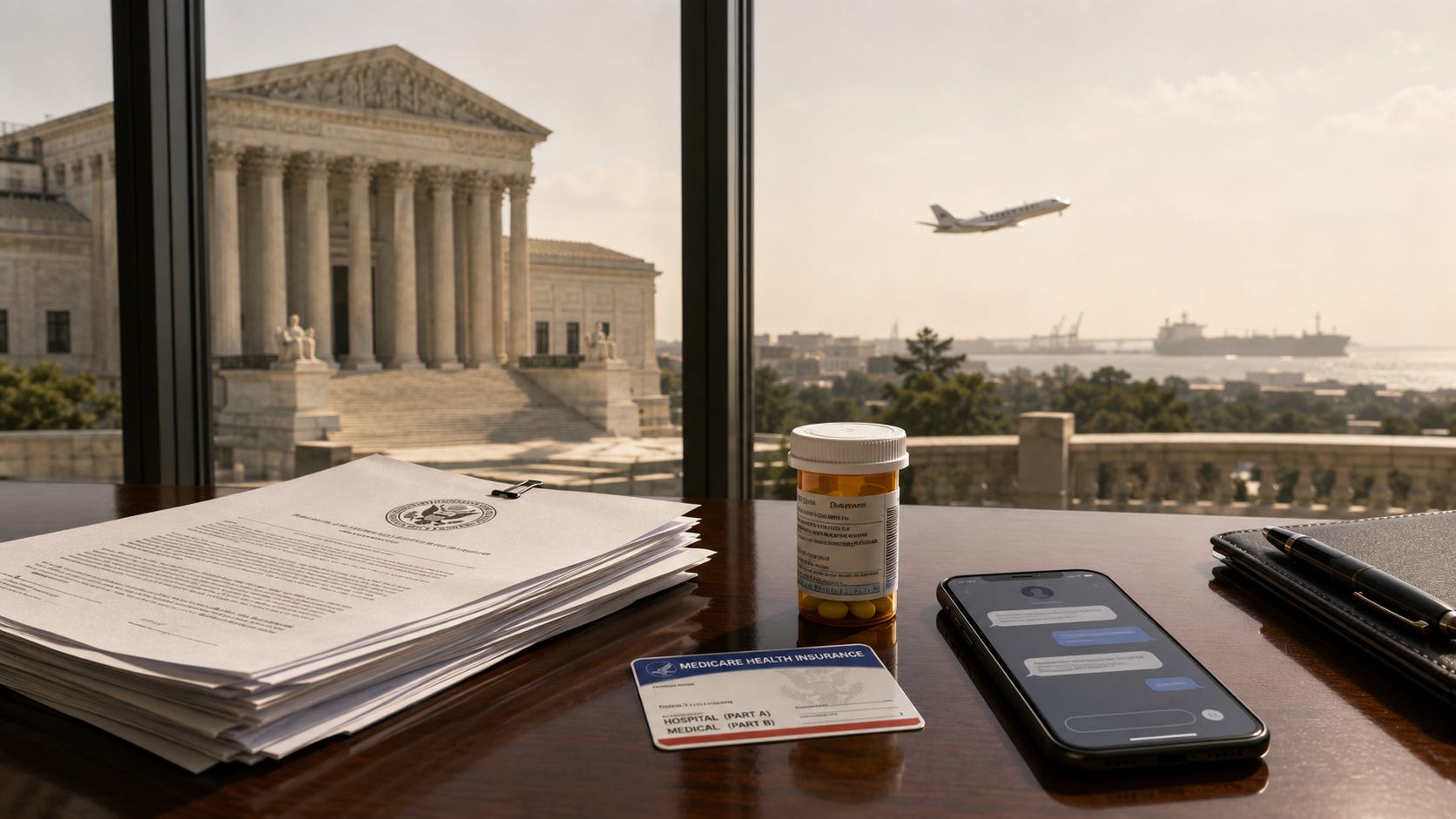
So that’s the day. The Court protected birthright citizenship while narrowing the world for trans youth. Trump’s crypto empire grew fat under the same administration that can shape the rules around it. A foreign government’s luxury jet entered presidential service while Medicare launched a temporary bridge to drugs people need, AI made medical misinformation feel cleaner, Europe kept burning, Hormuz kept reminding the world that energy security is a very expensive illusion, and Colorado reminded incumbents that a safe seat is only safe until voters decide it isn’t.
None of this is subtle, exactly, but subtlety may be overrated at this point. The republic isn’t whispering. It’s making the noise an old machine makes when someone keeps feeding it money but refuses to replace the broken parts.
Shanley, you and your mom have a wonderful talent for writing phrases that completely encapsulate the issues. Today's essay contains a wealth of those phrases. Three of my favorites are:
"America loves to make healthcare feel like a coupon that expires while you are still reading the fine print."
"But heat is not sudden anymore. It’s scheduled, seasonal, and arriving with receipts from every decade of delay, denial, lobbying, extraction, and polite political cowardice. The atmosphere doesn’t care whether a party platform prefers another word for crisis."
"The republic isn’t whispering. It’s making the noise an old machine makes when someone keeps feeding it money but refuses to replace the broken parts."