

Last night, my husband and I sat together watching historian Ruth Ben-Ghiat explain how democracies begin to fray, which is apparently what passes for marital entertainment when the republic has developed a persistent cough.
Ben-Ghiat is a historian of fascism and authoritarianism, and in a recent WIRED video, she laid out the symptoms experts watch for when a democracy is weakening: electoral manipulation, weaponized government, intimidation of the press, normalization of extremism, and a crisis in the peaceful transfer of power.
My husband and I kept looking at each other and shaking our heads, because she was ostensibly describing patterns observed across countries and across history, but the patient on the examination table looked distressingly familiar.
She explained that democracies don’t necessarily die because people are protesting, political parties are fighting, elections are contested, or scandals keep arriving faster than anyone can properly absorb them. Democracies can survive noise, anger, corruption, and conflict. The more serious danger comes when the machinery of government is gradually altered to protect the leader, punish his enemies, frighten the public, and make conduct once considered extreme; feel ordinary.
Then I opened the news this morning, and the pattern didn’t merely emerge. It put on a federal lanyard, kicked open the examination-room door, and smacked me directly in the face, the republic has symptoms.
The Justice Department has become the President’s private practice. Ben-Ghiat describes weaponized government as the transformation of public institutions into instruments of personal power. Impartial civil servants are removed, loyalists are installed, and the agencies meant to restrain the leader are repurposed to serve him.
On Wednesday, Todd Blanche appeared before the Senate Judiciary Committee seeking permanent confirmation as attorney general. Blanche isn’t merely someone Trump knows socially or once encountered near a buffet. He was Trump’s personal defense attorney before becoming deputy attorney general and, eventually, acting attorney general. Now he is asking the Senate to place the Justice Department formally under the leadership of a man whose most prominent legal qualification is having personally defended the president it may someday need to investigate.
During the hearing, Blanche faced questions about investigations of Trump’s political enemies, the Justice Department’s mishandling of the Epstein files, January 6 pardons, and a proposed $1.776 billion “Anti-Weaponization Fund” that would have compensated Trump allies who claimed they had been mistreated by the government. The proposal was abandoned after bipartisan outrage, although Republican senators remained concerned that it could somehow return from the dead, presumably after being bitten by another federal slush fund.
Blanche also defended a settlement protecting Trump and his family from certain tax audits. This is rather convenient because, as Ben-Ghiat explained in the video, another symptom of weaponized government is a tax system no longer permitted to scrutinize the leader or his family. The patient isn’t being subtle, in fact, the immune system is filling out paperwork to exempt the infection from further testing.
The armed agents may be coming to a polling place near you. Ben-Ghiat’s first warning sign is electoral manipulation, especially efforts that make voting feel difficult, dangerous, or watched. Autocrats have historically used armed groups, state security forces, and loyal enforcers to intimidate opponents and reduce confidence in the fairness of elections.
During Blanche’s hearing, Sen. Amy Klobuchar asked whether he would deploy armed federal agents to polling places. Blanche said he would “follow the law,” but would not promise that the agents would remain away.
This is one of those answers that sounds reassuring only if heard from several rooms away with a vacuum cleaner running. The question was whether armed agents from an increasingly violent immigration force might appear where Americans cast their ballots. The prospective attorney general declined to say no.
The importance of that answer became considerably harder to ignore when placed beside another story unfolding at the same time. ICE officials had temporarily suspended most vehicle stops after agents fatally shot two men in Maine and Texas. Neither man was reportedly the intended target of the enforcement operation, and the officers involved were not wearing body cameras. A third man died in Florida while fleeing federal agents.
The pause was not an abolition of ICE, a surrender of the border, or a ceremonial burning of Stephen Miller’s favorite detention-center blueprints. It was an internal effort to review a practice after multiple people died. Trump objected.
He called traffic stops one of ICE’s “most important and effective crime fighting tools” and ordered agents to continue. Within a day, the administration reversed the restriction. Death produced a brief institutional impulse toward caution. The president treated the caution as the emergency.
The thermometer is also under investigation. Another symptom Ben-Ghiat identifies is press intimidation. An autocratic leader can’t easily maintain his preferred version of reality while independent journalists are wandering around collecting facts, interviewing witnesses, and behaving as though truth exists independently of presidential approval.
The solution is rarely to abolish the press in one dramatic ceremony. Modern democratic decline is generally more administrative than theatrical. Reporters are sued, investigated, threatened, discredited, or buried beneath legal expenses until everyone else understands that asking certain questions may become professionally hazardous.
Days before Blanche’s confirmation hearing, the Justice Department issued federal grand jury subpoenas to New York Times reporters who had written about security concerns involving Trump’s Qatari-donated Air Force One. The journalists were ordered to testify on July 15, the same day Blanche appeared before the Senate. The Committee to Protect Journalists described the subpoenas as part of a broader pattern of press-freedom violations.
Under healthy government, journalists investigate officials. Under autocratic government, officials investigate the journalists. The thermometer reports a fever, so the administration raids the medicine cabinet and demands to know who authorized the thermometer.
The fever is now an investment opportunity. At the same time Blanche was trying to convince senators that the president’s former lawyer could independently oversee the president’s Justice Department, Trump appeared at the Pennsylvania Defense and Innovation Summit at the U.S. Army War College.
The summit gathered leaders from defense, technology, finance, government, and some of the world’s largest weapons manufacturers to discuss what organizers called a “generational opportunity.” That opportunity has become especially generous because Trump’s war with Iran has depleted American supplies of Tomahawk missiles and Patriot and THAAD interceptors, some of which could take years to replace.
Trump used the summit to promote his proposed $1.5 trillion defense budget and celebrate new investment in the defense industry. The war has emptied sections of the national arsenal, but there is no reason to be gloomy when shortages can be repackaged as a networking event.
This is how permanent crisis becomes politically useful. The leader creates or expands the emergency, the emergency justifies greater spending and authority, private interests become invested in its continuation, and the resulting machinery is presented as proof of strength. The fever isn’t a failure of the treatment; it’s the whole business model.
The public inheritance is being liquidated. On Monday, Trump signed proclamations reducing Bears Ears National Monument from approximately 1.36 million acres to 121,100 acres and Grand Staircase-Escalante from roughly 1.87 million acres to 181,500 acres. Nearly three million acres lost monument protection, leaving each site about one-tenth of its former size.
The White House called this “rightsizing,” which is the sort of word governments use when “removing protections from millions of acres of public inheritance” threatens to agitate the waiting room. The reductions are so extreme that the Grand Staircase itself is no longer inside Grand Staircase-Escalante National Monument. Valley of the Gods is no longer inside Bears Ears. Apparently, the administration intends to preserve these places primarily through their names.
This land isn’t merely empty federal acreage awaiting a more profitable purpose. Bears Ears contains places sacred to tribal nations. Both monuments protect archaeological, geological, ecological, and cultural resources that can’t be rebuilt after extraction. Yet under increasingly autocratic government, public inheritance begins to resemble presidential inventory, available for reclassification whenever the leader and his allies see an opportunity beneath it.
The patient keeps insisting it feels fine. None of these developments alone announces the formal death of American democracy, which is precisely Ben-Ghiat’s point. Autocracy doesn’t always arrive with a coup, a declaration, or a villain kind enough to explain the entire plot before the commercial break.
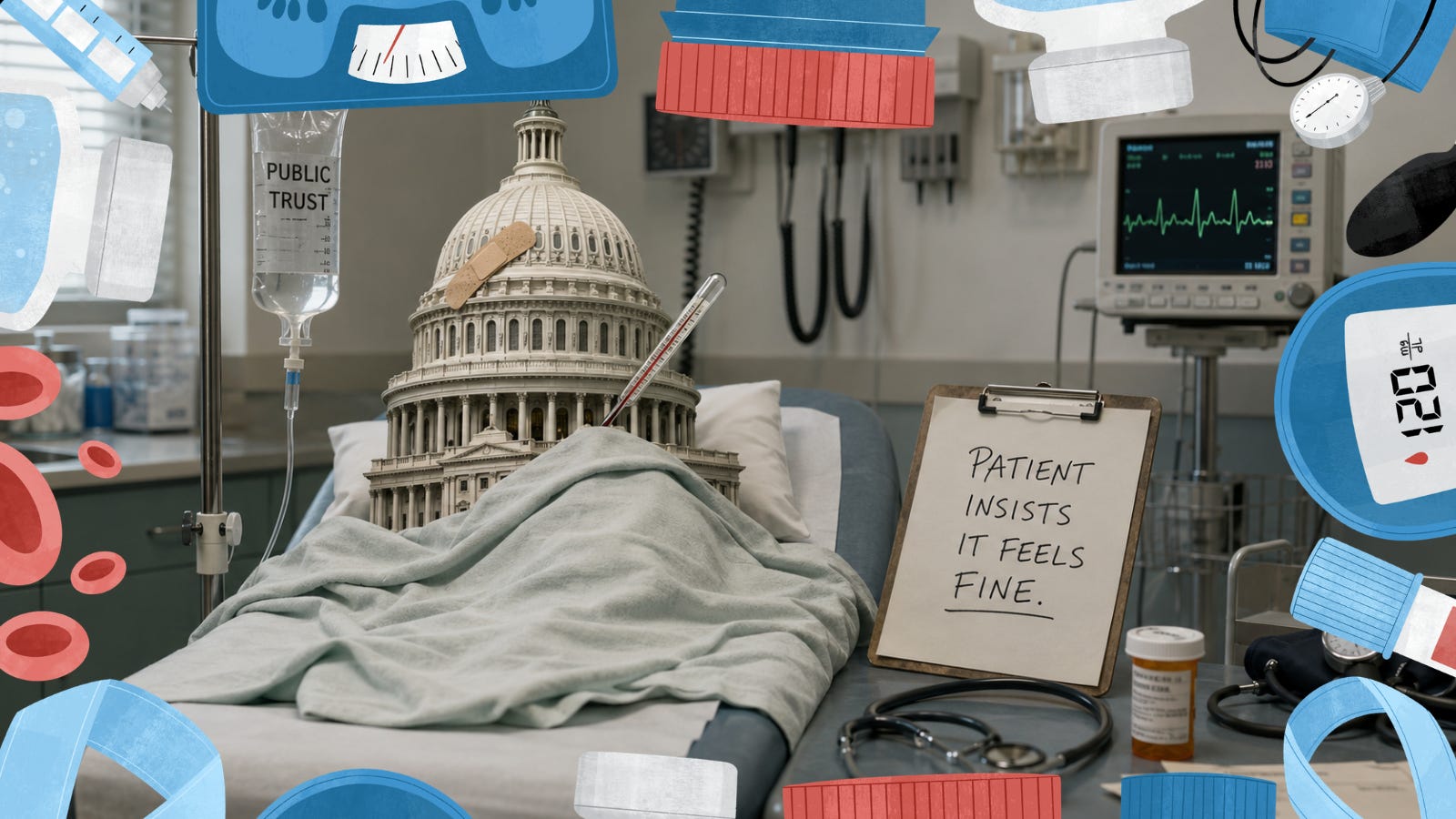
It accumulates through decisions reported separately. A personal lawyer takes control of public justice. Armed agents may be sent near polling places, journalists investigating the president are subpoenaed, political violence is pardoned, deadly enforcement produces demands for more enforcement, war becomes an investment opportunity, and protected land becomes extractable property. Each story is assigned its own headline, its own news cycle, and its own exhausted little compartment in the public mind.
Separated, they look like controversies. Together, they form a diagnosis. The good news, if one may use that phrase while the patient is attempting to fire the nurses, is that symptoms are not a death certificate. Ben-Ghiat doesn’t believe American democracy is doomed. Courts are still resisting unlawful actions, civil society is still organizing, and independent journalists continue reporting what the administration would prefer the public not know.
There is still time for treatment. We have spent years waiting for someone in authority to enter the room, review the chart, and announce that the republic is ill. We have looked to Congress, the courts, inspectors general, prosecutors, and other institutions in the hope that one of them might prescribe a pill capable of restoring the constitutional order before dinner.
Those institutions matter enormously, but democracy doesn’t keep a private physician on retainer. Its courts can slow the disease, its journalists can document its progression, its organizers can keep the patient conscious, but ultimately, the doctor is the public.
That is the burden hidden inside self-government. We are responsible not only for choosing our leaders, but for recognizing when they have become dangerous to the body that gave them power. We must name the sickness, refuse the quacks selling authoritarianism as a miracle cure, protect the people documenting the symptoms, and administer the one treatment every autocrat fears.
An informed public that has decided not to die.
Thank you for an extraordinary synthesis and analysis. The word that seems most apropos is “coup”. What makes this one especially deplorable is the evident motive: personal greed for Trump and his benefactors - for power and control, yes, but perhaps more so for personal wealth obtained by extracting and exploiting the “public inheritance” of this nation in all its manifestations.
Trump operatives are drunk on lies, cruelty and power without conscience or shame. We can laugh at the absurdity of claiming healthy dissent is the work of communists, and elections are valid only when a Republican wins. Was it Voltaire who said “those who can make you believe absurdities can make you commit atrocities”?
The patient is not fine. Military and paramilitary forces are being funded, formed and trained with dangerous rhetoric calling for all opposition to be crushed. We must not let this coup succeed.
Adam Kinzinger reported in his Wednesday daily video that, after the administration said there was no plan to send ICE agents to election sites, a judge found 11,000 pages of just such a plan. I'm glad of the find although I instinctively knew there was a plan. But who generates all these pages??? Eleven thousand??? And there's millions of pages of Epstein crap already released and millions more held back. These criminals are too verbose. We need conciseness, succinctness, brevity (notice I used 3 words where 1 would have done the job?) Good thing we invented AI cause what human would read all that bs. Besides, it goes without saying ... of course ICE is going to be at election sites. They've already got the masks and the guns.
This administration gives me a surprise every single day ... something I could not have imagined. Yesterday it was testosterone testing. OMG!
Bless you all for doing this outrageous journey with me ... you are my lifeline to sanity.