


Today’s installment of America confusing cruelty with procedure comes to us from the front desk.
Not the grand front desk of a marble hotel with flowers in the lobby and a bellhop pretending not to hear your suitcase make that noise. This is a cheaper operation, the carpet has opinions, the ice machine is broken, there is one pen on a chain, two laminated signs, and a man in charge who keeps demanding identification from people standing in the rain while waving firearms through the lobby because nobody told him not to.
Welcome to the Republic Inn. Check-in is at three; rights are subject to availability.
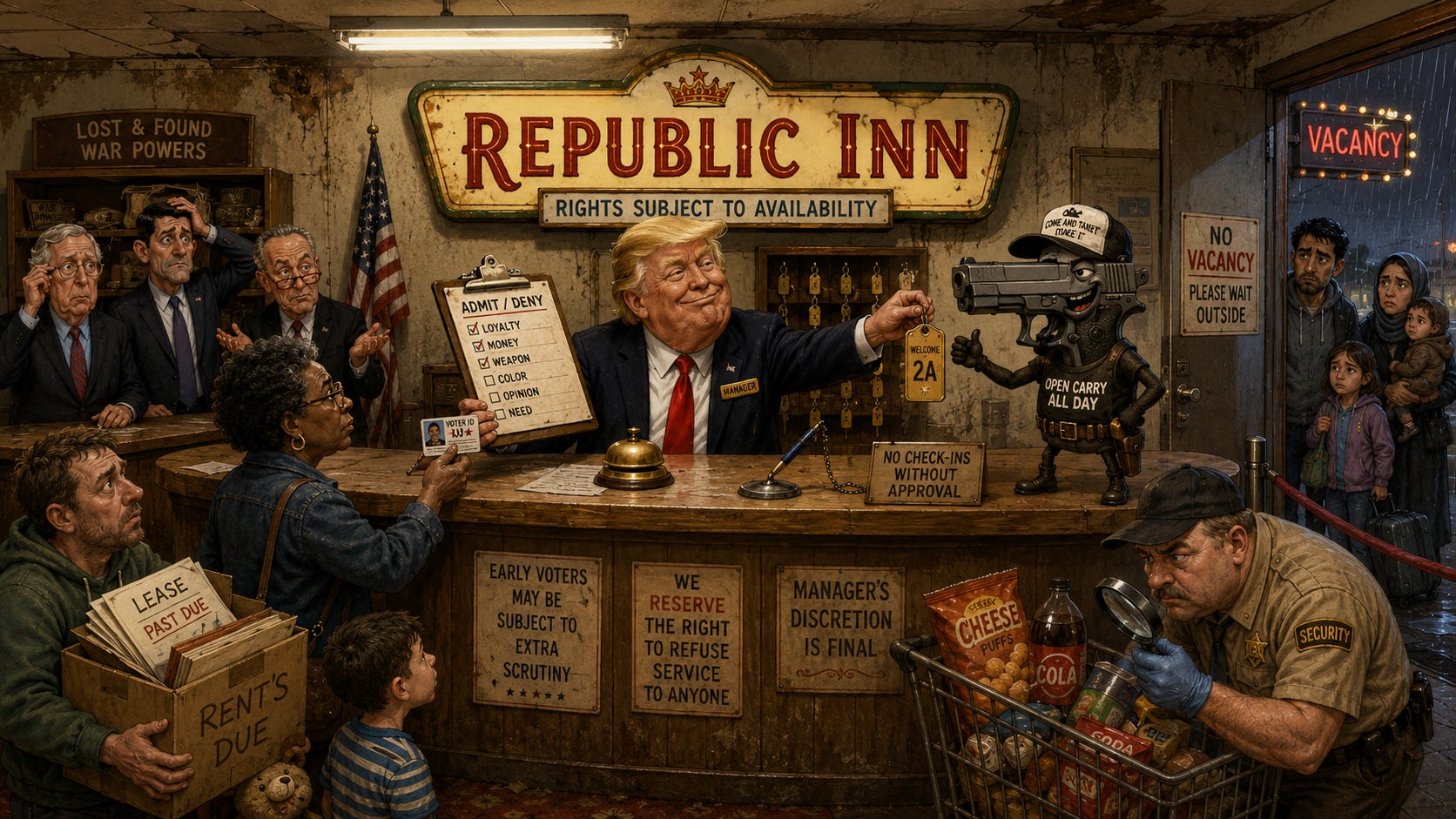
The Supreme Court began the day by looking at asylum seekers at the southern border and deciding that the Trump administration may revive metering, a policy that limits how many people can apply for asylum at ports of entry each day. Metering is a tidy little word, the kind of word a front desk uses when it has overbooked the building and would prefer not to say that families are waiting outside because management has decided their suffering needs an appointment.
It doesn’t say danger, children sleeping in uncertainty, or a person has reached the place where the law says they may ask for protection, only to be told the desk is closed, the manager is unavailable, the system is down, and no, standing at the entrance doesn’t mean you have arrived. That last part is the trick.
The legal theory is that asylum seekers turned away at ports of entry have not technically entered the United States, even though the United States is somehow present enough to stop them. It’s a beautiful little front desk maneuver. You’re close enough for us to deny you service, but not close enough for us to owe you anything. You’re at the counter, but not in the hotel. Then the same country turned around and handed the lobby to the guns.
In another 6-3 ruling, the Court struck down Hawaii’s law requiring permission before carrying firearms into private businesses open to the public, including stores, hotels, malls, and gas stations. The old rule was sometimes called the vampire rule because, like a vampire, the gun needed an invitation before entering. This comparison was meant to make the law sound silly, but it accidentally made the law sound more sensible than most of our current politics. At least vampires understand consent at the threshold.
Now the default changes. Unless the business posts a sign, the gun may come in.
So, there is the whole front desk doctrine, sitting under bad lobby lighting. The asylum seeker waits outside because arrival is apparently a technicality, but the handgun gets to approach the continental breakfast unless someone at the counter printed a notice.
This is not a legal philosophy so much as a hotel policy written during a gas leak. One guest is told the rooms are full, another object with a trigger is presumed to have a reservation.
From there, the theme of the day was hard to miss, everyone was at the desk, and everyone was waiting to see what the clerk would demand. Congress somehow passed a bipartisan housing bill, which in Washington now counts as a rare natural phenomenon, like a comet, or a working escalator. The bill was meant to address housing supply and affordability, those polite terms for the national condition in which people work full-time and still feel like a front door has become a luxury upgrade.
Housing is where the toothbrush lives, and where the kid’s shoes pile up. It’s the table with the bills on it, the hallway light, the dog’s window, the place where people try to become ordinary without being financially hunted every month.
The bill reached the desk. Then Trump refused to sign it unless Congress passed his election legislation first. There it is, the front desk in its purest form. The rooms exist, but the manager has a condition. People need shelter, but first democracy needs to show extra ID. Before anyone gets a key, the president would like to narrow the entrance to the voting booth.
There are other ways to describe that, but hostage note feels the most efficient.
It’s not enough to control the room, no, he wants to control the check-in process. Who gets counted, who gets questioned, who has the right papers, who gets told the system can’t find their reservation even while they are standing there with a confirmation number.
A federal judge blocked most of Trump’s proof-of-citizenship voting order, and another judge blocked an order aimed at creating a federal voter list and restricting mail ballot distribution. In other words, the courts are still occasionally willing to look at the front desk clerk reaching for the bolt cutters and say, no, you may not remove the emergency exit.
But the purpose of these efforts is not only whether they survive in court. The purpose is to make voting feel conditional. To turn a right into a check-in process. To make the public stand at the counter while someone flips through a binder and decides whether their presence is convenient.
That same instinct showed up in the SNAP ruling, because no American front desk is complete until someone decides poor people need their snacks inspected.
A federal judge blocked the administration’s effort to let states ban SNAP purchases of soda, candy, and other sugary drinks. There are serious conversations to have about nutrition and poverty and the way cheap food is engineered, priced, marketed, and sold. But that is not the conversation our politics usually wants. Our politics wants the thrill of standing over a poor person’s grocery cart with a clipboard.
The wealthy get room service from the tax code. Corporations get upgrades, late checkout, a loyalty program, and somebody from management calling them sir. Poor families get asked whether the soda in their cart reflects sufficient moral development.
If you’re rich, your appetite is innovation. If you’re poor, your snack is an incident report.
The Pentagon, not wanting to miss its shift at the desk, restored mandatory flu shots for recruits after an outbreak at Lackland Air Force Base sickened nearly 300 people. The flu shot had been made optional, because someone apparently wanted to test whether viruses respect personal branding. They do not. Recruits were packed into close quarters, the virus checked in early, found the group rate, and began using the amenities.
There is a lesson there, but it is not complicated enough for modern government. Reality doesn’t wait at the counter. Germs do not need a key card. Rent doesn’t care whether a politician says affordability in a caring voice. People fleeing danger still need somewhere to go. People without housing still need housing. Voters still need access to the ballot even when powerful men would prefer a smaller guest list.
And Congress, poor Congress, spent the day reminding everyone that war powers have apparently been left in the lost and found. Senate Republicans reversed course on an Iran war powers resolution after pressure from Trump, which is what happens when the Constitution is treated like a framed document in the lobby, admired by visitors and ignored by staff. The founders were not saints, but they did understand that one person should not get to drift toward war because the mood in the executive suite feels muscular. Congress was supposed to have a role. Now lawmakers appear to be waiting at the desk, asking whether they may please retrieve their authority from storage.
The clerk checks the binder, the president taps his foot, and the war powers remain behind the counter. America isn’t merely arguing about policy, it’s arguing about who gets recognized at the desk. That is the front desk era.
It’s not always dramatic, a boot on the neck, or a torch in the street. Sometimes it’s smaller and duller and more efficient. A rule, a delay, a denied application, a missing document, a sign that should have been posted, a bill that won’t be signed, and a right that must be proven again and again to someone who already knows exactly what he is doing.
The cruelty doesn’t have to shout when procedure can do the talking. The front desk is open, the rooms are not. And somewhere in the lobby, under a flickering light, the little bell keeps ringing while the clerk pretends not to hear it.
Wonderful analogy, Shanley, and a very masterful piece of writing. You beautifully summarized the rot not only at management, but at the vendors that allow that rot to perpetuate and grow. The most egregious of those is the highly partisan, morally bankrupt, and utterly illegitimate majority at SCOTUS. They've proven time and again that idealogy means more than serving all people, and history will be very harsh on this iteration. A close second is the spineless, oleaginous, and utterly devoid of empathy majority in Congress. Their own constituents are in increasing revolt, but yet the majority still prefers licking the boot rather than actually representing the people that elected them. It's why they no longer hold town halls, among other things. I never imagined that we'd be at anything like this as a country, yet here we are. What a sad, pitiful time this is.
Inspired article! Dang, you nailed today's depressing news, tied it all up in an analogy that anyone who has ever traveled on a shoestring (and hopefully those who haven't) will instantly relate to.
Thank you, Shanley!