


There is something grimly efficient about the way war simplifies an authoritarian state’s PR problem. For years, the Islamic Republic has been facing crises of legitimacy, economic collapse, and waves of domestic fury, much of it led or embodied by women who were tired of being instructed on how to dress, how to behave, and how much pain to absorb in the name of tradition, religion, or national destiny. Then along comes a foreign assault, complete with airstrikes, regime-change rhetoric, and a familiar parade of men in Washington explaining that this time, unlike all the other times, external force will somehow produce internal freedom. The result, because history is a sadist, is that the regime suddenly gets to pose as the nation itself, which is the oldest magic trick in the authoritarian handbook and still somehow one of the most effective.
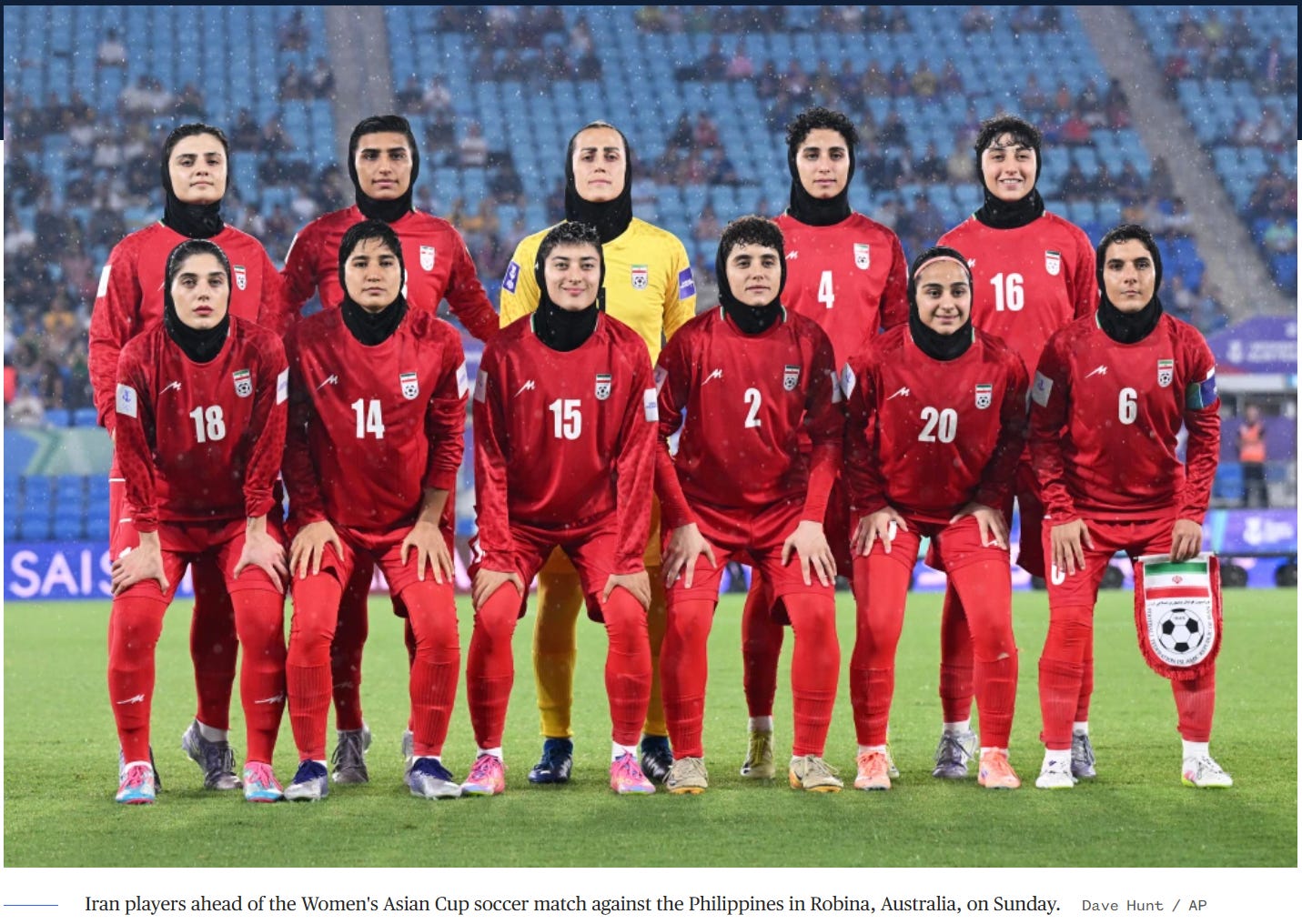
That is what makes the story of Iran’s women’s national soccer team so politically revealing. On paper, it is a sports story, or maybe a human-interest story, which is usually the genre journalists choose when politics has become too obviously ugly to look at directly. In practice, it is a miniature of the entire Iranian crisis. Before their opening Women’s Asian Cup match in Australia, the players stood silent during the national anthem. They did not give the world a nice, tidy explanatory statement, because people whose families live under an embattled security state do not always have the luxury of theatrical clarity. But the silence was read instantly as dissent or mourning, and Iranian state television responded the way brittle states always respond to ambiguity from women, which is to call it treason. A presenter denounced the players as traitors, calls for their protection escalated, and by March 9 multiple outlets were reporting that five players had sought refuge or protection in Australia rather than simply return home and hope for the best.
The reason this matters is not that eleven footballers are secretly steering Iranian geopolitics from a locker room in Queensland. It matters because wartime authoritarianism has two faces, and women are often forced to absorb both at once. On the one hand, the state needs women as symbols. It needs them to stand there in the uniform, carry the flag, sing the anthem, and reassure everyone that the nation is coherent, respectable, and emotionally intact. On the other hand, the same state is deeply suspicious of women as political actors, especially when they become visible in ways it cannot fully script. A woman who represents Iran beautifully is useful. A woman who represents Iran truthfully is a problem. That is why the silence of the players landed with such force. It was not loud, not programmatic, and not even fully explained. It was simply a refusal, however brief, to perform serenity for the cameras while the country burned.
This is also why the team’s later shift, from silence in the first anthem to singing in later matches, did not resolve the matter so much as underline it. Some observers wanted to read the first moment as courage and the second as capitulation, but real life under coercion is usually messier and less flattering to everyone’s preferred narrative. Maybe it was fear. Maybe it was tactical self-preservation. Maybe it was grief. Maybe it was pressure from officials hovering close enough to remind the players that performance in these situations is not merely symbolic. The point is not to decode the women from a safe distance as though they are characters in a prestige drama. The point is to notice how quickly the state converted a moment of ambiguity into a loyalty test, which is exactly what wartime governments do when they are trying to fuse country, leader, and obedience into one sacred object.
Then there is Donald Trump, who managed to make the whole thing even more grotesquely on brand. Trump publicly urged Iranians to seize the moment and overthrow their government during the military campaign, which is the sort of language that sounds thrilling if you have spent your life mistaking television for politics. The problem, as usual, is that countries are not blank screens waiting for America to pitch a third-act twist. A U.S. intelligence assessment completed before the intervention reportedly concluded that military action was unlikely to produce regime change because no coherent opposition was ready to take over and the Iranian power structure would move to preserve continuity. In other words, before the bombs, before the triumphal declarations, and before the usual chest-thumping about history being made, there was already a sober internal view that this was more likely to harden the system than shatter it.
Which brings us to one of the more darkly comic features of American foreign policy, namely its endless confidence that bombing a hostile regime will cause the local population to distinguish cleanly and gratefully between the homeland under attack and the government ruling it. Sometimes that happens. Often it does not. Just as often, people who despise their rulers decide they dislike foreign missiles more. External attack has a way of shrinking political room inside a country, because the state gets to announce that this is not the hour for dissent, this is the hour for unity, and every complaint can suddenly be relabeled as sabotage. Reports from this conflict have pointed to state media amplifying pro-government demonstrations and to a broader climate in which even many critics of the regime were pulled, however reluctantly, toward a language of national defense. That does not mean the Islamic Republic became beloved overnight. It means war let it masquerade as the wounded body of the nation, which is not the same thing but is often good enough.
This is where the soccer team becomes more than a sidebar. The players expose the gap between Iran and the Islamic Republic at exactly the moment the regime is working hardest to erase that distinction. These women are not exiles on satellite television or activists posting from abroad. They are national-team athletes in Iranian colors, representing the country on an international stage. When even they appear fearful, constrained, grief-stricken, or unable to safely express what they think, the regime’s preferred story starts to wobble. The wobble is small, but it matters. An authoritarian state can survive being hated. What it cannot easily survive is being visibly confused with the nation by people who are supposed to embody the nation and still failing to win their trust. So the players become doubly useful and doubly dangerous. Useful as proof that Iranian women still serve the nation. Dangerous as proof that service to the nation does not necessarily imply faith in the state.
And then, because irony in this story prefers the broadest possible brush, Iran selected Mojtaba Khamenei as the new Supreme Leader after the death of his father. If you were looking for a sign that the regime understood this moment as a call for introspection, reform, or meaningful political opening, the hereditary flavor of this succession was probably not encouraging. The Assembly of Experts moved quickly, and reporting has emphasized both Mojtaba’s ties to the Revolutionary Guard and the widespread sense that his selection was meant to secure continuity rather than invite experimentation. The Islamic Republic, a system born in explicit opposition to monarchy, has now produced a father-to-son transfer that looks suspiciously like the thing it once claimed to have transcended. It turns out that anti-monarchical revolutions can become very attached to dynasty once enough security officials are invested in keeping the building standing.
That succession is politically clarifying in a way that should make the last two weeks easier to read. Whatever rhetorical fog surrounded the war, whatever fantasies circulated in Washington about a neatly collapsing regime, the Iranian state itself responded like institutions respond when they intend to survive. It replaced the dead leader from within the existing order, leaned on the security apparatus, and treated symbolic dissent as a wartime threat. This is not what regime change looks like. This is what regime consolidation looks like while smoke is still rising. The promise, or delusion, that violence would somehow blow open a democratic transition now sits next to the very ordinary image of an entrenched system choosing continuity, tightening loyalty rituals, and letting a familiar hard line inherit the throne.
There is a temptation, especially in American commentary, to turn every foreign crisis into a referendum on whether dissidents are sufficiently legible to us. Why did the players not say more. Why did they sing later. Why did the public not rise all at once. Why did the regime not crack open on schedule. The more honest answer is that war is not a laboratory for democratic neatness. It is a machine for panic, coercion, and bad incentives. Under those conditions, the state usually gets first mover advantage because it already has the guns, the microphones, and the script. Women, athletes, and other symbolic figures are dragged into that script whether they want the role or not. Their value to the regime lies in their visibility. Their danger to the regime lies in their humanity, because humanity is messy, frightened, grieving, and never quite as obedient as propaganda would prefer.
So yes, there is a bitter joke at the center of all this, and it is not a subtle one. Trump talked like a man kicking down the door of history, and what followed looks, at least for now, like a familiar authoritarian maneuver in which the regime wrapped itself tighter around the state, crowned continuity as destiny, and treated female athletes as potential enemy propaganda because they failed to sing on cue. If you wanted a cleaner illustration of how foreign intervention can accidentally strengthen the very political logic it claims to destroy, you would have trouble designing one. The soccer team did not cause that contradiction, and they certainly did not deserve to be trapped inside it. They simply revealed it in the most piercing way possible, which was by standing there in public, saying almost nothing, and making the whole edifice suddenly look exactly as scared and vindictive as it is.
Brilliant and timely analysis on the women here. I'll just add that one possibility re Mojtaba Khamenei's succession is that, given Trump's threats to assassinate a successor, he is a sacrifice. There might just be the real successor in the wings, or being sought for.
What a terrific exposition of the lyric "What's war good for? Absolutely nothing."