


Good morning! Trump took an unscheduled motorcade trip to the Lincoln Memorial Reflecting Pool yesterday evening, which is one of those sentences that sounds like the setup to a deleted scene from Veep until you remember that we are, unfortunately, the extras.
There he was, inspecting the water. The surface. The cleaned-up pond, a polished aesthetic project. Markwayne Mullin was with him, because every crumbling empire needs a Homeland Security secretary standing beside a fountain nodding solemnly while the emperor explains that beauty, tariffs, ballroom security, gas prices, 401(k)s, and “one big glow coming out of Iran” are all part of the same normal afternoon.
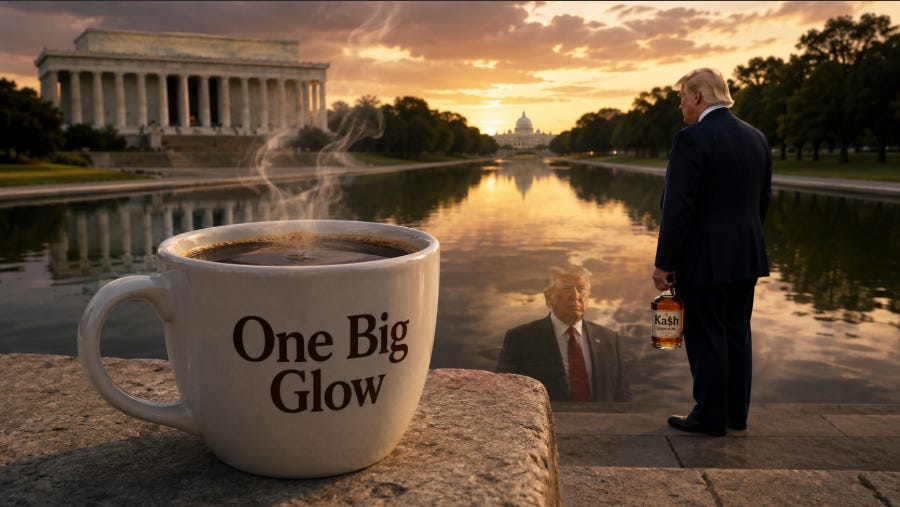
Asked why he was focused on beautification projects “against the backdrop of war in Iran,” Trump called the question “stupid” and scolded the reporter: “You probably don’t see dirt, but I do.” Workers had removed “11 or 12 truckloads of garbage” from the reflecting pool, he explained. America is about “beauty, cleanliness, safety, great people, not a filthy capital.” The question, he added, was “a disgrace to our country.” The dirt did the work. He just labeled it.
And then, standing near the monument to Abraham Lincoln, the president who tried to preserve the Union through sacrifice and moral clarity, Trump explained that the ceasefire with Iran was still intact because Iran had merely “trifled” with us, and “we blew them away.” If there were no ceasefire, he said, reporters would not need to be told. They would just have to look for “one big glow coming out of Iran.”
Nothing says “land of Lincoln” quite like threatening a radioactive sunrise while admiring fresh concrete.
That scene is the day in miniature. Trump went to the reflecting pool to inspect the surface, which is fitting, because the surface is the only part of this presidency he has ever understood. The photo op. The gleam. The branded ballroom. Beneath the surface, everything is cracking: the war, the courts, the economy, the immigration machine, the voting system, the FBI, and the relationship between the White House and the Vatican.
Let’s start with the war that is somehow still, according to the White House, a ceasefire.
The United States and Iran exchanged fire in the Strait of Hormuz, which would normally be the sort of development that causes adults to lower their voices and move carefully. Instead, Trump described the American strikes as “just a love tap,” because apparently we are now conducting foreign policy in the language of a mob boss. The U.S. says Iran launched missiles, drones, and small boats at three American destroyers transiting the strait, and that U.S. forces intercepted the threats before striking Iranian launch sites, command-and-control locations, and intelligence nodes. Iran says the U.S. violated the ceasefire first by attacking an Iranian oil tanker and sites along its southern coast, including Qeshm Island. Explosions were also reported in Tehran.
So, to summarize, we are striking Iran. Iran is striking us. The Strait of Hormuz is unstable. Oil markets are watching nervously. But apparently we are not at war, and the ceasefire holds. This is the kind of ceasefire where everyone keeps firing and then insists the paperwork is still technically valid.
The New York Times added one of the most revealing details: Trump’s “Project Freedom” plan to escort ships through the Strait of Hormuz reportedly collapsed after Saudi Crown Prince Mohammed bin Salman denied the U.S. access to Saudi airspace and bases needed to make the operation viable. Trump announced a military operation in one of the most volatile waterways on earth before securing the regional support required to carry it out. Saudi officials reportedly feared the plan was poorly studied and could escalate the war, which is awkward because when even Mohammed bin Salman is looking at your Iran strategy and saying, “Maybe let’s not be reckless,” the strategic instincts have officially outrun the strategic planning.
This would be bad enough if the administration’s public claims matched reality, but they do not. The Washington Post reports that a confidential U.S. intelligence assessment says Iran can likely survive Trump’s naval blockade for at least three to four months before facing more severe economic hardship, and possibly longer. That directly undercuts Trump’s claim that Iran is already collapsing under his “wall of steel” blockade and whatever other rejected WWE pay-per-view names the administration cycles through for foreign policy operations.
Even worse for the victory lap, the intelligence assessment reportedly found that Iran still has about 75 percent of its mobile launchers and 70 percent of its missile stockpile, despite weeks of U.S. and Israeli bombardment. Trump claimed Iran’s missiles were “mostly decimated” and down to “18, 19 percent,” because numbers are now just vibes wearing a tie. It is the difference between “mission accomplished” and “the mission is currently assembling new missiles in a warehouse.”
Trump and Pete Hegseth appear to have confused “we bombed some things” with “we solved Iran,” which is the mistake history files under “expensive and avoidable.” Iran can endure. Iran can wait. Iran still has missiles and drones. And, as one analyst noted, it only takes one drone hitting one ship to make insurers panic and shipping seize up.
The public narrative has been a carnival of contradiction. MS NOW did the heroic work of walking through Trump’s own Truth Social timeline on the war, and the result is less “commander in chief” than “man live-blogging a head injury.” First there would be no deal with Iran except unconditional surrender. Then Iran had supposedly apologized and surrendered. Then the Strait of Hormuz had to stay open or “death, fire and fury” would rain down. Then NATO was joining the operation. Then NATO was not joining, but we never needed them anyway. Then America was out. Then negotiations were productive. Then Iran had no cards. Then the “Strait of Iran” was fully open, which would be more reassuring if that were the name of the strait.
Then came Project Freedom, the escort mission to open the strait that was apparently open, closed, reopened, blockaded, abandoned, paused, renamed, and possibly converted into a Trump licensing opportunity, all while aides insisted the ceasefire was still in effect. The host summed up the situation beautifully: “We are having a hard time keeping track, and it is literally our jobs.”
Same, friends. Same.
The gap between Trump’s performed war and the actual war is the story. In Trump’s version, Iran is crushed, begging, decimated, leaderless, desperate, and moments away from signing whatever he waves in front of them. In the intelligence community’s version, Iran can outlast the blockade for months, retains much of its missile capability, still has drones, and may keep enough economic oxygen flowing through storage, reduced production, and smuggling routes to wait out American political will.
That is the Trump doctrine in one sentence: declare victory before reality has been briefed.
While the administration was trying to sell the war as strength, Trump was also trying to sell it to the Pope as moral clarity.
Secretary of State Marco Rubio went to the Vatican to meet Pope Leo, the first American-born pope, in what the White House would very much like everyone to believe was a normal diplomatic visit. Completely routine. Nothing to see here except the first American pope sitting across from the Trump administration after weeks of tension over war, peace, immigration, theology, and the president’s inability to encounter moral authority without trying to insult it.
Even Fox could not quite avoid the obvious subtext: Rubio’s visit looked like an effort to ease tensions between Washington and the Vatican. J.D. Vance, also a practicing Catholic, had recently gotten into it with the pope after warning him to be careful about “matters of theology,” which is quite a thing to say to the pope, even for a man whose political philosophy appears to have been assembled from resentment, venture capital, and a haunted comment section.
They sent Rubio instead, Catholic, polished, and less likely to tell the Bishop of Rome to read the manual. The Fox guest even reached back to the medieval “walk to Canossa,” when Emperor Henry IV stood in the snow for three days begging Pope Gregory VII to lift his excommunication. He was careful to say Rubio was not exactly begging for forgiveness, but once you invoke Canossa, the image is doing cartwheels on its own.
Rubio did not technically go to Canossa. But spiritually? The man was at least shoveling the driveway.
Trump, naturally, made Rubio’s job harder from home. Asked what message Rubio should deliver to Pope Leo, Trump said, “whether I make them happy or I don’t make them happy, Iran cannot have a nuclear weapon.” Then he claimed the pope “seemed to be saying that they can.”
He did not. The pope’s message has been peace. Trump heard that as an endorsement of Iranian nuclear ambitions because the distance between those two positions is apparently not visible from the reflecting pool.
Here is the thing: Trump accidentally makes the Pope’s argument for him. Trump says Iran cannot have a nuclear weapon because then the entire world would be hostage. Correct. That is what nuclear weapons do. They hold the world hostage. That is not an argument about Iran alone. That is an argument about nuclear weapons as a category.
Trump’s problem is not that he has discovered a moral principle. It is that he is simultaneously its author and its best argument against itself.
While all this was happening abroad, the enforcement machinery at home kept grinding forward. ProPublica reports that at least 79 children have been harmed by tear gas or pepper spray during Trump’s immigration crackdown. Children walking to school. Children sitting in cars. Children standing near protests. Children inside their homes. Children in strollers. Children coughing, wheezing, struggling to breathe, developing rashes, and in one Minneapolis case, a 6-month-old who briefly stopped breathing after a tear gas canister rolled under his family’s minivan.
The administration calls this “protecting the American people.”
DHS says it does “NOT target children,” which is one of those lawyerly denials that collapses the moment you remember children do not have to be the intended target to be the victims. Tear gas drifts. Pepper spray spreads. Canisters roll under cars. Chemicals seep into homes. Children breathe faster than adults, have narrower airways, and stand closer to the ground where tear gas pools. These weapons are especially dangerous to them. And the administration is using them in neighborhoods, near schools, around apartment buildings, and against crowds where children are plainly present.
Judges in multiple cities have already blasted ICE and CBP for excessive force. One judge said agents acted with “deliberate indifference” to the risks, including to children. But those rulings were limited or later vacated, and the practice continued elsewhere. So the machinery rolls on: chemical weapons, federal denials, local terror, sick children, and the same dead-eyed claim that this is all about safety.
This is the moral core of Trump’s deportation campaign. Not the slogan. Not the press release. Not Stephen Miller’s twitchy little fantasies about federal immunity. The reality is a child crying “It burns,” a baby struggling to breathe, an asthmatic teenager gasping in his bedroom, and federal agents treating American neighborhoods like occupied territory.
If ICE is terrorizing communities on the street, it is also manipulating the legal system in court.
Harry Litman walked through a grotesque episode out of Rhode Island, where a Trump DOJ lawyer had to apologize profusely to a federal judge after the government failed to tell her that a detained man was reportedly wanted for murder in the Dominican Republic. According to the discussion, DHS and ICE had told the DOJ lawyer not to disclose the information because of supposed international-agreement concerns. So the judge ruled based on the information the government gave her. Then DHS and ICE turned around and publicly attacked her for releasing a “murderer,” branding her a “Biden activist judge” and feeding the right-wing outrage machine. They withheld the match, watched the judge walk into the dark, then screamed that she failed to see the fire.
The DOJ lawyer later told the court he was “deeply sorry” and that what the government had said was “completely erroneous,” but the damage was already done. The judge was reportedly facing threats, while the DHS press release attacking her remained up.
Harry Litman called it a combination of “ineptitude and nastiness” and “indifference to the rule of law.” That feels exactly right. The legal system depends on government lawyers being honest with the court. Under Trump, DHS and ICE are not just enforcing policy. They are manufacturing political content. They create chaos, sandbag judges, endanger people, and then package the fallout as proof that courts are the enemy.
ICE has discovered a new form of legal strategy: hide the ball from the judge, then accuse the judge of not catching it.
Then there is Kash Patel, because no portrait of institutional decay is complete without a personalized bourbon bottle engraved with “Ka$h.”
The Atlantic reports that FBI Director Kash Patel has been handing out personalized bottles of Woodford Reserve bourbon engraved with “Kash Patel FBI Director,” an FBI-style shield, and his preferred spelling, “Kah.“Yes,Kah.” Yes, Ka h.”Yes,Kah. With a dollar sign. On bourbon. Branded with the FBI. At this point, satire is not dead. It has simply walked into the ocean holding a tiny white flag.
According to The Atlantic, Patel has given the bottles to FBI staff and civilians, transported them on DOJ aircraft, and brought at least one case to Quantico for a “training seminar” where UFC fighters instructed aspiring FBI agents and senior staff. Because nothing says sober, apolitical law enforcement like the FBI director handing out personalized bourbon during mixed-martial-arts day at Quantico.
Then came the most Kash Patel detail imaginable: at least one bottle reportedly went missing, and according to a retired agent advising FBI employees, Patel “lost his mind” and began threatening polygraphs and prosecution over the missing booze. Agents reportedly sought legal guidance, not because of a national-security breach, but because the director’s vanity whiskey had vanished.
This is the Federal Bureau of Investigation, now apparently operating somewhere between a frat house, a loyalty cult, and an airport duty-free kiosk with badges.
The FBI says the bottles are part of a longstanding commemorative tradition and that Patel follows ethics rules. Former FBI officials told The Atlantic they had never seen anything like a director regularly distributing personally branded liquor, especially while the bureau traditionally holds agents to strict standards around alcohol. One former agent called the bottles “demoralizing,” saying they suggest one standard for the director and another for everyone else.
The swag is ridiculous. The decay underneath it is not. The FBI is supposed to project discipline, restraint, and institutional seriousness. Instead, Trump installed a man who appears to see one of the most powerful law-enforcement jobs in the world as a personal branding opportunity. Challenge coins, Punisher scarves, bourbon bottles, replica guns that reportedly caused a diplomatic incident in New Zealand, it is government by merch drop.
Tennessee Republicans passed new congressional maps eliminating the state’s one Democratic, Black-majority congressional district just days after the Supreme Court weakened a major section of the Voting Rights Act. Memphis, the heart of that district, is cracked into three pieces, with each new district containing roughly one-third of the city’s Black voters. The result: all nine Tennessee congressional districts become Republican-leaning.
This is the part where the Supreme Court majority’s theory collapses under the weight of observable reality. The Court said, in effect, that the old protections were no longer needed. Tennessee Republicans heard that and immediately reached for the scissors; not because voters moved or communities changed, but because the legal guardrails came down.
Stacey Abrams told Tennessee lawmakers they were being asked “to dismantle the protections that helped bury the abomination of Jim Crow.” That is exactly the point. The Voting Rights Act was not some antique souvenir from a solved problem. It was a restraint on people waiting for permission. The moment the Court loosened that restraint, Tennessee showed us what comes next.
The laws were not obsolete; they were inconvenient. The people insisting they were unnecessary appear to have been standing right next to the people waiting to prove why they were essential.
The Supreme Court said the fire alarm was no longer needed, and Tennessee Republicans immediately started playing with matches.
Trump’s trade policy has reached the “Plan B was also illegal” stage.
A divided three-judge panel on the U.S. Court of International Trade ruled that Trump unlawfully used Section 122 of the Trade Act of 1974 to impose his replacement 10 percent global tariffs, the backup plan he rolled out after his broader worldwide tariffs had already been knocked down. The court majority said Trump’s proclamation was invalid, and the tariffs imposed on the plaintiffs were unauthorized by law. Relief was limited to Washington state and two companies, meaning most importers remain stuck paying while appeals play out, but the ruling is still a decisive rejection of Trump’s legal theory.
This is the Trump governing model in miniature: break the law loudly, lose in court, find another statute, misuse that one too, then insist the economy is booming while small businesses pay the bill. Section 122 was designed for temporary import surcharges in response to serious balance-of-payments emergencies, not as a magic wand for turning every Trump grievance into a global import tax.
And while Trump was asked about the ruling at the reflecting pool, he responded in the usual way: by attacking the judges as “radical left,” insisting “nothing surprises me with the courts,” and saying they would simply “do it a different way.”
There it is. The law says no. Trump hears “try another door.”
The deficit story is the quieter version of the same problem. Not the explosion, but the invoice.
The national debt, once treated as a five-alarm political scandal, is now over $31 trillion, larger than the entire U.S. economy, and Washington has mostly decided to whistle past the crater. In the 1990s, candidates fought elections over deficits. Today, both parties keep cutting taxes, spending more, and pretending compound interest is someone else’s problem.
Debt used to be treated like personal debt, a sign of irresponsibility and decline. Then low interest rates made borrowing seem easy, economists grew more comfortable with deficit spending, and politicians discovered they could hand out tax cuts, stimulus checks, war spending, subsidies, and other goodies without immediate punishment from voters. George W. Bush cut taxes while funding two wars. The government borrowed heavily after the 2008 crash. Then came the pandemic. Now the conditions that made borrowing cheap are gone, but the habit remains.
The truly absurd part is that even people who call themselves fiscal hawks voted for tax cuts last year that will add trillions more to the debt. So the deficit scolds have become deficit arsonists in reading glasses: gravely warning about the fire while carrying gasoline into the next committee hearing.
The math is no longer abstract. Interest payments on the debt are now enormous, competing with the cost of major programs and devouring money that could go to schools, infrastructure, health care, climate resilience, or child poverty. The standard solutions have not changed: spend less, tax more, or both. The problem is that neither party wants to be the adult who says the candy store is closed.
Trump did not create the debt crisis by himself, but he is the perfect avatar of the politics that made it inevitable: promise everything, pay for nothing, declare victory, and leave the invoice for someone weaker, poorer, or not yet born.
So here we are. A president inspecting the reflecting pool while threatening a “big glow” over Iran. A ceasefire held together with Scotch tape, oil futures, and semantic denial. A war sold as victory while intelligence says the enemy can endure for months. Federal agents tear-gassing children and blaming parents for the drift. ICE sandbagging judges and calling it accountability. The FBI director reportedly handing out Ka$h-branded bourbon like the bureau is a MAGA bachelor party with subpoena power. Tennessee cracking Black voting power days after the Court weakens the law designed to stop exactly that. Tariffs struck down, then routed around. Debt ignored until the interest becomes the policy.
At the Vatican, an American pope quietly stands for peace while the American president reframes peace as weakness, diplomacy as betrayal, and opposition to nuclear weapons as permission for Iran to build one.
The Pope Leo episode is so revealing. Trump says Iran cannot have a nuclear weapon because then the whole world would be hostage. He is right. That is what nuclear weapons do. They hold the world hostage.
The man threatening a “big glow” over Iran is lecturing the Pope that Iran cannot have nuclear weapons because no one should be allowed to hold the world hostage.
It would be profound to see a sketch of the parameters of the economy that IS booming, because all the evidence (and the stock market) suggests that it is. Only thing is: this economy is not the official economy, the one that is being drawn down to create the parallel one. BTW, I live forty minutes from a city of 120,000 people, many extraordinarily wealthy, that was long rumoured to have an openly hidden economy. One estimate was that 15 years ago half the regional economy came from under-the-table cannabis money. One problem with these arrangements is that official government finds it impossible to fix anything, because although the tools and smarts to do so are present, the money is not flowing through its channels. Right now, there are a lot of unknowns. One of those is "Who is profiting from insider information on oil futures?" and "Where is that money going?" and "What is it being used for there?" We don't know the actors, but the process is clear: someone is profiting, the money is flowing to them, and they're using it for something. This could apply to anyone from Kushner to Musk to Putin to Milei to who knows. It doesn't have to be one of them for the pattern to be clear, because it sure looks like we're dealing not just with an alternate economy but an alternate government. Why, it's like the day I went into a coffee shop in which the local leaders of the Hells Angels, who owned the shop, were gathered around the main table openly discussing, for all to hear, the day's price for cannabis and how they were going to deal with competitors undercutting that price. Quite the cappuccino I had that day.
Thank you for calling Mohammed bin Salman by his full name instead of "cool" initials. I am convinced the Trump regime (looking at you, Kushner) works hard to make names like Mohammed and bin ____ more palatable to MAGAts, just as those same Trumpers now use Obama's full name whenever possible.
Re bin Salman: oh, he's up to something, and I doubt it has anything to do with quelling the non-war. Either there's more at stake, or he's angling for something (money? control?), because in that regard he's just like Trump. Always "Me first."
Actually, I guess I do have a cool monogram moniker for him, as in this sentence: "I wouldn't trust that SOB as far as I could throw him."