

Robert F. Kennedy Jr. has always understood something basic about modern public life: if you can make people feel that the system is lying to them, you don’t have to win every argument, you just have to win the doubt.
For years, Kennedy’s brand has been built on that doubt. It’s doubt in pharmaceutical companies, in regulators, in doctors who speak in careful probabilities while parents want certainty. Doubt in the institutions that aim to protect children, but have sometimes failed spectacularly in other arenas like opioids, lead, environmental toxins, medical racism, and access disparities. In that landscape, skepticism is easy to sell. And Kennedy has sold it with the intensity of a crusader: a lawyer and activist who says he is taking on captured institutions, taking on corruption, taking on the cozy relationship between money and medicine.
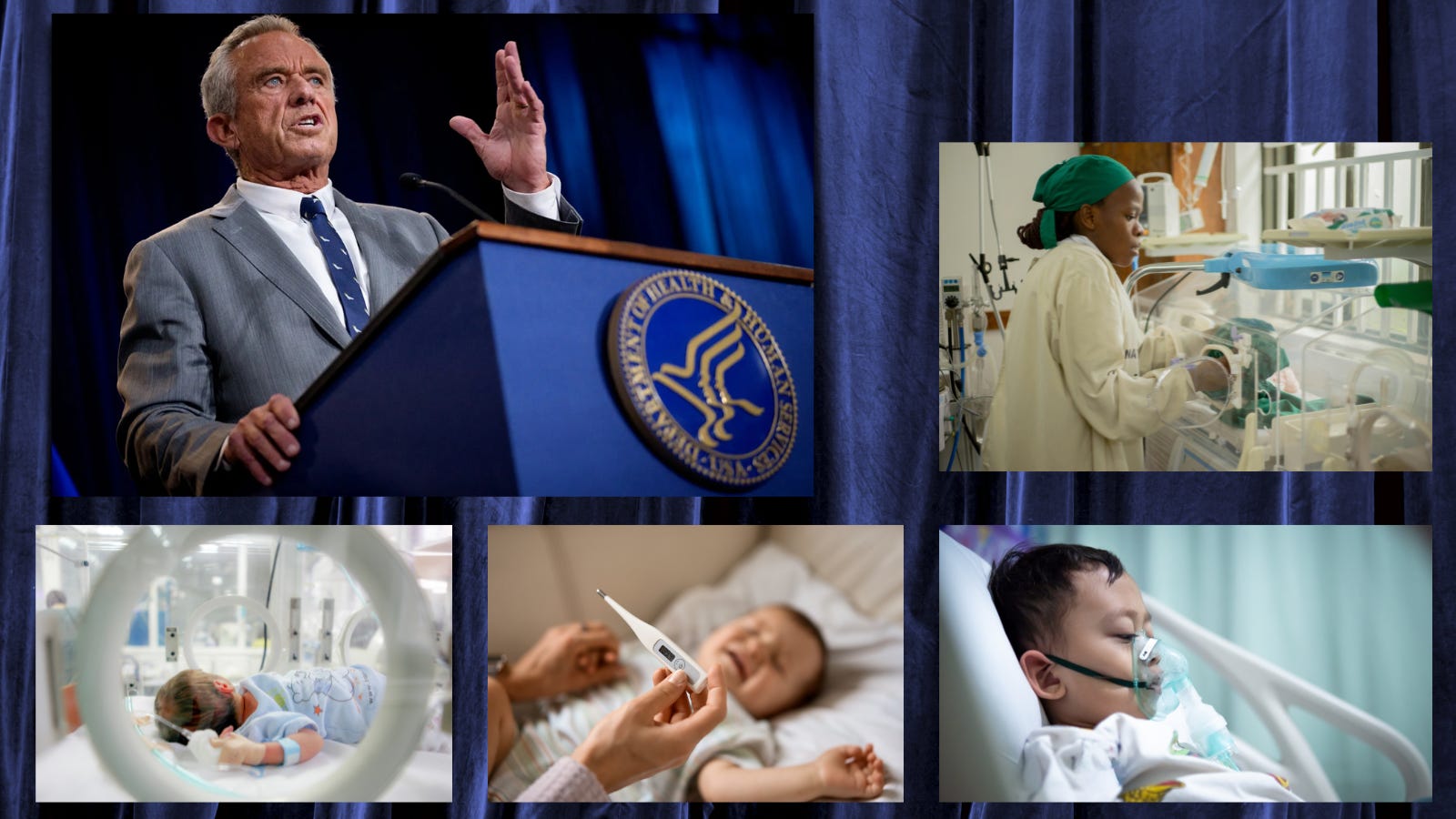
Now, that crusade has moved inside the U.S. government. Kennedy’s confirmation as Secretary of Health and Human Services didn’t merely elevate a controversial figure. It placed a man with a long record of vaccine skepticism at the center of the country’s public health apparatus, an apparatus that shapes the childhood immunization schedule, sets norms that insurers and schools follow, and communicates risk during outbreaks. You don’t have to believe he is malicious to see the danger: when a person’s career has been spent litigating and campaigning against vaccine confidence, and that person becomes responsible for guiding vaccine policy, the stakes are not theoretical. They are children.
This is not a story about whether vaccines are perfect. Nothing in medicine is, it is not a story about whether institutions can be wrong, they can, sometimes disastrously. This is a story about what happens when the levers of public health are pulled by someone whose central narrative has long depended on convincing the public that those levers cannot be trusted.
And it is a story about power, how it’s gained, how it’s wielded, and how it can be used to transform a system without ever formally “banning” anything.
In January 2025, in a Senate confirmation hearing, Kennedy was questioned about a trip he took to Samoa in 2019. The trip has long drawn scrutiny because it occurred not long before a catastrophic measles outbreak. To many public health experts, the Samoa episode represents a worst-case scenario of what can happen when vaccine confidence collapses: preventable disease returns, and children pay the price. Kennedy told senators that his trip had “nothing to do with vaccines,” repeating the claim when pressed. He portrayed the visit as not being motivated by vaccine activism, despite his long association with the anti-vaccine movement and his work with Children’s Health Defense.
But newly disclosed emails, turned over by the U.S. Department of State and reported by the Associated Press, complicate that story sharply. The AP describes these contemporaneous communications as providing an “inside look” at how the trip came about, with accounts suggesting that vaccine safety concerns motivated the visit. The story reports that the emails also reveal previously unknown details, including that a U.S. embassy employee helped Kennedy’s team connect with Samoan officials. The documents, AP notes, are heavily redacted. Still, their existence matters because they pull the Samoa question out of the realm of vague insinuation and into the realm of an evidentiary conflict: sworn public testimony on one side, internal contemporaneous records on the other.
Calling something “perjury” is a legal claim that requires proof of intent and materiality. But you don’t need to settle that question to grasp why the Samoa emails matter. They are an early warning about something that becomes crucial when an activist steps into an executive role: whether the public, Congress, and the medical community can trust his descriptions of his own actions. Because public health is not just science, it’s governance, and it requires credibility. If trust collapses, especially around childhood immunization, the pathogen does not debate. It spreads.
If the Samoa story is a test of credibility, Kennedy’s approach to the CDC’s vaccine advisory machinery is a test of strategy. In the U.S., vaccine policy doesn’t primarily live in dramatic decrees. It lives in committees, recommendations, and the slow turning gears of institutional consensus. One of the most consequential parts of that system is ACIP, the Advisory Committee on Immunization Practices. ACIP’s recommendations shape the standard schedule and influence coverage norms, When ACIP recommends a vaccine for a group, it isn’t merely offering advice; it is often setting the practical baseline for clinicians, insurers, and public messaging.
CBS reports that Kennedy removed all 17 ACIP members, describing it as “retiring” them, while accusing the committee of functioning as a “rubber stamp.” Medical groups including the American Medical Association and the American Academy of Pediatrics rebuked the move. CBS also highlights why ACIP matters: the committee’s work connects to insurance coverage structures and broader vaccine policy infrastructure.
This is an institutional earthquake masquerading as an administrative reshuffle. Whatever one thinks of the prior members, removing an entire advisory committee in mass is not “business as usual.” It signals something larger: a desire not merely to critique the system, but to rebuild it around a different premise, one more aligned with Kennedy’s history.
If you are trying to move U.S. vaccine policy without passing a single law, this is how you do it. You don’t need to announce, “We will end the childhood schedule.” You can instead remold the body that defines it. You can slow its recommendations, alter the framing of risk, change the evidence standards, and turn previously routine guidance into a perpetual question mark. The effect can be the same, without the clarity that would trigger public backlash. That is why “process” matters, process is where the future is decided quietly.
The Guardian reports that the chair of ACIP has said the committee is “reevaluating all of the vaccine products including risks and benefits.” That phrase is not inherently sinister. In medicine, reevaluation is healthy; safety monitoring is essential. But the Guardian frames this as a dramatic departure from decades of how ACIP has functioned, with statements emphasizing “autonomy versus public health.” It also argues that the chair mischaracterizes “mandates,” emphasizing that ACIP recommendations are not themselves federal mandates and that states and localities govern requirements. The story situates this overhaul amid significant measles activity early in 2026, an especially charged backdrop for moving the nation’s vaccine guidance infrastructure into a posture of wholesale reconsideration.
This gets at the heart of Kennedy’s governance style. He often frames the central problem not as disease, but as the institutions responding to disease. The moral drama is not a virus harming children; it is a bureaucracy infringing on freedom, a regulator missing risks, a medical establishment dismissing parental concerns.
When that framing becomes the operating philosophy of a national health department, the country can slide from “vaccines are a tool, sometimes imperfect but lifesaving” to “vaccines are a perpetual suspect.” And once you turn lifesaving tools into suspects, public behavior changes.
No subject in this debate carries more emotional voltage than autism. Parents want answers, they want meaning. They want something concrete to hold responsible for the fear and grief that can accompany the unknown. Autism, as a diagnosis category, has expanded over time; the reasons include evolving criteria and better recognition, but that nuance is cold comfort to families who are living the daily reality of care.
For years, Kennedy has aligned himself with circles that promote the debunked narrative that vaccines cause autism. That narrative has been repeatedly rejected by scientific research and major health authorities, but it persists precisely because it offers something emotionally irresistible: a clear culprit and a story of betrayal. The Daily Beast reports that NIH Director Jay Bhattacharya said he has not seen evidence that any single vaccine causes autism, and it contrasts that with Kennedy’s history and with recent changes to autism-related advisory structures. The piece reports that Kennedy overhauled the Interagency Autism Coordinating Committee (IACC), with critics warning that the committee now overrepresents vaccine-skeptic views. Bhattacharya also endorsed measles vaccination as the best answer to outbreaks, an on-the-record contrast that matters when the nation’s top health institutions are expected to speak with coherence.
Here, again, the risk is not only the claims Kennedy might make. It is what staffing signals: who gets elevated as credible, whose theories become “worth investigating,” what kinds of stories gain institutional oxygen. Even if no formal policy is changed, there is harm in using the weight of government to amplify insinuations that have already cost lives.
Because the autism-vaccine narrative has consequences. It affects vaccination rates. It affects outbreak dynamics. It shapes whether parents feel fear when they should feel reassurance.
When people say, “What is he gaining?” which I find myself asking more and more, they are not always asking for a hidden conspiracy. Often they are asking something simpler: what set of incentives could make a person keep returning to the same claims, the same fights, the same enemies?
Axios, summarizing financial disclosures, reports that Kennedy had income including $326,000 from Children’s Health Defense and a $100,000 licensing fee for the “Make America Healthy Again” brand, alongside other reported earnings and legal interests. Axios also reports he pledged to transfer or forfeit some interests if confirmed and references vaccine-related litigation ties described in the disclosures.
None of this alone proves corrupt intent, people can believe what they argue, people can change roles. Disclosures can include recusal plans. But incentives still matter. A political identity built around fighting vaccine orthodoxy is not just an ideology; it can be a platform, one that generates attention, donations, speaking opportunities, brand licensing, and loyalty. In the modern attention economy, conflict is not a side effect. It is the product. And the product is valuable.
That’s why you don’t need a cartoon villain to be concerned. A public official can sincerely believe he is saving children while still being pulled by incentives that reward disruption over stability, suspicion over clarity, and grievance over governance.
There is another lens that isn’t scientific or financial: legitimacy. In April 2024, the Associated Press reported that more than a dozen Kennedy relatives endorsed President Joe Biden rather than support RFK Jr.’s campaign, and he responded publicly that he loves his family either way. The significance here is not gossip. It is that people who share his name, people whose lives were shaped by the same family history he invokes, publicly broke with him.
That kind of rupture is rare, and it suggests that those closest to his legacy saw something in his trajectory that they believed the public should not normalize. Even if one dismisses family opposition as political disagreement, it still functions as a signal: Kennedy is not merely “a Kennedy with different views.” He has become something else, aligned with a different coalition, a different story, and a different kind of politics. And that coalition has now moved into the machinery of health policy.
This is the part that matters most: the risk to children and to the country does not require you to believe Kennedy is lying about everything, or plotting something hidden, or acting with malice. Public health systems are fragile. They are built on trust and routine and the boring stability of recommendations that parents don’t have to rethink every week. When those systems are destabilized, the harms are asymmetric: it is far easier to destroy confidence than to rebuild it.
A Secretary of HHS who repeatedly minimized vaccine-related intent in a context where documents suggest otherwise is a credibility risk. A Secretary who removes an entire vaccine advisory committee is a structural risk. A leadership environment that treats “reevaluate everything” as the posture of the moment, while measles spreads, is an outbreak risk. A reshaping of autism advisory infrastructure toward vaccine-skeptic narratives is a misinformation risk with a uniquely powerful emotional hook. And an official whose platform has had financial and brand entanglements with the very controversies he now oversees is, at minimum, a conflict-of-trust risk, even if every ethics box is checked.
Put differently: the danger is not only the policies he might enact today. It is the cultural and institutional shift his leadership can catalyze, one that makes preventable disease more likely tomorrow. The United States does not need a perfect system to understand what is at stake. We’ve already seen what happens when vaccine confidence erodes: measles returns, and kids end up in intensive care over something that should have stayed in the past. That’s what makes this moment so unsettling. It is not a debate happening on podcasts anymore. It is governance. It is the authority of a federal department, it is the quiet rewriting of what counts as “normal” health policy.
Parents do not have the luxury of treating this like a game of ideology. They have to make decisions on schedules and shots and risk. They have to decide whether to trust the system. And when the system’s highest messenger makes the system itself sound untrustworthy, the consequences are predictable.
This isn’t about partisan dislike; it is about the difference between skepticism and sabotage. Skepticism asks hard questions while still respecting the accumulated evidence and the life-and-death reality of infectious disease. Sabotage makes the questions the point, and leaves families alone with fear, and leaves children exposed to preventable harm.
If the U.S. is going to reform public health, it should be led by people who can strengthen trust through transparency and consistency, not by someone whose political identity has been forged in undermining the very confidence that keeps outbreaks at bay. Because when you gamble with childhood immunization, the losses aren’t abstract. They’re measured in hospital beds, in frightened parents, and in children who did not have to suffer.
This is the line, hold it. Our children are not test cases in someone else’s crusade. They are not collateral damage in a political story about “freedom” that never shows the ICU, the IV lines, the high fevers, the terrified parents counting breaths. If public health is going to be changed, it must be changed by people who respect evidence, who listen to clinicians, and who understand that trust is a life-saving resource.
So, speak, write, call, and show up. Demand oversight and transparency from Congress. Demand that advisory bodies be filled with qualified experts, not ideologues. Demand that our health agencies tell the truth clearly, even when it’s complicated, because that’s the only way the public can make good decisions. Talk to your pediatrician, share credible information with other parents, and hold the line in your own community, because outbreaks don’t wait for Washington to come to its senses. And don’t let anyone tell you this is just politics, because it’s not. It’s children’s lungs, children’s brains, it’s children’s lives. If you care about kids who are too young to be vaccinated, kids with cancer, kids with immune disorders, and newborns who depend on the rest of us to form a shield around them, this is the moment to speak up. Silence isn’t neutrality here, silence is permission.
Honestly, what's the point of having Senate confirmations:
Independent fact-checks found that Robert F. Kennedy Jr. gave misleading testimony about vaccines — including saying it’s unclear whether COVID-19 shots saved lives, downplaying his vaccine-related advocacy during the Samoa measles crisis, and describing himself as “not anti-vaccine” despite a long résumé of anti-vaccine claims.
He also overstated supposed conflicts of interest in federal vaccine advisory panels and contradicted well-established scientific consensus — the kind of moment where senators weren’t arguing about policy so much as quietly googling during the hearing.
When the stakes are extreme (our children’s life) we are already afraid & concerned. Then, when doubt is constantly layered over the entire process, facts then become doubted, making it impossible to rationally decide.
If I were a new father without a medical background, I’d be checking with everyone I knew. (My children are middle age, no measles. I had measles age 6. Also chicken pox).