


Good morning! Earlier this year, without a press conference or a statement to Washington, the Dutch central bank moved roughly 86 tons of gold out of its vaults in New York and Ottawa and into London. Officially, the reasons were “increasing geopolitical unrest,” crisis preparedness and the need to make those reserves easier to use in an emergency. In March, the Bank of France did the same thing with 129 tons. Neither decision had anything to do with the war in Iran.
For nearly two years, allies and investors have been adapting to a United States they regard as less predictable. This week is putting hard numbers on what unpredictability costs, numbers you can read in a Congressional Budget Office report, in a Treasury bond auction, in a count of how many interceptor missiles it takes to stop twenty incoming ones.
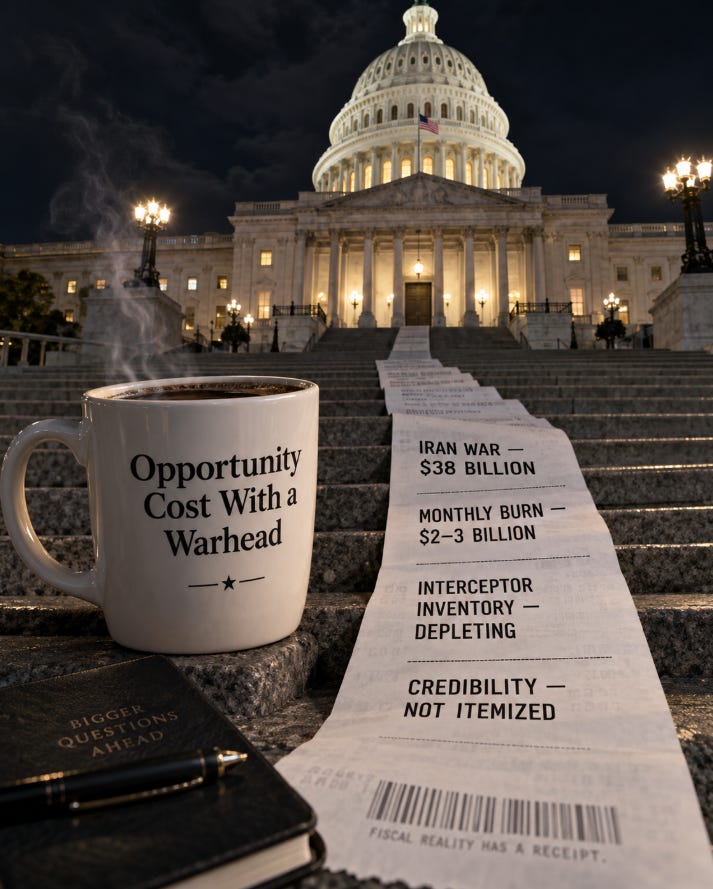
This week hands us a clean look at both halves of that story at once: the price tag on one war, and the far larger ledger it’s just the latest entry in. Call it a predictability premium: the extra cost, paid in dollars, alliances and interest rates, of being a country nobody can quite plan around anymore. Some of that bill is coming due in Tehran and Amman. Some of it is coming due in Strasbourg and Oslo and the bond market. And, at long last, some of Washington, a full two years late, appears to be starting to notice.
The United States has spent approximately $38 billion on the war with Iran through August 1, according to a new estimate from the nonpartisan Congressional Budget Office. Keep fighting at roughly the relatively low intensity of May and June and the meter runs another $2 billion a month. Return to July levels and it is closer to $3 billion. Escalate beyond that and, well, apparently the meter has a sport setting.
That $38 billion covers replacement munitions, equipment lost in battle, extra flying hours, operations and fuel. It does not include every federal cost associated with the war, and CBO warns that its estimate carries unusual uncertainty for a rather remarkable reason: the Defense Department did not respond to its requests for information.
Making Congress’s budget analysts reconstruct your war from databases and newspaper articles does not inspire confidence.
The money is only the beginning. CBO says the war’s largest military opportunity cost has been the extraordinary expenditure of missile-defense interceptors, leaving American inventories reduced for several years. The agency then does something budget reports rarely do: it explains how a shortage becomes particularly dangerous if the United States faces an adversary possessing large numbers of ballistic and cruise missiles.
Like China.
Around Taiwan.
Congress’s budget office identified a strategic asset being consumed while the current war continues.
The Wall Street Journal supplied the picture behind those numbers yesterday. When Iran fired roughly 20 ballistic missiles at American forces in Jordan last week, the United States reportedly fired somewhere between 60 and 70 Patriot interceptors and more than a dozen THAAD interceptors trying to stop them. Some Iranian weapons still got through and struck aircraft at Muwaffaq Salti Air Base. Iran has been changing trajectories, missile types and warheads, including using warheads that separate into multiple projectiles as they approach their targets, in an apparent effort to make American defenses work harder and spend more.
The arithmetic gets worse. By mid-July, according to officials cited by the Journal, the United States had already fired roughly 1,700 Patriot interceptors, more than 200 THAAD interceptors and another 150 Navy Standard Missile interceptors during the war. Lockheed Martin produced a record 620 Patriot interceptors during all of 2025 and is trying to ramp up production dramatically. Those are not directly interchangeable numbers, but you do not need a Pentagon logistics degree to spot the underlying problem.
The invoice tells us what the war costs, while the inventory reveals what it consumes. Consumption is a much bigger word here because money may be appropriated tomorrow, but appropriating a Patriot interceptor is another thing altogether. The same holds for a THAAD missile, a trained production workforce or an industrial supply chain that has spent decades being optimized for peacetime procurement schedules rather than sustained missile warfare.
The Pentagon’s own inspector general said this week that the war has produced “strategic inventory shortfalls” and exposed industrial-base bottlenecks in replacing munitions. The Journal reports that some American officials consider Patriot inventories in Europe to be beyond critical, that Gulf allies are scrambling for interceptors of their own and that the pressure has affected Ukraine’s ability to obtain the air defenses it needs against Russian strikes. So the real cost of firing an interceptor over Jordan is not merely what it costs to manufacture its replacement. It is the missile that is no longer sitting in Europe, Guam, Japan or some allied battery if another crisis begins before the factory catches up. Opportunity cost with a warhead.
CBO also estimates that the war has discovered the grocery aisle. Disruptions to oil and natural-gas shipments through the Strait of Hormuz and to Red Sea shipping have pushed up global energy prices, which flow into gasoline, diesel, jet fuel, and ultimately the transportation cost embedded in nearly everything else Americans buy. CBO now estimates first-quarter 2027 PCE inflation will be half a percentage point higher than it projected before the war, with core inflation three-tenths higher. It estimates that the energy shock alone added 2.3 percentage points to the annualized inflation rate during the second quarter of this year.
Here is the part that is hard to put on a spreadsheet. For nearly two years, there have been signs that governments, central banks, investors, and companies abroad are reconsidering how much they want to depend on the United States. The Iran war did not begin that process; tariffs, sanctions, debt, repeated threats against allies, and concern about the predictability of American policy were already pushing countries to think about diversification.
Iran is the latest and, conveniently for accountants everywhere, most quantifiable entry in a broader erosion.
The New York Times reports this morning that global investors have become more cautious about American bonds, discussion about the dollar’s long-term position has intensified and some foreign governments are moving reserves or building alternatives to systems dominated by the United States. The United States remains enormously powerful financially. Money continues pouring into American stocks and technology, and nothing is poised to replace the dollar as the world’s principal reserve and transaction currency next Tuesday afternoon.
We are not talking about collapse, at least not yet, we are talking about hedging. Hedging is what people do when they still believe an asset is valuable but have begun wondering whether keeping all their eggs there remains prudent.
The Netherlands gave us a particularly vivid example earlier this month. The Dutch did not announce that they expect Donald Trump to rappel into the New York Fed wearing a balaclava and carrying a wheelbarrow. De Nederlandsche Bank said it wanted its reserves more geographically balanced, more readily tradable and better positioned for “increasing geopolitical unrest” and severe crises.
A central bank asked itself where it wanted its emergency asset during an emergency and changed the answer.
Now add Canada. European Commission President Ursula von der Leyen this week proposed opening the door for Canada to become the European Union’s first “associate member,” a category that does not presently exist in the form being discussed. She paired it with a proposal for an EU version of NATO’s Article IV — the mechanism that lets any member summon an emergency meeting over an evolving threat — and revived an idea for a European Security Council that would seat non-EU members Norway, the U.K. and Canada alongside EU leadership. Canada is not preparing to become Belgium with better hockey. Full EU membership is off the table, and plenty of technical and political obstacles remain.
What is under discussion is nevertheless extraordinary: deeper integration of European and Canadian defense production, critical-mineral supply chains, energy, artificial intelligence, data infrastructure and economic-security policy, potentially accompanied by new mobility arrangements. Carney’s government responded within hours, describing the move as deepening Canada’s sovereignty and security “while safeguarding our way of life,” language entirely consistent with Carney’s broader push to reduce Canada’s vulnerability to any single partner.
Canada and Europe had already been moving closer before the Iran war. Canada signed a security and defense partnership with the EU last year and has been deliberately seeking alternatives to its historic economic dependence on the United States. The proposal is less a declaration of independence from Washington than a demonstration that traditional allies now have the option of maneuvering around it.
Von der Leyen herself described the project as strengthening cooperation among like-minded democracies and building resilience in what she called an “openly hostile world.” Canadian Prime Minister Mark Carney has spent much of his tenure talking about diversification and sovereignty rather than some dramatic divorce from Washington. The practical agenda is therefore less theatrical and potentially more consequential: build another supplier, another market, another defense-production chain, another technology partner, another place to sell energy, another option. Build Plan B before Plan A has a nervous breakdown.
The Times finds the same logic elsewhere. Countries are exploring payment systems that reduce their vulnerability to American financial sanctions. Businesses abroad are increasingly asking whether reliance on American technology could someday leave them exposed if Washington restricts or disables access during a dispute. Central banks are buying gold. Governments are diversifying reserves.
Credibility is capital too. For decades, the United States accumulated it so successfully that we stopped treating it like an asset. Treasury securities became the world’s safe haven. The dollar became the plumbing beneath international commerce. American military guarantees became assumptions. American technology became infrastructure. Allies stored gold in New York because, well, of course they did.
Those arrangements created extraordinary power precisely because nobody had to think about them very much. Now they are thinking.
This makes what happened in Congress Tuesday night more interesting than it might otherwise have been.
Tuesday night, the House voted 220–204 to pass another Iran War Powers resolution, the third such measure it has passed this year after earlier efforts fell short. Seven Republicans crossed over this time, three of them for the first time, up from four on each of the two earlier tries, a small but perceptible defection that’s worth taking seriously as a political fact.
The War Powers vote was not the only sign of congressional restlessness. Hours earlier, Republican Thomas Massie walked onto the House floor without warning his own leadership and began reading eight articles of impeachment against Defense Secretary Pete Hegseth.
Three of them go directly to the war: Massie accuses Hegseth of beginning hostilities without congressional authorization, continuing them beyond the War Powers Resolution’s statutory clock and disregarding Congress’s repeated attempts to order American forces out. The remaining articles range across the Pentagon’s handling of civilian casualties, the maritime strikes, retaliation against Senator Mark Kelly, Venezuela and Yemen. They are allegations, not findings, and Republican leaders were never likely to let Hegseth be removed over them. But Massie did something the War Powers resolutions cannot do by themselves: he attached a name, an office and a proposed consequence to the question of who is responsible for continuing the war.
He made sure leadership did not know it was coming. Massie told reporters he deliberately kept the resolution secret because when Republican leaders discovered what he was doing with the Epstein discharge petition, they canceled legislative days. If they had known about the Hegseth articles, he said, he feared they might simply send everybody home again.
On Wednesday morning, House leaders canceled Thursday’s votes and moved up the beginning of the pre-election recess.
Whatever one makes of the stated scheduling reasons, the result is wonderfully congressional: the House found time to vote for the third time to end the war, but not enough legislative days to deal with the Republican who wants to impeach the man running it.
It is worth taking considerably less seriously as a legally self-executing command. This is a concurrent resolution, so it never goes to the president for signature or veto. And the constitutional force of that §5(c) mechanism has been disputed since the Supreme Court rejected legislative-veto devices in INS v. Chadha.
Which is, in its own way, the tell. Congress is not leading this reassessment of American reliability. It’s arriving at one the bond market, the Dutch central bank and the European Commission arrived at months ago, using a tool built to make a point rather than force an outcome. A growing count of Republicans on the record against the war is real information, especially heading into a midterm where the war is already a live issue. It may also be the sound of Washington starting to notice what everyone else priced in already. Remember, the Republicans could end this nightmare now.
By the time the House gaveled out Tuesday night, 220 to 204, the vote changed nothing, the resolution was never built to reach a president’s desk in the first place. Nobody in Strasbourg or Amsterdam or the bond pits was waiting on it. They’d already done the math and made their moves months ago: the gold moved for its reasons. Canada and Europe are building alternatives for theirs. Bond investors are making still another calculation. None requires Iran to explain it.
The war simply gives this broader story a receipt.
Thirty-eight billion dollars through August. Another two or three billion every month. Interceptors disappearing faster than industry can readily replace them. Higher energy prices feeding into inflation. Strategic options narrowing as inventories fall.
Those are costs CBO can count.
What it cannot count is an ally building another supply chain, a central bank deciding it wants its emergency asset somewhere else, or a government creating infrastructure it might need if American reliability becomes a question rather than an assumption.
Those costs do not arrive as invoices. They arrive as alternatives.
Tuesday night’s 220–204 vote did not end the war. But it did add another number to the ledger.
Difficult subject. Excellent report.
Who/What responsible for not understanding what modern warfare would need to include? USA and Lockheed Martin and Chevron colluded with bigger (and more expensive) is better the motto.