


I regret to inform you that my late-night worm research has taken a dark turn.
This is what happens when you start watching gardening videos with your husband and tell yourself it is just a wholesome little phase, because one minute you are learning that earthworms breathe through their skin, improve soil structure, and leave behind castings so valuable that gardeners speak of them with the reverence usually reserved for sourdough starters, Italian grandmothers, and people who actually remember to bring reusable bags into the grocery store.
The next minute you are deep in the worm internet, learning that one of the most common things people believe about earthworms is not actually true.
You know the old story: if you cut an earthworm in half, you get two worms.
That turns out to be false, wildly unhelpful, and honestly a little rude to the earthworm, which has been out there aerating our soil, improving drainage, feeding the underground economy, and asking only for darkness, moisture, and the occasional dead leaf in return.
Cut an earthworm in half and you have most likely injured or killed a creature that was minding its own business and participating more constructively in civilization than most people with a cable news contract.
Now, a normal person might have heard this, filed it away under “childhood myths I was today years old when I learned,” and moved on with her life.
But being who I am, and born of who I was born from, thanks, again, Mom, I could not simply accept that the myth was wrong. I needed to know why so many of us believed it in the first place. Where did that idea come from, and why had it survived in the public imagination with such weird confidence?
Was it childhood folklore, a playground rumor with better distribution than most newspapers, a lie Big Worm let spread because it wanted us all confused, or some tiny wriggling lie that got passed from adult to child because none of us wanted to admit we had no idea what an earthworm could actually survive?
So, I kept digging, spiritually speaking, because no actual worms were harmed in the making of this inquiry. And that is when I found the flatworm. Specifically, I found the hammerhead flatworm, a creature so unsettling and so politically on the nose that I almost resent nature for being this obvious.
Because here is the part that got me: the thing people falsely believe about earthworms is, in some cases, actually true about flatworms.
Cut certain flatworms into pieces and those pieces can regenerate, which is horrifying enough in a lab context, but becomes spiritually aggressive when you learn that some hammerhead flatworms can also reproduce this way and that the advice from people who know about these things is very clear. Don’t chop them up.
Please sit with that for a moment, preferably not too long, because nobody deserves to sit with hammerhead flatworms for longer than necessary. Don’t chop up the creepy invasive worm-shaped pest, because you may just make more of them. The myth was false about the helper, but it was true about the pest.
And friends, if that is not a metaphor for Donald Trump and the entire hideous ecosystem of Trumpism, I don’t know what is.
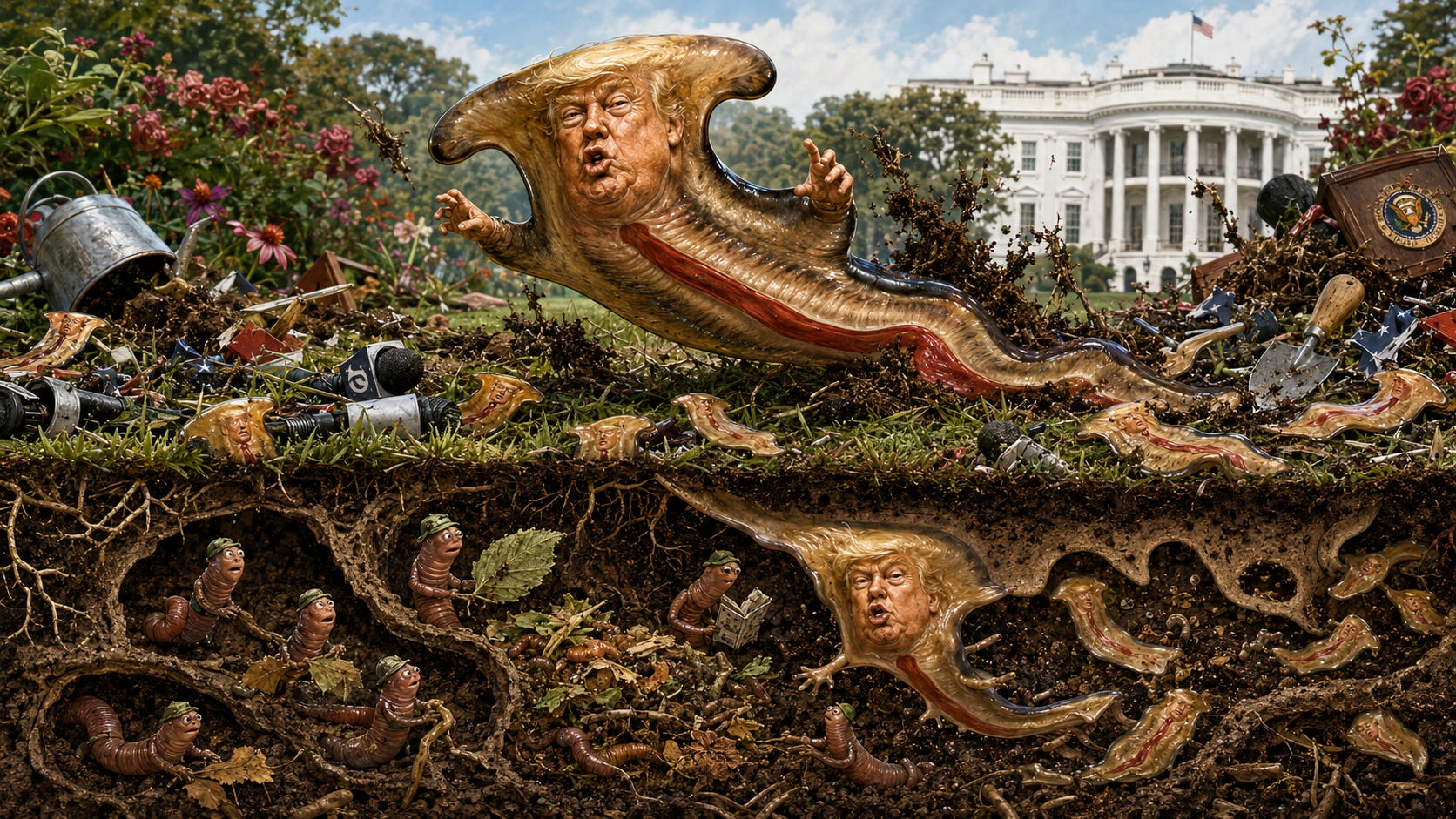
This is the kind of thing that happens when you pay attention to a garden. You think you are learning about compost, but really you are learning about power. You think you are learning about worms, but really you are learning about the difference between repair and predation. You think you are avoiding the news by watching a video about soil health before bed, but then nature, because she has jokes, introduces you to a creature that looks like a political cartoon of fascism with a mucus trail.
The hammerhead flatworm doesn’t merely look creepy, although it certainly commits to the bit. It is a worm-shaped predator with a head like a tiny shovel, or a misplaced boomerang, or the kind of design choice that suggests someone in evolution’s back office was having a bad week. It feeds on earthworms, which means it threatens the very creatures we just spent an entire essay praising for turning rot into life.
That is important, because the first lesson of the earthworm was that the world is held together by the quiet workers of repair.
Earthworms take the fallen leaves, the dead roots, the scraps, the waste, and the soft collapse of living things into not-living things, then they help turn all of that into structure, nourishment, fertility, and the possibility of growth. They are not glamorous, and they are not sentimental, but they are generous in the ancient way living systems can be generous when they are allowed to function.
The hammerhead flatworm is not that. The hammerhead flatworm is the false worm, the look-alike, the thing that shares the general silhouette of the helper while behaving like a villain in a damp little cape. That distinction matters, because one of the easiest ways to ruin a garden, a democracy, or a life is to mistake the predator for the worker.
Donald Trump has always benefited from this exact confusion. He presents himself as a builder, though his true talent has always been extraction. He presents himself as a champion of working people, though he has spent a lifetime stiffing, mocking, exploiting, and discarding them. He presents himself as a strongman, though so much of his strength depends on other people being too exhausted, too afraid, too cynical, or too compromised to call the pest a pest.
He is not the worm turning rot into soil. He is the thing that feeds on the worms. He feeds on public servants who still believe the law means something. He feeds on judges who have to treat bad faith as if it arrived wearing a necktie and therefore deserves another procedural courtesy. He feeds on journalists who are trapped in the endless machinery of “both sides,” even when one side is a constitutional republic and the other side is a man trying to convert the White House lawn into a personal poorly designed blood bath. He feeds on voters who are tired, frightened, furious, and looking for someone to blame. He feeds on the decay, then calls the decay proof that only he can save us.
The hammerhead flatworm, in this metaphor, is not dangerous because it is powerful in some grand majestic sense. It is dangerous because it preys on the repair system. This is what I keep coming back to as I think about gardens and politics and all the unglamorous work required to keep living things alive. The real threat is not always the rot itself, because rot can become compost when the system is healthy enough to transform it. The real threat is the pest that attacks the organisms doing the transforming.
A healthy garden can handle fallen leaves. A healthy democracy can handle disagreement. A healthy soil ecosystem can take death and make it useful. A healthy republic can take conflict and turn it into law, reform, accountability, and some better way of living together.
What it can’t survive indefinitely is a predator that eats the helpers while calling itself the victim, or a creature that thrives on being chopped into content, scandal, outrage, spectacle, fundraising appeals, cable panels, courtroom sketches, campaign merchandise, and the eternal question of whether this, finally, will be the thing that makes people stop pretending the pest is just another worm.
Every time we think we’ve cut Trumpism down to size, some new wriggling segment appears. An impeachment becomes a badge of honor, a scandal becomes a fundraising email, a criminal charge becomes a campaign poster, and a loss becomes a lie big enough for an entire movement to live inside. This doesn’t mean accountability is wrong, because accountability is the moral pesticide of a functioning democracy, and I would very much like us to apply it with the seriousness usually reserved for heirloom tomatoes. It means that we’ve to understand the organism we are dealing with, because some pests don’t respond to shame, exposure, or ordinary moral sunlight the way decent people think they should.
There is a particular liberal fantasy that if everyone just sees the thing clearly enough, the thing will stop being powerful. I understand the fantasy, because it is built on a sweet and possibly doomed belief that facts behave like disinfectant, that hypocrisy is self-defeating, and that shame still has a working address in American public life.
But Trumpism doesn’t die from exposure alone, because exposure is often part of its life cycle. It grows in attention, spreads through outrage, and feeds on the disgust of people who can’t look away, the cynicism of people who have given up looking, and the obedience of people who have decided that moral rot is acceptable as long as it punishes the neighbors they hate.
In this way, Trumpism has the emotional intelligence of an invasive flatworm, which is not a compliment to the flatworm. The flatworm, at least, is not pretending to defend Western civilization while eating the earthworms, it’s not holding a press conference beside a pile of damaged soil and insisting that the worms were treated very unfairly by radical-left compost, it’s not asking the Supreme Court for immunity from garden tools, and it’s not selling commemorative gold sneakers to the grubs.
Still, the metaphor holds because the danger is reproduction by fragmentation. This is one of the bleakest lessons of the Trump years, because the man himself has always been grotesque enough to command attention, but the larger damage has been the way his behavior has seeded itself throughout the political soil. His cruelty has become a style, his shamelessness, a strategy, his contempt for limits, a credential, and his endless victim act has become a governing philosophy for people who don’t want to govern so much as punish.
He has been chopped into imitators. There is the podcast version, the congressional version, the school board version, the billionaire version, the statehouse version, the cable chyron version, the online troll version, the red-hatted uncle version who ruins Thanksgiving before the potatoes have even made it around the table. Each one carries a piece of the original problem, and each one insists that the real victims are the people doing the devouring.
This is where the garden teaches us something important and uncomfortable. You can’t love the earthworm in theory while ignoring the things that prey on it in practice, can’t praise healthy soil while refusing to learn what harms it, can’t say you believe in democracy while shrugging at the pests that feed on the people who maintain it.
Care is not just affection. Care is attention, and attention means learning the difference between what belongs, what heals, what feeds, what restores, and what only looks familiar because the category in your head is too broad.
A hammerhead flatworm is not an earthworm, a strongman is not a public servant, a spectacle is not leadership, a grievance machine is not a movement for working people, a man who feeds on the repair workers is not a restorer.
This is why the myth matters to me. The myth told us that you could cut a worm in half and get two worms, but it didn’t tell us that this was false for the creature doing the work and closer to true for the creature doing the harm. It taught us the wrong lesson about resilience. It made the helper seem more indestructible than it is, while failing to warn us that the pest might multiply when handled carelessly.
Is that not exactly what we’ve done in America? We’ve treated the helpers as infinitely durable. We’ve treated teachers, nurses, civil servants, election workers, librarians, farm workers, journalists, judges, scientists, parents, organizers, caregivers, and ordinary exhausted citizens as if they can be cut and cut and cut and still somehow regenerate into enough people to hold everything together.
We’ve treated the repair class as renewable, while treating the predator class as inevitable. We’ve watched the people who keep the soil alive get harassed, underpaid, threatened, scapegoated, and burned out, and then we’ve acted surprised when the ground feels less stable beneath us.
Meanwhile, the pest gets attention, money, immunity, analysis, amplification, excuses, and an entire political party willing to stand there with a shovel saying it definitely didn’t see anything unusual in the mulch. This is where the humor curdles a little, because the worm is funny until you remember the worm is vulnerable.
The earthworm, that small blind worker in the dark, is not indestructible. It needs moisture, habitat, soil that has not been compacted, poisoned, stripped, or treated like a lifeless medium for whatever humans want to impose on it. It needs us, in the same way all living systems eventually need the powerful thing walking above them to stop being careless.
The same is true of democracy. It needs more than admiration; it needs protection, people willing to notice not only the rot, but the workers trying to turn that rot into something livable. It needs us to stop romanticizing resilience as an excuse to keep injuring the resilient, to stop confusing endurance with health, and to stop treating every new fragment of Trumpism as entertainment, novelty, content, or proof that politics is just gross now, because a living system doesn’t survive by getting used to the thing eating its worms.
In the garden, the advice is practical. Don’t handle hammerhead flatworms barehanded, don’t chop them up, follow local guidance, because different places have different reporting and disposal recommendations, and be careful with soil, mulch, nursery plants, and anything that can move unwanted creatures from one place to another.
Most importantly, learn what you are looking at before you decide what to do. A worm is not always a worm, a disruption is not always reform, a performer is not always a leader, and a man who says he alone can fix it may simply be the thing feeding on everyone who was already fixing it before he arrived.
And if that sounds dramatic, I would like to remind you that I didn’t set out to find a political metaphor in a hammerhead flatworm, because I set out to learn about healthy soil and perhaps become the kind of woman who says things like “we should really be feeding the microbes” without sounding like she has joined a compost-based religion.
Yet here we are. The garden keeps teaching, the worms keep working, the pests keep revealing themselves, and somewhere between the compost bin and the news cycle, I find myself thinking that maybe the work of this moment is not only to ask what we can grow, but what we must stop feeding.
Maybe the work is to protect the quiet workers of repair before the false worms eat through the system and to understand that not every wriggling thing in the soil is there to help.
The myth was false about the earthworm, which means the helper was more fragile than we thought and it was true about the flatworm, which means the pest was more dangerous than we wanted to believe. And if America is going to survive this particular infestation, we are going to have to learn the difference before we pick up the shovel.
Well done!!!!
Love the invasive worm comparison to our invasive occupant of the Oval office