


After several difficult years involving wars, recruitment problems, exhausted troops and a national security apparatus held together with congressional appropriations and an alarming number of group chats, the Pentagon has finally identified the threat facing the American military. Men over thirty experiencing a perfectly ordinary decline in testosterone.
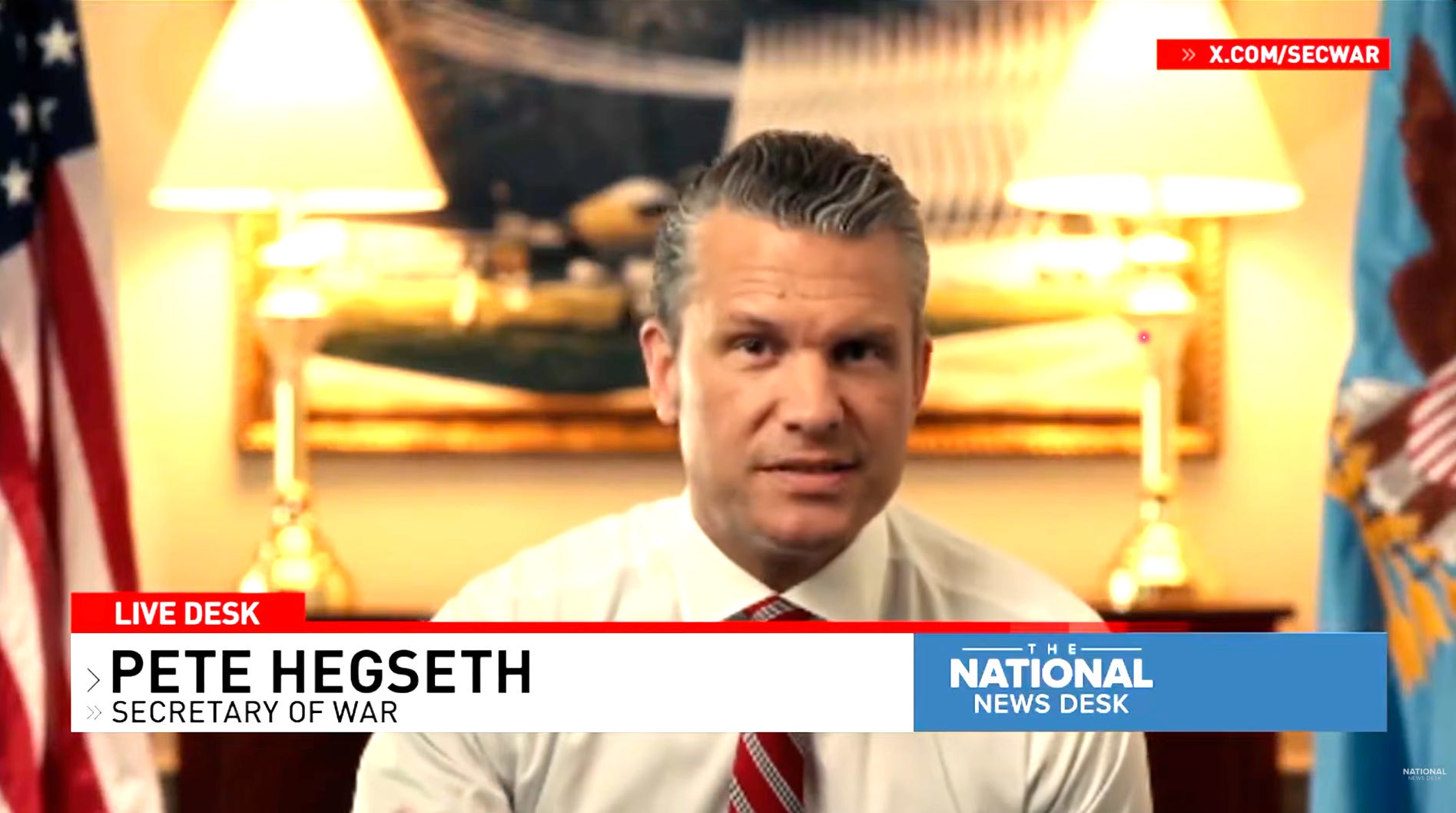
On Wednesday, Defense Secretary Pete Hegseth announced that service members age thirty and older will receive annual testosterone screenings as part of their required health assessments. Younger troops may volunteer for testing, while those diagnosed with a deficiency will have the option of receiving testosterone replacement therapy.
The announcement was promoted under the caption “The High-T Department of War,” which is apparently what happens when the federal government allows a men’s wellness podcast to acquire nuclear weapons.
“At the Department of War, we have the most elite warriors on the face of the Earth,” Hegseth declared, before explaining that maintaining the proper testosterone levels would help keep those warriors on the “leading edge of lethality.”
For most of human history, the leading edge of lethality involved weapons, training, judgment, logistics and an adequate supply of food. Under Hegseth, it will also require Sergeant Miller to report to the laboratory before breakfast so the government can determine whether his endocrine system remains sufficiently patriotic. Welcome to Operation Enduring Virility.
The new initiative arrives at a moment when testosterone has become far more than a hormone. Within a particular corner of American politics, it has become a mystical substance that explains nearly everything. Testosterone wins wars, builds civilizations, restores order, repairs marriages, defeats political correctness and presumably teaches boys how to back a trailer into a narrow driveway without asking anyone for help.
Low testosterone, meanwhile, has become a biological explanation for national decline. America isn’t struggling because its institutions have been hollowed out, its citizens have been squeezed economically or its political leaders have spent decades treating government like a demolition derby. America is struggling because somebody, somewhere, has insufficient T.
This is convenient because testosterone deficiency is a real medical condition. Men with hypogonadism can experience diminished sexual function, reduced bone density, loss of muscle mass, anemia and changes in mood or energy. Those men deserve proper diagnosis and treatment, including testosterone replacement when it is medically appropriate.
That isn’t the same thing as annually screening every service member over thirty in search of the correct biological foundation for war. The Endocrine Society recommends diagnosing testosterone deficiency only when a patient has symptoms consistent with the condition and repeatedly low hormone levels. Because testosterone fluctuates throughout the day and can be affected by sleep, illness, nutrition, medication, weight and physical exertion, a low result should be confirmed with a second fasting blood test conducted in the morning.
The same guidelines specifically recommend against routinely screening the general male population. Hegseth has nevertheless chosen thirty as the age at which the federal government begins its annual investigation into whether a person’s masculinity remains combat-ready.
Perhaps there will be a color-coded system. Green means deployable, yellow means the warrior has recently turned thirty-eight and would prefer to spend Saturday assembling a raised garden bed, and red means he cried during a dog food commercial and must report immediately for hormone optimization.
We don’t yet know because Hegseth didn’t provide the medical details necessary to evaluate the program. The Pentagon hasn’t explained what testosterone level it considers “right,” what testing method will be used, whether low results will be confirmed, or how clinicians will distinguish a medical disorder from the predictable effects of military life.
Those effects matter because the military routinely exposes people to conditions that can reduce testosterone. Sleep deprivation, chronic stress, extreme physical exertion, inadequate nutrition and insufficient recovery are not obscure possibilities among service members. They are practically included in the recruitment brochure.
The military’s own health materials warn that inadequate sleep can contribute to lower testosterone, along with poor decision-making, irritability, reduced focus and impaired muscle recovery. If the Pentagon discovers widespread hormonal disruption among its personnel, it may therefore be measuring the biological consequences of the conditions it created.
That would require an uncomfortable institutional conversation about deployment schedules, workloads, nutrition, stress and recovery. It is considerably easier to draw blood from the soldier and conclude that the deficiency belongs to him. The institution is never deficient, the individual body has merely failed to keep up.
This is the same logic that allows employers to respond to burnout with a meditation app. The conditions remain unchanged, but the worker receives a breathing exercise and a cheerful notification reminding her that resilience is a personal responsibility.
Hegseth’s version comes with camouflage packaging and the word “lethality” printed on the label. Testosterone replacement therapy may be enormously helpful for patients with confirmed hypogonadism, but it isn’t a masculinity vitamin. Research has found that treatment can improve sexual symptoms and produce modest gains in muscle mass and bone density for some patients, while showing little or no consistent improvement in memory, fatigue or overall well-being.
It also requires careful monitoring. Testosterone can elevate blood pressure and red-blood-cell concentration, reduce sperm production and worsen certain cases of sleep apnea. The FDA removed an earlier cardiovascular warning after a major study found no increased risk of major cardiovascular events among properly diagnosed patients, but it simultaneously required new warnings because testosterone products consistently increased blood pressure.
In other words, this is medicine. It has legitimate uses, meaningful limitations and potential consequences. It should be administered through individual clinical judgment, not presented as premium fuel for a government-owned weapons platform.
Hegseth insists that treatment will remain voluntary, which is reassuring until one considers the institution making the promise. Military medicine doesn’t exist entirely apart from military command. Health assessments can affect deployment status, job assignments, retention and career advancement. The Pentagon hasn’t said whether an abnormal testosterone result could change any of those things, who would have access to the information, or whether declining treatment would remain free of unofficial consequences.
A service member may technically have a choice while understanding perfectly well which choice the institution considers sufficiently lethal. There is also the unresolved question of women, who remain inconveniently present in the United States military despite Hegseth’s repeated efforts to describe the ideal warrior in exclusively masculine terms. His announcement referred broadly to “service members,” but appeared to address testosterone deficiency among men. When reporters asked whether women would receive comparable hormonal screening or access to treatment for conditions such as perimenopause, the Pentagon didn’t provide an answer.
Apparently, hormones become a matter of military readiness only when they can be arranged into a political metaphor about masculinity. That’s what makes this announcement more significant than an additional blood test. Hegseth isn’t merely expanding preventive care. He is constructing a biological definition of the ideal American warrior, one in which strength, psychological readiness and national purpose can be located in a vial of blood.
The language gives the game away. This isn’t the Department of Defense quietly improving access to endocrinologists. This is the “High-T Department of War” ensuring that its troops possess the “biological foundation” necessary to “sustain the fight.” Testosterone has been transformed from one complicated hormone among many into a federal measurement of warrior worth.
There was a sensible policy available here. The Pentagon could have expanded confidential endocrine care for symptomatic service members, trained clinicians to recognize hormonal disorders and ensured that anyone requiring treatment could receive it without stigma. It could also have examined how sleep deprivation, stress, poor nutrition and inadequate recovery affect the long-term health of the people it sends into combat.
Instead, Hegseth announced an annual census of military manhood. The blood draw itself may be clinical, but the definition of adequacy is political. We still don’t know what number the Pentagon will consider “right,” although one suspects the answer will be communicated through a bald eagle wearing wraparound sunglasses and carrying a syringe.
Uncle Sam still wants you. He would simply like you to fast for eight hours first.
What a insulting policy. Let's put Hegseth top of the list to be tested.
This has got to be one of the most absurd policies I have ever heard about! I'm not talking about things that Trump and company have done that that's just mean. This is somewhere in the La La Land of hyper masculinity!