


Four seed and chemical companies control 78 percent of the market. Three fertilizer companies control 90 percent. Four beef companies control 85 percent. The most accurate description of the American farm economy delivered in Chippewa Falls on Thursday came from a farmer in the audience, not the president who flew there to explain it to him.
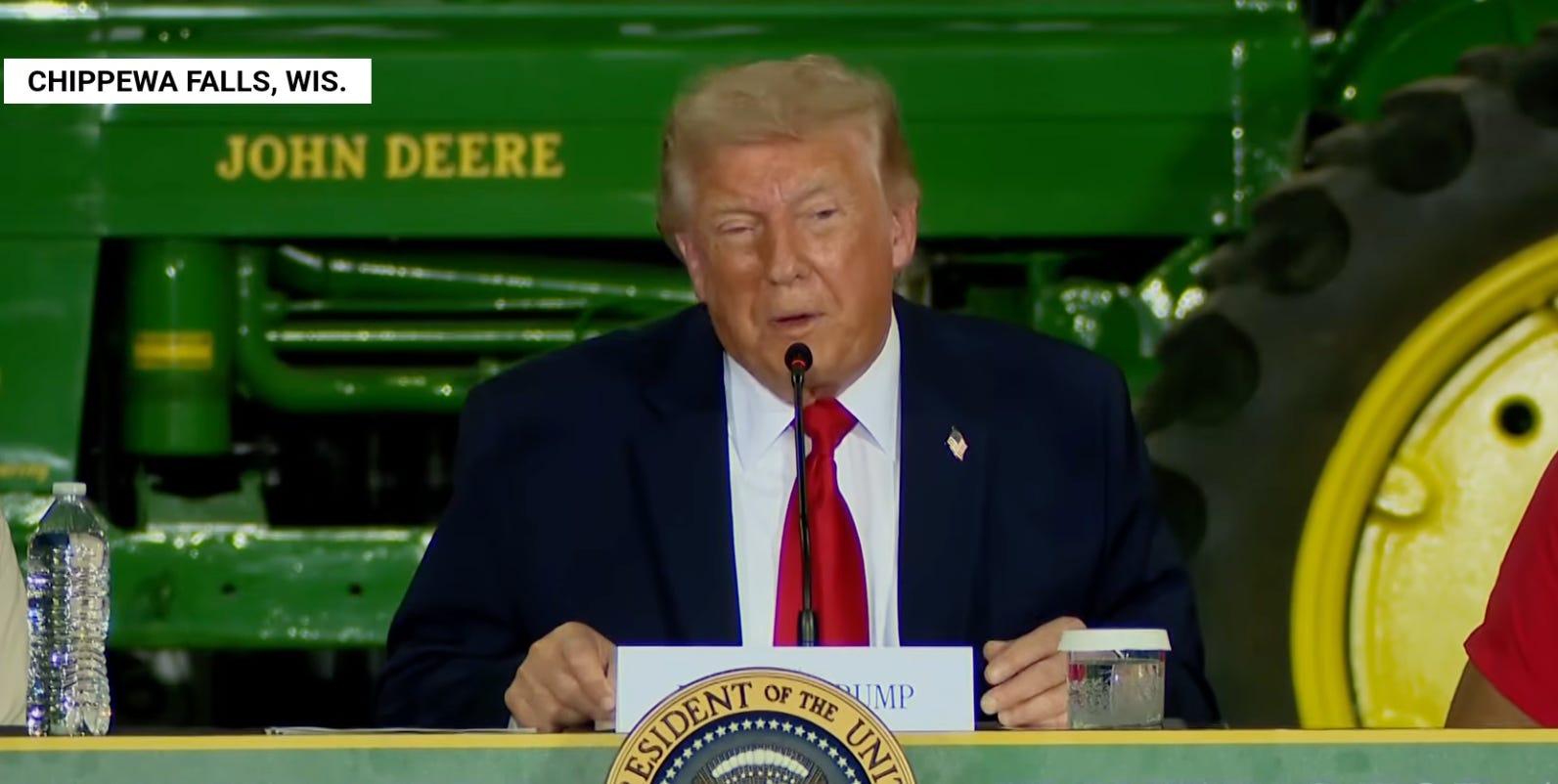
Hold those three numbers for a moment. Seventy-eight, ninety, eighty-five. Sit with them the way you’d sit with anything a man says when he clearly knows what he’s talking about—the cadence of someone reporting from inside the thing rather than about it. They are the most substantive sentences spoken at a two-hour “roundtable” with Wisconsin farmers on Thursday. Precise, and corroborated by USDA studies, by Texas A&M, by the peer-reviewed literature on agricultural consolidation. They identify, with more accuracy than anything else said that afternoon, why a third-generation dairy operation can do everything right and still get squeezed to the bone, and they did not come from Donald Trump.
A farmer named Steve, near the very end, after the president had finished spoke those numbers. After the jobs numbers and the eggs and the border and the fountains and the pool sealant. Steve waited his turn, and then he said the quiet thing out loud: the problem isn’t the estate tax, or sleepy Joe Biden, or men playing women’s sports. The problem is that a handful of corporations sit astride every input a farmer needs and every market a farmer sells into, and they collect a toll at each gate.
He was right. The figures check out. Four firms, Bayer, Corteva, Syngenta, BASF, constitute a documented oligopoly in seed and agricultural chemicals; at the national level USDA found two companies alone accounted for 72 percent of planted corn acres. Fertilizer concentration runs from the high seventies for nitrogen to a clean 100 percent for potash and phosphate, the top four owning the whole thing. Four meatpackers control north of 80 percent of beef. Steve’s recall, from memory, at a podium, with the President of the United States sitting a few feet away, was more reliable than the president’s prepared remarks. That is the story of Thursday, and everything else is detail.
The detail is worth your time, because the gap between what Steve knew and what Trump performed is the whole architecture of this presidency in miniature.
Trump arrived in Chippewa Falls having already run the show once that morning, for the traveling press, in a gaggle on the way in. Watch the same claims in both rooms and you learn something about how the sausage is seasoned for different tables.
To the reporters, the May jobs report was “incredible,” “far better than even anticipated,” vague, expansive, no numbers to pin. By the time he reached the farmers, it had hardened into specifics: 172,000 jobs, “4 times higher than anticipated,” experts who “predicted 30,000,” a figure that “smashed all expectations by 3 times.” Set aside that “4 times higher” and “smashed by 3 times” describe the same number in the same breath. The 172,000 is real, that part the Bureau of Labor Statistics confirms. The rest is invention with a purpose. The actual consensus forecast was around 80,000 to 85,000 jobs. A beat of roughly two-to-one is a decent month. But two-to-one doesn’t draw applause in a barn, so the expectation got marked down to 30,000 on the way to the podium, and a good month became a miracle. You inflate the triumph by deflating the bar, and you hope nobody in the folding chairs has the BLS release open on their phone.
Then came the number that should have set off every smoke alarm in the building. Eighteen trillion dollars, Trump said, “coming into the United States” in eleven months—against “much less than 1 trillion” under Biden across four years.
Eighteen trillion dollars.
This one has a history, and the history is the point. The figure is a relic of the tariff campaign. Through 2025, as Trump used the threat of tariffs to pry investment “commitments” out of trading partners, the total he claimed those commitments came to kept inflating, “close to $10 trillion” by spring, then doubling to $18 trillion and as high as $21 trillion by December, deployed at Cabinet meetings, in a Wall Street Journal op-ed, even, oddly, dropped into the middle of a Rwanda-Congo peace announcement. The Cato Institute took to calling it “Trump’s Eighteen Trillion Dollar Hoax.” Even at its peak it didn’t survive contact with the White House’s own website, which documented $9.6 trillion, half his figure, and that smaller number was itself padded with aspirational multi-year goals and product purchases rather than actual capital. The Peterson Institute counted roughly $5 trillion in real pledges and doubted most of it would ever arrive.
So the figure was already shaky when it was a claim about future promises wrung out of foreigners under duress. Then the tariffs that were supposed to have produced it ran into the courts, and the boast went quiet, a talking point that had lost not just its evidence but its premise. Until Thursday, in a barn in Chippewa Falls, where it was exhumed for an audience that hadn’t been following its slow public death, and exhumed with a promotion: the “commitments” hedge was gone. Now it was simply $18 trillion “coming into the United States,” cash in the door, eleven months flat.
Measure it against anything real. The total cumulative stock of foreign direct investment in the United States, every dollar of it, accumulated across the entire history of the republic, was $5.71 trillion at the end of 2024. New foreign direct investment in a normal year runs around $150 billion; through the first three quarters of 2025 it ran at an annual pace below even that, and by the Federal Reserve’s own data, foreign investment grew faster under Biden than it has under Trump. The thing he says his tariffs summoned actually slowed. His $18 trillion exceeds the entire historical accumulation of foreign investment in America by more than threefold. It is not an exaggeration or a rounding error. It is a number that died once already, dressed up and walked back out for people whose livelihoods depend on the real economy, and who were not given the courtesy of a real figure.
Which brings us to the swimming pool, because no account of Thursday is complete without it, and because it is the toll booth made visible.
Trump devoted a substantial stretch of a farm event to the Lincoln Memorial Reflecting Pool, which he has had repainted a shade he calls “American flag blue.” He was proud of it. He narrated the economics himself: it would have cost $400 million and taken four years, he told the farmers; Obama and Biden had blown $150 million and never fixed it; he got it done for “like 10 million” in about a month, because rather than trust the government he called in his own man “my pool guy,” a “pro,” someone who’d built him “many, many swimming pools.”
Here is the same story with the documents attached. The work was awarded through a no-bid contract, the kind that invokes an urgency exemption to skip competitive bidding. Federal contract records show at least $14.8 million obligated and climbing, Trump himself, weeks earlier, had already revised his estimate upward to “less than $20 million” once he decided the exterior needed work too. The “$400 million” counterfactual he hung on his predecessors cannot be documented; when fact-checkers asked the administration for the basis of a prior $355 million estimate, they got criticism of Obama instead of paper. The actual prior renovation, under Obama, cost about $35 million and went through normal contracting. And the “pool guy” has had a journey of his own: Trump first said the contractor was his own man who’d worked at his golf club, then posted on Truth Social that he hadn’t picked the contractor at all, Interior did, and had never used them before.
So the comparison he sold to the farmers, $10 million versus $400 million, the brilliant builder versus the bumbling state, is, measured against his own shifting numbers, closer to twenty-ish million in no-bid contracts versus Obama’s competitively-bid thirty-five. The man who flew to Wisconsin to celebrate frugality and the wisdom of cutting out the middleman had just handed a friend-of-a-friend a no-bid contract to paint a national monument the color of a backyard pool, and was bragging about the savings.
This is not a digression from the farm economy. It is the same logic the farmers live under, performed by the man who benefits from it. Steve’s seed companies and fertilizer cartels and meatpackers collect their toll because they control the gate and the farmer has nowhere else to go. The pool contract collects its toll because the bidding was waived and the contractor was chosen. The difference is that when the toll runs through Washington and into the right hands, it gets called a bargain.
The performance has a foreign-policy wing, call it Schrödinger’s Navy, and it runs on the same fuel.
“They have no Navy,” Trump told the farmers of Iran. “159 ships in 4 days... at the bottom of the sea.” He said it with the satisfaction of a man delivering settled history. It is worth knowing where that number comes from. It comes from Trump, specifically from a Truth Social post he wrote on April 24, in which he declared that Iran’s “naval ships are ALL, 159 of them, at the bottom of the sea.” He is now quoting his own social media back to a farm audience as though it were a Pentagon briefing.
His own military tells a different story. The commander of U.S. Central Command put the number of sunk Iranian naval vessels at 17. CENTCOM’s blockade tally was 85 vessels intercepted and three seized, with Lloyd’s List counting 26 that slipped through entirely. There is no official accounting under which 159 ships were sunk. The figure exists in exactly one place, the president’s thumbs, and it has now been promoted, by repetition, into something a man says to farmers in Wisconsin while explaining why their fertilizer will get cheaper.
The same afternoon offered a smaller, sharper specimen. Trump told the room he’d recently pardoned a man “sentenced to 7 years in jail because he got caught fixing his car’s truck,” and promised the farmers that if any of them were ever jailed for fixing a tractor, he’d pardon them too. The applause line refers to a real person: Troy Lake, a Wyoming diesel mechanic. But Lake was pardoned in November, not “last week”; he served seven months, not seven years; and he wasn’t jailed for fixing a truck, or a car’s truck, he was convicted of disabling federally required emissions-monitoring systems under the Clean Air Act. Every load-bearing fact in the anecdote is wrong in the direction that makes it land harder. And on the very day Trump was promising preemptive pardons from a podium, his administration was meeting with Ford, GM, and auto-dealer executives over the actual right-to-repair rules, an industry fight that was reportedly split, and that no applause line was going to resolve.
Now come back to Steve, because by the time he spoke, the function of the whole event had become clear, and his three numbers landed like a window thrown open in a sealed room.
Everything Trump offered the farmers was a story about someone else’s villainy and his own rescue. Biden’s inflation. Crooked judges. Radical-left reporters. Democrats who voted against the farmers. The estate tax, the “death tax,” which he returned to again and again as the thing standing between a farm family and ruin. He built it into the emotional climax of the afternoon: land rich and cash poor, the father dies, the kids can’t pay, they go to the bank, they borrow too much, and “in many cases,” he said, “they do terrible things. They commit suicide.”
It is worth being careful here, because the crisis he reached for is real. Farmer suicide in America is a documented public-health emergency; the rate runs several times the national average. But the literature on why is extensive and consistent, and it does not say what Trump’s anecdote implies. The drivers are debt, collapsing commodity prices, physical and social isolation, the scarcity of rural mental-health care, and ready access to lethal means. Across decades of study, in country after country, the estate tax does not appear as a cause. It is essentially absent from the research.
What does appear, repeatedly, is the thing Steve named. Consolidation. The squeeze from both ends: inputs controlled by a few firms that set the price going in, buyers controlled by a few firms that set the price coming out, and the farmer absorbing the difference. The peer-reviewed work on farm financial stress points directly at the market structure Steve described from memory. And there is one more detail the record supplies, almost too on-the-nose to use if it weren’t true: the $28 billion bailout Trump kept invoking Thursday as proof of his devotion, the money he got the farmers in his first term, is cited in that same literature as having failed to cover what farmers lost in the trade war he started. The relief he brags about is, in the research, an example of relief that fell short.
So watch what happened in that room, structurally. A genuine tragedy, with documented causes, was lifted out of its context and bolted onto an estate-tax repeal that the evidence does not connect to it, and then, without a breath in between, converted into a voting instruction. “Every single Democrat in Congress voted against saving family farms from the death,” he said, and then: “just remember that when you go into the polls.” The grief was the setup. The midterm was the punchline. The farmers’ real creditors, the four seed firms, the three fertilizer firms, the four packers, were never named, because naming them would require a fight the president was not in Chippewa Falls to pick. He was there to sell salvation from a tax that barely touches them, by a man who would not say the names of the companies that do.
The input costs squeezing those farmers? Partly downstream of Trump’s own tariffs, which by the assessment of even sympathetic economists have raised the prices farmers pay for fertilizer, chemicals, and equipment. The toll booth runs in a circle. The trade war raises the cost of the inputs; the bailout fails to cover the loss; the bailout becomes the campaign brag; the campaign brag asks for another vote; and the four companies at the gate go unmentioned through all of it.
There is an old aristocratic conceit that the lord understands the estate better than the peasant who works it, that vision flows downward, from the manor to the field. Thursday inverted it completely. The man at the head of the table, surrounded by staff and screens he was “too cheap” to turn on, narrated a fantasy economy: $18 trillion that doesn’t exist, 159 ships his own admirals didn’t sink, a pool that cost what he says it cost until the contracts say otherwise. The man in the folding chair, who actually farms, delivered the only figures in the room that would survive a fact-check.
That is the true structure showing through. The people who do the work can see the gate and feel the toll, because they pay it every season. The people who collect the toll have every incentive to talk about something else, about flags and fountains and pool sealant and the color blue, and to make sure the conversation never arrives at the four companies and the three companies and the four companies that own the road.
Steve arrived there anyway. He was, for about ninety seconds at the end of a long afternoon, the only reliable narrator in the room. The president had two hours and a microphone and the full faith and credit of the United States behind every word, and a third-generation dairy farmer from thirty miles up the road still out-reported him on his own beat.
Remember that when you go into the polls.
If you or someone you know is a farmer or farmworker in crisis, the AgriStress Helpline (1-833-897-2474) offers free, confidential support staffed by people trained in the specific stresses of agricultural life. The 988 Suicide and Crisis Lifeline is also available by call or text, 24 hours a day.
Banks are merging so there are fewer of them - less competition.
Entertainment and media companies are merging so there are fewer of them - less competition.
Pharmaceutical corporations are merging so there are fewer of them - less competition.
Insurance companies, retail outlets, food conglomerates: all are merging so there are fewer of them - less competition.
Steve the farmer pointed out the problem that's affecting the nation's economy in every aspect.
The rich get richer and the poor get poorer...
It’s so much easier to swallow his bullshit than it is to face reality. Farmers have been getting led around by the nose through decades of government intervention and the United States has denied itself the opportunity to stay abreast of the exciting new world of modern agriculture.